

It’s time for a new edition of the Post Performance Report (PPR), a series in which we highlight social media posts and campaigns that inspire us and analyze the genius behind them. We dissect how your brand can utilize these cases to ignite your own attention-grabbing ideas—while optimizing your budget and achieving more with less.
When a C-suite leader posts something inappropriate on social media, it can escalate into a brand crisis and jeopardize their position. This risk often leads many executives to shy away from establishing a personal brand, whether by their own choice or corporate directive. However, despite these challenges, many successfully grow their followings by consistently sharing brand content, thought leadership, and glimpses into their private lives.
When executives intentionally engage on social media, it enhances the perception of their brand as approachable, honest, and credible. With a targeted executive social strategy, leaders can boost visibility and strengthen connections with customers, employees, investors, media, and partners.
Let’s explore our featured executives (and their supporting teams) who excel on social media, along with tips for creating your own effective executive communications strategy.
Salesforce: A First for Everything
As the force behind a leading CRM software, Salesforce is a B2B marketing leader. With major events such as Dreamforce and millions of followers on various platforms, this SaaS company sets the benchmark. Yet, until recently, they faced a significant challenge: leveraging their CEO on social media.
When CEO Marc Benioff shared his inaugural LinkedIn post on October 30, 2024, it sent shockwaves through the platform’s algorithm. At the time of publication, the post garnered over 18,000 likes, 800 comments, and 1,900 shares. Benioff’s post discussed an AI system update to their platform—an important move amid stiff competition in the AI field.

This post significantly amplifed the reach of the announcement through both organic engagement and paid promotion.
The PR boost from Benioff’s post and related discussions led to media coverage connected to the launch, assuring customers and investors about the company’s direction.
The play: For social and communications professionals struggling to persuade their executives (especially their CEO) to embrace social brand advocacy, know that you’re not alone. Even the largest global brands are navigating this issue. Let Salesforce serve as your inspiration.
Advocate for the establishment of an executive communications strategy using Benioff’s post as a reference point. Share a compelling narrative about the potential benefits for your brand when connecting a key brand launch with a leader’s debut on social media.
Symphonic Capital: Fostering a Sense of Belonging
Symphonic Capital is a venture capital firm that invests in the future of institutions supporting overlooked and underserved communities. On LinkedIn, founding general partner Sydney Paige Thomas has built a following by sharing insights from her investment experiences in infrastructure technology and highlighting the firm’s events.
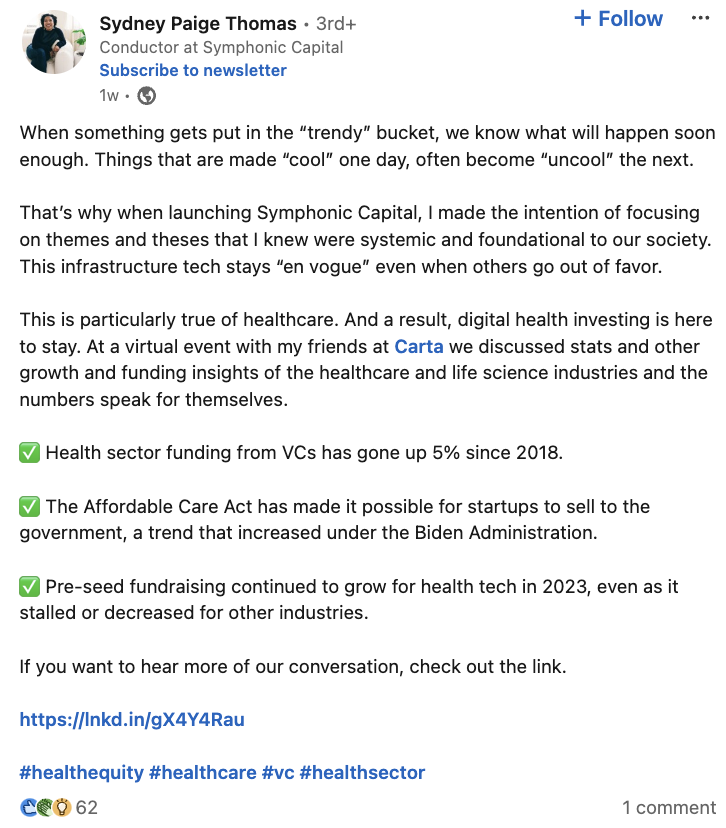
Thomas maintains a consistent social presence which is crucial. More importantly, she remains authentic. She shares personal stories as the daughter of the first Black Chief of Staff at San Diego Mercy Hospital. Thomas recounts anecdotes from her educational background and even references astrology in her content.
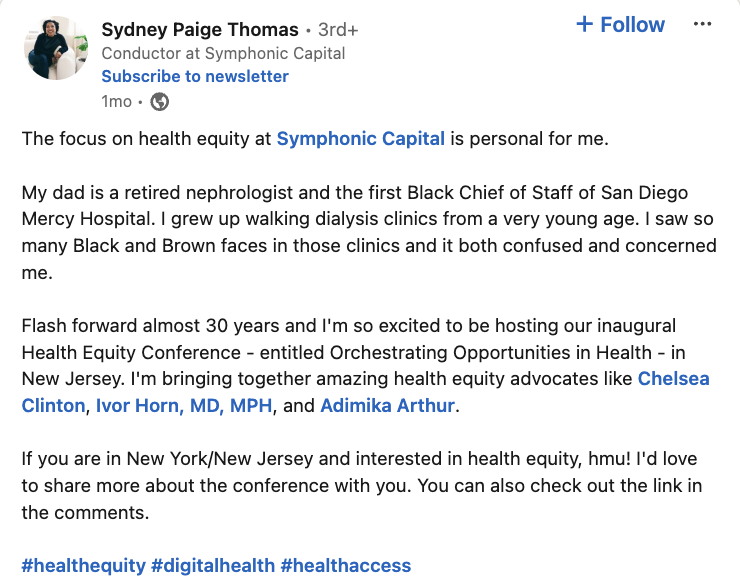
Thomas illustrates why executives can (and should) express their full selves through their online persona. Humanizing leaders instills confidence in your mission by allowing your audience to witness your leaders’ values directly. What inspires them, what drives their purpose, and why their work matters.
Thomas’ initiatives earned her a spot on the AFROTECH™ Future 50 list, a noteworthy recognition among her growing achievements as a respected voice in the investment community. With her continued ascent, her firm’s profile also rises.
The play: Follow the example of Thomas and Symphonic Capital by allowing your leaders to embody their complete identities online. Empower them to discuss their backgrounds, interests, and families along with their professional passions. People relate to people and prefer to hear from them.
Raising Cane’s: From CEO to Celebrity
In both B2C and B2B sectors, it’s uncommon to see a CEO as deeply engaged in company marketing as Todd Graves. Graves is the founder of Raising Cane’s, the rapidly growing American chain famous for its chicken fingers. He has shared stages with Snoop Dogg, appeared as a guest shark on Shark Tank, and provided Travis Kelce with free chicken for a year.

The Raising Cane’s team capitalizes on Graves’ charismatic personality and popularity, regularly featuring him in the brand’s social media content. Graves manages his own public Instagram profile (another rarity for CEOs) where he is credited as a collaborator on most posts from Raising Cane’s, extending their reach to his over 500,000 followers. He also appears in influencer content, such as one where he dined at Raising Cane’s with an influencer who had never visited one of his outlets.

Describing the effectiveness of this strategy is challenging. His unexpected origin story has become a foundation for the brand’s identity, inseparably linking Graves and Raising Cane’s. The success of one inevitably drives the success of the other. The company is on the path to generating $5 billion this year, and Graves has been named on the Fortune 400 list.
The play: The strategy of “placing your CEO in the spotlight” may not succeed for every company. In fact, it may not succeed for most companies. This approach is primarily suited for founders who remain with their businesses throughout their careers until their legacy is passed down. Even among those brands, this tactic should be adopted only if there’s a leader who possesses well-defined values, excels in the spotlight, and is discerning about what to share publicly.
For brands that fit these criteria, your CEO could be the golden key to significant growth and outpacing competitors. For others, adapt elements that fit your company’s culture. Perhaps it’s motivating your CEO to launch an Instagram account managed by the social media team. Or it could involve increasing media outreach for your C-suite.
Google: Sharing the Stage Across the C-Suite
For a multinational publicly traded entity like Google, having executive thought leaders on social media carries considerable risk (even more than for smaller firms). Consequently, some members of the C-suite might be entirely absent from social media, while others may take a cautious approach.
Google’s CEO, Sundar Pichai, opts for the latter approach, sharing well-curated updates such as highlights from earnings calls, clips from chats with leaders at other firms, and reflections on the future of emerging technologies on LinkedIn.

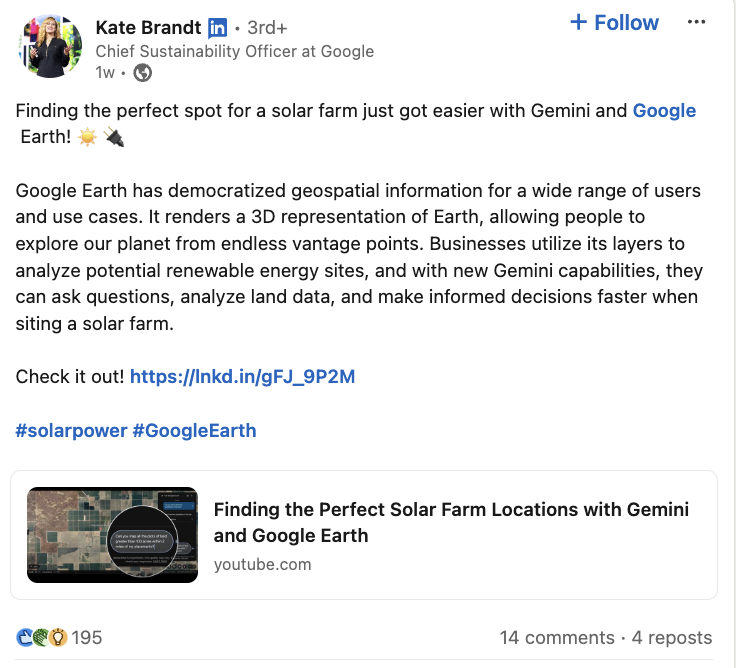
Likewise, Google’s Chief Sustainability Officer Kate Brandt shares how Google technology facilitates sustainable initiatives, such as optimizing locations for solar farms, from her own account. She additionally discusses new avenues the company is forging for clean energy and AI-driven sustainability.
Melonie Parker, Chief Diversity Officer at Google, leverages her LinkedIn presence to spotlight corporate initiatives linked to employee resource groups, partnerships with HBCUs, and collaborations with NGOs.

It is evident that Google executives collaborate closely with their internal communications and content teams, playing a crucial role in shaping the company’s public narrative and directing attention toward their strategic directions.
The play: Though launching an executive communications initiative on social media can pose risks, the greater risk is having no executive presence at all. Even if leaders only reshape existing brand content with thoughtful commentary, it helps companies manage news stories, amplify reach, and boost employee engagement.
Hilton: Revealing Organizational Culture
For a well-established brand in the hospitality sector like Hilton, the necessity of a robust executive presence on LinkedIn might not be immediately clear. The brand enjoys global recognition (even boasting a celebrity spokesperson in their family). However, as the demand for talent in hospitality grows, so does the importance of enhancing their employer brand.
Hilton’s Chief Marketing Officer Mark Weinstein regularly shares content using the hashtag #EveryJobMakesTheStay, reflecting the Hilton belief that every team member contributes significantly to delivering outstanding guest experiences.
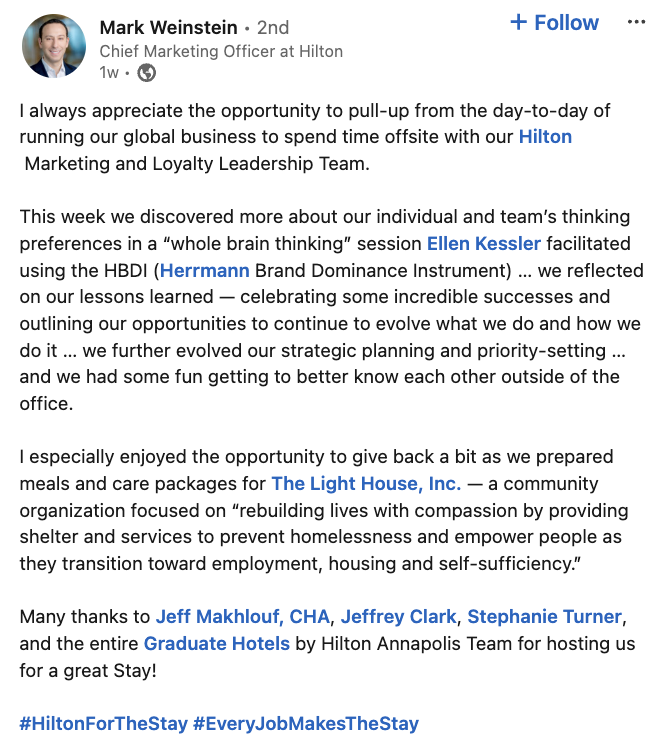
Weinstein also highlights Hilton’s awards, charitable initiatives, and accessibility programs on LinkedIn, as well as leadership opportunities available within the organization.
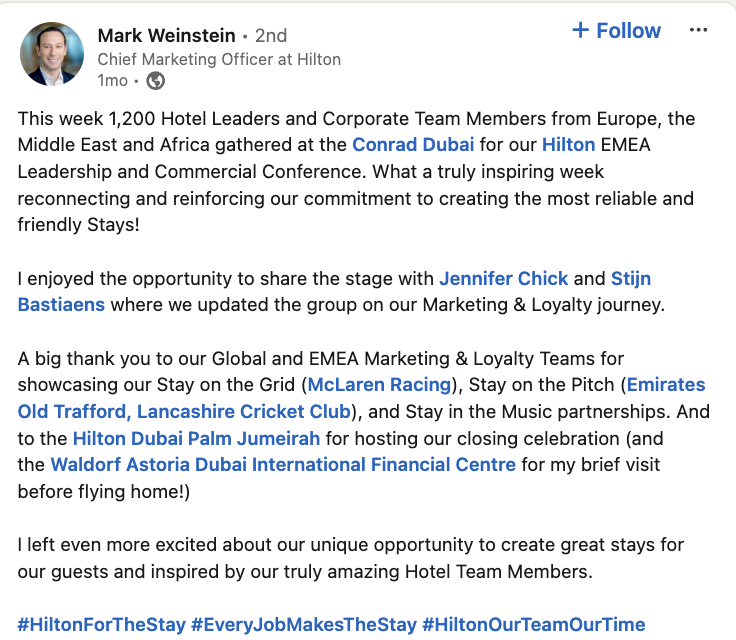
Having leaders like Weinstein champion recruitment and retention efforts—even if indirectly—strengthens Hilton’s positive workplace culture. His posts complement media stories about Hilton’s partnerships with organizations like the U.S. Committee of Refugees and Immigrants, emphasizing the brand’s commitment to investing in people.
The play: Establishing a lasting employer legacy is a primary reason to initiate or augment your executive communications strategy. Regardless of your industry, showcasing what daily life at your company entails is crucial for attracting and retaining top-tier talent.
Global Spotlight: Telstra’s CEO on the Frontlines
Telstra, Australia’s leading mobile network, builds, operates, and upgrades telecommunications infrastructure across the country. The brand’s CEO, Vicki Brady, shares stories from the ground while crews develop network capabilities. For instance, in one post, she discusses the sacrifices made by those on the frontlines and how their efforts enhance intercity fiber networks.
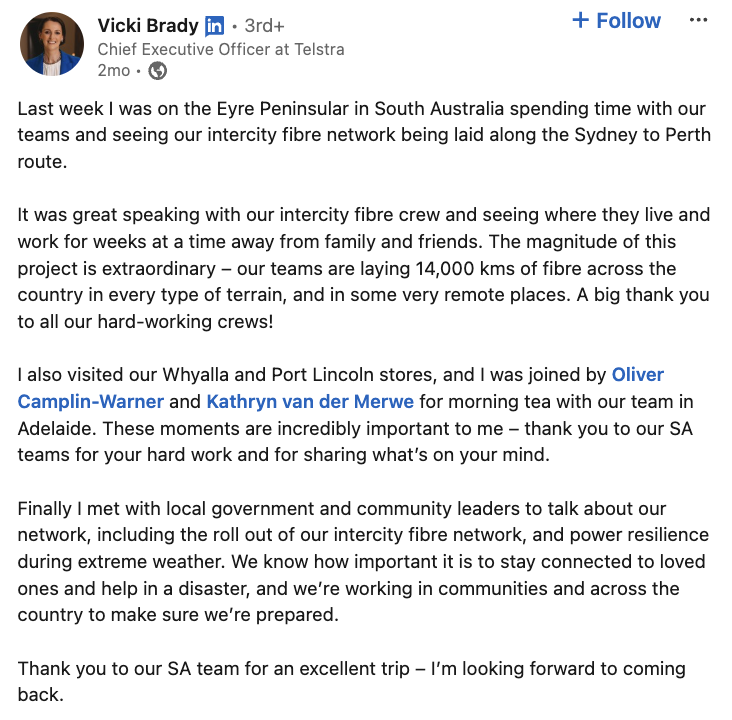
Through posts such as this, Brady illustrates her empathy for both the brand’s customers and employees. She underscores Telstra’s dedication to delivering reliable service, particularly as weather events become more severe, while expressing gratitude for the crew members who dedicate weeks away from home.
She also shares insights from discussions with customers to better understand their needs—particularly those in isolated regions.

Telstra’s dedication to providing superior service and connectivity is evident in their earnings forecasts, even as they navigate challenging economic conditions.
The play: Executives play a crucial role in humanizing not just your brand, but also your customers and employees. As Brady demonstrates, making individuals feel acknowledged can have a profound impact. Customers and team members are more than just numbers, and executives who convey this message on social media earn trust.
From Boardroom to Feed
This concludes this month’s edition of the PPR. Stay tuned for the upcoming edition next month, where we will feature brands that have captivated us throughout 2024. Meanwhile, keep these key takeaways in mind:
- Executive advocacy adds a human touch to your brand. Your company appears more genuine and relatable when leaders reveal their true selves.
- Amplifying existing brand narratives is an excellent starting point. Getting executives to participate in regular postings can be challenging. Providing them with a low-effort way to contribute still increases reach and garners attention for key updates.
- Social media allows leaders to shape public perceptions and reinforce company culture. Executives can utilize social content to align public sentiment with their corporate objectives—a strategy that helps gain the trust of consumers and potential hires alike.
Post Performance Report Highlights
Looking for comprehensive guidance on cultivating an executive brand? Download our executive social media strategy cheat sheet.
If you come across a social post or campaign that deserves recognition, tag us @sproutsocial and use #PostPerformanceReport to have your idea featured in a future article.
The post Post Performance Report: Masterful examples of executive brand advocacy first appeared on Sprout Social.
![[ PLR] Video Lead Magnet – 5 Different Ways To Make Money Online – honestPLR](https://imtoolshq.com/wp-content/themes/Extra/images/post-format-thumb-text.svg)
Recent Comments