Month: July 2024

Enhancing Customer Satisfaction: The Significance of Prompt Response Times in Fostering Loyalty

When it comes to a business’s success, the duration a customer is left waiting for a response can make all the difference.

If a customer seeks assistance or has an inquiry, lengthy response times can swiftly affect your business’s profitability. A report from The 2022 Sprout Social Index™ reveals that 36% of consumers will share a poor support experience with their network, 31% may abandon their purchase, and 30% are likely to turn to a competing brand.

For support teams, the time taken to give a first response (FRT), also termed first reply time, is often a pivotal moment for each customer query. This metric directly correlates the quality of customer care provided to the likelihood of retaining that customer.

This article will investigate the significance of FRT, how to assess it, and ways to enhance it.

What does first response time mean?

First response time refers to how long it takes for a business to reply to a customer inquiry or issue from the time it is received.

First response time definition, which states First response time (FRT) is the time it takes for a company to respond to a customer inquiry or issue from the moment it's received.

Enhancing FRT is crucial as it influences the overall customer experience. The Index indicates that 76% of customers recognize and value when a company prioritizes customer support. A rapid first reply to an incoming message can elevate customer contentment, whereas a sluggish response can result in irritation and dissatisfaction with your brand.

How can FRT be measured?

Calculating the first response time requires two main data points for the customer service team:

  • The duration taken to acknowledge and respond to a customer request over a defined period
  • The total number of responses issued during that timeframe

For instance, if an online apparel retailer processes 120 support cases in one week, and the cumulative first response times equal 15,000 seconds, the store can derive its FRT using this formula:

Sum of First Response Times / Total Number of Cases = Average First Response Time

Thus, we arrive at: 15000 / 120 = 125 seconds as the average first response time per case.

Nonetheless, this calculation might not reflect the true FRT of the brand accurately. It should also consider:

  • Prefer medians over averages. Median first response times offer a more reliable metric for FRT than averages, as they are less susceptible to distortion. For example, suppose the store’s dataset includes four FRTs of three minutes and only one of 30 seconds. An average first response time might suggest two minutes and thirty seconds, but using a median would indicate three minutes, which more accurately reflects the responsiveness of the customer service team.
  • Standard business hours. The first response time should be evaluated based on regular working hours, excluding periods when the customer service team is unavailable. If, for instance, the team operates from 8 a.m. to 7 p.m. and a customer inquiry comes in at 10 p.m., but it only receives a reply at 8:05 a.m. the next day, the FRT for that request is recorded as five minutes, not 10 hours and five minutes.
  • Service Level Agreements (SLAs). Should the team have established SLAs, this calculation will also account for whether the response time objectives and targets set for the team are being met.

These variations imply that FRTs will vary according to each company’s unique circumstances, aspirations, and operational hours.

How can first response time be improved?

<pTo enhance your first response time, you need to focus on three distinct actions: monitoring, training, and assessment. Let’s delve into each action in detail.

Data card that lists the steps you must take to improve first response time.

Monitor your existing FRT

Before improving FRT, it’s vital to measure it to assess your team’s performance regarding response times.

Tracking first reply times allows you to identify trends and obstacles within your response procedures while also assessing your team’s performance against established benchmarks. Depending on your customer service software, this monitoring might already occur automatically.

For example, Sprout’s Inbox Activity Report uses a widget to track Average Time to Action. It monitors how long it takes your team to provide a first response over a defined period while considering factors like operating hours. It subsequently calculates an average time to action for your team alongside further breakdowns of specific time frames.

Gather similar reports for every channel you utilize to handle customer inquiries.

Understand the expected benchmarks for FRT

Being aware of industry benchmarks for FRT aids in setting attainable targets for your team while ensuring customer satisfaction.

Our Index data indicates that nearly 70% of consumers anticipate a brand to respond within 24 hours, with 76% of respondents emphasizing how much they appreciate the speed with which a brand can cater to their demands.

A graph showing results of how fast consumers expect a response from brands on social media

However, research from Klaus shows that only 20% of customer service teams actively track first response time.

To tackle this aspect effectively, identify the channels your customer service team uses to respond to queries and gather FRT benchmarks relevant to your sector.

Educate your customer care teams to prioritize FRT

The Index revealed that just 30% of brands have established a customer care process and tools to engage with customers on social media actively.

This leaves brands vulnerable to adverse feedback and sentiment if customers opt for social media over email or chatbots for complaints. An effective social media response process enables a brand to cover all bases promptly.

However, merely having a social media response strategy is insufficient. It’s imperative to train your customer service team to prioritize FRT across all channels and to respond to customers within their anticipated reply timeframe. Your support team should be adept at managing complicated inquiries, understanding expectations regarding response formats, and knowing how to escalate cases when necessary.

Align your team with FRT expectations. Utilize our customer care training material to inform them about the significance of quick replies and furnish them with the necessary strategies to meet your objectives.

Establish your FRT improvement goals

Define specific objectives for your customer service team to reach the desired first response time by creating service level agreements (SLAs).

These agreements outline the expected services and responsibilities of your support team, linking key performance indicators to their efforts. To formulate FRT improvement goals, associate SLAs or deadlines with initial inquiry replies, holding the support team accountable for their response times.

A baseline FRT is determined based on past data and industry benchmarks, which is subsequently integrated into your SLA along with a target goal and deadline.

For instance, if an SLA stipulates a goal of responding to customer inquiries in four hours or less, the support team reaches 100% SLA compliance by adhering to that timeframe for all incoming inquiries.

Also, consider whether establishing separate SLAs for different customer support channels is practical. For example, a baseline FRT goal for live chat could be two minutes or less, yet it may be 30 minutes or less for a DM on Instagram. Be realistic about the infrastructure available to support your team in responding promptly on each platform.

Smart use of AI

The findings of The 2023 State of Social Media report indicate that 93% of leaders believe that enhanced investment in AI and machine learning (ML) will be vital in scaling customer care functions. AI can simplify customer inquiries and aid customer support teams in efficiently managing cases and improving first response times.

According to The 2023 State of Social Media report, 93% of leaders believe increased investment in AI and machine learning (ML) will be crucial for scaling customer care functions.

Imagine a customer support team striving to enhance its first response time while simultaneously managing communications in different languages based on individual customer interactions.

Utilizing Sprout’s Enhance by AI enables personalized customer exchanges, ensuring the right tone is maintained with every reply. After drafting an initial reply, Enhance by AI Assist transforms the message into four stylistic variations to select from in the Smart Inbox.

Create a comprehensive knowledge base for quick access

A thorough knowledge base allows your team to swiftly locate any necessary information to address customer concerns effectively. This data not only improves response quality but can also be employed to train AI chatbots for handling customer queries.

A major advantage of building a knowledge base is that it also empowers customers to resolve issues independently, thereby saving your support team considerable time and effort. Even if a case ends up in your support team’s queue, a well-structured knowledge base can help them send detailed articles to customers to aid in resolving their issues.

Ultimately, when agents encounter fewer requests, they can expedite responses for the cases they do receive, subsequently enhancing the overall first response time for the business.

FRT: A crucial component of customer service

First response time is an essential KPI for customer satisfaction, which can significantly affect customer loyalty to your brand.

By monitoring FRT, training your team, and setting improvement objectives, customer service teams can markedly boost FRT to keep customers satisfied. Enhancements like adopting AI and establishing knowledge bases can further connect customers to answers for simple inquiries. This, in turn, allows your customer service teams to focus on more complex challenges.

However, first response time is just one of several essential metrics that brands should leverage to deliver outstanding customer experiences. Customer service teams must operate in harmony across every touchpoint, from email to social media, to ensure customers enjoy a seamless experience.

To further understand customer expectations, consider exploring the role of social media in customer service and how maintaining quality support across social platforms can significantly boost brand loyalty.

The article First response time: How to win over customers with quick replies was originally published on Sprout Social.

Read More

Improving Team Collaboration: Advantages of Merging Sprout Social with Salesforce

There’s a reason why an increasing number of businesses are connecting their CRMs with social media management solutions like Sprout Social: Prioritizing your customer experience should be central to your social media strategy.

Thanks to a global collaboration with Salesforce that began in 2022, Sprout and Salesforce are paving the way for a new chapter in social customer service. The integration between Sprout Social and Salesforce enables your brand to provide top-notch social customer service—all while maintaining your team’s workflow uninterrupted.

Additionally, the Service Cloud integration guarantees that Salesforce users can handle all their social customer care inquiries directly from Service Cloud. It enhances customer CRM profiles with social insights to offer a comprehensive view of customer interactions—accelerating internal collaboration and revealing valuable insights.

In this guide, we’ll detail how the Sprout Social Salesforce integration operates. We will also emphasize how this integration simplifies tasks throughout your organization and facilitates demonstrating the success of your initiatives.

Why you should integrate your CRM with social media immediately

The significance of social media integrations with your company’s tech stack cannot be overstated. Your CRM platform should certainly be a priority.

This is even more crucial as customers increasingly utilize social media as a research tool, support avenue, and forum for voicing opinions about brands.

As reported by the 2023 Sprout Social Index™, 76% of consumers notice and value when companies make customer support a priority, and 70% expect personalized responses to their service needs. Yet, only 30% of brands have implemented customer care systems and tools aimed at actively engaging with customers on social platforms.

When brands neglect their customers, they miss opportunities to enhance retention and improve profitability.

The Sprout Social Salesforce integration addresses this challenge.

Before we delve deeper, let’s explore some of the major benefits of connecting your CRM with your social media presence.

Build a comprehensive view of your customer

Social data is the crucial element that completes the comprehensive view of your customer.

As highlighted in the 2023 State of Social Media report, 88% of business leaders concur that insights from social media are vital to providing outstanding customer care.

Empower your agents with a complete customer 360 view before they engage with customers. Sprout Social augments your Salesforce CRM data with social insights to offer a detailed perspective. Thanks to this integration, agents can interact in real-time with the necessary context.

Sprout’s Tableau Business Intelligence (BI) Connector goes further by merging social data into a unified view, tailored with the specific visuals and metrics companies require. This offers rich data options and visualizations that present users with a thorough understanding of their customers without extensive labor.

With a fuller picture of your customer, you can craft significant customer journeys and categorize audiences according to their social engagements with your brand. Leverage the extensive social data provided to Salesforce to ensure your communications resonate and convert prospects into lifelong customers.

Track crucial moments in the buyer’s journey

CRMs assist businesses in guiding leads and customers through the purchasing process.

Social media is where many pivotal moments occur during that journey.

This is valid for both B2B and B2C scenarios. Assuming that the average B2B buyer’s journey lasts about eight months, social interactions are essential for individuals researching a product.

Meanwhile, research from TikTok describes the buyer’s behavior as an “infinite loop” in B2C. The contemporary purchasing path is non-linear, with people interacting across multiple channels.

As clients navigate through various platforms and content, social media serves as an area for making pivotal touchpoints along their journey, including addressing inquiries and sharing informative content to nurture leads.

In fact, the latest Index revealed that the primary reason individuals follow brands on social media is to stay updated on products and services.

Generate (and monitor) more social sales

The rise of social selling is self-evident.

Do functions like customer support and content marketing play a significant role in closing and retaining clients? Definitely.

However, tracking these efforts without a CRM can be challenging.

With integrations such as those between Sprout Social and Salesforce, attributing social-driven sales becomes much simpler. The ability to swiftly address inquiries and transfer cases between social platforms, sales, and support facilitates rapid responses.

Collect valuable customer insights you might otherwise overlook

The more knowledge you have about your customers, the better.

Integrating touchpoints between social media and your CRM grants you a deeper understanding of your audience. Utilizing Sprout’s Tableau BI Connector allows your team to access extensive consumer data in one spot, providing a panoramic view of how social media fits into the overall picture.

Fact: the 2023 State of Social Media report discovered that 95% of business leaders believe they need to rely more on social data for decisions beyond marketing. Consider how many users turn to social media to express their opinions about brands.

These dialogues and activities yield insights for sales and support, which include:

  • Sales objections
  • Pain points and challenges
  • Wants and needs
  • Competitor advantages (and disadvantages)

With these insights readily available, your team can approach leads and customers with the confidence they need.

Reimagine the role of social in your business

A powerful, all-in-one social media management platform


Start Your Free Trial

How does Salesforce integrate with Sprout Social?

Here’s a brief overview of the Sprout Social Salesforce integration and its capabilities:

  • Generate Salesforce contacts, leads, and cases directly within Sprout. This enables seamless routing of social customers to support and sales teams without leaving Sprout or Salesforce.
  • Create a comprehensive view of your CRM contacts with data and exchanges facilitated through social media.
  • Connect your social presence to tangible business outcomes via analytics and reporting.
  • Tailor customer segments and journeys in Marketing Cloud based on your social insights.
  • Interact directly within Service Cloud where agents operate, minimizing the need for multiple tools layered with governance and security.
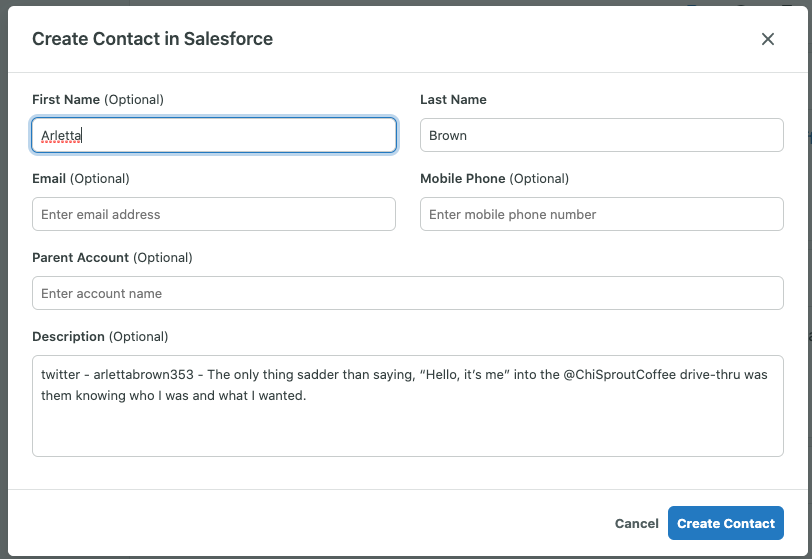
The link between Sprout and Salesforce shares information about a Salesforce contact's social profiles, including; name, email, phone and a description of how they've interacted with your brand on social.
Sprout Social within the Salesforce Service Cloud console

Moreover, our Salesforce integration is accessible across all Sprout plans. Below are the features and prerequisites:

  • Requirements: Active Salesforce account
  • Data Types: messages, contacts, tickets
  • Key Functionality: create leads, modify contact details, establish cases, amend cases, automatic syncing

What entities can be utilized with the Sprout Social Salesforce integration?

The integration that links Salesforce with social media via Sprout Social enables the direct creation and editing of these entities within Sprout’s interface:

  • Leads: Initiate the sales process by recognizing prospective clients through inquiries, comments, and other social media interactions.
  • Cases: Direct customer issues or inquiries shared on social media to your support team without departing from the platform.
  • Contacts: Besides customers, you can also monitor social interactions with contacts like corporate partners.

For more details, you can take a look at this comprehensive breakdown.

Sprout + Tableau + Salesforce

We recognize that there are instances where you need to extract social data from Sprout to merge it with other data streams (such as customer service and additional marketing data) and to customize it further based on your company’s internal preferences.

With Sprout’s Tableau BI Connector, you can harness the power of social data alongside other business channels. This tool allows you to analyze data, formulate custom metrics, and integrate different data sources.

A screenshot of a Tableau dashboard populated with Sprout Social data and other digital marketing data (banner ad impressions and email click through rates). The dashboard includes an interactive map that breaks down engagements per state.

This smooth and tailored view provides you with an integrated source of truth for wider business insights and performance metrics.

The integration:

  • Consolidates broader business updates
  • Constructs your ideal dashboard
  • Accesses data without needing a development network

For Salesforce users, this guarantees that social data and insights are included in your comprehensive view of your customers.

4 key advantages of utilizing the Sprout Social Salesforce integration

To conclude, let’s review some specific benefits of implementing a social media integration with Salesforce like Sprout.

1. Deliver superior customer support

The Index indicates that the most notable brands on social media actively respond to customers. Moreover, 69% of consumers expect brands to reply within the same day when they seek assistance.

Our Salesforce integration aids in keeping track of every customer inquiry that arises and facilitates timely responses when necessary.

Documenting social interactions leads to a more thorough understanding of your customers’ desires and needs. Eliminating the need to switch between your CRM and social tools results in significant time savings, consequently improving your response time.

sprout social salesforce integration case creation

Additionally, our intelligent, automated case creation and routing feature enhances agent efficiency and fine-tunes the customer experience. It ensures incoming messages reach the appropriate agent rapidly—directly inside of Salesforce. Since agents don’t need to sift through an endless stream of messages, they can dedicate more time to high-quality customer care initiatives, resulting in an enhanced customer experience.

The end result: quicker responses to customers and the development of better solutions to cater to their needs. This approach is a recipe for cultivating long-term loyalty and retention.

2. Harmonize your marketing, sales, and support teams

It’s worth noting that 36% of marketers report difficulties with cross-team collaboration.

When marketing, sales, and support teams align, everyone is empowered to excel in their roles. There is ample scope for mistakes if customer interactions on social media are logged inconsistently.

Consider this: If either marketing or sales omits crucial customer details from your CRM, your support team remains uninformed. Conversely, marketing teams should be aware of sales objections and reservations to better address customer aspirations.

Here are several specific ways the Sprout and Salesforce integration can assist:

  • Streamline by removing unnecessary exchanges between vendors, managers, and social managers.
  • Quickly direct cases to prevent unnecessary tool switching.
  • Equip each team with the context necessary to effectively serve your customers.
create a salesforce contact in sprout social

3. Increase the value behind your marketing content

Understanding what keeps customers engaged or causes them to leave is invaluable for marketers.

Monitoring these touchpoints may provide insights needed to create more impactful content, significant marketing messaging, and personalized customer journeys. This includes:

  • Blog posts
  • Social media posts (e.g., tutorials, educational content you share to engage customers)
  • Reports, white papers, and other lead-generating materials
  • Webinars

For instance, marketers might discover that high pricing is the most frequent sales objection among lost leads. This information motivates the marketing side to rethink their messaging and how they engage with their audience.

4. More meaningful attribution through analytics

Perhaps the most crucial aspect is that social integration with your CRM highlights the ROI of your team’s endeavors.

This remains an ongoing challenge for marketers, specifically. While social media is essential for businesses, assessing its business impact can be perplexing.

This is where Sprout comes in. With our marketing and analytics functionalities, brands can observe how social engagements correspond directly with revenue. Demonstrating the contribution of these interactions to profitability emphasizes the value of social media to stakeholders.

sprout social salesforce integration showing attribution for key metrics

Furthermore, with our reporting capabilities in Salesforce, you can keep track of your complete omnichannel experience, including identifying which channels (e.g., phone, email, social) and which social platforms (e.g., LinkedIn, Facebook) generate cases.

Salesforce Service Cloud console with Sprout Reporting

When you need to compile all your marketing, customer service, and social data into one accessible location, Sprout’s Tableau integration will assist you in articulating the narrative of your brand’s achievements on social media and beyond.

Refer to this article to see why Sprout is considered the best alternative to Salesforce Social Studio.

Ready to explore the Sprout Social Salesforce Integration?

From gaining customer insights to enhancing services, the advantages of integrating your social presence with your CRM are evident.

Fortunately, getting started with the Sprout Social Salesforce integration can happen quickly. Our platform simplifies the process of enhancing your tech stack while connecting your team more effectively.

Request a demo of our Service Cloud integration or discover how Salesforce saved 12,000 hours in their initial year using Sprout.

The article How the Sprout Social Salesforce integration strengthens your team first appeared on Sprout Social.

Read More

Grasping the Distinctions Between Social Media Monitoring and Social Media Listening

What’s the distinction between social media listening and social media monitoring? Many people use these phrases interchangeably, yet they differ significantly.

To clarify:

  • Social media monitoring refers to the process of observing social media messages, comments, and discussions directly tied to your brand, allowing you to engage with those interactions.
  • Social media listening entails examining the entirety of conversations surrounding your industry, brand, and related topics to gain deeper insights into your audience and refine your marketing strategies.

Ultimately, companies benefit from both social media monitoring and listening because monitoring reveals what people are saying about your brand or industry, while listening uncovers why.

For instance, assume you manage marketing for an online retail firm, and you’ve just unveiled a new item. Social media monitoring may indicate that numerous customers are discussing a specific product. These observations could suggest that the product is well-received—in theory.

However, social media listening might uncover that many of those discussions are negative. Digging deeper could reveal that the concern isn’t with the product itself but with shipping delays. While monitoring addresses the symptoms, listening identifies the underlying issue.

In this piece, we will thoroughly analyze social media monitoring and listening and illuminate the vital differences between the two.

Definition of Social Media Monitoring

Social media serves as a primary avenue for brands to engage with their audience. Social media monitoring is the first step toward enhancing these connections, helping brands discover the discussions they should monitor or engage in. It is the process of collecting pertinent social discussions and messages to stay updated on customers’ preferences, aversions, desires, and evolving needs.

Social media monitoring is a process that helps brands find social conversations they should be aware of or participate in.

This allows you to monitor mentions of your:

  • Brand name and common misspellings
  • Product names and common misspellings
  • Main competitors
  • Specific products or brands in targeted areas

Example of Social Media Monitoring

Social media monitoring tracks significant phrases and terms pertinent to your business and surfaces them for you to engage with.

For example, earlier this year, 100 Thieves, a lifestyle and gaming brand, referenced the footwear label Crocs on X (previously known as Twitter). Even though they didn’t tag the account, Crocs likely utilized social media monitoring to detect the mention and respond promptly. An X (formerly Twitter) interaction between 100 Thieves and Crocs.

The Advantages of Social Media Monitoring

Neglecting to monitor social media mentions—akin to ignoring the telephone—is something many brands do, leading them to overlook essential business intelligence that could facilitate more strategic decision-making.

Monitoring is crucial for your brand’s communication framework. Social media managers and customer care representatives should manage most of this interaction, serving as air traffic control for incoming communications across your social networks.

Maximizing Social Media Monitoring

Initially, consolidate your social profiles into a single platform that enables extensive message monitoring. Next, establish alerts to assist your agents in easily tracking and responding to direct or indirect brand mentions. Include your brand’s handle and wider references. Also, account for common misspellings, nicknames, flagship products, and relevant industry terms.

By receiving these alerts, your social team will be more equipped to proactively manage your brand’s interests, addressing FAQs while forwarding other crucial messages to different departments within your company—from HR to sales.

To further refine the process, your community managers can pinpoint potential avenues to influence purchasing choices. However, exercise caution: This approach requires both creativity and analytical skill.

Quote from Jason Keath from Social Fresh. The quote reads, “We commonly see people tag others to talk about attending our conferences. Sometimes we reply, and we always add everyone to our CRM. We definitely see ticket sales from it.”

Definition of Social Media Listening

Social media listening involves scrutinizing the conversations and trends surrounding your brand and industry, using these insights to make informed marketing decisions.

Social media listening is about examining the conversations and trends around your brand and industry, and using those insights to make smarter marketing choices.

This assists you in identifying why, where, and how these discussions occur, as well as understanding public opinion—not just when they mention or tag your brand directly.

Example of Social Media Listening

Social media listening can enhance your campaign planning and improve your content strategy and messaging by eliminating the uncertainty surrounding what content will resonate. Analyzing metrics such as volume, share of voice, and sentiment will help disclose which offers resonate most with your audience and their true feelings about your brand and products.

One social media listening example is a franchise restaurant that utilized Sprout’s Listening tools to discover which menu items received customer adoration and which items were being neglected.

The Listening Topic Themes data uncovered intriguing insights. While nachos weren’t frequently mentioned alongside other dishes, they garnered the highest percentage of positive feedback and the lowest percent of negative remarks. Consequently, the franchise opted to generate more content featuring nachos since the data indicated customer enthusiasm for them.

Sprout Social Themes report that shows key social media listening metrics such as comments, shares, potential impressions, positive and negative mentions, and engagement rates

The Advantages of Social Media Listening

In the absence of social media listening, you may overlook crucial industry trends and customer preferences that could lead to missed opportunities for enhancement. Moreover, while social media monitoring hones in on what is being said and by whom, listening aids businesses in grasping the overall sentiment and context of those conversations. Without this, firms may misinterpret customer attitudes and feedback.

Implementing Social Media Listening for Your Business

Deploying a social listening strategy might appear more complex than everyday monitoring; however, it doesn’t need to be. Begin with straightforward solutions, then evolve to more sophisticated techniques. Robust, automated listening tools require minimal setup and can provide meaningful, actionable data while offering customizable options.

For example, you might gauge how frequently your brand is mentioned on X during a specified timeframe, including which hashtags, keywords, and related terms are commonly used. This can reveal how audiences perceive your brand, products, and campaigns—all achievable without complicated search queries or reliance on algorithmic sentiment triggers. Simply paying attention to what people say alongside your brand mentions suffices.

Acquiring more advanced listening solutions that not only provide total volume but also help identify patterns, capture trends, and determine share of voice across keyword groups or queries can be incredibly beneficial.

Regardless of your approach, the aim is to achieve clearly defined outcomes within your broader social strategy. If monitoring tactics yield heightened engagement and listening efforts foster more strategic decision-making, you’re progressing towards success.

Fundamental Differences Between Social Listening and Social Monitoring

If monitoring acts as the gateway, listening represents the advanced study. Most social media platforms provide basic, native monitoring functionalities. Yet, a comprehensive strategy for social monitoring and listening necessitates a third-party tool like Sprout Social to record mentions and analyze data across various social media platforms.

A diagram comparing social monitoring and social listening. Social monitoring is shown as a series of steps from gathering data to analyzing and extracting insights. Social listening is shown as a series of steps from gathering insights to driving proactive decisions.

Here are several additional fundamental distinctions between social monitoring and listening.

Micro vs. Macro

Social media monitoring is micro-focused. It centered on specifics, such as individual brand mentions or comments. In contrast, social media listening takes a macro perspective. It involves examining the broader context and understanding discussions about your brand, products, industry, and competitors.

For instance, monitoring would indicate that thirty individuals tagged your brand in posts today. Listening would reveal that the majority of those mentions were either glowing reviews about a new product or complaints regarding customer service.

Reactive vs. Proactive

Social media monitoring is reactive. It involves witnessing and addressing direct mentions or tags as they occur. Conversely, social media listening is proactive. It offers more profound insights that allow you to strategize and plan effectively.

For instance, while monitoring might inform you of a single consumer complaint, listening can unveil a pattern of complaints about a specific product feature, prompting you to address or optimize it to preempt future issues.

Tactical vs. Analytical

Social media monitoring is a more tactical, task-oriented approach. Several social media monitoring tools, such as Sprout Social, gather all your mentions in one centralized location and alert you whenever a new conversation arises. From there, it’s your responsibility to respond to the message through a reaction, reply, or direct message.

Conversely, social listening is more analytical and strategic. Social listening tools offer extensive insights into the context and sentiment behind what people express. Rather than merely replying to messages, listening helps identify engagement patterns and trends relating to your brand and industry. Such information assists in establishing data-informed benchmarks and goals, enabling more strategic decision-making. However, social listening necessitates analyzing many variables, making it unfeasible without a dedicated social listening tool that automates the process.

Utilizing Sprout Social for Social Monitoring and Listening

Sprout Social is a comprehensive social media management solution that combines monitoring and listening functionalities. These capabilities empower users to focus on significant conversations and analyze trends and patterns influencing their social media strategy.

How precisely? Let’s dive deeper.

Smart Inbox

The Smart Inbox is where you can oversee every conversation with and about your brand. It’s the core of monitoring, helping you centralize and nurture genuine conversations with actionable intent. Messages from your social channels are unified into a single feed to ensure you stay focused and never overlook a message.

Sprout Social’s Smart Inbox, showing brand mention messages with user and sentiment tags.

Brand Keywords

Brand Keywords enable you to capture more pertinent conversations regarding your brand, industry, or competition. This is a progression towards listening as it allows you to track diverse topics beyond your brand. Brand Keywords consist of custom searches that operate continuously and present results in your Smart Inbox, which you can engage with just like any other message. You’re still primarily focused on dialogues that prompt responses or support on a personal level.

If you’re not actively seeking out these kinds of messages, you might miss critical opportunities to join significant conversations.

Sprout Social’s Brand Keyword Query that helps you run custom searches constantly and get results in your Smart Inbox, which you can interact with just like any other message.

Trends Report

The Trends Report automatically highlights the most popular topics and hashtags concerning your brand. With this report, we find ourselves firmly situated in the middle of our continuum.

The X Trends Report presents the hashtags and topics that are trending among the mentions and replies for your connected profile(s). It also showcases the individuals and brands most often discussed alongside your business. This feature allows you to gain a broader understanding of the dialogue surrounding your brand to recognize trends related to your business or campaigns.

Sprout Social Trends Report showing the most popular keyword topics and hashtags.

Keyword Report

The Keyword Report divulges the share of volume for fundamental keywords relevant to your brand, competition, and industry. The X Keyword report swiftly uncovers trends in X traffic for any keyword, hashtag, or complex search query over any date range. With this report, we begin to tread into listening territory. The focus is no longer solely on individual messages; instead, you assess more substantial trends concerning specific keywords over time to evaluate your campaign’s performance, monitor your market, or identify keyword usage patterns.

Sprout Social’s Share of Volume report

Sprout’s Premium Listening Solutions

Sprout’s Listening offerings provide a view into an audience’s genuine thoughts and feelings, uncovering trends, revealing patterns, and measuring emotional responses concerning any topic. They furnish data to support broader trends in popular topics, demographics, and influencers, while also allowing for a close examination of individual posts for qualitative insights.

The insights derived from listening can fuel your social strategy, overall marketing plans, and even your business strategy. Grasping the “why” behind the “what” is a significant asset that necessitates an equally robust solution.

Sprout Social’s Listening Home, which includes listening templates for Topics like Brand Health, Industry Insights, Competitive Analysis and Campaign Analysis.

Initiate Social Monitoring and Listening

Social monitoring and listening are remarkable for tuning into the interactions surrounding a brand and industry. However, it also comes with a learning curve. From determining which hashtags and keywords to follow, to deciphering how to interpret and act on the data in listening reports, it can initially feel daunting.

Nevertheless, our social listening guide serves as an excellent starting point. Within just 90 minutes, you’ll receive answers to inquiries regarding brand sentiment, trending conversations, and content performance, allowing for the optimization of your content strategy.


The post Social media monitoring vs. social media listening first appeared on Sprout Social.

Read More