

Most U.S. digital ad platforms saw slowing ad spending last quarter, according to a new report from digital marketing agency Tinuiti.
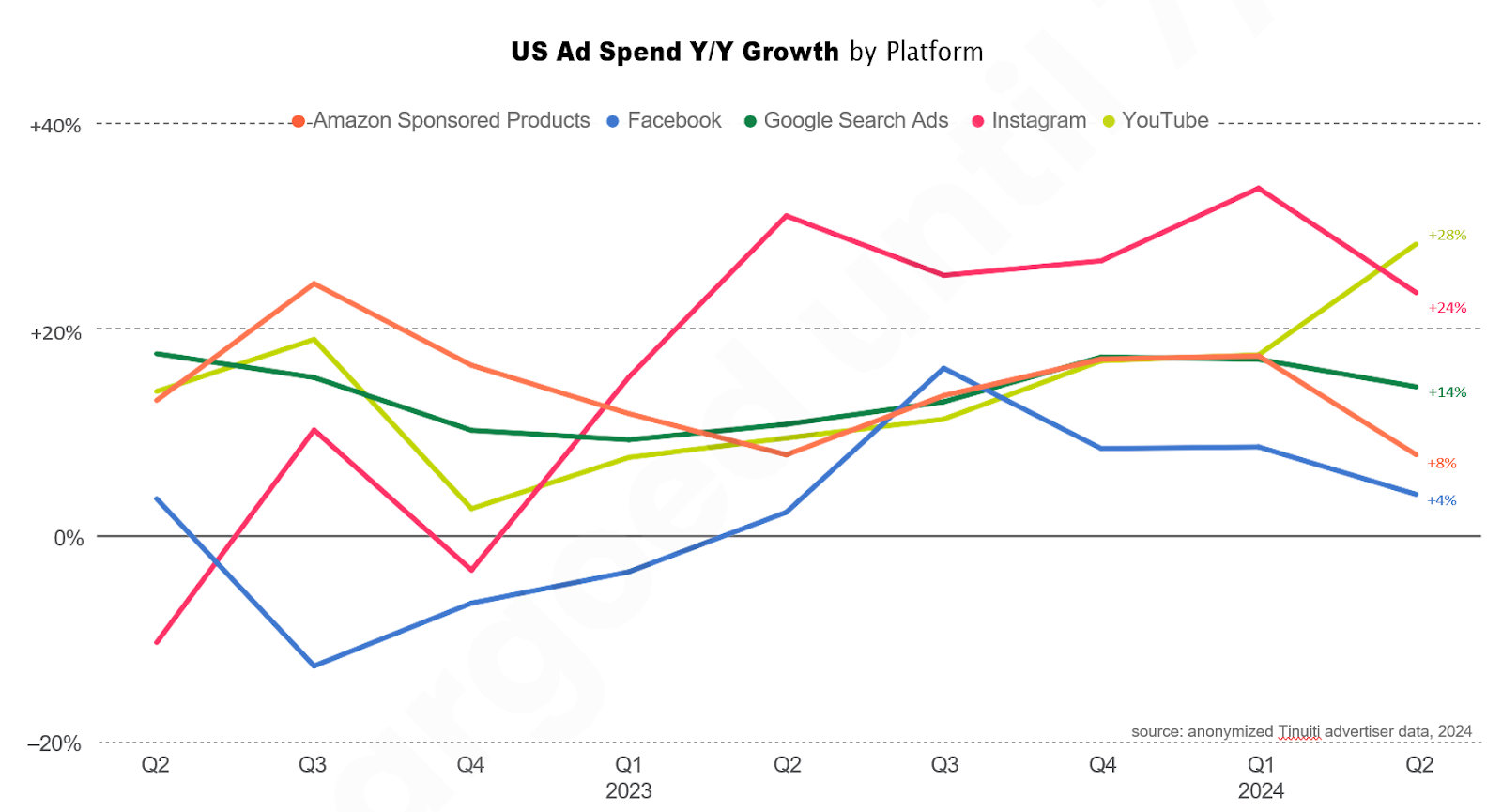
Amazon Sponsored Products, Facebook, Google search and Instagram all saw lower spending growth year-over-year in Q2 2024 than a quarter earlier. YouTube was the only major platform that saw an increase.
The video platform saw a 28% increase in ad spend last quarter, compared to 18% in Q1. This was in response to a 74% increase in impression volume. At the same time, those new impressions were relatively cheap, which pushed average CPM down 26% year-over-year in Q2, down from a 3% decline in the previous quarter, according to Tinuiti’s Q2 2024 Digital Ads Benchmark Report.
Meta
Investment in Meta properties rose by 10% year-over-year in Q2, down from a 16% increase in Q1. This deceleration is partly due to a tougher comparison with Q2 of the previous year, where spend growth surged from 0% in Q1 2023 to 9% in Q2 2023.
Facebook’s share of total Meta ad spend dropped compared to last Q2 but still accounted for 68% in Q2 2024, maintaining its dominance among Meta’s platforms. Instagram’s spend share increased from 29% last year to 32% this year, as its spend growth outpaced Facebook’s in Q2. Messenger and Audience Network continue to represent a small portion of total Meta ad spend for most advertisers.
Dig deeper: How marketers are leveraging the Olympics’ focus on women’s sports to drive engagement
In the second quarter, Instagram’s advertising spend growth rate cooled to 24% year-over-year, placing it second behind YouTube. This marks a shift from Q1, where Instagram led the pack, according to the report.
Across both Facebook and Instagram, AI-driven Advantage+ campaigns continue to be a major factor in retailer advertising expenditure. However, the share of spending to this format has slightly decreased since the peak holiday shopping season in Q4. This shift in ad format popularity and spending patterns reflects Meta’s ongoing efforts to optimize its advertising offerings across its platforms.
Facebook’s CPM decreased by just 1% year-over-year in Q2 2024, the fifth consecutive quarter where the year-over-year CPM decline has lessened. The report said this is partly because of the increasing share of Facebook impressions from Reels videos and overlay ads, which are significantly cheaper than Feed placements, lowering the overall CPM for the platform.
Google search advertisers increased their budgets by 14% year-over-year in Q2 2024, down from 17% growth in the previous, according to the report. Spending on Google shopping ads, including Performance Max and standard Shopping campaigns, rose by 16% year-over-year in Q2. In contrast, click growth for Google text ads remained weak in Q2, with a notable drop in click-through rates in May as Google introduced AI Overviews to all U.S. users.
Google’s search advertising landscape showed mixed results in Q2 2024. Advertiser spending on Google search ads increased by 14% year-over-year, a slight deceleration from the 17% growth observed in the previous quarter. This marks the fifth consecutive quarter of slowing click growth for Google’s search ads, with Q2 seeing only a 3% increase.
On the pricing front, advertisers experienced some relief as the cost-per-click (CPC) growth rate slowed to 12% year-over-year, following four quarters of accelerating CPC growth. Despite this overall slowdown, Google shopping ads remained a bright spot in the company’s search ad portfolio.
Notably, the growth in shopping ad spending over the past two quarters has been primarily driven by higher CPCs, indicating that advertisers are willing to pay more for these high-performing ad formats, the report found.
Amazon
Amazon Sponsored Products spending growth decelerated more significantly in Q2 compared to Google search, reaching 8% year-over-year. However, sales generated through Sponsored Product ads performed better, increasing by 11% year-over-year for the quarter, resulting in improved return on investment for advertisers.
Dig deeper: The top ecommerce trends from record-breaking Amazon Prime Day 2024
Amazon maintained its high share of Google shopping ad impressions from Q1 to Q2, reaching levels typically seen only during holiday seasons. This aggressive approach in 2024 follows Temu’s significant push to gain US market share in 2023, which included becoming a major buyer of Google shopping ads. Interestingly, the report found Amazon reduced its presence in Google’s text ad auctions this year, suggesting a potential reallocation of spending between ad formats.
Emerging platforms
Several emerging advertising platforms experienced significant growth last quarter. Walmart Sponsored Products’ advertisers boosted their spending by 45% year-over-year, the fifth consecutive quarter of over 30% growth. TikTok saw a 10% year-over-year increase in ad spend, while Snapchat and Pinterest demonstrated more robust growth at 26% and 22% respectively.
The full report can be found here. (Registration required)
The post Second quarter saw slowing ad spend on most platforms appeared first on MarTech.
### Ad Spend Declines Across Most Platforms in Second Quarter: An In-Depth Analysis
The advertising industry, a cornerstone of modern commerce, has always been a barometer for economic health and consumer sentiment. Recent data from the second quarter of this year indicates a notable decline in ad spend across most platforms, prompting industry experts to analyze the underlying causes and potential long-term impacts.
#### The Current Landscape
According to the latest reports, digital advertising, which has been on a meteoric rise over the past decade, saw a significant slowdown. Major platforms such as Google, Facebook, and Amazon reported lower-than-expected ad revenues. Traditional media, including television, radio, and print, also experienced a downturn, continuing a trend that has been exacerbated by the shift to digital.
#### Key Factors Contributing to the Decline
1. **Economic Uncertainty**: The global economic landscape has been marked by volatility, with inflation rates soaring in many regions and fears of a potential recession. Businesses, wary of uncertain economic conditions, have tightened their marketing budgets, leading to reduced ad spend.
2. **Supply Chain Disruptions**: Ongoing supply chain issues have impacted various industries, from electronics to automotive. Companies facing inventory shortages are less inclined to invest heavily in advertising, knowing they cannot meet potential demand.
3. **Privacy Regulations**: Stricter privacy laws and regulations, such as the General Data Protection Regulation (GDPR) in Europe and the California Consumer Privacy Act (CCPA) in the United States, have made targeted advertising more challenging. Platforms that rely heavily on user data for ad targeting have been particularly affected.
4. **Shifts in Consumer Behavior**: The pandemic has permanently altered consumer behavior, with more people shopping online and spending significant time on streaming services. While this shift initially boosted digital ad spend, the saturation of digital channels and changing consumer preferences have led to diminishing returns for advertisers.
5. **Increased Competition**: The digital advertising space has become increasingly crowded, with new entrants vying for a share of the market. This heightened competition has driven up ad costs, making it more expensive for businesses to achieve the same level of reach and engagement.
#### Platform-Specific Insights
– **Google**: Despite being a dominant player in the digital ad space, Google reported a slowdown in ad revenue growth. The company cited macroeconomic factors and changes in consumer spending patterns as primary reasons.
– **Facebook**: Now rebranded as Meta, Facebook faced a double whammy of privacy changes from Apple’s iOS updates and regulatory scrutiny. These factors have made it harder for advertisers to track and target users effectively.
– **Amazon**: While Amazon’s ad business has been a bright spot in recent years, the second quarter saw a deceleration. The e-commerce giant attributed this to supply chain challenges and a cautious approach from advertisers.
– **Television and Radio**: Traditional media continued to struggle, with TV and radio ad revenues declining. The shift to streaming services and on-demand content has eroded the audience base for traditional broadcasters.
#### Potential Long-Term Impacts
1. **Shift to Performance-Based Advertising**: Advertisers are likely to focus more on performance-based advertising, where they can directly measure the return on investment. This could lead to increased spending on platforms that offer robust analytics and targeting capabilities.
2. **Innovation in Ad Formats**: To counteract declining ad revenues, platforms may innovate with new ad formats and technologies. Interactive ads, augmented reality (AR), and virtual reality (VR) experiences could become more prevalent.
3. **Diversification of Ad Spend**: Businesses may diversify their ad spend across a broader range of platforms and channels to mitigate risk. This could benefit emerging platforms and niche markets.
4. **Emphasis on First-Party Data**: With privacy regulations tightening, companies will place greater emphasis on collecting and utilizing first-party data. Building direct relationships with consumers will become increasingly important.
#### Conclusion
The decline in ad spend across most platforms in the second quarter reflects broader economic and industry-specific challenges. While the immediate outlook may appear bleak, it also presents an opportunity for innovation and adaptation. Advertisers and platforms that can navigate these changes effectively will be well-positioned to thrive in the evolving landscape.
As the industry continues to grapple with these shifts, one thing remains clear: the ability to adapt and innovate will be crucial for sustained success in the ever-changing world of advertising.

Recent Comments