
From manipulation tactics to account takeover, social media profiles encounter numerous potential threats. It’s crucial for organizations, particularly in regulated sectors like finance and healthcare, to prioritize social media security. The digital footprint of a brand—especially that of its executive team—plays a vital role in its overall credibility. A single security breach can erode customer trust and expose sensitive business data.
As cyber threats continuously evolve, companies must consistently reassess and refine their strategies. This article aims to outline effective social media security practices to foster a risk-aware culture for your organization’s online accounts.
What does social media security entail?
Social media security encompasses the measures, tools, and best practices that businesses and individuals employ to manage risks and safeguard assets on social networks. This includes protecting sensitive data such as customer information, employee records, and confidential business documents.
Notable social media security hazards include:
- Credential theft
- Account impersonation
- Phishing and social scams
- Data breaches
With adequate privacy and security safeguards in place, organizations can mitigate the likelihood of these incidents and uphold a sturdy reputation.
The significance of social media security
Social media security extends beyond just preventing hacking and phishing scams. It is crucial for preserving your brand’s reputation, safeguarding employee and customer data, ensuring adherence to evolving data protection regulations (such as GDPR and CCPA), and averting financial setbacks.
Consider this: Every employee, vendor, and executive interacting with your social accounts influences your overall security framework. Why? Because social media is inherently public. A security incident can swiftly tarnish your brand’s reputation through inappropriate content, false information, or scams visible to a large audience. Moreover, due to the instantaneous nature of social media, a damaging post can proliferate rapidly, allowing little room for a response.
The stakes are particularly high for brands. Non-compliance with data protection regulations may result in substantial fines, alongside lost revenue due to striped brand trust. According to a Q1 2024 Sprout Social Pulse Survey, 78% of consumers believe that a brand’s social media presence has become more influential on their trust in the brand compared to a year ago.
Key social media security risks and threats
Below are some prevalent social media cybersecurity risks, accompanied by illustrative scenarios of how they may manifest within an organization.
Credential theft
Credential theft refers to the unauthorized acquisition of login details (username and password) to access a social media profile unlawfully. This could occur through stealing an employee’s login information or via a brute force attack.
This threat affects social networks and any third-party applications utilized to manage social accounts.
Account impersonation
Account impersonation within social media security involves creating a counterfeit account that replicates a genuine individual, business, or organization.
Fraudsters utilize these fake accounts to mislead others into believing they are engaging with the authentic entity. This can involve impersonating executives, team members, or entire companies to deceive clients, propagate falsehoods, or damage a brand’s reputation.
Phishing
Phishing is a prevalent cyberattack technique wherein cybercriminals masquerade as trusted organizations through email or social media to trick individuals into divulging sensitive information, including login details or financial information. These communications may seem credible but often include links or attachments that lead to malicious websites or introduce malware—programs intentionally crafted to disrupt devices, networks, or servers.
This threat is severe, as phishing can jeopardize accounts and systems, resulting in privacy violations and financial damage.
Malware
Malware refers to malicious software developed to harm a device, network, or server. On social media, it can circulate through links, downloads, or attachments posted on different platforms.
A single incorrect click may install malware on a user’s device, potentially exposing sensitive data or giving adversaries control over the system.
Social engineering
Social engineering employs manipulation techniques to deceive individuals into disclosing confidential information, such as login credentials or financial details. Rather than exploiting technological vulnerabilities, social engineers leverage psychological tactics to manipulate human behavior.
For instance, a con artist impersonating a client or partner may send a direct message (DM) containing a link to a harmful website. Without appropriate training regarding social media security best practices, your team might mistakenly click the link, believing it to be genuine.
Spam and bot accounts
Spam and bot accounts are automated accounts used to disseminate spam, harmful links, and false information, potentially damaging your brand’s reputation. These accounts often mimic real users, making them challenging to identify.
The primary risk lies in their capability to spread damaging content, initiate phishing schemes, and impersonate legitimate users or brands. This heightens cybersecurity threats for both your social media team and followers.
Privacy breaches
Privacy breaches happen when unauthorized users access personal or sensitive information shared on social media platforms. This could encompass login details, private communications, financial data, or proprietary business information.
Such breaches frequently occur due to weak security measures, phishing attacks, or vulnerabilities within social networks and third-party platforms.
4 social media security best practices for 2025
Here are several social media security best practices to protect your brand, employees, and customers:
1. Enforce robust password protocols
Strong passwords serve as the foundation of your social media security efforts. They form the initial barrier against unauthorized access, safeguarding your social accounts and any third-party management platforms. While individuals typically recognize the dangers associated with weak or shared passwords, it’s easy to neglect them in practice.
Therefore, selecting tools with integrated security features, such as multi-factor authentication and single sign-on, is vital. These features alleviate “password fatigue” by simplifying the creation and management of strong, unique passwords for each account. They also significantly hinder unauthorized individuals from gaining access, even if a password is compromised.
Equally critical is avoiding manual password sharing (like saving passwords in a shared document). This creates confusion over who may access which profiles, generating a substantial security vulnerability. If access cannot be controlled, security cannot be guaranteed.
2. Train employees about social media security
Social media operates at a rapid pace. This quick evolution enables cybercriminals to innovate swiftly and, regrettably, exploit vulnerabilities on a considerable scale. However, many employees may not fully grasp the specific security threats associated with using social media for professional purposes.
Hence, it’s essential to provide comprehensive education to your staff about the distinct challenges posed by social media security. Key points to address include:
- Public nature: Given the openness of social media platforms, attackers can more easily gather information about your employees and target them with tailored assaults.
- Decentralization: Security in social media is a shared obligation among platforms, users, and businesses. This complicates the implementation of consistent security measures across all entities.
- Third-party applications and integrations: Many marketers link their social media profiles to third-party applications and services, which may amplify the risk of data breaches if those tools adhere to weak security practices.
Equip your team to make better security decisions through ongoing training that highlights specific examples of social media dangers. By demonstrating how these threats can manifest in realistic situations, you can empower employees to identify and respond to potential attacks intelligently.
3. Periodically review and adjust access permission settings for third-party applications
People transition between roles, depart from organizations, and projects mature. To uphold strong social media security, it’s vital to frequently review and modify access rights for all social accounts and third-party tools.
Begin by setting explicit user permissions. Your social media management platform should allow you to assign particular access levels according to each team member’s duties. For example, in Sprout Social, you can establish user permissions at both the company and feature levels. This guarantees that team members can access the resources they need—and nothing more.
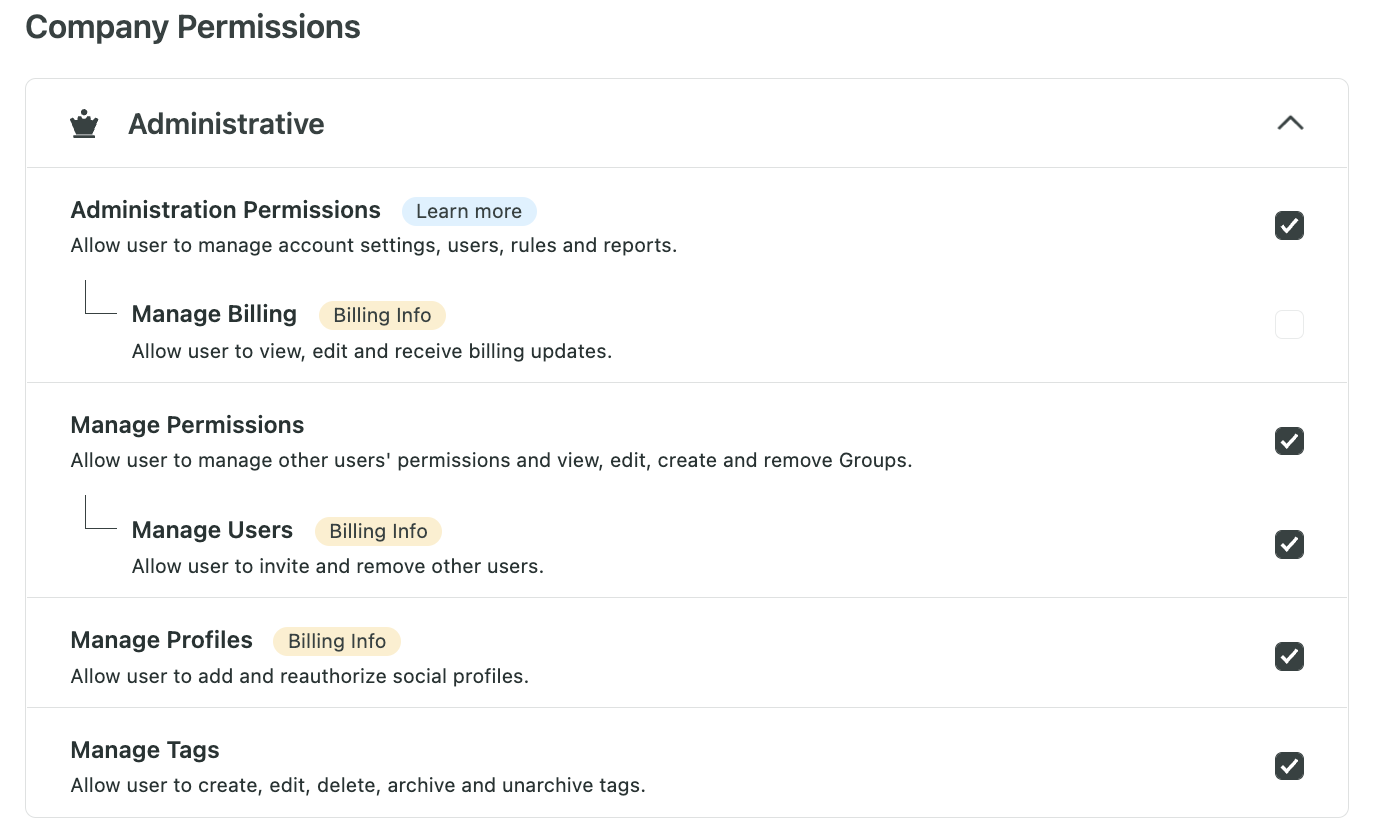
Equally crucial is creating a defined workflow for revoking system access when an individual leaves the organization or transitions to a different role. This assists in preventing former employees or those with updated responsibilities from accessing confidential information or engaging in actions for which they no longer have authorization.
4. Develop a social media crisis management strategy
Crisis situations do not adhere to business schedules. When a social media crisis arises, a plan is necessary to direct your response and mitigate harm to your brand. This plan should detail the steps your team will undertake to address various scenarios, such as a compromised account or data breach.
Imagine if a hacker gains entry to your social accounts and begins posting content that contradicts your brand values. Or worse, what if they expose sensitive customer data? Without a plan in place, your response is likely to be reactive, inconsistent, and potentially damaging.
A solid social media crisis management plan will help you:
- Act swiftly and efficiently to mitigate harm.
- Communicate clearly and consistently with your audience.
- Preserve your brand’s integrity and maintain customer trust.
- Coordinate efforts across various teams (social media, IT, communications, legal).
- Regularly back up vital data and devise a recovery framework to handle security breaches.
- Learn from the incident and enhance your future response.
Bonus Resource: Access our three-step template for documenting a social media crisis management plan. This template will aid your team in effectively responding and recovering should a crisis arise.
Social media security best practices for executives and brand advocates
Executives and other employees can serve as influential brand champions. Their personal social media activity can humanize your brand, foster trust, and reach new audiences. However, it is vital to enable their participation in a safe and effective manner that does not jeopardize security.
Here’s how to empower these groups while ensuring a robust level of social media security:
Executives
For executives, managing their social media footprint within a secure environment is crucial. This eliminates the necessity for shared passwords and provides a centralized space for content management and approvals.
Through Sprout Social, communication teams for executives can effectively oversee leadership profiles on LinkedIn and X (previously Twitter). Simply schedule and sanction posts, images, and videos directly within Sprout. If an executive prefers content approval outside the platform, assign them an “External Approver Seat” to forward content for approval directly to their email.
Employees
Employee advocacy can significantly enhance your brand’s visibility. Utilizing a centralized platform allows employees to easily disseminate pre-approved brand content while ensuring adherence to your company’s social media guidelines.
If your team has reservations about linking their personal profiles to a corporate tool, reassure them that platforms like Sprout Social prioritize data confidentiality. Clarify that Sprout only gathers the essential data needed for employees to connect their profiles and share content through the platform. This allows employees to post company updates directly via our Employee Advocacy tool without accessing their personal accounts.
How secure social media management platforms protect you
Secure social media management platforms serve as a centralized hub for all your social media interactions, simplifying access control, enforcing security policies, and monitoring for suspicious activities. They provide an additional protective layer between your valuable brand accounts and potential threats, helping you mitigate risks and protect your reputation.
At Sprout Social, we recognize the critical need for data security. That’s why we have integrated top-tier, enterprise-level security standards into our platform. More than 35,000 organizations trust us to help them manage millions of daily engagements across social media.
Here’s how we prioritize security:
- Purpose-limited data processing: We explicitly identify our purposes for processing personal data from social media networks and restrict our processing exclusively to those objectives.
- Data minimization: We ensure that the personal data we handle is adequate, relevant, and limited to what is absolutely necessary.
- Rigorous data retention policies: We have instituted standard data retention timelines for customer data and carefully respect deletion requests.
- Robust login security: We provide features like single sign-on (SSO) and multi-factor authentication (MFA) to add extra levels of security to user accounts and prevent unauthorized access.
- Responsible AI implementation: We integrate AI responsibly to enhance our platform’s functionalities while prioritizing data security. Whether utilizing Sprout’s proprietary AI models or collaborating with reliable external providers like OpenAI or Claude, we never sell customer data and ensure these models cannot utilize or store data for training purposes.
For further information about Sprout’s security and privacy protocols, visit trust.sproutsocial.com.
Protecting the gateways to social accounts and data
Securing your brand necessitates vigilance in the continuously shifting cybersecurity environment. Continuously educate yourself and your team to stay ahead of emerging threats. By remaining proactive, you can keep your accounts secure today and into the future.
Centralizing the management of all your accounts and permissions is a significant move towards enhancing social media security. Request a personalized demonstration to learn how Sprout Social enables over 35,000 brands to achieve smarter, faster business outcomes with comprehensive social media management solutions. Our platform includes tools for publishing, engagement, customer support, influencer marketing, advocacy, and AI-driven business insights.
The post Social media security best practices to keep your company and customer data safe appeared first on Sprout Social.

Recent Comments