


In a recent presentation for students at the University of Wisconsin-Madison, I encouraged them to expand the scope of their AI usage beyond the stereotypical applications like homework and social media. I started the discussion off with a question: Can AI’s impact be simultaneously over- and under-hyped?
My conclusion is yes, it can be over- and under-hyped. But I reached this conclusion based on a related insight: Our view of AI will be greatly shaped by if or when we’re able to invest the time for do-it-yourself (DIY) AI training and experimentation.
It’s always important to experiment with new technologies, but it’s particularly important with AI. I recently thought about whether my own adoption and value of AI was too limited. I decided to make a commitment to allocate even more time toward DIY experimentation.
Experimenting on our own with technologies like AI can shift your mindset and help you work through the “trough of disillusionment” that accompanies much-hyped technologies, while also driving more value for your customers.
Dig deeper: How to do an AI implementation for your marketing team
Remember your ChatGPT moment
We’ve all experienced AI vertigo over the past two years. For me personally, I experienced fortunate timing relative to ChatGPT’s release.
In late 2022, I made the decision to step away from my corporate leadership role for the longest break I would ever take. I eventually transitioned to consulting and teaching. I, of course, had no idea this break would coincide with ChatGPT’s launch. It’s still fascinating to hear OpenAI actually described it as a “low-key research preview.”
My break meant I had the time for self-directed training, testing and learning. Many friends and colleagues who were still in corporate roles did not have the time for experimentation and were quick to label AI as over-hyped.
Many of these colleagues lack the capacity or leadership aircover to make time for self-training. I was lucky. I attended live events rather than on-demand. I binge listened to any related podcasts. But most importantly, I had time to try things in a DIY mode that convinced me of the value, despite any limitations.
Crossing the AI DIY Chasm
To illustrate the importance of DIY time to creating value, I created my own hype cycle graphic with various training triggers that I believe we all pass through.
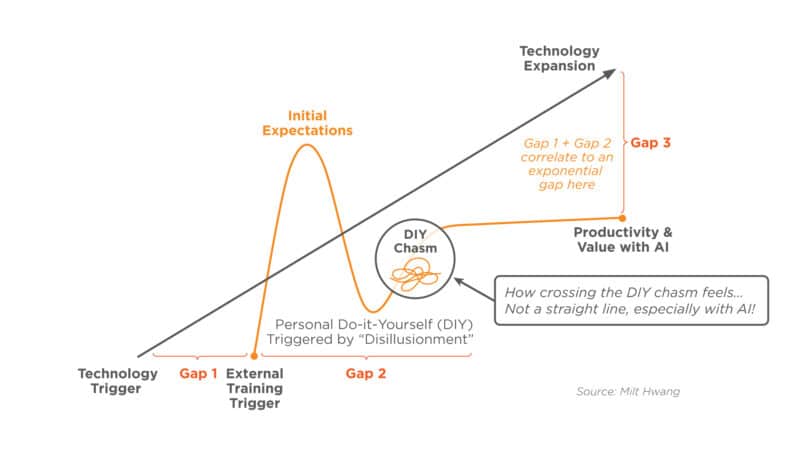
Gap 1 is the time between a technology being launched and when you start learning. This is typically based on an external training trigger, through your job or a peer network.
Gap 2 is not only when you leverage the technology, but critically, when you cross what I’m calling the “DIY Chasm.” You have to zig and zag your way through limitations and reach those “A-Ha” moments on your own terms.
The cumulative time between Gap 1 and Gap 2 has an exponential impact on a resulting gap you feel between the personal productivity and value you’re getting from AI and the current capabilities.
In my previous roles, I too would have held similar views about AI being over-hyped. The pressures of managing day-to-day projects meant established patterns for managing martech had set in. Previously, when you got stuck or hit a limit, a quick search produced an answer. But if that knowledge base did not include your specific context, you were stuck. We often blamed the software in these cases.
Because genAI is not constrained to those original limits, further experimentation to help optimize your results is even more critical.
Two years later, I breached the Gap 3 challenge. My work in teaching and consulting is reducing my capacity for DIY experimentation, while at the same time, the pace of change in AI is accelerating. There are some days I don’t feel like I’m behind. But every single time I devote more time to testing, I hit a “wow” moment.
Clearly, I am the limitation, not the AI technology. It’s been helpful to me to remain plugged in to thought leaders that remind us that this is the “worst AI” we’ll ever work with.
More content. Is it any better?
I always credit Scott Brinker with helping shape my “citizen martech” views. I was eager to take a look at the latest MarTech for 2025 report from Brinker and Frans Riemersma. But given my capacity crunch, I only had time for a quick read, not the thorough review I’d prefer. (You’ll find a summary and download links on the MarTech website.)
A quick scan of the report revealed the leading AI use-cases are focused on content and personalization across various stages of ideation and distribution, with the number of mentions of these applications alone telling us the impact of AI is not, in fact, over-hyped.
But the jury is still out on whether customers are feeling improvements. That’s where my latest AI DIY experimentation revealed some insights for the future of personalization.
Dig deeper: Consumers are underwhelmed by AI experiences
Personalized content ‘channels’
I will absolutely go back to read Brinker and Riemersma’s report, which spans more than 100 pages, in full. However, I want to share two AI-infused shortcuts that helped me close the value gap, and simultaneously signal the future of more personalized content.
First, before a recent drive, I loaded Brinker’s chiefmartec articles into ElevenLab’s Reader. The AI-generated voice read the latest articles. If you haven’t tried this, it’s under-hyped, and it will forever change your consumption of long-form content.

Screenshot of ElevenLab’s Reader app.
Next, I loaded the full report into Google’s NotebookLM, and listened to the audio overview it generated.
The audio overview creates an AI-generated “podcast” with two enthusiastic hosts discussing themes from the source material you chose. It allows you to upload documents, YouTube links, web pages and more.
I also created a NotebookLM AI overview for my most recent series of articles for MarTech.
It’s the “source grounding” that makes NotebookLM so powerful, while still taking advantage of the overall model (Gemini) in this mult-modal format. As Steve Johnson, one of NotebookLM’s co-creators, said on the Google Deep Mind Podcast, it is “a kind of personalized AI that is an expert in the information that you care about.”
If you’re interested in NotebookLM, please continue testing more than the audio overview. NotebookLM allowed me to have a “chat” with Brinker and Riemersma through my back and forth with the AI overview.
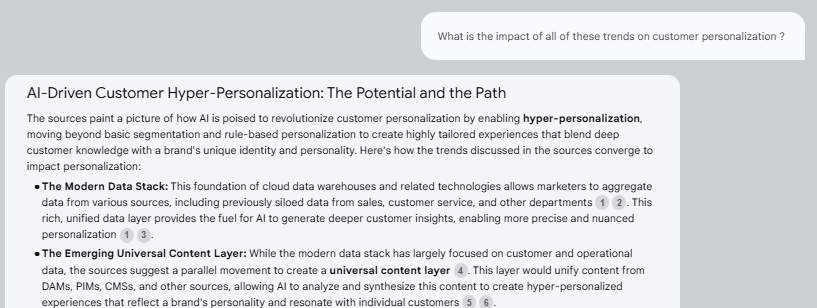
Screenshot of NotebookLM answering a question using source material.
At this point, I realized I needed to add a key topic to my learning plans for 2025 — the content layer. As discussed by Rasmus Houlind, this includes a chain of multiple content LLMs working together in a martech stack to improve personalization.
I think Houlind would agree with my thoughts on the need for a customer tone, leveraging the data from prior discussions like emails, meetings notes and more, which I proposed in Part 2 of my series.
Our roadmap to personalization
This personalized content discovery is a combination of the overarching trends I’ve written about in 2024. The ROI of crossing the original DIY Chasm two years ago with genAI was well worth it, but it has a shorter lifespan as we go through AI vertigo. I need to plan for more time dedicated to DIY Chasm crossing than ever.
With the help of the personal AI tech infusions I discussed here, I was still able to gain valuable insights despite a time crunch. Thanks to Q&A, engagement with AI and my preferred audio formats, AI helped drive personalization of the content’s key insights, on my own terms.
Now, we just have to prioritize efforts to scale these approaches for our customers.
The post Why DIY experimentation is critical to AI success appeared first on MarTech.
**The Importance of DIY Experimentation in Achieving AI Success**
In the rapidly evolving field of artificial intelligence (AI), innovation is the lifeblood of progress. While academic research, corporate investments, and large-scale collaborations have driven much of the AI revolution, there is an often-overlooked yet critical factor that plays a pivotal role in achieving AI success: DIY (Do-It-Yourself) experimentation. Whether you’re an aspiring AI enthusiast, a startup founder, or an experienced data scientist, embracing the spirit of DIY experimentation can unlock new opportunities, foster creativity, and accelerate breakthroughs in AI development.
### What is DIY Experimentation in AI?
DIY experimentation in AI refers to the hands-on, self-driven process of exploring, building, and testing AI models, algorithms, and systems. It involves taking initiative to experiment with ideas, tools, and datasets outside of formal academic or corporate settings. DIY experimentation often thrives in environments where curiosity, resourcefulness, and a willingness to learn are prioritized over access to massive computational resources or large-scale funding.
This approach can range from training a neural network on a personal laptop to developing novel algorithms in a home office or collaborating with like-minded individuals in open-source communities. DIY experimentation embodies the ethos of “learning by doing,” empowering individuals to take ownership of their AI journey.
### Why DIY Experimentation Matters in AI
1. **Fostering Creativity and Innovation**
AI is a field that thrives on creativity. Many groundbreaking ideas, from convolutional neural networks to reinforcement learning, were born out of curiosity and experimentation. DIY experimentation allows individuals to explore unconventional ideas without the constraints of rigid corporate or academic structures. This freedom to think outside the box often leads to innovative solutions that might otherwise be overlooked.
2. **Building Practical Skills**
Theoretical knowledge is essential in AI, but practical experience is what truly sets successful practitioners apart. DIY experimentation provides a hands-on opportunity to apply concepts, troubleshoot issues, and refine techniques. By working on real-world problems, individuals gain a deeper understanding of AI tools and frameworks, enhancing their ability to tackle complex challenges.
3. **Encouraging Resourcefulness**
Unlike large organizations with access to extensive computational power and vast datasets, DIY experimenters often operate with limited resources. This constraint fosters a mindset of resourcefulness, encouraging individuals to optimize code, leverage open-source tools, and creatively utilize available datasets. Such skills are invaluable in the AI industry, where efficiency and adaptability are highly prized.
4. **Democratizing AI Development**
DIY experimentation plays a crucial role in democratizing AI. By lowering the barriers to entry, it enables individuals from diverse backgrounds to contribute to the field. Open-source platforms like TensorFlow, PyTorch, and Hugging Face, along with freely available datasets and online tutorials, have made it easier than ever for anyone with an internet connection to start experimenting with AI.
5. **Accelerating Learning and Growth**
The iterative nature of DIY experimentation—where trial and error lead to incremental improvements—accelerates learning. Each experiment, whether successful or not, provides valuable insights that contribute to personal and professional growth. This hands-on approach also builds confidence, as individuals see tangible results from their efforts.
6. **Driving Grassroots Innovation**
Some of the most impactful AI applications have emerged from grassroots efforts. For instance, DIY experimenters have developed AI models for detecting diseases, optimizing energy consumption, and even creating art. These projects often address niche problems or underserved communities, demonstrating the transformative potential of AI when applied at a local level.
### How to Get Started with DIY AI Experimentation
1. **Identify a Problem or Area of Interest**
Start by choosing a problem that excites you. It could be anything from natural language processing to computer vision or even generative AI. Focusing on a specific area helps you stay motivated and provides a clear direction for your experiments.
2. **Leverage Open-Source Tools and Resources**
Take advantage of the wealth of open-source tools and resources available online. Platforms like GitHub, Kaggle, and Google Colab offer pre-built models, datasets, and collaborative environments to kickstart your projects.
3. **Start Small**
Begin with manageable projects that align with your skill level. For example, you could build a chatbot, train a simple image classifier, or experiment with pre-trained models. As you gain confidence, you can tackle more complex challenges.
4. **Join Communities**
Engage with online AI communities, forums, and social media groups. Platforms like Reddit (e.g., r/MachineLearning), Stack Overflow, and Discord servers dedicated to AI provide opportunities to learn from others, share your work, and receive feedback.
5. **Document and Share Your Work**
Keep track of your experiments, document your findings, and share your progress with others. Writing blog posts, creating GitHub repositories, or publishing tutorials not only helps you solidify your understanding but also contributes to the broader AI community.
6. **

Recent Comments