

As the customer journey grows more complex in 2025, organizations need a best-in-class martech stack to deliver a seamless, data-driven experience across multiple channels.
A critical component of this stack is the content management system (CMS), which must address key challenges businesses face today:
- Achieving visibility in multimodal search.
- Establishing a presence in large language models (LLMs).
- Managing total cost of ownership.
- Leveraging AI opportunities.
Why is the right CMS a critical building block for establishing a solid foundation?
A CMS is vital in creating personalized experiences and connecting customer touchpoints across all channels. It “enables organizations to collaboratively manage the creation, aggregation, orchestration and delivery of content to omnichannel touchpoints,” according to Forrester.
An ideal CMS should effortlessly manage discovery, experience, engagement and conversions, ensuring your digital presence remains optimized for AI-driven search advancements. It should automate fixing website health issues, reducing the need for ongoing technical SEO work.
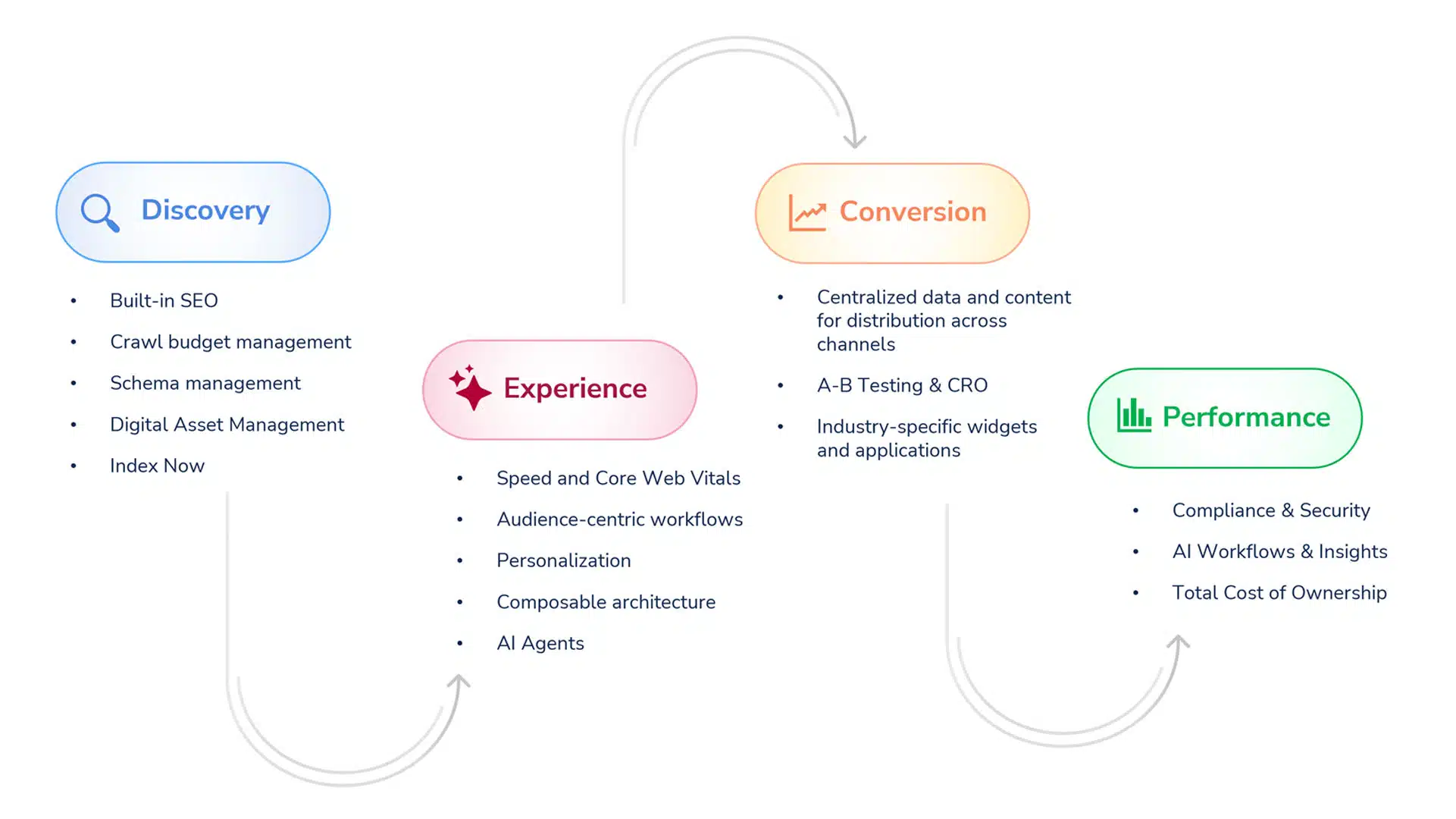
Let’s explore key considerations when selecting or upgrading your CMS, focusing on the four pivotal stages of the marketing journey:
- Discovery.
- Experience.
- Conversion.
- Performance.
Discovery
Content discovery and SERP saturation
Content discovery and visibility across different search results are major challenges for organizations. With content spread across multiple platforms, it’s hard to maintain consistent visibility. Many brands rely on paid ads to make up for poor organic discovery, even though consumers trust organic content more.
Your CMS should support content discovery by:
- Managing crawl budgets efficiently to ensure indexing, crawling and rendering of all high-quality content.
- Allowing easy addition and editing of schemas based on content architecture.
- Automating key SEO tasks like redirects, URL updates, sitemaps, breadcrumbs and page speed optimizations – especially during site edits, migrations, or deletions.
A CMS with built-in discovery features is even better. It should support protocols like IndexNow for notifying search engines of site content changes.
Prioritizing SERP saturation and discovery features is essential for any brand.
Dig deeper: Why 2025 is the year for martech optimization, not expansion
Optimizing your digital assets for enhanced discovery
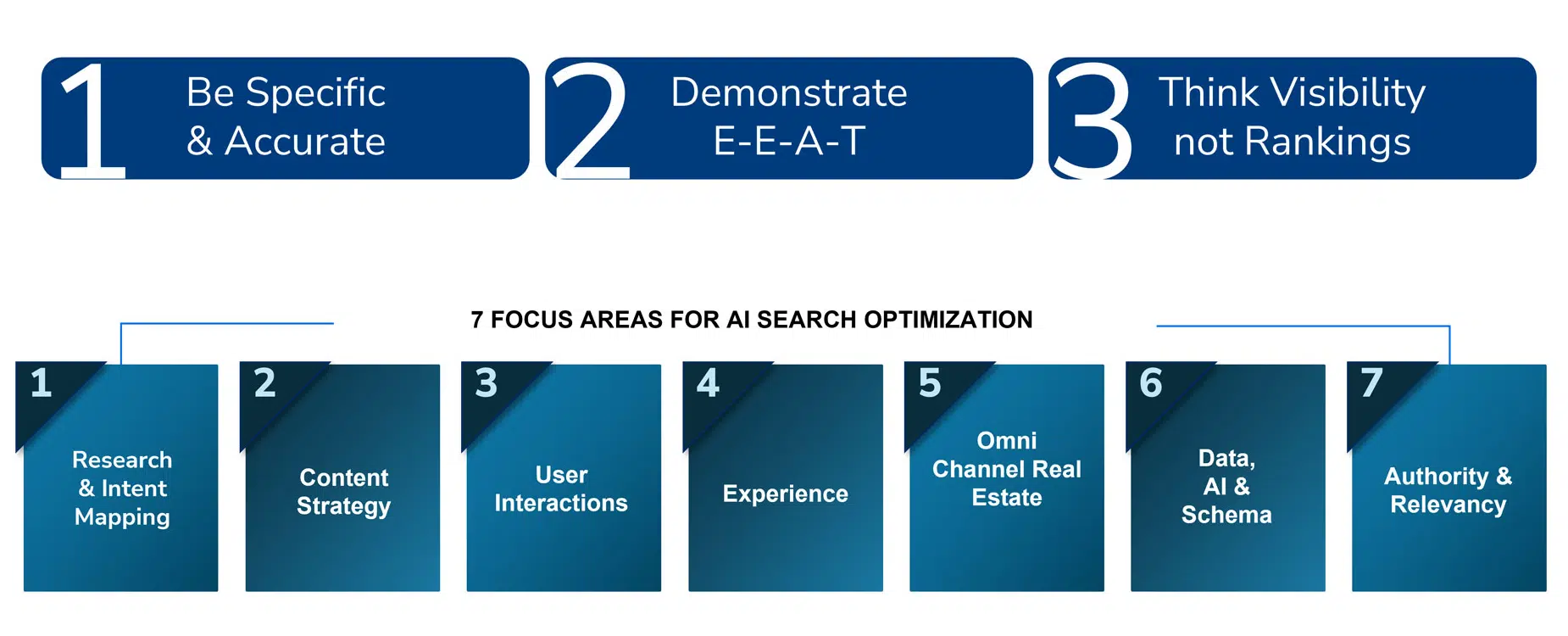
Search is now multimodal, with consumers engaging via images, videos, text and audio. To stay ahead, centralize, optimize and distribute your assets across all channels.
Experience
Once your content is discovered, the next focus is user experience. Personalization and A/B testing shouldn’t be afterthoughts.
Your CMS should offer an easy-to-deploy solution backed by a framework that improves experience and drives conversions.
Omnichannel experiences
In 2025, the customer journey will be more complex as users interact across various channels, such as images, videos, LLMs, social platforms, text and voice. Web traffic from traditional search engines may drop by 25%, Gartner predicts.
To ensure a seamless journey:
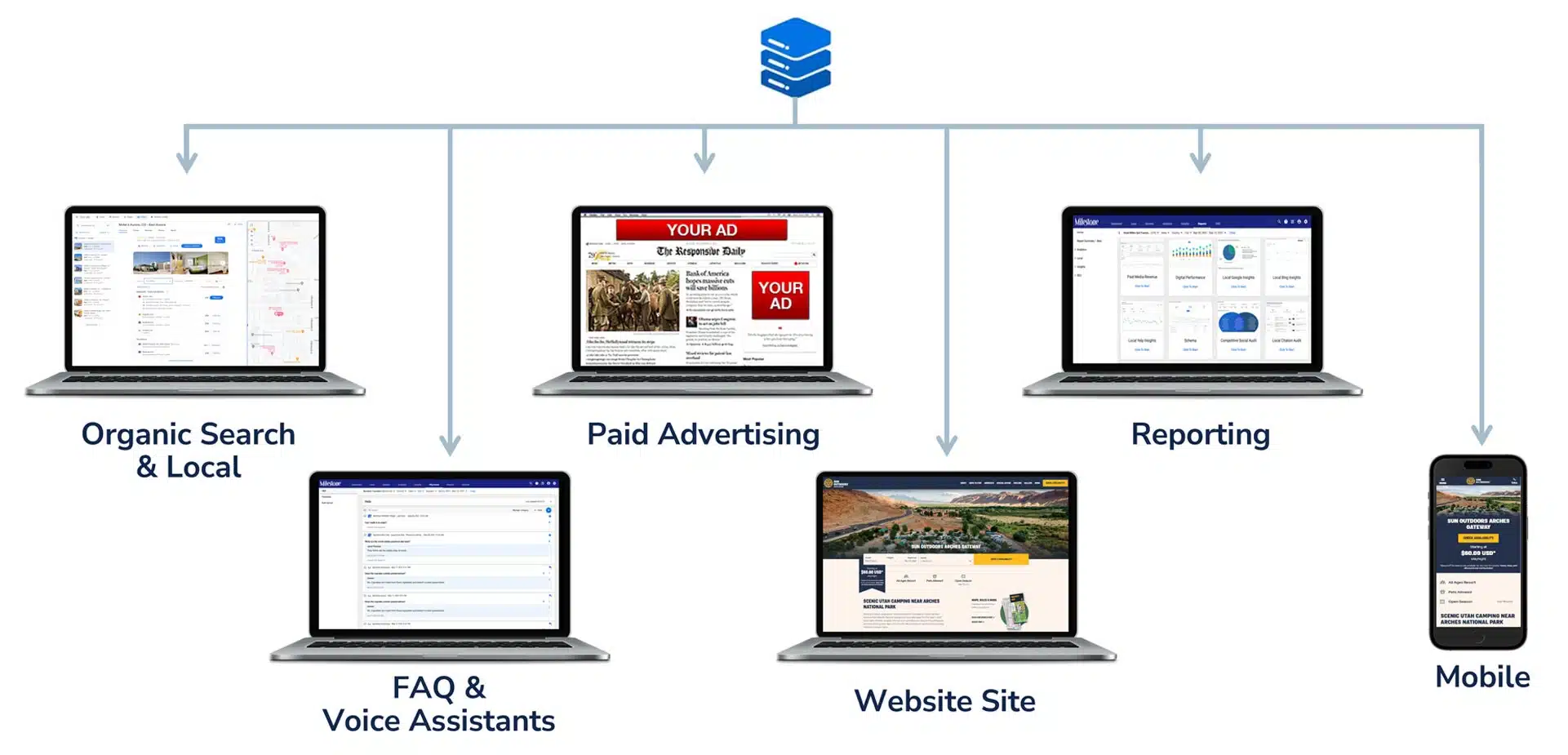
- Use a CMS that supports automated, personalized workflows for different audiences.
- Establish a centralized information hub with a separate data layer for flexibility.
- Automate rendering and publishing based on specific channels and audience needs.
Dig deeper: Transitioning to a headless CMS: Best of the MarTechBot
Personalization
Traffic from traditional search engines is declining, especially among younger generations. Gen Z increasingly turns to platforms like TikTok and Instagram for discovery, with nearly 40% bypassing search engines.
Brands that provide personalized, data-driven answers engage users better, driving loyalty and conversions. Effective personalization relies on:
- Using customer data.
- Connecting the customer journey.
- Streamlining content workflows.
Personalization includes location-based, channel-based, and behavioral approaches, with AI enhancing visitor segmentation, journey prediction, and content creation.

Dig deeper: How to grow your organic reach with behavioral analytics insights
Composable architecture
Customer journeys are increasingly complex, requiring flexible, scalable solutions. A “best of breed” architecture, built on composable, cloud-native SaaS and microservices, aligns with MACH principles and promotes growth.
This approach improves user experiences, shortens development time, lowers costs and makes systems scalable and robust, unlike rigid, monolithic systems. A CMS should offer:
- API-driven integrations for efficient data ingestion and egestion.
- High availability, scalability, and consistency.
- A robust partner ecosystem.
- Support for headless or hybrid configurations.
Conversion
After discovery and experience, focus on conversions. Key elements include:
- Landing page optimizations.
- Conversion optimization and A/B testing.
- Limited time offers and coupons.
- Revenue recovery.
- Widgets tailored to specific industries for engagement and conversions (e.g., online travel agencies, or OTAs, for hospitality).
To ensure seamless execution across all channels, your CMS needs to go beyond content management and allow for scaling and consistency.
Centralized assets and knowledge hub
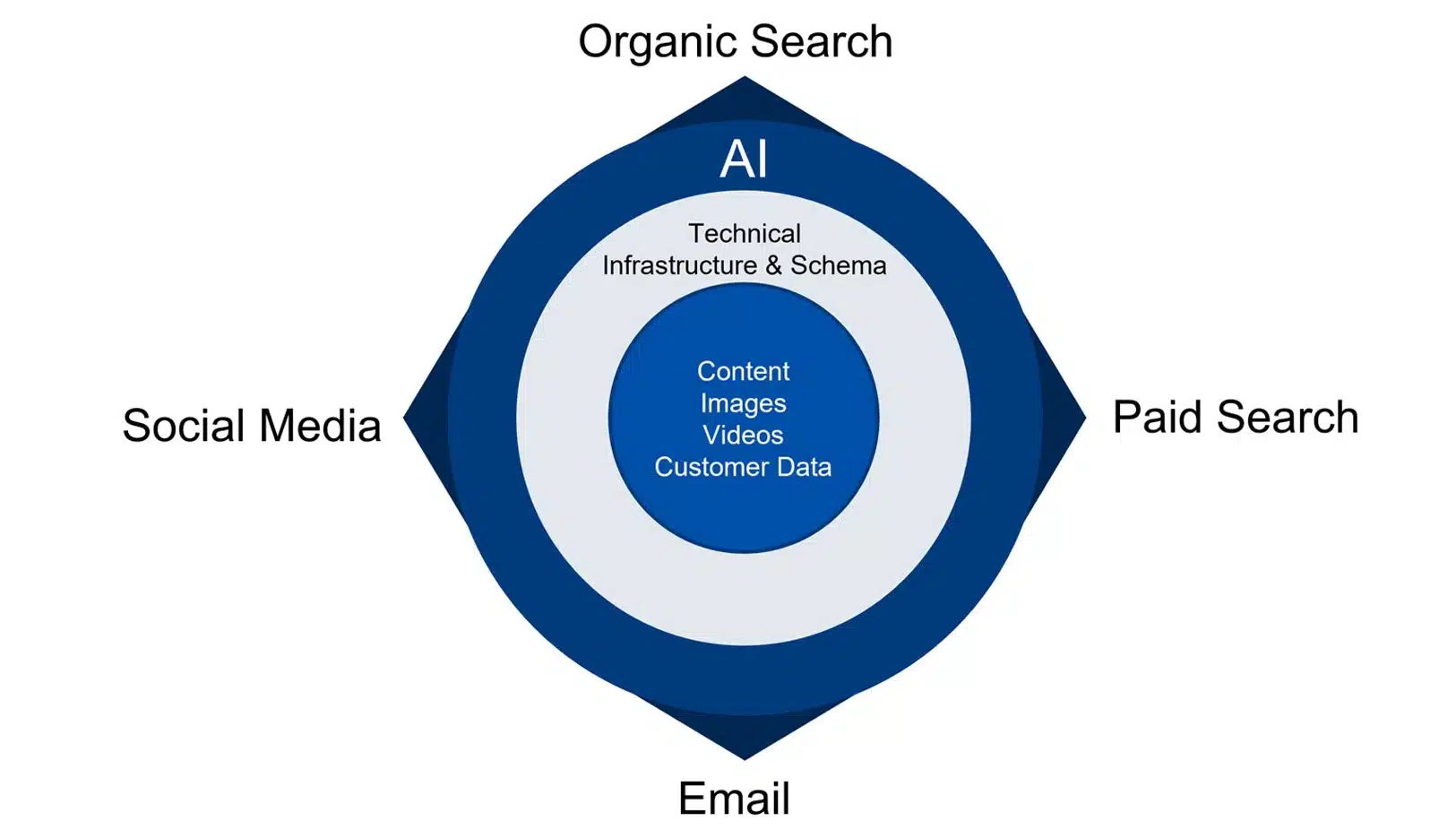
Content creation in a CMS has evolved. Businesses need enterprise-wide taxonomies and metadata to align content with brand voice. A centralized hub breaks silos, enabling shared resources, better collaboration, and faster content production.
Vertical-specific applications
Does your CMS support industry-specific tools like travel apps, mortgage calculators, event calendars, or marketplace integrations?
Research developer communities and vertical applications to ensure the CMS meets your business needs.
Performance
A robust CMS should integrate site and campaign performance analytics, delivering real-time insights across channels.
Infrastructure, compliance and security
This has become the foundation for building a resilient and adaptable tech stack.
Secure cloud hosting with micro-container architecture is essential for high availability, disaster recovery, and backups. A good CDN ensures fast website performance.
Multi-layered security with firewalls, intrusion detection, secured code, and DDoS protection provides robust defense. GDPR, CCPA compliance and ADA conformance enhance user trust and experience. Google has offered best practices for developers to ensure website users’ experience is secure and offers a safe browsing experience.
AI workflows
AI automates content creation, handles site migrations and resolves technical SEO issues. A CMS with built-in business insights, segmentation and A/B testing streamlines workflows and optimizes results.
CMS-enabled AI agents can play a significant role in providing content to various AI agents (i.e., chat agents and search agents). This will:
- Improve user experience.
- Maximize conversions.
- Enable easy access to relevant information.
- Ensure faster query resolution.
Dig deeper: Salesforce Agentforce: What you need to know
Total cost of ownership
When evaluating systems, focus on tools that deliver a seamless customer experience. A CMS is central to marketing success, connecting workflows and all stages of the customer journey.
Optimize your digital presence by choosing the right CMS
A good CMS should minimize time and costs with features like editable pages, reusable components, templates, built-in analytics and AI-driven automation. Developer support is equally critical.
Ensure the CMS provides comprehensive documentation and scalability for easy adoption, quicker time to market, and long-term business growth.
The post How to select a CMS that powers SEO, personalization and growth appeared first on MarTech.
**Choosing the Right CMS for SEO, Personalization, and Business Growth**
In today’s digital-first world, a robust Content Management System (CMS) is the backbone of any successful online presence. Whether you’re running a small business, a large enterprise, or a personal blog, your CMS plays a critical role in driving search engine optimization (SEO), enabling personalized customer experiences, and supporting long-term business growth. With countless CMS options available, choosing the right one can feel overwhelming. This article will guide you through the key considerations for selecting a CMS that aligns with your SEO, personalization, and growth objectives.
—
### **What is a CMS and Why Does It Matter?**
A Content Management System is a software platform that allows users to create, manage, and publish digital content without requiring extensive technical expertise. A good CMS empowers businesses to maintain their websites, optimize content for search engines, and deliver tailored experiences to their audiences. However, not all CMS platforms are created equal, and choosing the wrong one can hinder your ability to scale, compete, and thrive in the digital landscape.
—
### **Key Factors to Consider When Choosing a CMS**
#### **1. SEO Capabilities**
Search engine optimization is critical for driving organic traffic to your website. Your CMS should provide tools and features that make it easy to optimize your content for search engines. Here are some SEO-related features to look for:
– **Customizable URLs:** Ensure the CMS allows you to create clean, descriptive, and keyword-rich URLs.
– **Meta Tags and Descriptions:** The ability to easily edit title tags, meta descriptions, and alt text for images is essential for on-page SEO.
– **Mobile Responsiveness:** With Google prioritizing mobile-first indexing, your CMS must support responsive design to ensure your site performs well on all devices.
– **Site Speed Optimization:** A CMS that supports fast-loading pages can improve user experience and search rankings.
– **XML Sitemap Generation:** Look for a CMS that automatically generates and updates XML sitemaps to help search engines crawl your site efficiently.
– **SEO Plugins and Integrations:** Platforms like WordPress offer a wide range of SEO plugins (e.g., Yoast SEO, Rank Math) to enhance your optimization efforts.
—
#### **2. Personalization Features**
Personalization is no longer a luxury—it’s a necessity. Modern consumers expect tailored experiences that cater to their preferences, behaviors, and needs. A CMS with strong personalization capabilities can help you build deeper customer relationships and drive conversions. Key features to consider include:
– **Dynamic Content Delivery:** The ability to display different content to users based on their location, device, or browsing history.
– **User Segmentation:** A CMS that supports audience segmentation allows you to create targeted marketing campaigns.
– **Integration with CRM and Marketing Tools:** Seamless integration with customer relationship management (CRM) systems and marketing automation tools enables personalized communication at scale.
– **Behavioral Analytics:** Look for a CMS that tracks user behavior and provides insights to inform your personalization strategies.
—
#### **3. Scalability and Flexibility for Business Growth**
As your business grows, your CMS should grow with you. Scalability and flexibility are crucial for supporting increased traffic, expanding content needs, and integrating with new tools. Consider the following:
– **Content Volume Management:** Ensure the CMS can handle a large volume of content without compromising performance.
– **Third-Party Integrations:** A flexible CMS should integrate with e-commerce platforms, analytics tools, payment gateways, and other business-critical systems.
– **Multilingual and Multisite Support:** If you plan to expand globally or manage multiple websites, look for a CMS that supports multilingual content and multisite management.
– **Custom Development Options:** Open-source CMS platforms like WordPress and Drupal offer extensive customization options, while proprietary platforms like Squarespace may have limitations.
– **Cloud Hosting and Security:** A cloud-based CMS can provide better scalability and security compared to on-premise solutions.
—
### **Popular CMS Platforms: A Quick Comparison**
#### **1. WordPress**
– **Strengths:** Highly customizable, extensive plugin ecosystem, strong SEO capabilities.
– **Best For:** Small to medium-sized businesses, bloggers, and developers.
– **Considerations:** May require technical expertise for advanced customizations.
#### **2. HubSpot CMS Hub**
– **Strengths:** Built-in marketing tools, excellent for personalization, easy-to-use interface.
– **Best For:** Businesses focused on inbound marketing and lead generation.
– **Considerations:** Higher cost compared to open-source platforms.
#### **3. Shopify**
– **Strengths:** E-commerce-focused, great for SEO, easy integration with payment systems.
– **Best For:** Online stores and retail businesses.
– **Considerations:** Limited flexibility for non-e-commerce websites.
#### **4. Drupal**
– **Strengths:** Highly scalable, robust security, ideal for complex websites.
– **Best For:** Enterprises and government organizations.
– **Considerations:** Steeper learning curve

Recent Comments