

Every effortless ticket resolution is backed by a rigorously tested customer service case management strategy that empowers teams to optimize their efforts and achieve better results. It’s not just a structure—it’s the essential framework for providing a smooth customer experience.
This highlights the significance of your case management systems and procedures. Integrated tools and comprehensive documentation guarantee that every channel—from phone assistance to social media customer service—meets the standards your customers anticipate.
Don’t allow outdated case management practices to jeopardize your brand’s relationship with loyal customers. In this piece, we explore the best practices in customer service case management that can convert every interaction into a competitive edge.
Defining customer service case management
Customer service case management refers to the efficient tracking and resolution of customer issues across all support channels, ensuring each interaction is managed smoothly and uniformly.
A robust case management strategy encompasses more than just the method your team employs for case creation, assignment, and tracking. It also includes valuable analysis after resolution, contributing to ongoing improvement.
Collectively, these initiatives boost customer satisfaction by ensuring that clients receive quick resolutions that meet—and surpass—their expectations.
Enhancing your customer service strategy with case management
Adopting a progressive mindset towards customer service case management does more than just enhance your team’s results. It lays the groundwork for enduring customer relationships that yield stronger business results. After all, a rising tide lifts all boats.
Imagine the pioneering companies that replaced manual case tracking spreadsheets with centralized, automated systems. Their customers were probably impressed by the speed, efficiency, and precision of every interaction. These cohesive experiences ingrained trust and reliability in their brand’s core values.
Continuously innovating your case management strategy enhances your customer service approach by:
- Streamlining internal operations with efficient workflows that empower team members to resolve issues quickly and independently.
- Facilitating effective escalation management protocols that ensure priority issues are directed to the appropriate individual without unnecessary back-and-forth.
- Spotting data-informed opportunities for ongoing enhancement by monitoring customer engagement metrics.
Implementing case management for social media customer service
Social media is the next frontier of customer service evolution. Its open nature and users’ increasing demand for prompt, helpful feedback make it a challenging channel. However, businesses that excel in this arena are rewarded with the opportunity to surpass their competition and foster unmatched customer loyalty.

The initial step in delivering transformative customer service on social media is to implement the right tools for the task. As your business expands, so does the volume of social interactions. Social media customer service tools—like Sprout Social—are created to scale with your requirements, seamlessly managing increased workloads.
Sprout clarifies chaotic inboxes with our Case Management solution. Our intelligent automation capabilities eliminate tedious manual tasks and streamline case creation and assignment, allowing your care teams to quickly start assisting, provide the appropriate level of support, and minimize disruptions.
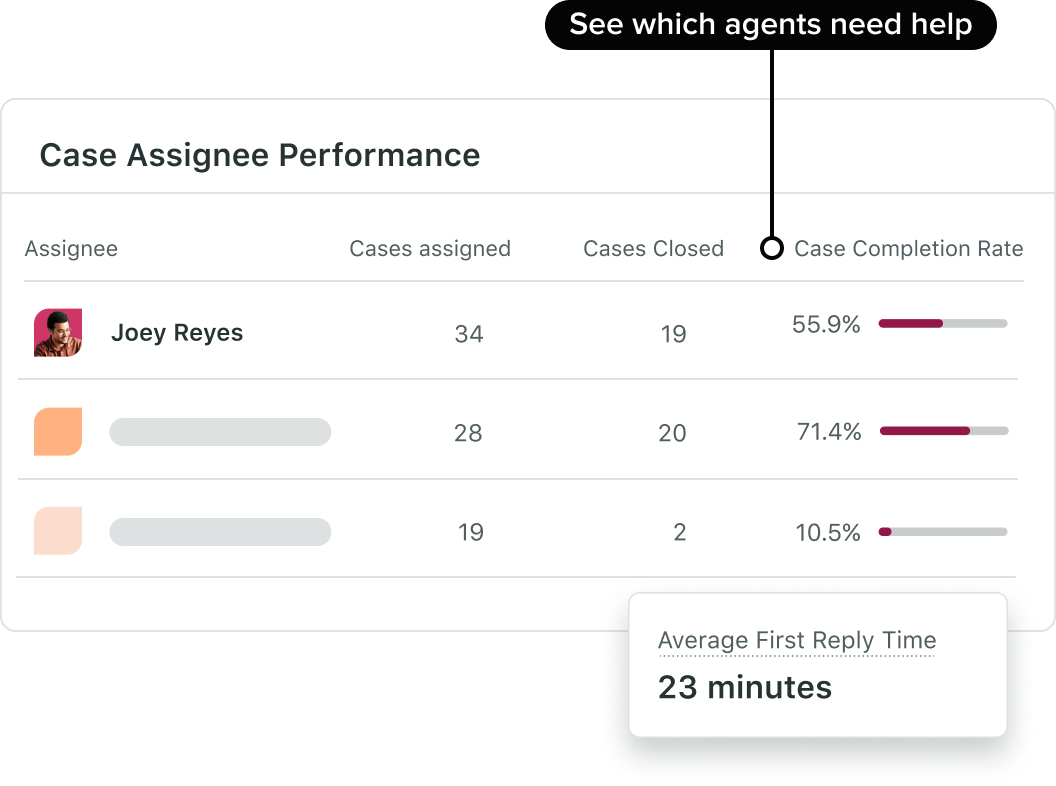
Five essential customer service case management best practices
An effective customer service case management strategy equips your team to handle cases smoothly across all channels. The less time they spend looking for documentation and switching between platforms, the more time they can focus on creating outstanding customer experiences.
The best practices outlined below will elevate your case management approach.
1. Centralize customer communications
Ideally, all of your customers would submit support inquiries via one preferred channel, making it easy to access their account histories. However, that’s not the reality.
Each customer has their own channel of choice for support. Some may prefer a hotline, while others are comfortable using a DM or a self-service tool. It’s critical to ensure they receive the same level of consistency, speed, and care, regardless of their chosen channel.
Centralizing customer interactions with integrated case management tools consolidates data so all your agents operate from the same reliable source.
For instance, Sprout Social’s Case Management solution centralizes billions of social conversations from major social networks and review sites, allowing you to manage inquiries efficiently at scale. For added efficiency, you can also implement smart automation that directs cases based on agent availability and capacity.

2. Categorize and prioritize cases
Establishing prioritization creates structure, and in customer service, structure is vital.
Automatically categorizing and prioritizing incoming messages ensures that the most critical issues are addressed first, enhancing customer satisfaction and preventing potential escalations. By concentrating on the urgency and consequences of each case, teams can allocate resources more proficiently.
Implementing customer service tiers helps create an organized structure within your customer service case management. Cases are directed based on complexity, urgency, and the required expertise to resolve them, allowing teams to use resources more efficiently, resulting in quicker resolutions.
3. Regularly update your documentation
Keeping your customer service case management documentation current has a direct effect on your ability to provide consistent, efficient, and high-quality support. It’s the only guaranteed method to ensure everyone on your team is aligned and following the same protocols—from long-standing employees to new recruits.
These efforts also enhance efficiency and ensure agents have access to the resources they need when they need them. Up-to-date documentation cuts down the time spent searching for answers in knowledge bases or from colleagues, allowing all that time to be redirected toward resolving cases and improving customer experiences.
4. Evaluate the success of your customer service case management
To continuously enhance your customer service case management initiatives, measuring their effectiveness is essential.
Data-driven insights are vital for recognizing trends, assessing performance, and refining processes. By routinely analyzing case data, teams can identify patterns, uncover the root causes of recurring problems, and make informed choices that enhance overall service quality.
Tracking case data starts with the use of tools that monitor productivity to demonstrate the impact your team has on customer experiences. Automating data collection ensures you can keep pace with the myriad benchmarks influencing your care strategy. Sprout’s Case Management Report assesses the quality and efficiency of customer care by evaluating key metrics such as case volume, handling time, and response time.
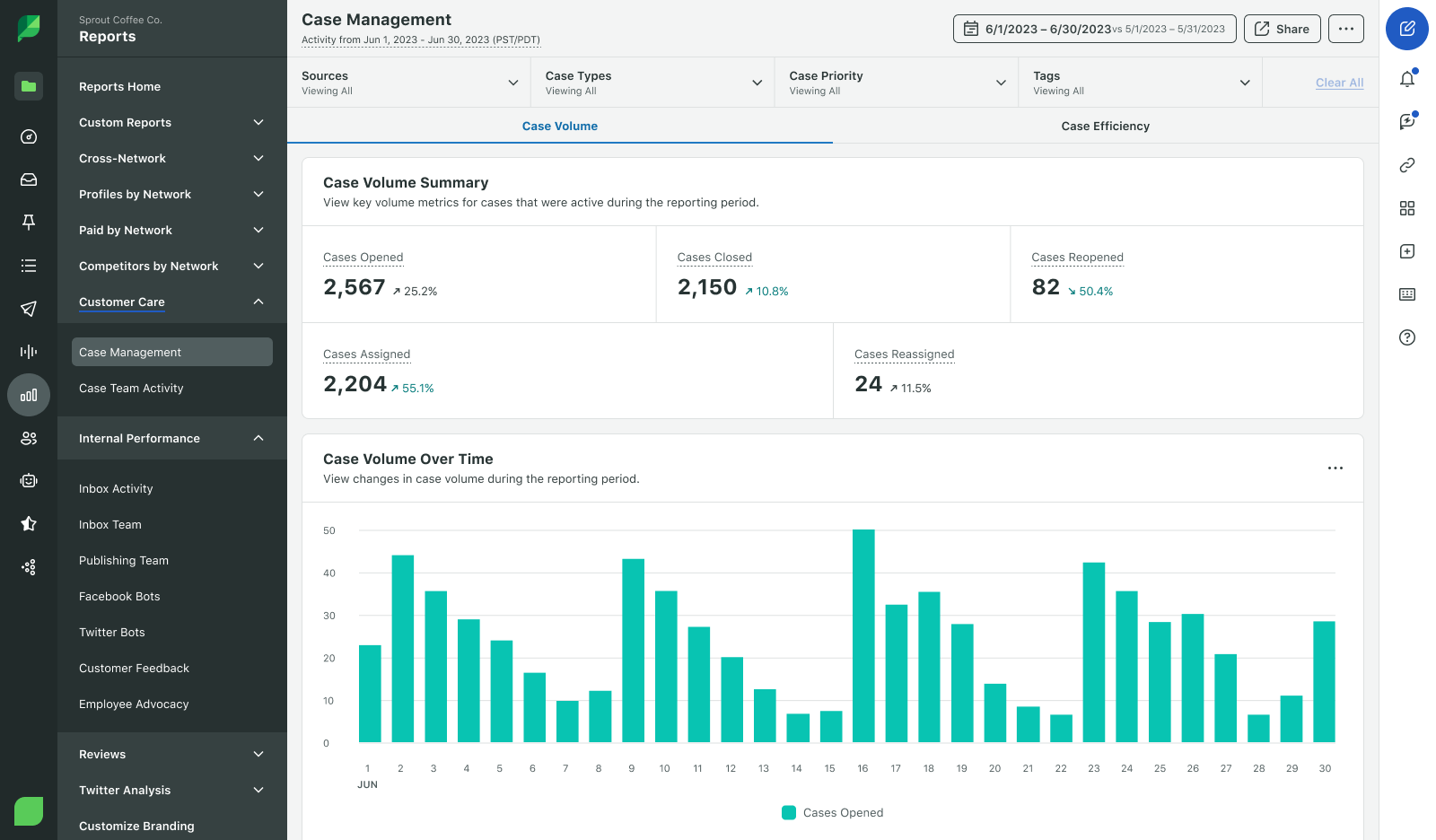
Segmenting this data by time frames, issue types, and individual agents can reveal significant opportunities to refine your care strategy, enabling you to focus on enhancing your approach rather than dedicating time to manual data gathering.
5. Dedicate yourself to continuous innovation
The requirements for creating unforgettable customer experiences are changing. Emerging technologies empower businesses to innovate in ways that surprise and delight consumers. However, eventually, everything that surprises and delights transitions into consumer expectations.
Merely maintaining best practices isn’t sufficient. To elevate customer service into a genuine competitive advantage, staying ahead of the innovations shaping the future of customer care is crucial.
Innovative customer care leaders are increasingly implementing AI to scale their operations without overwhelming agents. Aspect-based sentiment analysis assists customer care agents in identifying common themes in customer grievances and questions, enabling them to address issues more effectively. Predictive analytics advances this further, helping agents foresee customer needs, allowing them to provide more proactive and personalized service.

These AI innovations are revolutionizing customer service today. Imagine the potential impact they’ll have on your strategy in the future.
Transform your customer service case management strategy into a competitive differentiator
In the current marketplace, customer loyalty is unpredictable. Brands that dedicate themselves to offering the best possible experiences will gain a larger market share and ultimately, more revenue. The time to rethink your case management strategy is now.
If you’re prepared to enhance your case management approach, explore our comprehensive list of customer service software tools. These platforms are guaranteed to keep your strategy at the forefront of customer expectations.
The post How to master the art of customer service case management for social media appeared first on Sprout Social.


Recent Comments