


The customer journey for B2B software is long and complex for everything but the most basic, inexpensive products.
Regardless of the complexity of the product or process, it’s safe to say most B2B SaaS buyers want to see the product in action before they invest. In response, vendors have several strategies to get the product in front of prospects.
- Free trials: Users try the software for a limited number of days.
- Freemium: A free version is available, but more advanced features require a license.
- Demos: See the software in action, usually with a product specialist and a seller present.
Each puts the product at the forefront of the experience but in slightly different ways. Demos, for example, are typically the gateway to a traditional sales-led GTM strategy.
However, an increasing number of small and mid-market B2B SaaS vendors are trying product-led growth (PLG) and product-led marketing (PLM). There are two business drivers for taking a product-led approach to sales and marketing.
- Sales teams are expensive. Hiring, training, paying and inevitably replacing an experienced sales team is resource-intensive. The best performers consume more resources because they make more money. The worst need to be replaced often, which also incurs costs.
- Buyers will avoid sales if you give them an opportunity. Salespeople make everything sound great, which makes buyers skeptical. They put pressure on buyers to act. It’s not an enjoyable experience for many.
Mike Nierengarten is the founder of Obility, an agency that serves mid-market B2B SaaS vendors with SEO, paid search and paid social services. He’s seen the movement to PLG and PLM firsthand. For now, most of Obility’s clients remain focused on demos and sales-focused strategies.
“We’re starting to see the transition,” he said. “We’re now making that transition internally as well.”
Vendors aren’t the only ones driving the transition to PLG. Resistance from prospects to lead generation and sales-led strategies is not uncommon today.
“People want to buy directly on their own,” Nierengarten said, “especially if you’re targeting developers. Additionally, people are pushing back on filling out forms.”
Dig deeper: Demand gen vs. lead gen: Have we reached a final verdict?
Show me the data
It’s no surprise demos and free trials are performing well for Obility’s clients. But which message is more effective? Nierengarten brought the data in a recent LinkedIn post.
The experiment
The Obility team looked at 11,286 responsive paid search ads that ran between January 2023 and August 2024.
- The ads offered either a free trial or a demo.
- The vendors included both Obility clients and non-clients.
- The total spend on the ads was more than $20 million.
The results
Among the findings:
- A demo CTA generally drew a higher conversion rate, but the free trial call to action drove a higher click-through rate (CTR).
- For non-branded campaigns, a free trial CTA showed nearly twice the CTR of a demo call to action.
- Calculating conversions by 1,000 impressions shows free trials nearly double demos.
- For non-branded campaigns, demos drove fewer conversions than trials per 1,000 impressions.
- For branded campaigns, free trials drove 167% more conversions per impression.
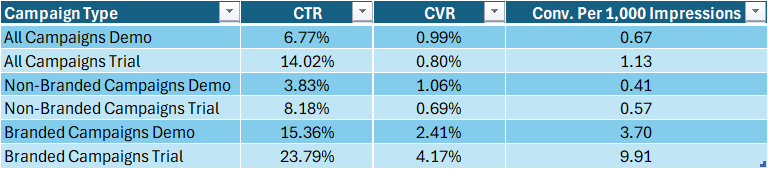
Obility’s analysis of paid search ads for demos and free trials. Source: Mike Nierengarten.
As with any analysis of campaign performance, your results may vary, of course. But I asked Nierengarten about the secrets to success when running paid campaigns, whether for demos, free trials or another approach.
“Run profitable campaigns and re-invest in the profitable campaigns to really get that flywheel going,” he said.
Sounds like common sense? It’s more difficult than it initially appears.
Too many B2B SaaS vendors are trying to run the same campaign over and over. For large vendors, Nierengarten said, the problem is too often they aren’t running profitable campaigns. Smaller vendors, on the other hand, often lack the resources to re-invest, he said.
Dig deeper: Product-lead growth: 3 important lessons from the front line
The post Free trial vs. demo: What’s more effective in B2B SaaS ads? appeared first on MarTech.
**Comparing the Effectiveness of Free Trials vs. Demos in B2B SaaS Advertising**
In the competitive world of B2B Software as a Service (SaaS), companies are constantly seeking the most effective strategies to convert leads into paying customers. Two of the most common tactics employed are offering free trials and providing product demos. While both approaches have their merits, they cater to different buyer personas and stages in the decision-making process. Understanding the strengths and weaknesses of each can help SaaS companies optimize their marketing strategies and maximize conversion rates.
### 1. **Understanding Free Trials**
**Definition:** A free trial allows potential customers to use the full or limited version of a SaaS product for a specific period, typically ranging from 7 to 30 days. The goal is to let users experience the product’s value firsthand before committing to a purchase.
**Pros:**
– **Hands-On Experience:** Free trials give users the opportunity to explore the product at their own pace. This hands-on experience can be particularly effective for tech-savvy buyers who prefer to test the product’s features and functionality before making a decision.
– **Low Commitment:** A free trial lowers the barrier to entry, making it easier for potential customers to engage with the product without feeling pressured. This can lead to a higher volume of leads, as prospects are more likely to sign up when there’s no immediate cost involved.
– **Self-Qualification:** Users who invest time in a free trial are more likely to be serious about purchasing the product. By the end of the trial period, they have a clearer understanding of how the product fits their needs, making them more qualified leads.
**Cons:**
– **Risk of Underutilization:** Not all users fully engage with the product during the trial period. Some may sign up out of curiosity but never actually use the software, leading to a lower conversion rate.
– **Support Costs:** Offering a free trial can increase the demand for customer support, as users may require assistance in navigating the product. This can strain resources, especially for smaller companies.
– **Potential for Misalignment:** If the product is complex or requires significant customization, users may not fully grasp its value during the trial period, leading to a lower likelihood of conversion.
### 2. **Understanding Product Demos**
**Definition:** A product demo is a guided presentation of the software, typically conducted by a sales representative. Demos can be live or pre-recorded and are designed to showcase the product’s key features and benefits.
**Pros:**
– **Tailored Experience:** Demos can be customized to address the specific needs and pain points of the prospect. This personalized approach can be highly persuasive, as it demonstrates how the product can solve the customer’s unique challenges.
– **Immediate Value Proposition:** A well-executed demo can quickly convey the product’s value, making it easier for prospects to understand its benefits. This is particularly effective for complex products that require explanation or context.
– **Opportunity for Engagement:** Demos provide an opportunity for direct interaction between the prospect and the sales team. This allows the sales representative to answer questions, address concerns, and build rapport, which can significantly increase the likelihood of conversion.
**Cons:**
– **Higher Commitment:** Scheduling and attending a demo requires more effort from the prospect compared to signing up for a free trial. This can result in fewer leads, as some potential customers may be hesitant to commit to a demo.
– **Sales-Driven:** Demos are typically led by sales representatives, which can sometimes be perceived as a high-pressure sales tactic. Prospects who prefer a more self-directed exploration of the product may be less receptive to this approach.
– **Limited Exploration:** Unlike free trials, demos do not allow prospects to explore the product on their own. This can be a drawback for users who prefer to test the software independently before making a decision.
### 3. **When to Use Free Trials vs. Demos**
The decision to offer a free trial or a demo depends on several factors, including the complexity of the product, the target audience, and the stage of the buyer’s journey.
**Free Trials Are Ideal When:**
– **The Product Is Intuitive:** If the software is user-friendly and easy to navigate, a free trial can be an effective way to let prospects experience its value without the need for extensive guidance.
– **The Target Audience Is Tech-Savvy:** Tech-savvy buyers are more likely to appreciate the opportunity to explore the product on their own. A free trial allows them to dive deep into the features that matter most to them.
– **The Goal Is to Generate a High Volume of Leads:** Free trials typically attract a larger number of leads, as the low commitment makes it easier for prospects to sign up. This can be beneficial for companies looking to build a large pipeline of potential customers.
**Demos Are Ideal When:**
– **The Product Is Complex:** For products that require

Recent Comments