


Jason, director of product marketing at a global cybersecurity company, celebrates a big win. His product ranks as the third-fastest growing in the company.
But there’s a problem — the company operates in silos, treating all products as separate cost centers. Vanessa, his no-nonsense VP, demands change. “We need a scalable platform. Get this right, and we’re set for success.”
Jason’s mission is clear: Lead the company through the final stage of go-to-market maturity, platform-market fit, where integrated solutions drive customer value and position the company for long-term growth.
The 3Ps model of GTM maturity
Jason’s organization is working through the 3Ps model of go-to-market (GTM) maturity:
- Problem-market fit.
- Product-market fit.
- Platform-market fit.
In the final stage, the company evolves from managing multiple separate products to building one platform. This platform approach allows the company to integrate its products into a unified solution, solving broader customer problems and scaling efficiently.
Platform-market fit is about scaling, improving execution and tracking key metrics by customer groups. These groups, or cohorts, are based on how customers use the platform, helping Jason’s team customize solutions and increase adoption. This approach meets multiple customer needs with integrated solutions while allowing the company to grow efficiently across its products.
It’s not just about selling more products. The real challenge is creating customer value with one unified platform that solves multiple customer problems, making it easier for them to adopt and scale.
Dig deeper: Rethinking fit, growth and go-to-market for the modern startup
Scaling with platform-market fit
Jason’s goal is to expand the company’s reach into new industry verticals and geographies. He knows that this is no small feat. The stakes felt higher every day and as his team grew more invested in the vision, Jason felt the pressure to make every move count.
“Products can’t work in silos,” Vanessa reminds him. By integrating products into a unified platform, Jason clears the path for customers to adopt new solutions and expand their usage as they grow. This streamlines sales, strengthens loyalty and expands revenue through seamless upgrades and bundled offerings.
Applying the 3Vs of ABM
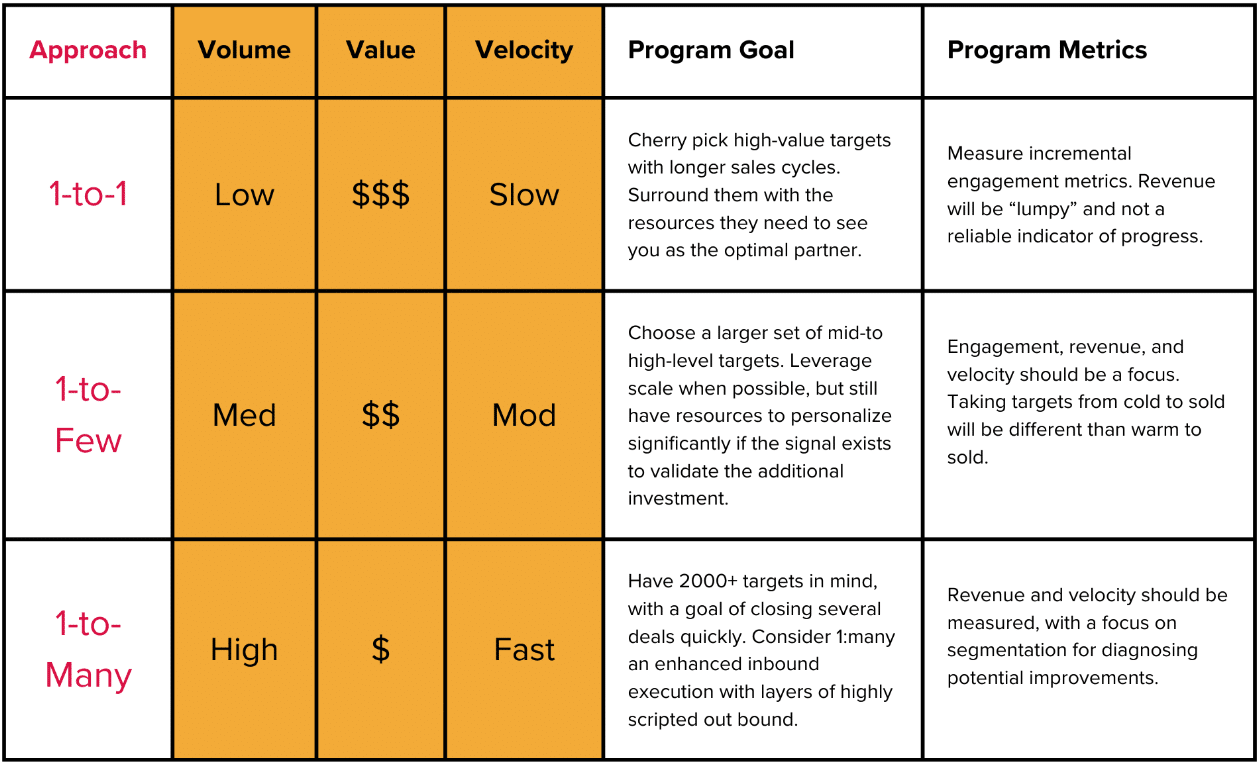
Scaling a platform requires precision and account-based marketing (ABM) plays a critical role in achieving that. Jason focuses on volume, targeting fewer but higher-value accounts that can benefit from the full platform. “It’s about depth, not breadth,” Leila, the ABM Manager, reminds him. These accounts drive significant revenue and become valuable case studies for other businesses to follow.
Value is at the core of Jason’s approach. He’s not just selling individual products; he’s bundling solutions that solve pain points across multiple areas of a client’s business, increasing cross-product value and making the platform more attractive and sticky for customers.
Speed is also crucial in ensuring ABM success. Jason’s team emphasizes Velocity, working quickly to move accounts through the pipeline and deliver value faster. Pipeline velocity doesn’t just help close deals; it helps onboard customers swiftly, creating opportunities for upselling as their needs evolve.
The following framework highlights how Jason applies the 3Vs of ABM — volume, value and velocity — to focus on high-value accounts, create integrated solutions and drive faster results through the pipeline.
Source: GTM Partners 3V’s of ABM
Building partnerships to extend reach
With the ABM strategy in place and the platform aligned to meet customer needs, Jason knows that scaling requires more than internal resources. He partners with resellers, technology integrators and industry consultants to extend the platform’s reach. These strategic alliances help the platform penetrate new markets efficiently while increasing credibility in different verticals.
The FUTURE framework: Building a martech stack for scale
None of this works without the right tech foundation. Jason needs a martech stack that can handle a growing platform. That’s where the FUTURE framework comes in. It isn’t just a roadmap — it’s the strategic fuel to power the tech stack and support platform expansion.
- Flexibility: Adapt quickly to different business models.
- Unification: Integrate marketing, sales and customer success seamlessly.
- Technology: Use advanced analytics to predict customer needs.
- Utilization: Train teams fully to maximize tool usage.
- Relevance: Align tools with both global goals and local market needs.
- Expansion: Scale the stack smoothly as the platform grows.

Dig deeper: How marketing fuels the shift from problem-market fit to product-market fit
Key metrics for platform-market fit
Jason, working closely with the VP of finance, prioritizes rigorous financial tracking to ensure that both efficiency and effectiveness drive the GTM strategy, given the current macroeconomic conditions. Together, they assess key metrics that show how the platform is adopted and scaled across multiple products.
Pipeline velocity is crucial for understanding how fast deals move through the pipeline, not just for one product, but across the platform. Jason’s team uses a layered approach, examining connected metrics to understand how each product impacts platform performance. Linking these metrics helps them spot synergies and bottlenecks, driving faster growth.
Customer lifetime value (CLV) is another important metric, which Jason tracks across products to identify which drives the most value. This sharpens the team’s upsell and cross-sell strategies, improving retention.
Cross-product engagement tracks how many customers use multiple products. The layered approach reveals how customer behaviors across products are linked, allowing Jason and the VP of finance to strengthen customer retention and expand platform adoption.
Jason’s team also monitors net revenue retention (NRR), which measures how much revenue grows within existing accounts through upsells and cross-sells. This ensures that customers are continuously adopting more products from the platform and contributing to long-term growth.
To ensure overall efficiency, Jason and the VP of finance track the “magic number,” a financial ratio that compares revenue growth to customer acquisition costs. This metric shows how efficiently the company’s sales and marketing spend is driving new revenue, helping them maintain sustainable growth.
For broader financial effectiveness, they rely on the “Rule of 40,” which balances the company’s revenue growth rate with profit margins. By ensuring that both sum exceeds 40%, Jason’s team stays focused on scaling the platform effectively without sacrificing profitability.
Aligning for global platform success
Jason realizes that moving up and to the right to achieve platform-market fit is more than selling more products. It’s about seamless integration and delivering customer value that increases adoption and usage.
He knows success hinges on aligning the entire GTM revenue team — product, sales, marketing, customer success, enablement and revenue operations. For the platform strategy to work, everyone must be unified around a shared goal.
For Jason, this isn’t just about hitting targets — it’s about proving his leadership and advancing his career. Below are his key takeaways:
- Precision targeting: Focus on the right accounts and show value quickly.
- Cross-product value: Hook customers on the platform and your CLV grows.
- Scaling for growth: Keep your tech stack flexible, unified and ready to scale.
The post How to make the jump from product-market fit to platform-market fit appeared first on MarTech.
**Steps to Transition from Product-Market Fit to Platform-Market Fit**
In the lifecycle of a successful business, achieving product-market fit (PMF) is a significant milestone. It signals that your product has found a market where it meets the needs of customers, and there is a clear demand for what you’re offering. However, for companies looking to scale and create long-term value, the next logical step is often to transition from product-market fit to platform-market fit (PMF to PMF 2.0). This shift involves evolving from a single product to a platform that can support multiple products, services, or even third-party integrations, creating a broader ecosystem.
This transition is complex and requires careful planning and execution. Below are the key steps to successfully make the leap from product-market fit to platform-market fit.
### 1. **Understand the Difference Between Product and Platform**
Before diving into the transition, it’s essential to understand the fundamental differences between a product and a platform. A product is a standalone offering that solves a specific problem for a target audience. In contrast, a platform is a foundation that enables multiple products, services, or third-party solutions to interact and create value for users.
A platform is not just an extension of your product; it’s an ecosystem where different stakeholders—such as users, developers, and partners—can interact and co-create value. This shift requires a change in mindset and strategy.
### 2. **Validate the Need for a Platform**
Not every product needs to evolve into a platform. Before making the transition, validate whether there is a genuine need for a platform in your market. Ask yourself:
– Are there multiple products or services that could be integrated into a cohesive ecosystem?
– Is there demand from your customers for more comprehensive solutions that go beyond your core product?
– Are there third-party developers or partners who could add value to your offering?
If the answer to these questions is yes, then transitioning to a platform might be the right move.
### 3. **Identify Core Platform Components**
Once you’ve validated the need for a platform, the next step is to identify the core components that will form the foundation of your platform. These components should be flexible enough to support multiple products or services and scalable enough to handle growth.
Key platform components may include:
– **APIs (Application Programming Interfaces):** APIs allow third-party developers to build on top of your platform, extending its functionality.
– **Data Infrastructure:** A robust data infrastructure is crucial for enabling seamless interactions between different products and services on the platform.
– **User Management:** A centralized system for managing user accounts, permissions, and data across multiple products.
– **Developer Tools:** If you plan to open your platform to third-party developers, providing them with the right tools (SDKs, documentation, etc.) is essential.
### 4. **Build a Two-Sided or Multi-Sided Network**
A successful platform often operates as a two-sided or multi-sided network, where different groups of users (e.g., consumers, developers, and partners) interact with each other. For example, in the case of a marketplace platform like Amazon, buyers and sellers are the two sides of the network.
To build a thriving network, you need to:
– **Attract both sides:** Initially, you may need to incentivize one side (e.g., developers or partners) to join your platform by offering financial rewards, marketing support, or other benefits.
– **Create value for both sides:** Ensure that both sides of the network derive value from the platform. For example, developers should be able to monetize their contributions, while users should benefit from the additional functionality provided by third-party apps or services.
### 5. **Leverage Network Effects**
One of the key advantages of a platform is the potential for network effects, where the value of the platform increases as more users or partners join. To leverage network effects, focus on:
– **User Growth:** The more users your platform has, the more attractive it will be to third-party developers and partners.
– **Developer Ecosystem:** Encourage developers to build on your platform by providing them with the tools and support they need to succeed.
– **Interoperability:** Ensure that different products, services, and third-party integrations can work seamlessly together on your platform.
The stronger the network effects, the more difficult it will be for competitors to replicate your success.
### 6. **Re-Align Your Business Model**
Transitioning from a product to a platform often requires a shift in your business model. While a product-based business typically generates revenue through direct sales or subscriptions, a platform-based business may generate revenue through multiple streams, such as:
– **Transaction Fees:** Charging a fee for transactions that occur on the platform (e.g., marketplace commissions).
– **Subscription Fees:** Offering premium features or services to users or partners.
– **Developer Fees:** Charging third-party developers for access to APIs or other platform tools.
– **

Recent Comments