
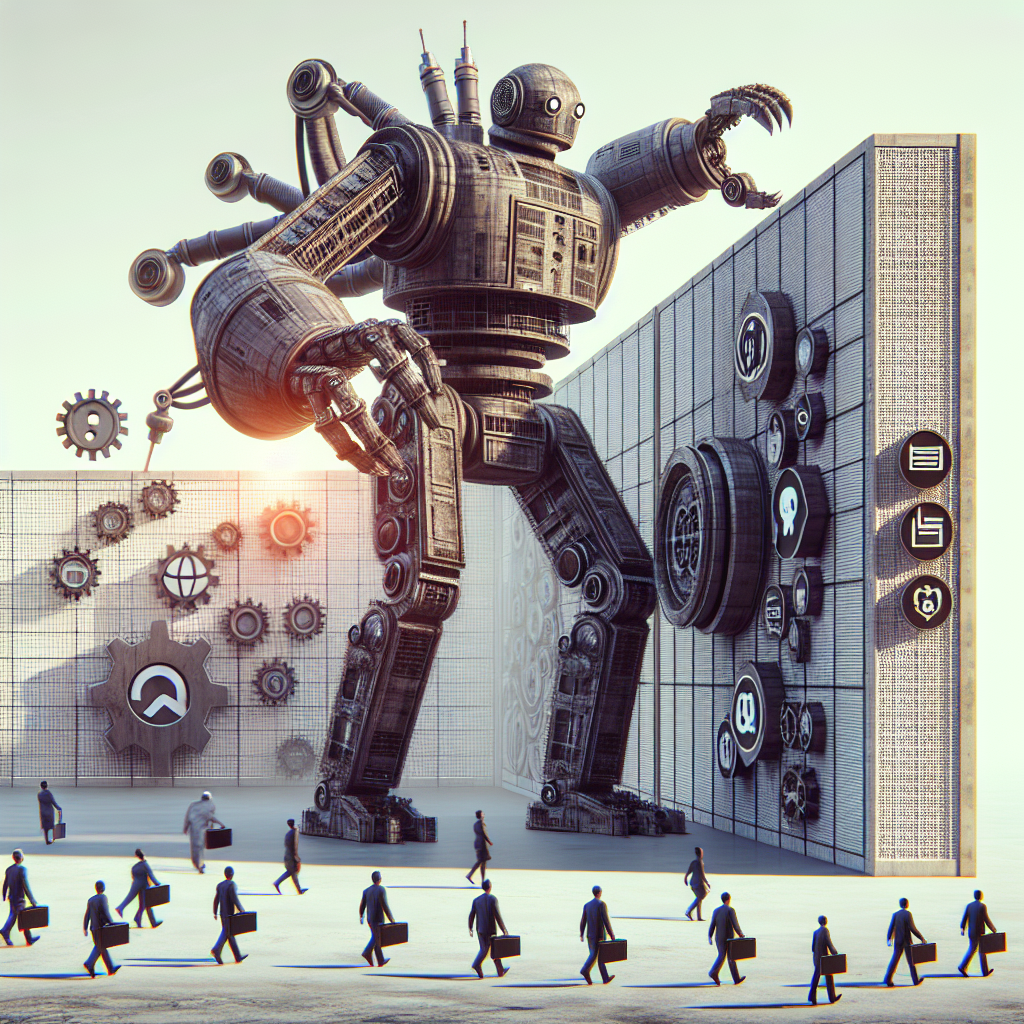

Somebody in B2B needs to hear this today: AI isn’t a one-size-fits-all solution. A new core skill every marketer needs to develop moving forward is the ability to discern where AI enhances our efforts and where human expertise remains irreplaceable.
Significant gaps exist in AI’s capabilities, particularly in industries where human expertise is essential to achieving meaningful outcomes. Some of B2B’s most influential sectors require the most sophisticated, accurate content and strategies.
The B2B content creation conundrum
Of the 61.4% of marketers who report using AI, 44.4% use AI to create content. Yet, while generative AI has made significant strides, it has a pronounced Achilles’ heel.
AI mimics. It doesn’t create. Marketing based on mimicry is inherently incapable of being specific or creative enough to make a brand stand out. B2Bs, particularly in complex industries, demand specialized knowledge and the ability to create messages that resonate with well-informed decision-makers.
Moreover, B2B content must integrate current market trends, competitive analysis and forward-thinking strategies. AI can gather data and make predictions from past events, but it still can’t match the strategic insights or emotional understanding experienced human marketers provide. This limitation is clear in thought leadership content, especially LinkedIn, where fresh ideas and innovative perspectives are key.
Dig deeper: Unlocking AI’s potential in B2B marketing
The aesthetic challenge of AI in design
Design is another area where AI’s impressive capabilities fall short of human creativity and judgment. AI-generated designs often struggle with adhering to brand guidelines and understanding subtle aesthetic principles. (And I won’t even get started on the AI-generated portraits, where the subject has three legs or six fingers.)
Visual AI tools like Midjourney and Ideogram can quickly generate design options, including typography (though results may vary). Still, they lack a deep understanding of how humans perceive and interact with visuals.
A skilled human designer brings an intuitive grasp of balance, harmony and visual hierarchy that AI has yet to master. For instance, in logo design or brand identity creation, AI might produce designs that fulfill their prompts while completely failing to capture the essence of a brand’s personality or values.
AI’s interpretation of design prompts also misses the subtleties of client requests. A human designer reads between the lines, asks clarifying questions and iterates with nuance. This human touch is crucial in creating well-designed designs that effectively reflect a brand’s essence.
High-stakes industries: Where precision is non-negotiable
The global marketing transcription market is projected to reach $4.4 billion by 2033. B2B marketers serving highly regulated and technical industries like legal, medical and law enforcement know that precise, accurate communication is crucial. In these sectors, where expertise and nuance are needed most, AI’s limitations are particularly pronounced.
As industry expert Ben Walker, CEO of Ditto Transcripts, explains, “A trained human can easily differentiate between ‘hyper’ and ‘hypo.’ Those prefixes have opposite meanings, but people’s accents, speech patterns and the audio recording quality can confuse AI systems.”
If you’re marketing a medication for hypoglycemia and an AI transcript from your trusted subject-matter expert says “hyperglycemia,” you run the risk of serious — even dangerous — false advertising. Publishing an inaccurate data point or term damages an audience’s trust in a brand, company or institution, resulting in a public backlash, negative press and legal ramifications.
Misunderstandings also have grave implications for other industries. For example, my company works with law firms that require PR tied to their working cases and new legislation. Quotes need to be attributed to the right speaker. Phrasing and terminology need to be exact.
How can a PR professional write a pitch based on a court transcript if that transcript’s accuracy can’t be trusted? And in the time it takes for an AI transcript to be reviewed by a subject-matter expert, valuable time is wasted. In fact, with news moving at the speed of our social media feeds, the opportunity might even be completely lost.
Dig deeper: Cutting through the hype: Generative AI adoption in B2B
The irreplaceable human connection
Post-pandemic, there’s been a strong comeback in demand for in-person events. I’m getting more speaking and keynote bookings. The energy from live audiences is more eager and intense than ever. The event industry market is booming at a CAGR of 6.4% and is projected to reach $2.1 trillion by 2032. In a B2B context, 82% of event attendees prefer to attend in person, and 80.4% of organizers identify in-person events as their organization’s most impactful marketing channel.
We’re also seeing a continued appreciation for virtual human interactions through webinars, livestreams and podcasts. These formats are increasing in value precisely because they offer what AI cannot: authentic human engagement. Human-centric events provide opportunities for spontaneous conversations and memorable networking — the kind of relationship-building that’s difficult to replicate in faceless, digital spaces.
Whether it’s in-person or via livestream, the human element remains crucial. The energy of a live audience, the ability to read a room and the spontaneity of real-time interactions are elements that AI cannot replicate. Audiences appreciate real people sharing their knowledge and answering real-time questions and the ability to build this rapport remains a uniquely human skill.
Balancing AI and human expertise
It’s clear that while AI offers benefits in many areas, it also has significant limitations across the board, from B2B content and design to highly regulated industries and human-powered events. The value proposition of human expertise with advanced technology is becoming a critical differentiator in the marketplace.
The key for marketers is to strike a balance, using AI where it enhances efficiency while recognizing the areas where human skills are irreplaceable. Understanding these nuances allows us to create marketing strategies that harness the best of both worlds.
As we look to the future, the most successful B2B marketers will be those who seamlessly integrate AI tools into their workflows while identifying and prioritizing the human elements that drive engagement, build trust and create lasting connections with audiences.
Dig deeper: 5 ways to harness AI in B2B content creation
The post Where AI falls short in high-stakes B2B industries appeared first on MarTech.
# Limitations of AI in High-Stakes B2B Industries
Artificial Intelligence (AI) has revolutionized numerous industries, from healthcare to finance, and is increasingly being adopted in Business-to-Business (B2B) sectors. AI’s ability to automate processes, analyze vast amounts of data, and provide predictive insights has made it an attractive tool for businesses looking to optimize operations and gain a competitive edge. However, despite its potential, AI is not without limitations, especially in high-stakes B2B industries where decisions can have significant financial, legal, and reputational consequences. This article explores some of the key limitations of AI in these critical sectors.
## 1. **Data Quality and Availability**
AI systems rely heavily on large datasets to function effectively. In high-stakes B2B industries such as finance, healthcare, and manufacturing, the quality and availability of data are crucial. However, these industries often face challenges related to data collection, storage, and accuracy.
– **Incomplete or Inaccurate Data**: AI models are only as good as the data they are trained on. In industries like healthcare, where patient data may be incomplete or inconsistent, AI models can produce unreliable results. Similarly, in sectors like finance, where historical data may not fully capture market volatility or black swan events, AI predictions can be flawed.
– **Data Silos**: In many B2B industries, data is often stored in silos across different departments or organizations. This fragmentation makes it difficult for AI systems to access comprehensive datasets, limiting their ability to provide accurate insights.
– **Data Privacy and Compliance**: High-stakes industries are often subject to strict regulations regarding data privacy and security. For example, healthcare organizations must comply with HIPAA, while financial institutions must adhere to GDPR and other regulations. These legal constraints can limit the amount of data available for AI training, reducing the effectiveness of AI models.
## 2. **Lack of Explainability and Transparency**
One of the most significant challenges of AI in high-stakes B2B industries is the “black box” nature of many AI models, particularly deep learning algorithms. These models can make highly accurate predictions, but their decision-making processes are often opaque, making it difficult for businesses to understand how they arrived at a particular conclusion.
– **Regulatory Scrutiny**: In industries like finance and healthcare, where decisions can have life-altering consequences, regulators require a high level of transparency. For example, if an AI system denies a loan application or recommends a medical treatment, businesses must be able to explain the rationale behind the decision. The lack of explainability in AI models can make it difficult to meet these regulatory requirements.
– **Trust and Accountability**: In high-stakes industries, trust is paramount. If businesses cannot explain how an AI system arrived at a decision, it can erode trust between B2B partners. Additionally, when things go wrong, it can be challenging to assign accountability. Who is responsible if an AI system makes a mistake—the vendor, the developer, or the business using the AI?
## 3. **Ethical Concerns and Bias**
AI systems are not immune to bias, and in high-stakes B2B industries, biased decisions can have serious consequences. Bias in AI can arise from the data used to train the models or from the algorithms themselves.
– **Discriminatory Outcomes**: In industries like finance, biased AI models can lead to discriminatory outcomes, such as denying loans to certain demographic groups. Similarly, in healthcare, biased AI models can result in unequal treatment recommendations for different patient populations.
– **Reinforcing Existing Inequalities**: AI systems trained on historical data may reinforce existing inequalities. For example, if a hiring algorithm is trained on data from a company that has historically favored certain candidates, the AI system may continue to favor those candidates, perpetuating bias.
– **Ethical Dilemmas**: In high-stakes industries, AI can raise ethical dilemmas. For example, in healthcare, should an AI system prioritize cost savings over patient outcomes? In finance, should an AI system prioritize short-term profits over long-term stability? These are complex questions that AI systems are not equipped to answer on their own.
## 4. **Over-Reliance on Automation**
AI excels at automating routine tasks, but in high-stakes B2B industries, over-reliance on automation can be risky. While AI can handle many tasks more efficiently than humans, it lacks the ability to understand context, apply common sense, or make nuanced judgments.
– **Human Oversight**: In industries like manufacturing, AI-powered automation can improve efficiency, but it can also lead to catastrophic failures if not properly monitored. For example, an AI system controlling a production line may not recognize subtle signs of equipment failure, leading to costly downtime or safety hazards. Human oversight is essential to catch these issues before they escalate.
– **Complex Decision-Making**

Recent Comments