


This article was co-authored with Mike Froggatt, Senior Director, Analyst, at Gartner.
Digital personalization is a double-edged sword. While it can significantly enhance customer experiences, it also risks alienating consumers if not executed thoughtfully. Digital marketing leaders must carefully manage the reality and perceptions around personalization.
A Gartner consumer survey of 2,001 respondents in April and May 2024 revealed that 63% acknowledge brands are good at guessing what they might be interested in buying, indicating progress in personalization efforts. The integration of generative AI technologies is poised to further refine these strategies by enabling more nuanced audience targeting and personalized customer journeys.
Encouragingly, 75% of consumers report more positive or neutral toward brands after receiving personalized recommendations online. This suggests that consumers have come to expect a degree of personalization in their digital interactions. But differences in attitudes exist. For example, more (47%) baby boomers felt negatively when they received an advertisement for a product after discussing or mentioning a product or brand online than younger generations. This highlights the need for marketers to tailor their strategies to different demographic groups.
The challenge of perceived intrusiveness
Although device manufacturers and media companies have long refuted the idea that devices and apps listen to consumers, consumers don’t necessarily believe this. As this chart shows, 81% say that after discussing a product offline, they either received an ad for the product online or a recommendation for the product on a retailer’s website.
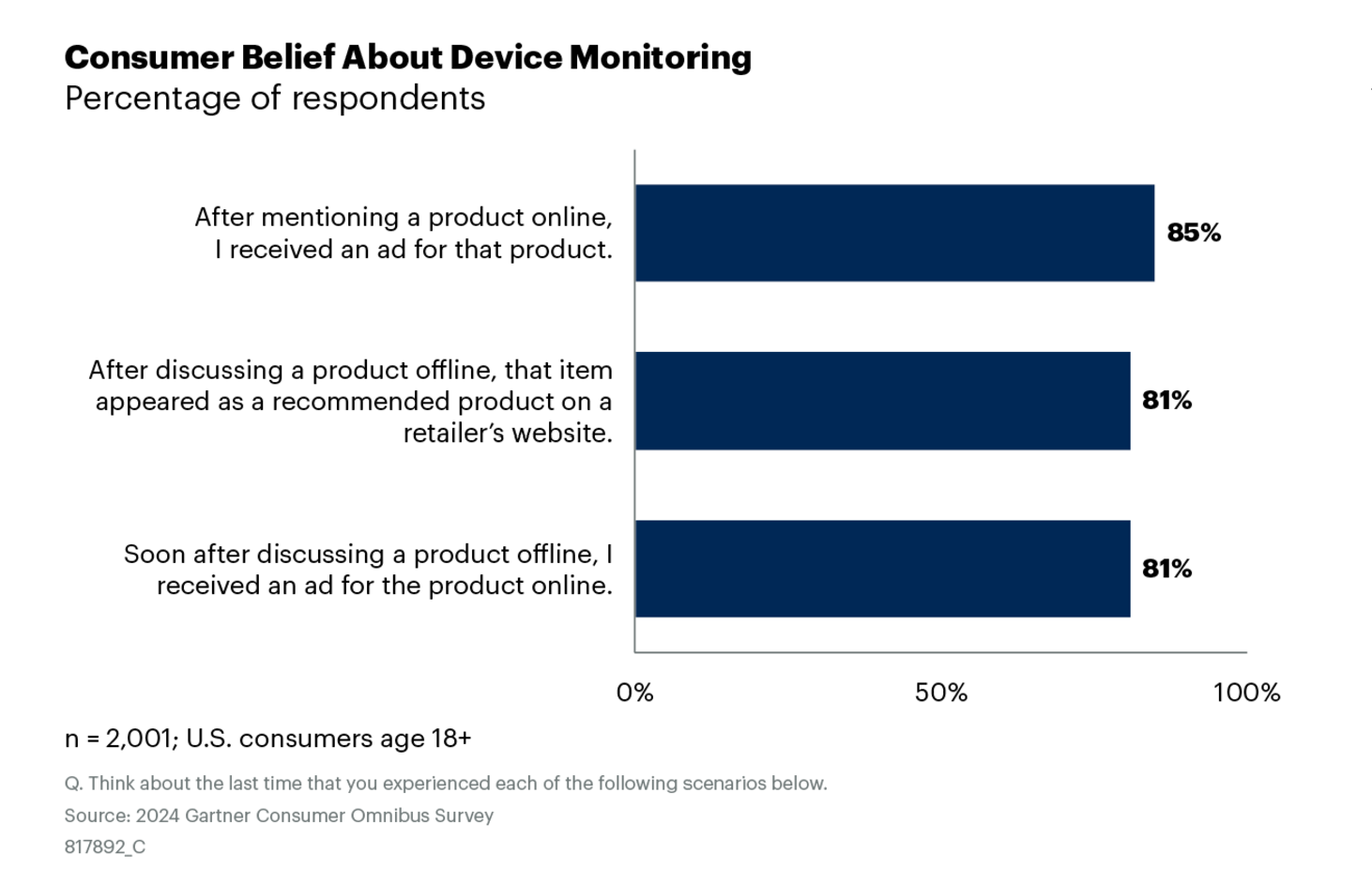
In reality, consumers receive product recommendations and retargeted advertisements due to multiple factors, including interactions with smart speakers and purchase histories. This contributes to the perception that devices and apps monitor consumers’ offline audio conversations. This can erode consumer trust and underscores why digital marketers should cautiously approach delivering excessively personalized advertisements and recommendations.
Using voice assistants for consumer profiling can also raise legitimate concerns about data privacy. Many consumers remain unaware of the specific data points used for ad targeting, underscoring the importance of transparency in data collection practices.
Dig deeper: AI is poised to disrupt the world of martech vendors and users
To better align advertising strategies with consumer expectations, marketing leaders should consider the following recommendations:
- Enhance transparency: Communicate how and why consumer data is used in product recommendations and retargeted ads. Transparency builds trust and can differentiate your brand in a crowded marketplace.
- Adapt to privacy regulations: Stay ahead of evolving privacy regulations by assessing your organization’s data collection practices and readiness. Bridging the gap between marketing and advertising technology is crucial for seamless integration and compliance.
- Leverage first-party data: Expand the use of first-party data for targeting, reducing reliance on cookies and mitigating associated liabilities. Collaborate with key adtech and media partners to maximize the effectiveness of your campaigns.
- Investigate ad targeting technologies: Stay informed about how adtech companies use consumer signals to deliver personalized ads. This can help refine your targeting strategies and improve consumer experiences.
Safeguarding brand reputation
Nearly one-half of consumers (49%) develop a negative view of a brand when its ads appear next to offensive content. Despite investments in brand safety technologies, challenges persist in ensuring ads are placed in appropriate contexts.
Repetitive video and audio ads also frustrate consumers, with 47% expressing negative sentiments towards brands employing such tactics. Leveraging programmatic buying for connected TV (CTV) and digital audio advertising can help offset repetition by enabling better frequency capping and campaign optimization across multiple streaming platforms.
To maintain a positive brand image, consider these strategies:
- Utilize safe sites and allowlists: Start with known safe sites and collaborate with adtech partners to achieve audience scale. Employ allowlists and denylists judiciously to manage ad placements effectively.
- Engage with private marketplaces: Leverage private marketplaces (PMPs) and programmatic guaranteed (PG) inventory for more controlled ad placements. Use vetted buying partners and measurement and verification tools to ensure quality impressions.
- Contextual targeting: Partner with providers capable of targeting specific content types or blocking undesirable content. Ensure agreements include provisions for quality assurance.
Brand impersonation threats
Brand impersonation, including spoofing attacks, poses significant risks to consumer trust.
Leaders must implement social media monitoring tools to detect and address brand impersonation and engage with communications and legal teams to formulate a robust response strategy. In addition, they must proactively share how customer data is used to improve ads and digital experiences to enhance organizational trustworthiness, credibility, and transparency.
Digital marketing leaders must strike a delicate balance between personalization and consumer trust. Organizations can foster lasting relationships with their audiences in an increasingly digital world by aligning advertising practices with consumer preferences and safeguarding brand reputation.
The post Personalization’s double-edged sword: Balancing relevance with intrusiveness appeared first on MarTech.
**Navigating Personalization: Striking the Balance Between Relevance and Privacy**
In today’s digital age, personalization has become a cornerstone of how businesses engage with consumers. From tailored product recommendations on e-commerce platforms to curated playlists on music streaming services, personalization enhances user experiences by delivering content, products, and services that align with individual preferences. However, as personalization becomes more pervasive, it raises critical questions about privacy. How much personal data should companies collect to provide relevant experiences? And how can they ensure that users’ privacy is respected in the process?
Striking the balance between relevance and privacy is a complex but essential challenge. This article explores the dynamics of personalization, the privacy concerns it raises, and strategies to navigate this delicate balance.
—
### The Appeal of Personalization
Personalization is a powerful tool for businesses. It allows companies to stand out in a crowded marketplace by offering experiences that feel uniquely tailored to each customer. For consumers, personalization simplifies decision-making, saves time, and enhances satisfaction. For example:
– **E-commerce**: Platforms like Amazon and Shopify use browsing and purchase history to recommend products that align with a user’s interests.
– **Streaming services**: Netflix and Spotify leverage algorithms to suggest movies, shows, and songs based on viewing or listening habits.
– **Digital marketing**: Personalized ads target users with products or services that match their preferences, increasing the likelihood of engagement.
The benefits of personalization are clear: it fosters customer loyalty, drives sales, and creates a more enjoyable user experience. However, these benefits often come at a cost—privacy.
—
### The Privacy Paradox
To deliver personalized experiences, companies must collect and analyze vast amounts of user data, including browsing behavior, location, purchase history, and even sensitive information like health data. This data collection raises significant privacy concerns, particularly in an era where data breaches and misuse of personal information are all too common.
The “privacy paradox” refers to the tension between users’ desire for personalized experiences and their concerns about how their data is collected, stored, and used. While many consumers appreciate the convenience of personalization, they are also wary of invasive data practices. According to a 2022 Pew Research Center study, 79% of Americans are concerned about how companies use their personal data, yet many still engage with personalized services.
This paradox creates a dilemma for businesses: how can they provide relevant, personalized experiences without compromising user trust?
—
### The Risks of Over-Personalization
When companies prioritize personalization without adequate safeguards, they risk alienating customers and damaging their reputation. Some of the key risks include:
1. **Data breaches**: Storing large volumes of personal data makes companies attractive targets for cyberattacks. High-profile breaches, such as those involving Equifax and Facebook, have highlighted the dangers of inadequate data security.
2. **Creepy factor**: Over-personalization can feel intrusive. For instance, when a user sees an ad for a product they only discussed in a private conversation, it can lead to discomfort and distrust.
3. **Regulatory penalties**: Governments worldwide are implementing stricter data privacy laws, such as the General Data Protection Regulation (GDPR) in Europe and the California Consumer Privacy Act (CCPA). Non-compliance can result in hefty fines and legal consequences.
4. **Erosion of trust**: If users feel that their data is being exploited or mishandled, they may lose trust in a brand and take their business elsewhere.
—
### Strategies for Balancing Personalization and Privacy
To navigate the fine line between relevance and privacy, companies must adopt responsible data practices and prioritize transparency. Here are some strategies to achieve this balance:
#### 1. **Adopt Privacy-First Design**
Businesses should integrate privacy considerations into their personalization strategies from the outset. This includes limiting data collection to what is strictly necessary and anonymizing data wherever possible. Privacy-first design ensures that personalization efforts are built on a foundation of trust.
#### 2. **Embrace Transparency**
Transparency is key to building trust. Companies should clearly communicate what data they collect, how it is used, and why. Providing users with easy-to-understand privacy policies and real-time access to their data fosters a sense of control.
#### 3. **Offer Opt-In and Opt-Out Options**
Giving users the choice to opt in or out of data collection and personalization features empowers them to make informed decisions. For example, Google allows users to customize their ad preferences or turn off personalized ads entirely.
#### 4. **Leverage Privacy-Enhancing Technologies (PETs)**
Innovative technologies like differential privacy, federated learning, and encryption can help companies analyze data without compromising individual privacy. These tools enable businesses to extract insights while minimizing the risk of exposing personal information.
#### 5. **Comply with Data Protection Regulations**
Adhering to regulations like GDPR and CCPA is not just a legal requirement—it’s a way to demonstrate a commitment to user privacy.

Recent Comments