

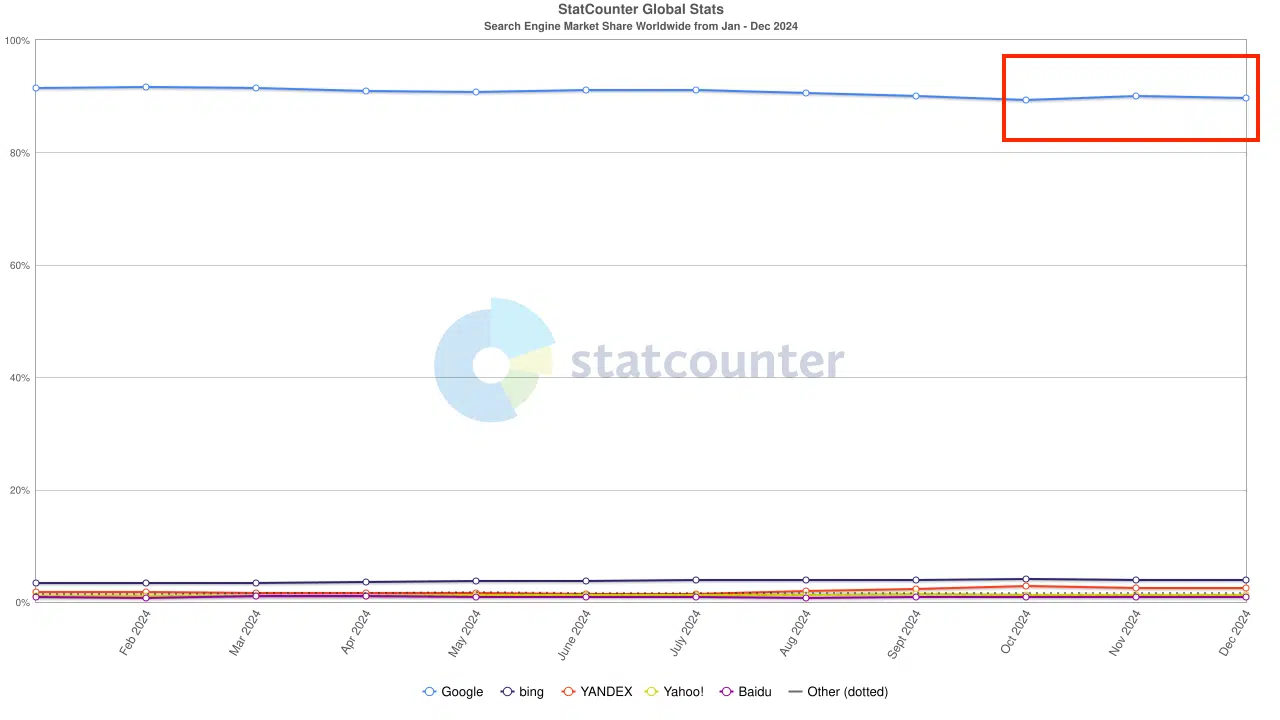
Google’s share of the global search engine market fell below 90% for the first time since 2015, according to Statcounter. Google’s global search market share was under 90% during each of the final three months of 2024.
The data. Here’s a screenshot of the 2024 search market share, showing Google dipping below 90% – to 89.34% in October; 89.99% in November; and 89.73% in December:
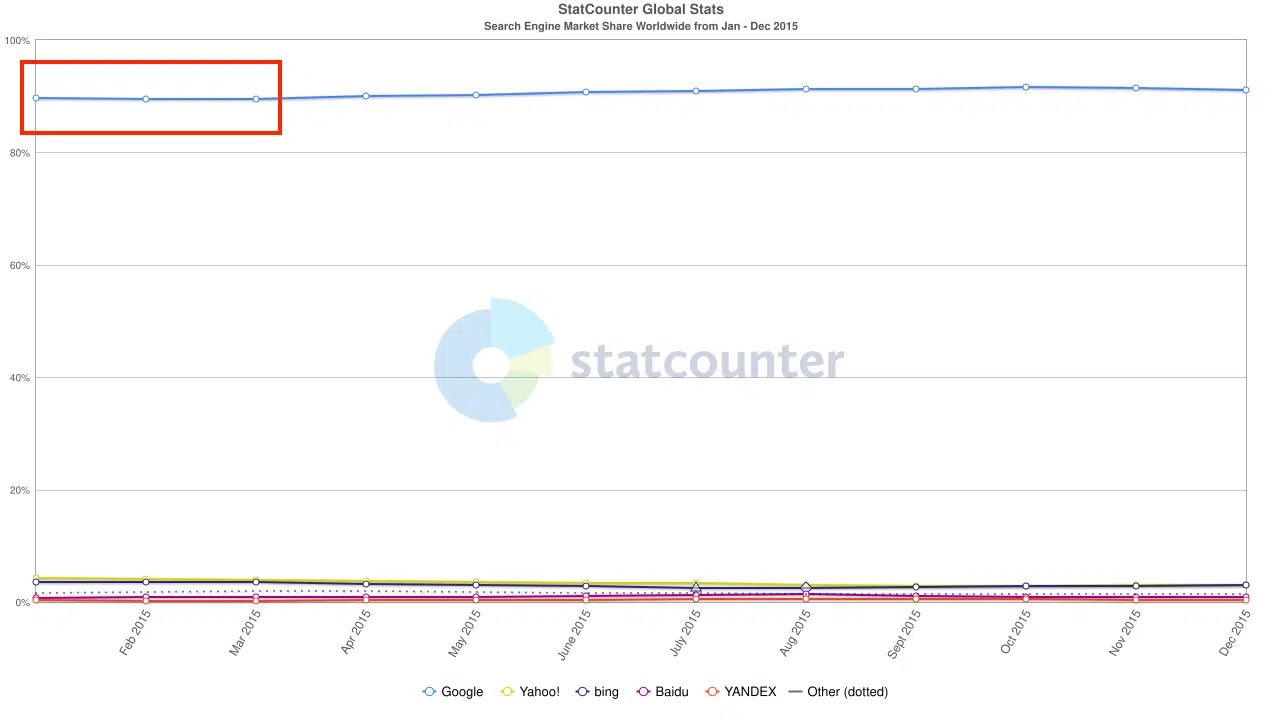
And here’s the last three-month stretch where Google’s search market share was under 90%, in 2015: 89.62% in January; 89.47% in February; 89.52% in March:
Why we care. As the old saying goes, one’s a dot, two’s a line, and three’s a trend. Cleary, we’re seeing a trend with Google losing search market share.
Where’s the drop? Google’s search market share appeared to be fairly consistent in most regions except Asia, which appears to have been a big reason for Google’s overall drop.
U.S. drop? Google’s U.S. search market share peaked at 90.37% in November, but fell to 87.39% in December. In the other months of 2024, Google’s U.S. search market share was fairly consistent, varying between 86-88%.
The big picture. Google has been under attack for nearly two years over the quality of its search results despite dominating thanks to its illegal monopoly status with a commanding and consistent 90%-92+% share for almost a decade.
- Are we now finally starting to see the beginning people moving away to other search engines? This will be an area of interest to watch in the coming months.
Where did searchers go? Did they go to AI answer engines, like ChatGPT Search and Perplexity? Well, not the way Statcounter measures things. Statcounter mainly tracks Microsoft Bing, Yandex, Yahoo and Baidu, but also has another grouping called “other,” which includes the likes of DuckDuckGo and Ecosia.
Bing, Yandex, and Yahoo each gained some of Google’s lost share. Second-place Microsoft Bing hovered at or just under 4% for the final five months of 2024.
Dig deeper. Optimizing LLMs for B2B SEO: An overview
Bug or blip? You may recall much rejoicing in search marketing and SEO adjacent space when it appeared Google lost a significant amount of search market share in April. However, Google’s huge search market share loss wasn’t real and Statcounter revised its data.
In this case, the drop seems believable because Google was consistently under 90% in October, November, and December.
The data. Statcounter’s Search Engine Market Share Worldwide.
The post Google’s search market share falls below 90% for first time since 2015 appeared first on MarTech.
**Google’s Search Market Share Drops Below 90% for the First Time Since 2015: What It Means for the Search Landscape**
For over a decade, Google has been synonymous with internet search, dominating the market with an iron grip that left competitors scrambling for scraps. However, recent data has revealed a significant shift in the search engine landscape: Google’s search market share has dropped below 90% for the first time since 2015. This development marks a pivotal moment in the tech industry, raising questions about the future of search, the rise of competitors, and the evolving preferences of internet users.
### The Numbers Behind the Shift
According to recent reports from analytics firms, Google’s global search market share has dipped to approximately 88%, down from its historically consistent position above 90%. While this may seem like a minor decline, it represents a major milestone in an industry where even small percentage changes can signal broader trends. The drop is attributed to a combination of factors, including the growing popularity of alternative search engines, advancements in AI-driven search technologies, and increasing regulatory scrutiny on Google’s dominance.
### The Rise of Competitors
Several competitors have been chipping away at Google’s market share, each capitalizing on unique value propositions that appeal to specific user demographics:
1. **Microsoft Bing**: Microsoft’s Bing has emerged as a formidable contender, particularly after the integration of OpenAI’s ChatGPT technology into its search engine. By offering AI-enhanced search experiences, Bing has managed to attract users looking for more conversational and context-aware search results. This innovation has positioned Bing as a viable alternative for those seeking a more interactive search experience.
2. **DuckDuckGo**: Known for its commitment to privacy, DuckDuckGo has gained traction among users concerned about data security and targeted advertising. As awareness of online privacy issues grows, more users are turning to DuckDuckGo as a way to browse the web without being tracked.
3. **Ecosia**: This environmentally-focused search engine has carved out a niche by planting trees with its ad revenue. Ecosia appeals to eco-conscious users who want their online activities to contribute to sustainability efforts.
4. **Brave Search**: Brave, a privacy-focused browser, has also launched its own search engine. Brave Search emphasizes user control and transparency, further diversifying the search engine market.
### The Role of AI and Innovation
One of the most significant factors contributing to Google’s declining market share is the rapid advancement of artificial intelligence in search technology. Competitors like Microsoft have leveraged AI to create more dynamic and personalized search experiences. For example, Bing’s integration with ChatGPT allows users to ask complex questions and receive detailed, conversational responses—something that Google’s traditional search model has struggled to replicate effectively.
Google, of course, has not been idle in the face of these challenges. The company has been heavily investing in its own AI initiatives, such as the development of Bard, its AI-powered chatbot, and the integration of AI features into its search engine. However, the competition has intensified, and users now have more options than ever before.
### Regulatory Pressures and Antitrust Concerns
Another factor contributing to Google’s declining market share is the increasing regulatory scrutiny it faces worldwide. Governments and regulatory bodies in the United States, Europe, and other regions have accused Google of monopolistic practices, prompting investigations and lawsuits. These actions have led to calls for greater competition in the search market, creating opportunities for smaller players to gain visibility and market share.
For instance, the European Union’s Digital Markets Act (DMA) aims to curb the dominance of tech giants by requiring them to provide users with more choices for default search engines. Such regulations have encouraged users to explore alternatives, further eroding Google’s market share.
### Changing User Behavior and Preferences
The way people search for information online is also evolving. Younger generations, in particular, are increasingly turning to platforms like TikTok and Instagram for discovery and recommendations, bypassing traditional search engines altogether. This shift in behavior highlights the growing importance of social media and visual content in shaping how users find information.
Additionally, voice search and smart assistants like Amazon’s Alexa and Apple’s Siri are becoming more prevalent, offering users new ways to access information without relying on traditional search engines. These trends indicate that the future of search may be more fragmented and diversified than ever before.
### What Does This Mean for Google?
While Google’s drop below 90% market share is significant, it is far from a death knell for the tech giant. With nearly 9 out of 10 searches still conducted on Google, the company remains the dominant player in the industry. However, the decline serves as a wake-up call, signaling the need for innovation and adaptation in an increasingly competitive landscape.
Google is likely to double down on its AI initiatives, refine its search algorithms, and explore new ways to engage users. The company will also need to address growing concerns about privacy and data security to maintain user trust in an era where these issues are becoming paramount.
### Imp

Recent Comments