

Half of all Americans use AI, according to a survey by Elon University’s Imagining the Digital Future Center.
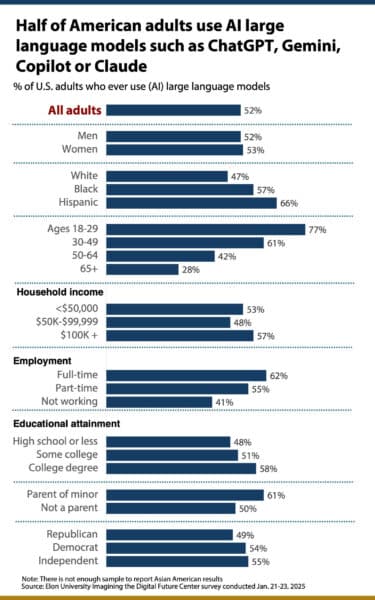
And it’s not just the tech bros and Silicon Valley elites, either. Sure, younger, wealthier, and better-educated folks are slightly more likely to use AI, but guess what? It is also used by 53% of households earning under $50. Hispanic adults (66%) and Black adults (57%) are even more likely to use LLMs than White adults (47%).
AI is bipartisan: It’s used by 49% of Republicans, 54% of Democrats and 55% of independents.
A solid chunk of users report relationships with these digital assistants, and 38% believe that AI will be capable of deep emotional bonds with humans within a decade. For some, that future is already here:
- 65% have back-and-forth convos with LLMs, and 34% do this several times a week.
- 40% feel like their AI gets them.
- 25% say their AI cheers them up. No judgment, we all need a pick-me-up.
- 22% claim their chatbot shows empathy — maybe we can learn.
- 7% say their AI gets jealous. We can eat chocolate. Of course, it’s jealous.
And, in an unusual display of humility, 49% think their LLMs are smarter than they are, including 26% who think they are “a lot smarter.”
Now, here is this week’s roundup of AI-powered martech releases.
- Stravito introduced Focus Mode, Snapshots and multilingual support to its generative AI tool, Stravito Assistant. Explore Mode searches an organization’s research library for self-service insights. Focus Mode activates when users select specific reports, videos, or collections for in-depth analysis. Snapshots extract key learnings and recommendations from reports and summarize them in the Viewer’s sidebar.
- Qualified launched Piper for Marketo, an AI-powered sales development representative for Adobe Marketo Engage customers. Piper engages with Marketo leads through a brand’s website and email, converting them into opportunities.
- CallMiner released CallMiner Outreach, a customer experience and feedback management solution that uses analytics and AI. It helps businesses analyze conversations, connect with customers and extract insights for strategic decision-making.
- Wunderkind added Wunderkind Analytics and WunderkindAI to its Autonomous Marketing Platform. These tools help retailers measure and optimize customer experiences by using automated, high-engagement marketing across channels such as email and text.
- Qualtrics partnered with LangChain to develop Experience Agents on the LangGraph Platform. This allows Qualtrics to build, deploy and manage AI agent workflows without coding while leveraging LangGraph’s APIs for debugging and customization.
- Attest introduced an audience research capability that lets businesses survey existing and potential consumers within a single solution. This feature allows side-by-side analysis to uncover insights and market opportunities.
- Persado launched Dynamic Email, an AI-powered tool for automating campaign setup, content creation and email personalization. Marketers can update and optimize content without coding, as the system adapts messages based on performance data.
- Scope3 introduced the Scope3 Agentic Media Platform and Brand Standards, a brand safety and suitability tool. The platform enables media and advertising companies to create efficient, sustainable advertising products. Amazon DSP is the first to integrate it for scalable media buying.
- dunnhumby expanded its retail media platform by integrating ad-serving capabilities from Osmos. This addition helps retailers and advertisers manage audience targeting, inventory and omnichannel measurement while enabling the rapid deployment of retail media businesses.
- Shopsense AI unveiled a Multi-Agent System that automates content monetization. It uses AI agents to coordinate in real time, streamlining the creation of sponsorable and shoppable integrations at scale.
- Lightspeed Commerce introduced an AI-driven website-building tool for retail merchants. The tool generates web pages from a screen grab, simplifying website creation for online businesses.
- Afiniti made its AI-powered eXperienceAI pairing solution available on AWS Marketplace. The technology enhances customer experience by improving retention, increasing sales conversions and reducing service costs.
- Omneky launched Smart Ads, an AI-powered feature for creating and optimizing digital ads. The system automatically generates on-brand advertisements using brand guidelines, assets and performance data.
- Resulticks introduced Genie, an AI-powered agent that automates audience segmentation and content creation. It helps brands personalize messages at an individual level and enables real-time decision-making for customer engagement.
The post AI-powered martech news and releases: March 20 appeared first on MarTech.
# Latest AI-Powered Martech News and Releases – March 20, 2024
The marketing technology (Martech) landscape is evolving rapidly, with artificial intelligence (AI) playing a pivotal role in transforming how businesses engage with customers, optimize campaigns, and enhance personalization. As of March 20, 2024, several key AI-powered Martech innovations and announcements have made headlines. This article highlights the latest developments, product releases, and trends shaping the future of AI-driven marketing.
## **1. Google Unveils AI-Powered Ad Optimization Tools**
Google has introduced new AI-driven features for Google Ads, aimed at improving campaign performance and automation. The latest updates include:
– **AI-Generated Ad Creatives**: Google’s AI can now generate ad variations, including text and image suggestions, based on performance data and audience insights.
– **Enhanced Performance Max Campaigns**: AI-driven recommendations help advertisers optimize their Performance Max campaigns by suggesting budget allocations and targeting improvements.
– **Conversational AI for Campaign Setup**: Google Ads now includes a chatbot assistant that helps marketers set up campaigns more efficiently by answering questions and providing real-time recommendations.
These advancements aim to streamline ad management and improve return on investment (ROI) for businesses leveraging Google’s advertising ecosystem.
## **2. HubSpot Introduces AI-Powered Content Assistant for Marketers**
HubSpot has expanded its AI capabilities with the launch of **Content Assistant**, an AI-powered tool designed to help marketers create high-quality content faster. Key features include:
– **AI-Generated Blog Posts and Emails**: Marketers can generate drafts for blog articles, email campaigns, and social media posts using AI-driven suggestions.
– **Smart Editing and Optimization**: The tool provides recommendations for improving readability, SEO, and engagement.
– **Automated Personalization**: AI analyzes customer data to suggest personalized content tailored to different audience segments.
This release aligns with HubSpot’s broader strategy of integrating AI into its CRM and marketing automation platform to enhance efficiency and engagement.
## **3. Salesforce Enhances AI-Powered Marketing Cloud with Einstein GPT**
Salesforce has announced new AI-driven enhancements to its **Marketing Cloud**, powered by **Einstein GPT**. The latest updates focus on:
– **AI-Driven Customer Journey Mapping**: Marketers can now use AI to predict customer behaviors and automate personalized journeys across multiple channels.
– **Predictive Analytics for Campaign Performance**: Einstein GPT provides real-time insights into campaign effectiveness and suggests optimizations.
– **AI-Powered Email and Social Media Content Generation**: The platform can generate personalized email subject lines, social media posts, and ad copy based on customer data.
These innovations reinforce Salesforce’s commitment to AI-driven marketing automation and customer engagement.
## **4. Adobe Launches AI-Powered Predictive Audiences in Adobe Experience Cloud**
Adobe has introduced **Predictive Audiences**, a new AI-powered feature within **Adobe Experience Cloud**, designed to help marketers identify high-value customer segments. Key capabilities include:
– **AI-Driven Customer Segmentation**: Machine learning models analyze customer behavior to predict which users are most likely to convert.
– **Automated Audience Targeting**: Marketers can create dynamic audience segments based on real-time data insights.
– **Integration with Adobe Sensei**: Adobe’s AI engine, Sensei, powers these predictive capabilities, ensuring more accurate targeting and personalization.
This release aims to enhance customer engagement and improve marketing ROI by enabling smarter audience targeting.
## **5. OpenAI and Microsoft Partner to Bring AI-Powered Chatbots to Martech Platforms**
OpenAI and Microsoft have announced a strategic partnership to integrate **GPT-4-powered chatbots** into leading Martech platforms. The collaboration focuses on:
– **AI-Powered Customer Support Bots**: Businesses can deploy intelligent chatbots for real-time customer interactions.
– **Conversational AI for Lead Generation**: AI-driven chatbots can engage website visitors, qualify leads, and guide them through the sales funnel.
– **Integration with Microsoft Dynamics 365**: The AI-powered chatbots will seamlessly integrate with Microsoft’s CRM and marketing automation tools.
This partnership underscores the growing role of conversational AI in enhancing customer engagement and lead conversion.
## **6. Meta Expands AI-Powered Ad Targeting Capabilities**
Meta (formerly Facebook) has rolled out new AI-driven ad targeting features for its advertising platform. Key updates include:
– **AI-Powered Lookalike Audiences**: Advanced machine learning models improve the accuracy of lookalike audience targeting.
– **Automated Ad Creative Optimization**: AI tests different ad variations and automatically selects the best-performing creatives.
– **Predictive Engagement Insights**: AI analyzes user behavior to predict which ads will generate the highest engagement.
These enhancements aim to help advertisers maximize the effectiveness of their campaigns on Facebook

Recent Comments