

There’s more evidence that AI-powered tools are transforming go-to-market (GTM) strategies by augmenting human capabilities and addressing shifts in buyer behavior.
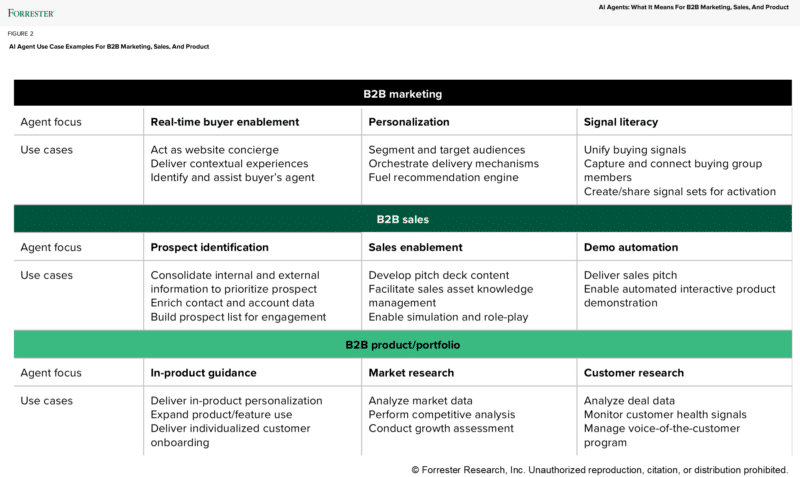
As the Forrester B2B Summit kicked off this week in Phoenix, the analyst firm released a report called “AI Agents: What It Means For B2B Marketing, Sales, And Product.” The report explores the rapidly evolving role of artificial intelligence agents within B2B operations.
In addition to discussing the near-term benefits of using AI agents to improve marketing, sales and product innovation, the report offers guidance on successful AI agent implementations while cautioning against potential pitfalls like over-reliance on hype and neglecting the human element.
Preparing your organization for AI agent success
The report touches on five critical things B2B marketing leaders need to do to prepare their organizations for success with AI agents.
Invest in understanding and strategically planning for AI agent integration
The report emphasizes that B2B marketing is undergoing a significant transformation due to AI agents. As such, marketing leaders need to clearly understand what differentiates these agents, their capabilities (such as reflection, memory, planning, tool use, multiagent collaboration, and autonomy) and their potential advantages for your GTM functions.
What to do now: It is crucial to stay competitive by proactively identifying how AI agents can augment your current marketing efforts and address changing buyer behaviors.
Focus on leveraging AI agents to enhance the buyer experience
AI agents can improve the customer experience and enable more self-directed purchasing journeys. The Forrester report highlights the potential of AI agents to act as personalized concierges that understand, guide and support buyers across various touchpoints.
What to do now: Identify specific points in the buyer journey where AI agents can remove friction, provide personalized information and facilitate the next step. Consider how AI agents can empower self-directed buying and even act as the customer in specific scenarios to gather and analyze data.
Dig deeper: Salesforce Agentforce: What you need to know
Prioritize the implementation of AI agents to automate tasks
AI agents can generate deeper insights and improve marketing productivity and pipeline generation. The Forrester report notes that AI agents can automate BDR/SDR outreach, improve productivity, engage in context-aware interactions and automate digital processes.
What to do now: Explore use cases where AI agents can streamline repetitive tasks, allowing your team to focus on more strategic initiatives. Leverage AI agents to mine vast amounts of data for relevant insights, enabling more informed decision-making and the delivery of role-relevant guidance. AI agents can also assist in generating meaningful pipeline through various marketing activities.
Establish clear guidelines, governance, and rigorous testing protocols
Forrester’s report strongly advises against haphazard adoption and stresses the need for guidelines and governance. To prevent undesirable behaviors, you must implement rigorous testing and validation processes before exposing AI agents to customers.
What to do now: Your human teams will need to upskill to effectively build, customize and interact with AI agents, focusing on articulating SMART goals rather than step-by-step instructions. Plan for multiagent systems and agent-to-agent interactions to maximize their potential.
Prepare your data infrastructure and marketing strategy to account
AI agents are the new stakeholders in the buying process and sources of new data. As B2B buyers increasingly use genAI tools, your AI agents can interact with vendor content on their behalf. Additionally, AI agents can become end users of products, generating new “buyer” data.
What to do now: Expand your understanding of the signal universe to include these AI agent interactions and ensure your data strategy can capture, analyze, and leverage this new information to refine your marketing efforts.
Dig deeper: AI agents will infiltrate your martech stack
The post 5 ways to help your B2B organization succeed with AI agents appeared first on MarTech.
**5 Strategies for Enhancing B2B Success with AI Agents**
In today’s fast-paced digital economy, artificial intelligence (AI) is revolutionizing how businesses operate, especially in the B2B (business-to-business) sector. AI agents—software programs that perform tasks autonomously using machine learning, natural language processing, and data analytics—are becoming indispensable tools for enhancing efficiency, customer engagement, and decision-making. To stay competitive, B2B companies must strategically implement AI agents to drive growth and innovation.
Here are five proven strategies for enhancing B2B success with AI agents:
—
**1. Automate Customer Support and Sales Processes**
AI-powered chatbots and virtual assistants can significantly streamline customer support and sales functions. In a B2B context, where sales cycles are longer and more complex, AI agents can:
– Handle routine inquiries 24/7, freeing up human agents for more complex tasks.
– Qualify leads by analyzing customer behavior and engagement.
– Provide personalized product recommendations based on client data.
– Schedule meetings and follow-ups automatically.
By automating these processes, businesses can reduce response times, improve customer satisfaction, and accelerate the sales funnel.
**2. Leverage Predictive Analytics for Smarter Decision-Making**
AI agents equipped with predictive analytics can analyze vast amounts of historical and real-time data to forecast trends, customer behavior, and market shifts. B2B companies can use these insights to:
– Anticipate client needs and proactively offer solutions.
– Optimize inventory and supply chain management.
– Identify at-risk clients and implement retention strategies.
– Improve pricing models based on demand forecasting.
This data-driven approach enables more informed decision-making and helps businesses stay ahead of the competition.
**3. Enhance Personalization at Scale**
Personalization is no longer just a B2C trend; B2B buyers now expect tailored experiences. AI agents can analyze data from CRM systems, past interactions, and external sources to create highly personalized communications and offerings. For example:
– Customized email campaigns based on client industry, role, or behavior.
– Dynamic website content that adapts to the visitor’s profile.
– Personalized product demos or content recommendations.
This level of personalization fosters stronger client relationships and increases the likelihood of conversion and long-term loyalty.
**4. Optimize Workflow and Internal Operations**
AI agents can also be deployed internally to improve operational efficiency. From automating repetitive administrative tasks to enhancing project management, AI can:
– Schedule meetings and manage calendars intelligently.
– Analyze team performance and suggest improvements.
– Automate data entry and reporting.
– Monitor compliance and flag anomalies.
By reducing manual workload and streamlining processes, companies can focus more on strategic initiatives and innovation.
**5. Strengthen Cybersecurity and Risk Management**
In the B2B space, where transactions often involve sensitive data and large-scale operations, cybersecurity is paramount. AI agents can bolster security by:
– Detecting unusual patterns or anomalies in network traffic.
– Automating threat detection and response.
– Monitoring compliance with industry regulations.
– Predicting potential vulnerabilities before they are exploited.
With AI-driven risk management, businesses can protect their assets, maintain trust, and ensure business continuity.
—
**Conclusion**
AI agents are transforming the B2B landscape by enhancing customer experiences, streamlining operations, and enabling smarter decision-making. By adopting these five strategies—automating customer interactions, leveraging predictive analytics, personalizing at scale, optimizing internal workflows, and strengthening cybersecurity—B2B companies can unlock new levels of efficiency and growth.
As AI technology continues to evolve, early adopters that strategically integrate AI agents into their operations will be best positioned to lead in their industries.

Recent Comments