
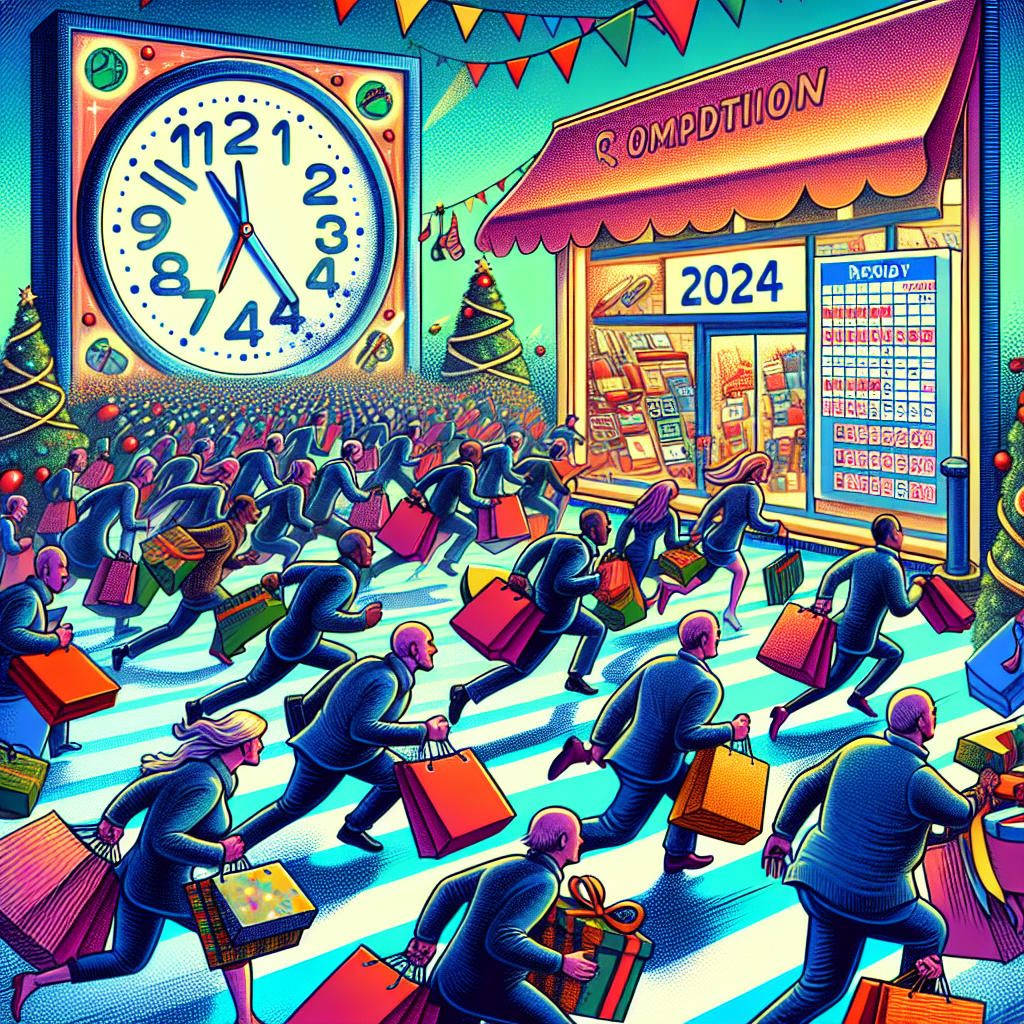

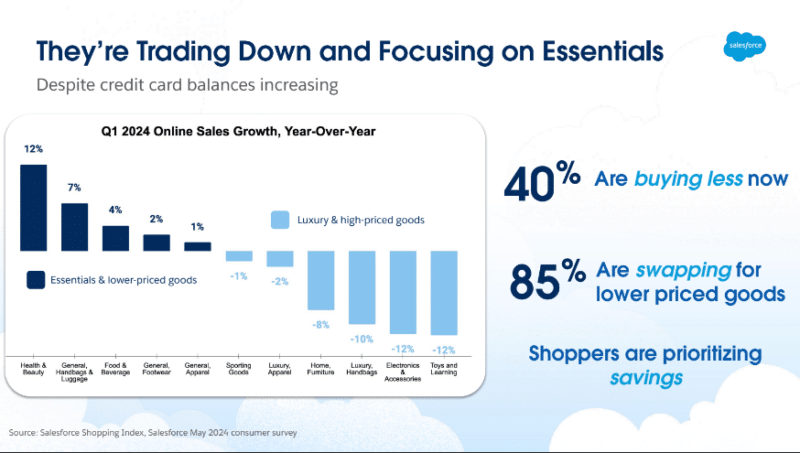
Salesforce expects the 2024 holiday season to be shorter and more competitive with brands facing the challenge of attracting consumers with less purchasing power. Based on global statistics, around 66% of shoppers plan to buy based on price this year, an increase of 20% since 2020. Also, 43% of shoppers are carrying more debt this year than they did in 2023. Additionally, challenges to the supply chain will continue to surface.
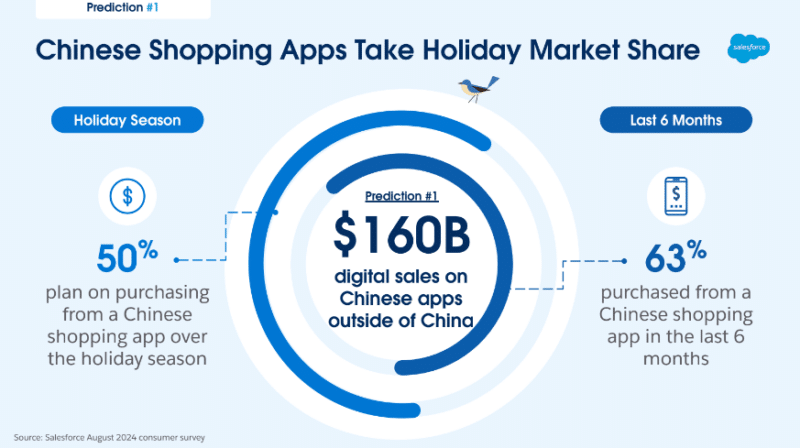
Brands also face the fewest days between Thanksgiving and Christmas since 2019 and fierce competition from the major cut-price Chinese shopping apps, Temu, Shein and AliExpress being joined by TikTok and its growing emphasis on shopability.
“Forty percent are buying less but spending the same,” Rob Garf said of consumers at a press briefing to unveil the forecasts. Garf is VP and GM of retail and consumer goods at Salesforce.
The forecast in figures
Here are the highlights of Salesforce’s predictions:
- YoY online sales growth is expected to be more sluggish than 2023, which itself showed only 3% growth YoY. Salesforce is predicting 2% growth, both globally and for the United States.
- Over 20% of purchases this holiday season will be made on Chinese shopping apps. Look out for TikTok which has seen a 24% growth in shoppers making purchases since April this year.
- Salesforce expects 18% of global orders during the 2024 holiday season to be influenced by a combination of predictive and generative AI, amounting to over $200 billion in global online sales. Over half (53%) of shoppers are interested in using AI to find products.
What brands can do
Salesforce has recommendations for addressing these market challenges:
- Leverage discounts. Two-thirds of consumers plan to wait for Cyber Week when they expect the discounts to be steepest. Prime Day in July saw meaningful discounts generate 3% more sales and a growth in sales volume.
- Use AI to power product recommendations and tailored promotions.
- BOPIS will be big, driving around a third of orders in the shortened pre-Christmas shopping season as consumers look to get orders filled fast and inexpensively.
Salesforce is anticipating a 28% average discount rate during Cyber Week. “Cyber Week itself has the potential to be a really big week,” said Caila Schwartz, director of consumer insights and strategy, retail and consumer goods.
The Salesforce forecast is based on aggregated activity data from more than 1.5 billion global shoppers across more than 64 countries.
The AI question
“This season will be competitive, intense, and no doubt focused on pricing and discounting strategies. It’s never been more important to leverage technology like AI and rely on your customer data for guidance and insight into marketing campaigns — especially the holiday promotional calendar,” said Schwartz in a release.
That makes sense. But despite much evidence that consumers have little trust in AI, Salesforce is also suggesting that using AI to help consumers find “the perfect present” is a good idea. It turns out there might be a very simple reason why both these things can be true.
“They don’t even know in most instances,” said David Oksman, VP marketing and DTC at Samsonite and a guest at the press briefing. “The consumer will never know it’s based off machine learning.” With an AI-powered recommendation engine embedded in search, the consumer is unlikely to know that the products are being surfaced by AI, Garf agreed. What’s critical is a friction-free shopping, ordering and delivery experience.
The post Salesforce sees a shorter, more competitive holiday season in 2024 appeared first on MarTech.
**Salesforce Predicts a Shorter and More Competitive Holiday Shopping Season in 2024**
As the holiday season approaches, retailers and consumers alike are preparing for what has traditionally been the busiest shopping period of the year. However, according to a recent forecast by Salesforce, the 2024 holiday shopping season is expected to be shorter and more competitive than ever before. This prediction has significant implications for retailers, marketers, and consumers, who will need to adapt to the changing dynamics of the holiday retail landscape.
### The Shortening of the Holiday Shopping Season
One of the key insights from Salesforce’s 2024 holiday shopping forecast is the anticipated shortening of the shopping season. Traditionally, the holiday shopping season kicks off in late November with Black Friday and Cyber Monday, extending through December until Christmas. However, Salesforce predicts that in 2024, the peak shopping period will be condensed into a shorter timeframe, with a more intense focus on the weeks immediately following Thanksgiving.
Several factors are contributing to this trend. First, the ongoing shift towards e-commerce has changed the way consumers approach holiday shopping. With the convenience of online shopping, consumers are increasingly waiting until the last minute to make their purchases, confident that they can still receive their orders in time for the holidays. Additionally, the rise of “Buy Online, Pick Up In-Store” (BOPIS) options has further encouraged procrastination, as shoppers can make purchases closer to the holiday and pick them up at their convenience.
Another factor is the growing influence of early holiday promotions. Retailers are increasingly launching holiday sales earlier in the season, sometimes as early as October, in an effort to capture consumer attention and spending before the traditional peak period. While these early promotions can drive sales, they also contribute to a more compressed shopping season, as consumers may complete their holiday shopping earlier, leaving less activity in the final weeks before Christmas.
### Increased Competition Among Retailers
In addition to a shorter shopping season, Salesforce predicts that the 2024 holiday season will be more competitive than ever before. Retailers will be vying for a share of consumers’ holiday budgets in an increasingly crowded and fragmented marketplace.
One of the primary drivers of this increased competition is the continued growth of e-commerce. As more consumers turn to online shopping, retailers are investing heavily in their digital channels, leading to a proliferation of online promotions, discounts, and marketing campaigns. This has created a highly competitive environment where retailers must differentiate themselves to capture consumer attention and drive sales.
Moreover, the rise of social commerce and influencer marketing is adding another layer of competition. Social media platforms like Instagram, TikTok, and Pinterest have become important channels for holiday shopping inspiration and discovery. Retailers are leveraging these platforms to reach younger, tech-savvy consumers, often through partnerships with influencers who can drive traffic and sales. As a result, the holiday shopping landscape is becoming increasingly fragmented, with consumers being bombarded with promotions from a wide range of sources.
### The Role of Technology in Navigating the 2024 Holiday Season
In this highly competitive and condensed holiday shopping season, technology will play a crucial role in helping retailers succeed. Salesforce emphasizes the importance of leveraging data and artificial intelligence (AI) to better understand consumer behavior, personalize marketing efforts, and optimize inventory management.
Retailers that can effectively harness the power of AI and data analytics will be better positioned to anticipate consumer demand, tailor their promotions, and ensure that they have the right products in stock at the right time. For example, AI-driven product recommendations can help retailers increase average order values by suggesting complementary items to shoppers. Similarly, predictive analytics can help retailers forecast demand more accurately, reducing the risk of stockouts or overstocking.
Additionally, Salesforce highlights the importance of creating seamless and personalized shopping experiences across all channels. Consumers expect a consistent experience whether they are shopping online, in-store, or through a mobile app. Retailers that can deliver a cohesive omnichannel experience, with personalized recommendations and convenient fulfillment options, will have a competitive edge in the 2024 holiday season.
### Consumer Behavior and Expectations
While the holiday shopping season may be shorter and more competitive, consumer expectations remain high. Shoppers are looking for convenience, value, and a seamless experience across all touchpoints. Retailers that can meet these expectations will be well-positioned to succeed in the 2024 holiday season.
One of the key consumer trends identified by Salesforce is the growing demand for sustainability and ethical practices. Shoppers are increasingly conscious of the environmental and social impact of their purchases, and they are seeking out brands that align with their values. Retailers that can demonstrate a commitment to sustainability, whether through eco-friendly packaging, ethical sourcing, or carbon-neutral shipping options, will resonate with these values-driven consumers.
Another important trend is the continued rise of mobile shopping. As smartphones become the primary device for online shopping, retailers must ensure that their mobile experiences are optimized for speed, ease of use, and security. Mobile payment options, such as digital wallets and

Recent Comments