


Here’s a question to consider: Does it take more than 250 touchpoints to close a B2B SaaS deal in today’s world?
That’s a lot of touchpoints. But B2B software sales are incredibly complicated things. They involve a lot of people.
Any sizable B2B SaaS deal includes:
- A buying committee.
- Influencers (not the ones you see on TikTok, but old-school influencers).
- Lawyers.
- Procurement professionals.
- Executives.
Each of these roles has its own horse in the B2B SaaS buying race, which isn’t really a race at all because it takes months, in many cases, to get all of these people to agree on anything.
Here’s what happened on LinkedIn this week when HockeyStack, a software vendor that helps marketers with attribution and account analysis, released a report on B2B touchpoints.
(Disclosure: I discussed a previous HockeyStack report with Canberk Beker, who used to lead growth for HockeyStack, but recently left the company.)
Here’s what the HockeyStack touchpoint report found
HockeyStack uses anonymized data from its clients to put together reports and paint a picture of how B2B marketing efforts lead to sales. The dataset is, therefore, limited to those companies. You can read the touchpoint report findings on the HockeyStack site.
Here are some of the high-level findings:
- The average number of touchpoints required to generate an MQL increased by 31% from 2023 to 2024 — it now takes 71 touchpoints for a B2B SaaS company to generate an MQL.
- In 2024, companies need 2,879 impressions and 266 touchpoints to close a deal. That’s a 10% increase in impressions and a 20% increase in touchpoints from 2023.
- A $100K+ deal requires 1,893 impressions until a website visit and thousands of more touchpoints to win the deal.
Dig deeper: The 4 types of content buyers want
And then comes the distribution…
Like a lot of software vendors that have reports, surveys and data to promote, HockeyStack found a partner to help spread the word. HockeyStack teamed up with Exit Five, a B2B marketing community and education outfit founded by former Drift marketing executive Dave Gerhardt, to promote the report. And that’s what the Exit Five team did on LinkedIn.
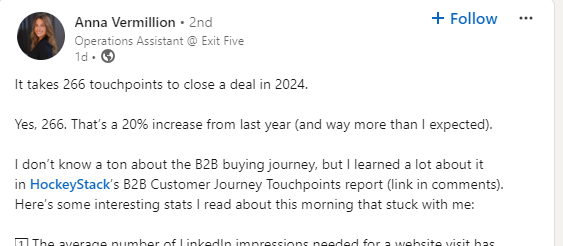
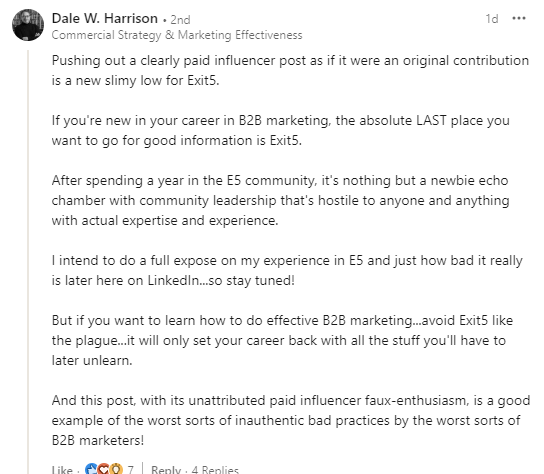
The world of sponsored posts and paid promotion on and off social media is murky. That Exit Five’s people wrote about the report in LinkedIn posts is nothing new — either for Exit Five or countless other organizations.
But some of the initial feedback on the report focused on just that. One thread of this story is about influencers and paid promotion and some people’s opinions about Exit Five.
Dig deeper: Why does everyone seem to be re-thinking B2B marketing?
And then the schism comes forward…
The other thread to this story is about a schism in the B2B marketing world in general.
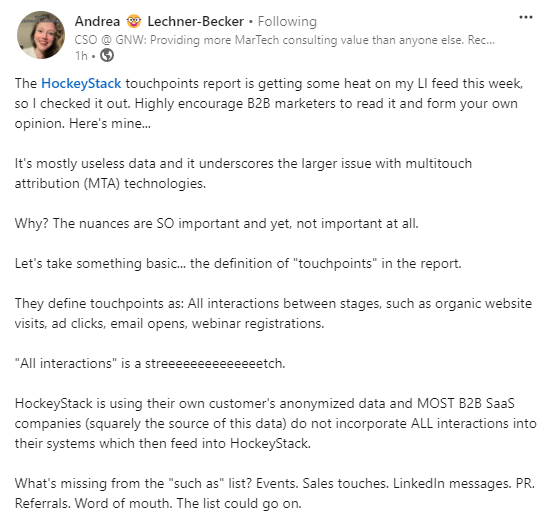
Part of HockeyStack’s appeal to B2B marketers is its offer of hope for attribution. Marketers who believe everything is measurable and it’s possible to accurately see how their spend leads to revenue were waiting for a tool to do what HockeyStacks claims to do.
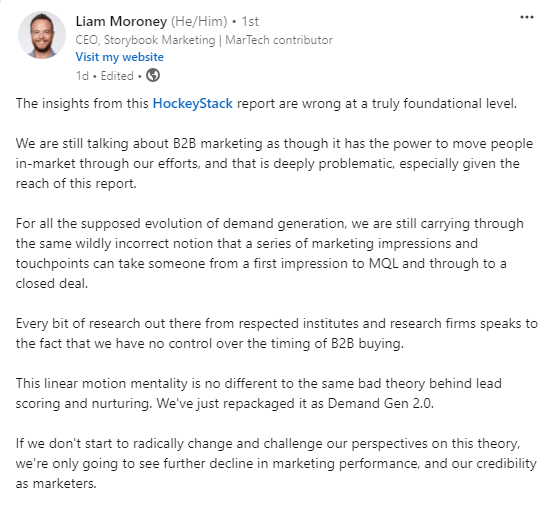
But there’s another school of marketers in B2B who believe, among other things, this obsession with attributing spend to revenue isn’t really marketing at all. It ignores the importance of brand marketing and brand recognition, they say, and it seems to promote the idea that marketers can push B2B buyers (committee, influencers, lawyers and all) into the market to make a purchase.
(Disclosure: Both Eric Dates and Liam Moroney are MarTech contributors.)

This divide in B2B marketing is becoming more pronounced
When a vendor like HockeyStack puts out a report, it expects opinions. That’s not a bad thing. Agree or disagree, the brand becomes part of the conversation.
Love or hate Exit Five, the issue around transparency and sponsored posts is real. LinkedIn users should, by now, understand everyone has an angle.
The most interesting part of the whole story is the battle for the soul of B2B marketing. There are now two camps for sure (and maybe more) with two very different views on what it is and how it should be done.
The discussion around this report highlights the division.
The post What the LinkedIn debate over a HockeyStack report says about B2B marketing appeared first on MarTech.
**Insights from the LinkedIn Debate on a HockeyStack Report: Implications for B2B Marketing**
In the fast-evolving world of B2B marketing, data-driven insights are the cornerstone of effective decision-making. Recently, a report published by HockeyStack, a leading B2B SaaS analytics platform, sparked a lively debate on LinkedIn. The report delved into key trends, challenges, and strategies in B2B marketing, prompting marketers, sales professionals, and industry experts to weigh in on its findings. The ensuing discussion provided valuable insights into the future of B2B marketing and highlighted several key implications for businesses looking to stay ahead of the curve.
### The HockeyStack Report: A Snapshot
HockeyStack’s report focused on the current state of B2B marketing, with a particular emphasis on attribution models, customer journey mapping, and the role of data in decision-making. The report highlighted several critical findings:
1. **Attribution Challenges**: Many B2B marketers struggle to accurately attribute revenue to specific marketing efforts, especially in complex, multi-touchpoint customer journeys.
2. **Data Silos**: The report emphasized the ongoing issue of data silos, where marketing, sales, and customer success teams operate in isolation, leading to fragmented customer insights.
3. **Content Saturation**: With the proliferation of content marketing, standing out in a crowded digital landscape has become increasingly difficult.
4. **Personalization**: The report underscored the growing importance of personalized marketing, with B2B buyers expecting tailored experiences similar to those in B2C.
These findings set the stage for a robust debate on LinkedIn, where professionals from various industries shared their perspectives on the report and its implications for B2B marketing.
### Key Takeaways from the LinkedIn Debate
#### 1. **The Attribution Dilemma: Moving Beyond Last-Click Attribution**
One of the most heated topics in the LinkedIn discussion was the challenge of attribution. Many marketers agreed with HockeyStack’s assertion that traditional attribution models, such as last-click or first-touch, are insufficient for understanding the full customer journey in B2B. Given the complexity of B2B sales cycles, which often involve multiple stakeholders and touchpoints, it’s difficult to pinpoint which marketing efforts are driving conversions.
Several participants advocated for the adoption of **multi-touch attribution models** that account for the entire customer journey. Others suggested that **AI-driven attribution** could be a game-changer, providing more accurate insights by analyzing patterns across various touchpoints. However, some marketers expressed concerns about the complexity and cost of implementing advanced attribution models, particularly for smaller businesses.
**Implication for B2B Marketers**: To improve attribution accuracy, B2B marketers should consider adopting multi-touch or AI-driven attribution models. However, it’s essential to balance the complexity of these models with the available resources and ensure that they align with the company’s overall marketing strategy.
#### 2. **Breaking Down Data Silos: The Need for Cross-Departmental Collaboration**
Another key theme in the LinkedIn debate was the issue of data silos. Many participants agreed that the lack of integration between marketing, sales, and customer success teams is a significant barrier to effective B2B marketing. When these departments operate in isolation, it becomes difficult to gain a holistic view of the customer journey, leading to missed opportunities and inefficiencies.
Several contributors emphasized the importance of **cross-departmental collaboration** and the need for a unified data platform that allows all teams to access and share customer insights. Some pointed to the rise of **revenue operations (RevOps)** as a potential solution, where marketing, sales, and customer success teams are aligned under a single operational framework.
**Implication for B2B Marketers**: To overcome data silos, B2B companies should prioritize collaboration between departments and invest in integrated data platforms. Implementing a RevOps approach can help ensure that all teams are working towards a common goal and have access to the same customer insights.
#### 3. **Content Saturation: Quality Over Quantity**
The HockeyStack report highlighted the growing challenge of content saturation in the B2B space, and this point resonated strongly with LinkedIn users. Many marketers acknowledged that producing high volumes of content is no longer enough to capture the attention of B2B buyers. Instead, the focus needs to shift towards creating **high-quality, value-driven content** that addresses the specific pain points of the target audience.
Several participants suggested that **interactive content** (e.g., quizzes, assessments, and calculators) and **video marketing** are effective ways to stand out in a crowded marketplace. Others emphasized the importance of **thought leadership** and **original research** as ways to differentiate a brand and build trust with potential buyers.
**Implication for B2B Marketers**: In an era of content saturation, B2B marketers should prioritize quality over quantity. Creating interactive, engaging, and research

Recent Comments