
AI-driven changes coming to inboxes will put even more pressure on your email subject lines. Are you prepared for the challenge?
The practice isn’t widespread yet, but as more inbox users adopt Apple Mail with Apple Intelligence or Google’s proprietary AI for Gmail, you can expect to see AI-driven automatic extraction replace your preheader copy with content they pull from your email message.
Where your subject line and preheader once worked in tandem to persuade subscribers to open and act on your emails, your subject lines will have to do more of the persuasion work because you can’t control what will show up in the preheader field.
The cost of deception
You might think you need to make your subject lines even catchier to offset this loss of preheader copy, but beware crossing the line where cleverness becomes deception. It’s notoriously thin.
Deception can erode trust. Your emails reflect on your brand, and customers don’t do business with brands they don’t trust. A 2022 Gartner study found that 30.4% of subscribers would opt out of emails whose subject lines didn’t line up with the message content. Subscribers might also ignore them or report them as spam. That endangers the financial success of your email program and can even affect deliverability if spam complaints go up and email activity goes down.
You could even face fines or other legal action under laws like CAN-SPAM in the United States, Canada’s Anti-Spam Law (CASL), the EU’s General Data Protection Regulation (GDPR) and the UK’s Privacy and Electronic Communications Regulations. For CAN-SPAM alone, fines can reach $51,744 for each email violation.
Is it deceptive marketing, good copywriting or CRM gone rogue?
That’s the question we’ve always had to answer with our subject lines. Inboxes are more crowded than ever, and subscriber attention is more distracted. We have to get people’s attention somehow, and sometimes stunts pay off.
However, these tactics are becoming more common. They could tarnish not only your brand’s name but also email marketing as a channel.
Most advice on writing effective subject lines includes at least a brief reminder not to deceive or mislead subscribers into opening an email. You would think it would qualify as a generally accepted best practice by now. So, why is my inbox filled with subject lines like these?
- Did you forget something?
- RE: Your $100 credit.
- Your cart is waiting for you.
- RE: Your cart — you need to see this today!
- FWD: Your exclusive FREE SHIPPING notification.
- FWD: Don’t open this email.
At first glance, most of these all look like legitimate subject lines. They don’t have funky spelling, nonstandard fonts or excess punctuation, all of which can be spam markers. But they have one thing in common. Not one of them stems from any actions I took or conversations I had with the brands that sent them. I did not leave something in a cart, ask about a $100 credit or get a free shipping offer from a friend.
That’s enough for me to classify these emails as deceptive. They might not break a law, or they might qualify as misdemeanors instead of felony-level deception. Nobody’s telling me I won a car or some other big prize. But they all come from brands I did subscribe to and which I even sometimes buy from. Because they appear bogus, I don’t feel compelled to open the emails.
I realize I might sound harsh in this assessment, but that’s because the stakes are getting higher for email marketers. Between AI content extraction and images-off viewing, we have less control over the email experience than we think. And with consumers becoming more suspicious about email that doesn’t quite look right, we need to be as transparent and honest as possible.
There’s another explanation for emails that appear to use deceptive tactics, of course, and one I hinted at earlier. Emails like this might indicate problems with your CRM platform. Is it creating false matches between customer IDs and behavior like abandonment or order confirmations?
Earlier this year, OpenTable mistakenly sent a restaurant reservation-cancelation confirmation email to a group of its users, including me. I was startled because I had used Open Table to snag a table at that very restaurant — 10 years ago. OpenTable sent a reassuring apology email a few hours later.
Not everyone who sends a misleading or deceptive subject line is a crook looking to steal your personal information or hoodwink you into thinking you’re getting a deal when you aren’t. We just need to find subject lines that excite or intrigue the imagination without making our customers feel deceived or annoyed when the email content doesn’t reflect the subject line.
5 categories of deceptive subject lines
Not included in this list are subject lines for fraudulent emails, like phishing or spear phishing, or obvious spam. Instead, these are five categories of subject lines that come from everyday retail brands. I subscribe to some of these and found others in Bird’s eDataSource database, which pixelates any emails or content that are 1:1 or personalized. None of these fall into that category.
One thing you might notice: several of these could go in more than one category. Multiple misdemeanors, you might say!
1. Fake abandonment email: Swimsuits for All (via eDatasource)
Subject line: “RE: Your pending order”
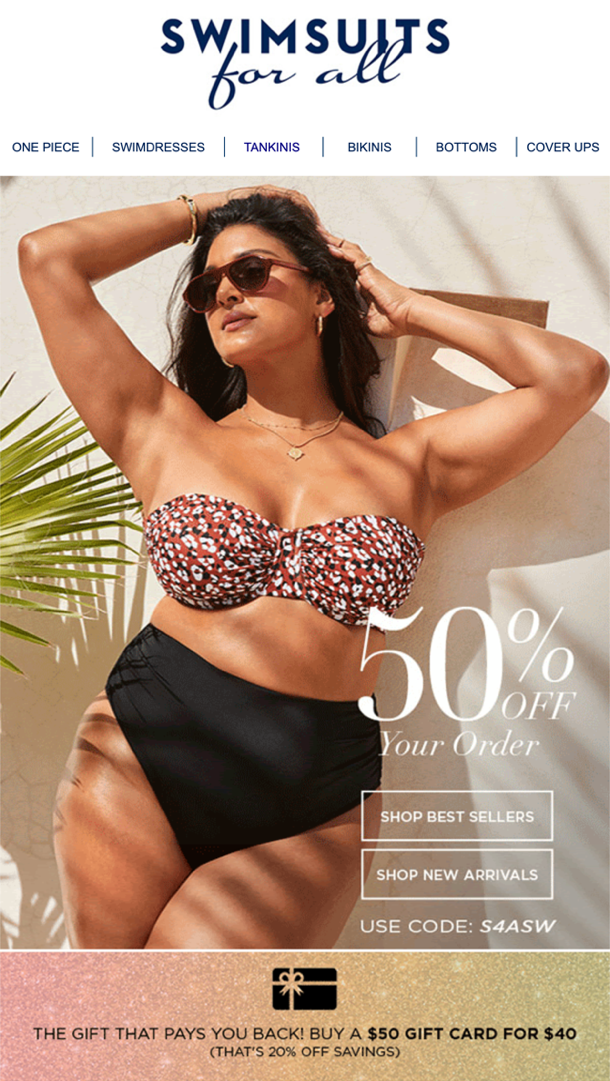
This email commits dual sins: It’s a promotional email disguised as a reply email. And, it implies you have an order awaiting completion or acceptance. Nothing in this email supports either interpretation. (See No. 3 below.)
Let’s think about the implications for a minute. Do you really want to worry your customers? Should their immediate thought about your email in their inboxes be “Oh no!” I would rather think “Oh wow!”
2. Fake forward: OneStopPlus (via eDatasource)
Subject line: FWD: $100 Credit
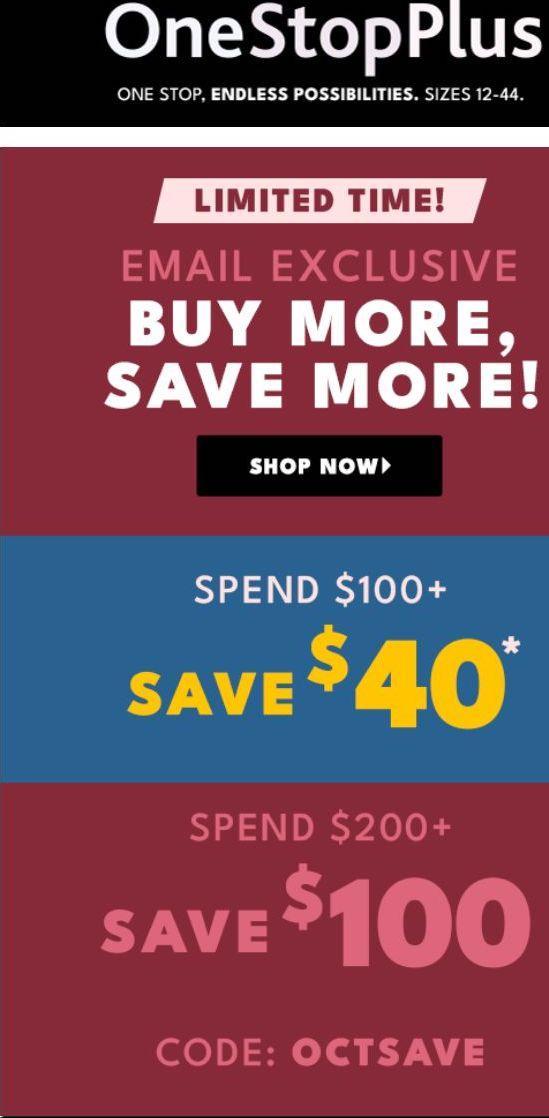
Here’s another email that uses two deceptive tactics. “FWD” implies this email is coming from a person, maybe someone in customer service who is telling me I have “free” cash to spend. That’s what “credit” implies to me.
However, I discovered I have to spend a set amount to receive the “credit.” It’s a common retail tactic that toes the line of propriety. I interpret a credit as something I have earned and can exchange for something at no cost to me.
3. Fake leak/error/oops email: Cernucci (via eDatasource)
Subject line: “FWD: Code Error”
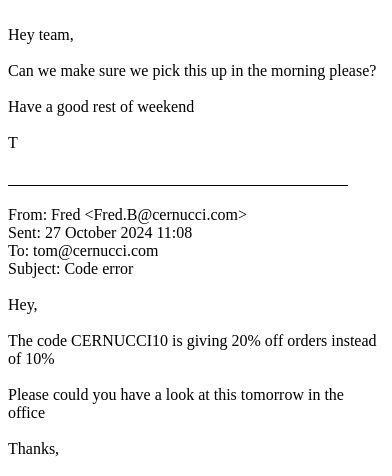
Uh oh! Somebody goofed and sent this email to the wrong person who then forwarded it to a whole bunch of other people who are now going to get a bigger discount than they’re supposed to! And you’d better not wait because it’s going to be corrected soon, and you don’t want to miss out.
Well, no. It’s another in a long line of fake mistakes. The misdirected office memo is one take on this tactic. Another is the fake “oops” email a brand sends out to work up interest in a promotional email. The email went out to the wrong list. Or the site was down, or checkout wasn’t working, or the offer code was wrong/broken/missing.
At one time an email with “Oops!” in the subject line piqued people’s curiosity and drove outsize responses. But they have lost their punch as brands overused them.
Note: “FOMO,” or “fear of missing out,” can be an effective persuasion tactic to prod customers into acting instead of letting the email ferment in the inbox. But you must use it judiciously. If not, the tactic loses its punch and your customers won’t trust or believe you.
4. Fake abandonment/resend email: 8 Sleep (sent to me)
Subject line: “Did you forget something?”
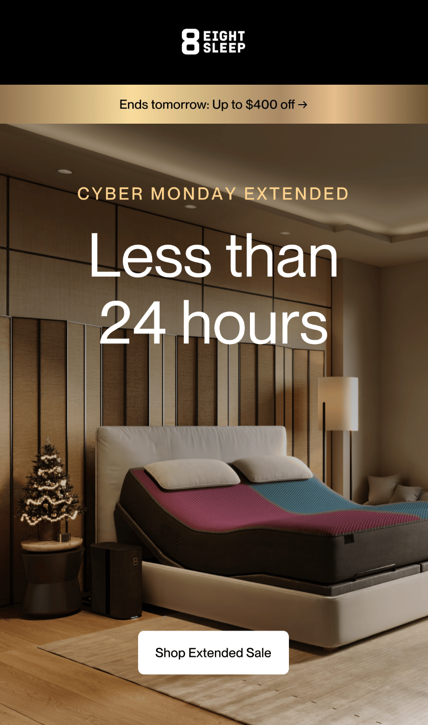
This email came at the end of a multiple-email campaign for Cyber Monday. All of the emails in this campaign looked much the same, although with different discount amounts. It made me wonder if this email was another way to resend promotions that didn’t drive enough action the first time around.
While resends themselves aren’t a bad practice, they require special handling. I did not open any of the emails in this campaign, so I should not be considered a prime target for a resend. It’s better to target customers who opened but did not click on the email, or customers who clicked but didn’t purchase.
In any case, the subject line is deceptive because it implies that I browsed the brand via the email, which I had not done.
5. Fake reply: Ellos (sent to me)
Subject line: Fw: 50% OFF Code you requested
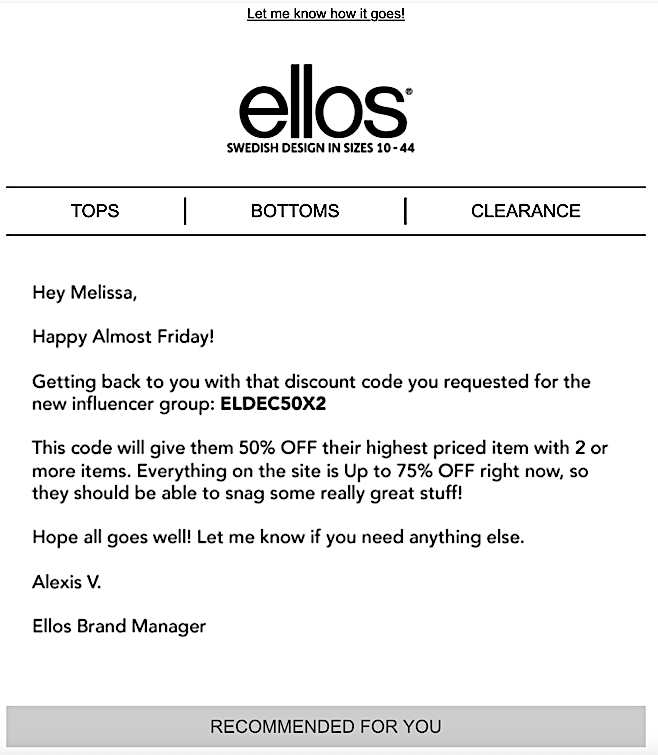
And now we come to an email employs all of these deceptive tactics in a single message:
1. It uses the “fake forward” tactic. (See No. 2 above).
2. It looks like a “fake reply,” even though it doesn’t use the “Re:” in the subject line, because the email content purports to be a private conversation between a fashion influencer and a brand representative.
3. As I mentioned, this looks like a private message mistakenly sent to the entire email list. As we saw in No. 2 above, it give you the impression that you’re peeking into a great deal that you’re not entitled to, so of course you’re going to jump on it, right?
At first glance this looks effective. A hallmark of influencer marketing is being able to share VIP deals with your audience, which builds up your following. And the language is definitely conversational. It sounds as if someone with a healthy Insta or TikTok following asked for a favor and was granted one.
But this strains credulity. I’m not even sure how this mistake could be made with any of the email platforms I work with, even the simplest ones. Your customers don’t know that, of course. And maybe the brand pulled off this stunt. But at best it could be a one-time send. Repeating it makes you look either incompetent or untrustworthy. Either way, it can hurt your brand. By the way — I am not Melissa, nor a fashion influencer.
Dig deeper: What every marketer should watch for in 2025
Should these marketers go to email jail?
No, because they aren’t trying to steal information. I don’t believe they are trying to do anything but drive another sale. However, I’m not a typical customer. I know what’s going on behind the scenes.
If you send emails with subject lines like these, each one can chisel away at your brand’s equity with its target markets. No one likes to be tricked unless it’s April Fool’s Day, and then you’re prepared for deceit. When you’re doing your day-to-day shopping? Not so much.
It also doesn’t stop with your brand. It can spread throughout the channel. Email has a hard enough time getting respect. We don’t need to contribute to that through our own actions.
If you struggle to write subject lines that get attention and action, here’s a better idea:
Go into your campaign history and create three lists: the campaigns with the top 10 open rates, campaigns with the 10 highest click rates, and campaigns with the 10 highest conversion rates.
You’ll likely find these campaigns are not the same. I usually use this test to illustrate why relying on the open rate to measure success is flawed, but here it can show you what’s more likely to move your customers to action.
Whatever you do with your subject line, always be sure it supports your campaign message. The most benign, transparent, and honest subject lines won’t help you if customers open your emails only to find something entirely different from what they expect.
Customer trust is hard to win and easy to lose. The inbox can be your reliable ally in the battle.
The post Are these email subject lines deceptive, clever copywriting or bad data at work? appeared first on MarTech.
# Analyzing Email Subject Lines: Deceptive Tactics, Clever Copywriting, or Data Errors?
Email subject lines are the digital equivalent of a first impression. They are the gateway to a recipient’s inbox, determining whether an email is opened, ignored, or sent straight to the trash. Crafting the perfect subject line is both an art and a science, requiring marketers to balance creativity, clarity, and strategy. However, not all subject lines are created equal. Some are brilliant examples of clever copywriting, while others veer into deceptive tactics or suffer from glaring data errors. This article explores the nuances of email subject lines, examining the fine line between effective marketing and unethical practices.
—
## The Role of Email Subject Lines in Marketing
Email subject lines are critical in driving open rates and engagement. According to research, 47% of email recipients decide whether to open an email based solely on the subject line. A well-crafted subject line can boost click-through rates, foster brand loyalty, and even drive revenue. However, the pressure to stand out in crowded inboxes has led to a range of strategies—some innovative, some questionable, and some outright problematic.
—
## Deceptive Tactics: The Dark Side of Email Marketing
Deceptive subject lines are designed to manipulate recipients into opening emails under false pretenses. While they may achieve short-term results, they often damage trust and harm brand reputation in the long run. Here are some common deceptive tactics:
### 1. **False Urgency**
– Subject lines like “Your Account Will Be Closed Today!” or “Final Notice: Act Now!” create a sense of panic, pressuring recipients to open the email. While urgency can be a legitimate marketing tool, false claims erode trust when recipients realize there is no real deadline or consequence.
### 2. **Misleading Promises**
– Promising something that the email does not deliver is a surefire way to alienate your audience. For example, a subject line that reads “Congratulations, You’ve Won!” only to reveal a discount code in the email body is likely to frustrate recipients.
### 3. **Impersonation**
– Some emails mimic trusted entities, such as banks or government agencies, to trick recipients into opening them. These tactics are not only unethical but also illegal under anti-phishing laws.
### 4. **Clickbait**
– Subject lines like “You Won’t Believe This!” or “This One Trick Will Change Your Life!” may generate curiosity clicks, but they often fail to deliver meaningful content, leaving recipients disappointed.
Deceptive tactics may boost open rates temporarily, but they come at the cost of long-term credibility. Worse, they can lead to spam complaints, unsubscribes, and even legal repercussions under regulations like the CAN-SPAM Act and GDPR.
—
## Clever Copywriting: The Art of Persuasion
On the other end of the spectrum, clever copywriting uses creativity and psychology to craft subject lines that are engaging, relevant, and ethical. Here are some techniques that marketers use to capture attention without crossing ethical boundaries:
### 1. **Personalization**
– Subject lines that include the recipient’s name or reference past interactions feel more tailored and relevant. For example, “John, Your Favorite Sneakers Are Back in Stock!” is likely to resonate with the recipient.
### 2. **Curiosity**
– Piquing curiosity without misleading the reader is a fine art. Subject lines like “The Secret to Better Sleep” or “What’s New in Your Area?” intrigue recipients while staying truthful.
### 3. **Urgency and Scarcity**
– Phrases like “Limited Time Offer” or “Only 3 Left in Stock” can drive action when they reflect genuine urgency. The key is to ensure that the urgency is real and not fabricated.
### 4. **Humor and Creativity**
– A witty or unexpected subject line can make an email stand out. For example, “We Like Big Discounts and We Cannot Lie” combines humor with a clear value proposition.
### 5. **Value Proposition**
– Clearly stating the benefit of opening the email is a straightforward yet effective approach. For instance, “Save 50% on Your Next Purchase” immediately communicates value.
Clever copywriting respects the recipient’s intelligence and builds trust over time, fostering a positive relationship between the brand and its audience.
—
## Data Errors: When Automation Goes Wrong
In the age of marketing automation, data-driven personalization has become a cornerstone of email marketing. However, when data errors occur, they can lead to embarrassing or confusing subject lines. Here are some common pitfalls:
### 1. **Placeholder Text**
– Subject lines like “Hi [First Name], Check Out Our New Arrivals!” are a clear sign of a failed merge field. Such errors make emails look unprofessional and can alienate recipients.
### 2. **Irre

Recent Comments