


HubSpot’s SEO strategy is the talk of the SEO world today. Why? Just look at this image:
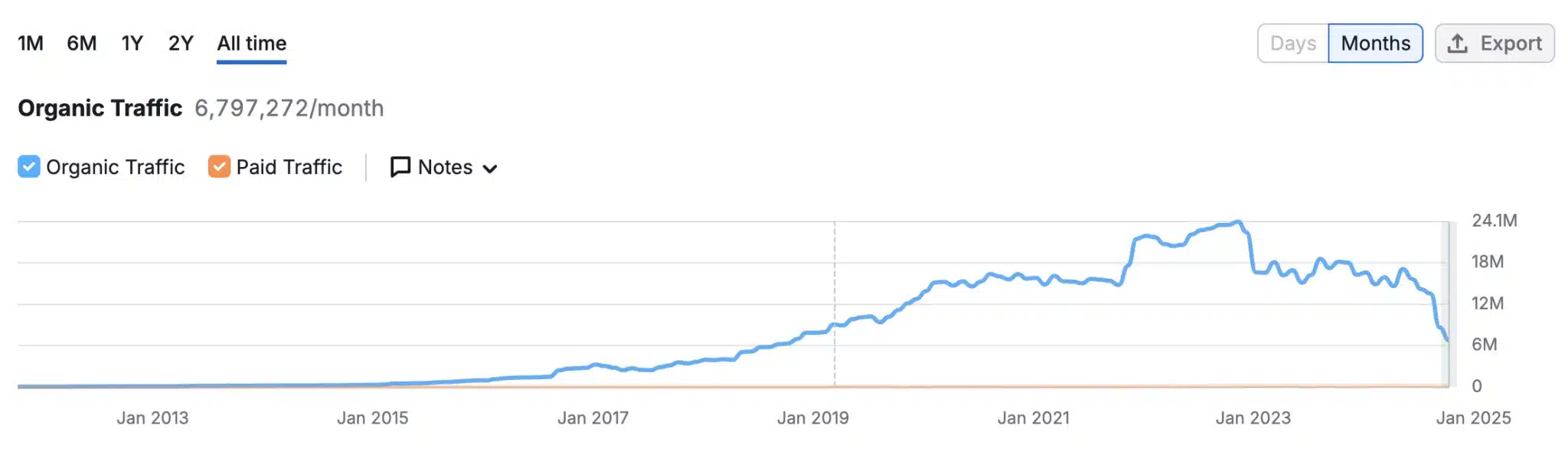
Organic traffic appears to have declined sharply, dropping from 13.5 million in November to 8.6 million in December, according to Semrush (disclosure: MarTech is a Semrush company). HubSpot’s blog seems to have taken most of the impact.
It may be that Google wants to stop rewarding websites that publish content outside their area of expertise – that lack depth and topical authority on. The type of content that is more geared toward getting Google organic traffic than being written for people. What Google might call “SEO-first content” (or helpful content).
Some of the topics seeing huge declines for HubSpot appear to be blogs about famous quotes, writing a resignation letter, and cover letter examples.
Why we care. SEO just keeps getting harder. HubSpot, for years, executed a masterful content strategy that was emulated by countless other brands and websites. For years, it was considered by many to be the gold standard of B2B vendor blogs. Now, it appears that SEO playbook is no longer working, likely due to a combination of Google core updates and AI Overviews. Think depth, not breadth.
SEO reactions. Some SEOs are blaming the huge traffic drop on HubSpot’s lack of topical authority, while others pointed to possible “thin content” issues. Here’s a sampling of some of the reactions to the news of HubSpot’s SEO results falling off a cliff:
Taylor (Berg) Chapa, group manager, web strategy and experience at Headspace, had a great thread on X, some highlights:
- “I don’t want a [mental health] company to rank for ‘why do I feel funny when I’m in love’ or ‘Thanksgiving’ or ‘love quotes’ that’s not a good use of resources and we weren’t the site for that.”
- “Our largest competitor was focusing so hard on traffic that they couldn’t even rank for MH keywords. And they still don’t. and it’s all because they have a ‘traffic at all costs’ keyword strategy.
Gemma Brunson wrote on X:
- “So about that massive drop to the HubSpot blog… just look what they’ve been publishing. They deserve the wreckage for being such lazy SEOs and content marketers!”
Chris Long had an interesting analysis of HubSpot’s blog traffic on X.
Adam Ryan, CEO of Workweek, wrote on X:
- “If this is true, this is very bad for companies who deeply depend on SEO. HubSpot has one of the very best blogs, invests heavily in that content, and has for a decade+. If they can’t…”
If this is true, this is very bad for companies who deeply depend on SEO.
HubSpot has one of the very best blogs, invests heavily in that content, and has for a decade+.
If they can’t… https://t.co/XrfAL5RFYg
— Adam Ryan
(@AdamRy_n) January 23, 2025
The post HubSpot’s SEO collapse: What went wrong and why? appeared first on MarTech.
# Analyzing HubSpot’s SEO Decline: Causes and Lessons Learned
In the ever-evolving world of digital marketing, even industry leaders are not immune to challenges. HubSpot, a pioneer in inbound marketing and a trusted name in the software-as-a-service (SaaS) space, has long been a powerhouse in search engine optimization (SEO). However, recent trends have shown a decline in HubSpot’s SEO performance, raising questions about the causes and the lessons that can be drawn from this situation. In this article, we will analyze the factors contributing to HubSpot’s SEO decline and explore the valuable insights that businesses can glean from their experience.
—
## **Understanding HubSpot’s SEO Legacy**
HubSpot has been a dominant player in the SEO landscape for years, leveraging its extensive content marketing strategy, thought leadership, and inbound methodology to rank highly on search engines. The company’s blog, resource library, and educational content have been instrumental in driving organic traffic, generating leads, and establishing authority in the marketing and sales space.
HubSpot’s success was built on three pillars:
1. **Content Volume and Quality**: HubSpot consistently produced high-quality, in-depth content on topics related to marketing, sales, and customer service.
2. **Keyword Optimization**: The company strategically targeted high-volume, high-intent keywords to capture organic traffic.
3. **Backlink Strategy**: HubSpot earned backlinks from authoritative websites, further boosting its domain authority and search rankings.
Despite this strong foundation, HubSpot has seen a noticeable dip in its SEO performance in recent years. Let’s explore the potential reasons behind this decline.
—
## **Causes of HubSpot’s SEO Decline**
### 1. **Increased Competition**
The digital marketing space has become increasingly crowded, with new players entering the market and existing competitors ramping up their SEO efforts. Companies like Semrush, Ahrefs, and Moz, as well as niche content creators, have been producing high-quality content targeting the same keywords and audiences as HubSpot. This heightened competition has made it harder for HubSpot to maintain its dominance.
### 2. **Content Saturation**
HubSpot has been a prolific content creator for over a decade, covering a vast array of topics. However, this extensive content library may have reached a point of diminishing returns. Many of the topics HubSpot has written about are now saturated, with multiple articles competing for the same keywords. This cannibalization of content can dilute SEO performance.
### 3. **Algorithm Updates**
Search engine algorithms, particularly Google’s, are constantly evolving. Recent updates, such as the Helpful Content Update and Core Web Vitals, have placed greater emphasis on user experience, content relevance, and authority. While HubSpot has historically excelled in these areas, the sheer volume of its content may have made it challenging to keep all pages up-to-date and aligned with new algorithm requirements.
### 4. **Shift in Search Intent**
User search behavior has shifted over time, with more people seeking highly specific, actionable content rather than broad, general information. HubSpot’s content strategy, which often focuses on comprehensive guides and long-form articles, may not always align with these evolving search intents. Competitors offering more niche or targeted content may be capturing a larger share of organic traffic.
### 5. **Over-Reliance on Legacy Content**
HubSpot’s older content has historically driven significant traffic, but aging content can lose relevance and authority over time. If not regularly updated, it risks being outranked by fresher, more relevant content from competitors. HubSpot’s vast content library may make it difficult to maintain and refresh all its articles effectively.
### 6. **Technical SEO Challenges**
As websites grow in size, they often face technical SEO challenges, such as slow page load times, broken links, or poor mobile optimization. While HubSpot is known for its robust platform, even small technical issues can have a compounding effect on SEO performance, especially in a competitive environment.
—
## **Lessons Learned from HubSpot’s SEO Decline**
HubSpot’s experience offers valuable lessons for businesses looking to build and sustain their SEO performance:
### 1. **Adapt to Changing Algorithms**
SEO is not a one-time effort but an ongoing process that requires adaptation to changes in search engine algorithms. Businesses must stay informed about updates and adjust their strategies accordingly. For example, prioritizing user experience, mobile optimization, and content relevance can help maintain rankings.
### 2. **Focus on Content Refresh**
Aging content can become a liability if it is not updated regularly. Businesses should audit their content libraries to identify underperforming pages and refresh them with updated information, new insights, and optimized keywords. This can help reclaim lost traffic and improve rankings.
### 3. **Diversify Content Strategy**
Relying solely on long-form, general content is no longer sufficient. Businesses should diversify their content strategy to include niche, actionable, and multimedia content (e



Recent Comments