


Generative AI is making inroads in search marketing, but it needs to win consumer trust if it wants to become a “Google killer,” according to a new study by Semrush and Statista. That said, genAI’s capabilities continue to win over digital marketers who find it a big boost to productivity and ROI.
Google has been the dominant force in the online search market for more than 20 years. The November 2022 release of the generative AI-powered chatbot ChatGPT had people predicting an end to the search engine’s position. ChatGPT attracted over 1 million users in five days and 5 million in the following months.
In 2023, 13 million U.S. adults used generative AI as their primary tool for online searches in 2023, a figure that is expected to reach over 90 million by 2027, according to the report “Online Search After ChatGPT” (registration required).
However, comparing that with traditional search engine usage is like comparing a matchstick to the sun. Last year, Google had 18 billion visits per month from the U.S. alone. ChatGPT’s total monthly traffic only surpassed 10 million visitors in April.
While many in the tech industry say consumers would warm to gen AI if they understood it better, it is clear that they have a good understanding of its largest problem: Reliability.
Using AI didn’t improve consumers’ opinion of it
In 2023, before many consumers had used gen AI tools, a survey of people in the U.S., U.K., Australia and India found that over 60% didn’t think AI was secure or trustworthy. The use of AI didn’t improve the situation. A 2024 survey of U.S. gen AI users found “most did not trust the content and did not believe it would enhance their search experience,” according to the Semrush report.
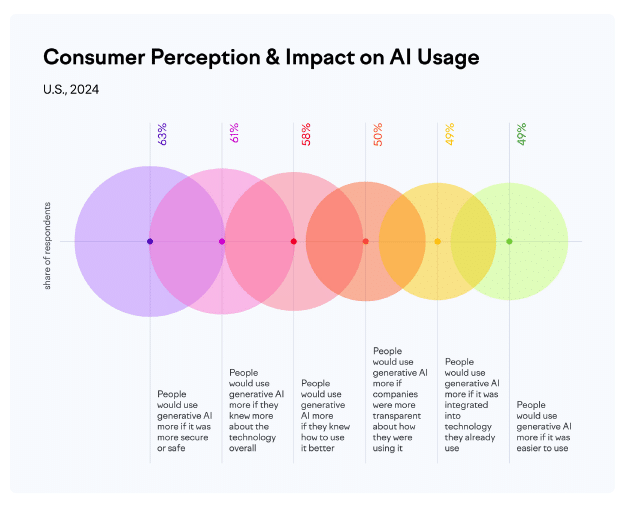
Consumers remain far less interested in AI than those selling it and using it professionally. Around 28% of U.S. respondents said that, in general, they do not care about AI tools. Meanwhile, 22% expressed an interest in trying out new and innovative AI tools, and 19% were excited about such applications.
The way to get more people to trust AI’s results is to have more people involved in the process. “Sizeable shares of U.S. respondents were more likely to trust AI-powered search tools if the content was confirmed to be verified by a human and if there were an increase in data privacy regulations,” according to the report.
AI, SEO and digital marketers
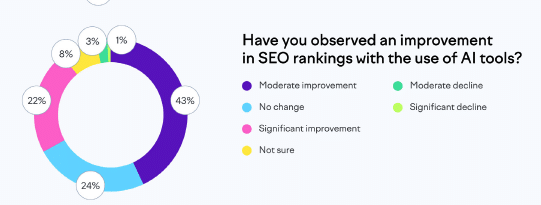
Even so, AI is having a significant impact on digital marketing. A Semrush survey of business owners, marketing managers and CEOs found 68% reported an increased return on investment when using AI for content marketing and SEO. Two-thirds said AI tools improved SEO rankings, with 39% saying it took one to two months to rank with AI-generated content.
Dig deeper: How to build customer trust through data privacy and security
While search engines remain essential for most online users, changes in the traffic patterns of standard search providers and Q&A sites show gen AI can divert traffic even from major players like Google. The big challenge for the technology remains improving its accuracy and proving that to consumers.
Note: Third Door Media, which is the publisher of MarTech, is owned by Semrush.
The post GenAI must win consumer trust if it is going to transform search marketing appeared first on MarTech.
**Building Consumer Trust: The Key to GenAI’s Impact on Transforming Search Marketing**
In the rapidly evolving digital landscape, Generative Artificial Intelligence (GenAI) has emerged as a transformative force, reshaping industries and redefining how businesses engage with consumers. One of the most significant areas of impact is search marketing, where GenAI is revolutionizing how brands connect with their audiences. However, as with any disruptive technology, its success hinges on a critical factor: consumer trust. Without trust, even the most advanced AI tools will struggle to achieve their full potential. This article explores how building consumer trust is essential to unlocking GenAI’s transformative power in search marketing.
—
### The Rise of GenAI in Search Marketing
Generative AI refers to advanced machine learning models capable of creating content, such as text, images, videos, and even code, based on patterns in data. Tools like OpenAI’s ChatGPT, Google’s Bard, and other AI-powered platforms are already being integrated into search engines, content creation workflows, and marketing strategies.
In search marketing, GenAI offers unprecedented opportunities. It can:
– **Personalize Search Results**: By analyzing user behavior and preferences, GenAI can deliver hyper-personalized search results that align with individual needs.
– **Enhance Content Creation**: Marketers can use GenAI to generate high-quality, SEO-optimized content at scale, saving time and resources.
– **Optimize Ad Campaigns**: AI-powered tools can analyze vast datasets to identify trends, predict consumer behavior, and fine-tune ad targeting for maximum ROI.
– **Enable Conversational Search**: With the rise of voice search and AI chatbots, GenAI can provide conversational, human-like responses to user queries, improving search experiences.
While these capabilities are transformative, they also raise concerns about misinformation, data privacy, and ethical use, making trust a cornerstone of GenAI’s adoption in search marketing.
—
### The Trust Gap: Challenges in GenAI Adoption
Despite its potential, GenAI faces skepticism from consumers. A 2023 survey by Edelman revealed that only 34% of consumers trust AI to make decisions that impact their lives. This trust gap stems from several factors:
1. **Transparency Issues**: Many consumers are unaware of how GenAI models work or how their data is being used. The “black box” nature of AI can lead to suspicion.
2. **Misinformation Risks**: GenAI’s ability to generate realistic but false information (e.g., deepfakes or fabricated content) raises concerns about credibility.
3. **Data Privacy Concerns**: Consumers worry about how their personal data is collected, stored, and used by AI systems.
4. **Bias and Fairness**: AI models can inadvertently perpetuate biases present in their training data, leading to unfair or discriminatory outcomes.
5. **Over-Automation**: Over-reliance on AI can make interactions feel impersonal, eroding the human connection that many consumers value in brand relationships.
Addressing these challenges is crucial for businesses looking to leverage GenAI in search marketing.
—
### Strategies for Building Consumer Trust in GenAI
To harness the full potential of GenAI in search marketing, brands must prioritize trust-building initiatives. Here are key strategies to consider:
#### 1. **Prioritize Transparency**
– **Explain AI Usage**: Clearly communicate how GenAI is being used in search marketing efforts. For example, if AI-generated content is displayed in search results, disclose this information to users.
– **Open Algorithms**: Whenever possible, provide insights into how AI models make decisions. Transparency fosters confidence in the technology.
#### 2. **Ensure Data Privacy and Security**
– **Adopt Ethical Data Practices**: Collect and use consumer data responsibly, adhering to regulations like GDPR and CCPA. Obtain explicit consent for data usage.
– **Invest in Security**: Implement robust cybersecurity measures to protect consumer data from breaches.
#### 3. **Combat Misinformation**
– **Fact-Check AI Outputs**: Regularly audit AI-generated content to ensure accuracy and credibility. Employ human oversight to verify critical information.
– **Partner with Trusted Sources**: Collaborate with reputable organizations to validate content and enhance reliability.
#### 4. **Address Bias and Fairness**
– **Diversify Training Data**: Use diverse datasets to minimize biases in AI models. Regularly update and refine models to reflect evolving societal norms.
– **Implement Ethical AI Guidelines**: Establish clear principles for ethical AI use and hold teams accountable for adhering to them.
#### 5. **Humanize AI Interactions**
– **Blend AI with Human Touch**: Combine AI-driven insights with human creativity and empathy. For example, use AI to generate content ideas but have human writers refine and personalize the message.
– **Provide Human Support Options**: Ensure that consumers can easily access human assistance when needed, especially for complex or

Recent Comments