


As a marketer, you are uniquely positioned to create compelling use cases for dismantling customer data silos. Your deep understanding of customer behavior, cross-functional perspective and ability to demonstrate tangible business impact make you a key player in this effort. Martech — whether you are selecting, implementing or managing these platforms — gives you another way to lead in using customer data.
Customer-centric perspective
You have a holistic view of the customer journey that goes beyond creating promotional campaigns or generating leads. This allows you to:
- Identify pain points caused by fragmented data: Quantify these pain points by estimating lost revenue or the negative impact on marketing processes, such as longer time-to-market for new campaigns.
- Illustrate how integrated data enhances customer experiences: Demonstrate gains through unlocked revenue opportunities, increased customer satisfaction scores or decreases in complaints and cart abandonment.
- Show the value of a unified customer view across touchpoints: Integrating data sources can improve engagement and conversion rates.
Cross-functional insights
Your collaboration with various departments enables you to:
- Highlight interdependencies between different data sources: Show how customer data silos negatively impact marketing processes and hinder customer experience improvements.
- Demonstrate how integrated data improves collaboration: Better data management helps you become a stronger partner to other teams and take greater ownership of customer data.
- Identify opportunities for cross-selling and upselling: This is especially useful for companies with multiple business units, ensuring cross-selling opportunities across different product or service lines.
Quantifiable business impact
You can create use cases that demonstrate clear return on investment (ROI), as seen in these areas:
- Improved campaign performance: Better targeting and personalization enhance marketing effectiveness.
- Increased customer lifetime value: More relevant interactions drive deeper customer relationships.
- Cost savings: Eliminating redundant or ineffective marketing efforts streamlines operations and maximizes budgets.
Dig deeper: 5 things marketers can do to abolish data silos
Data-driven decision-making
As a marketer, you should be at the forefront of leveraging customer data for strategic decisions:
- More accurate insights and predictions: Integrated data allows for more intelligent decision-making.
- Greater agility in marketing strategies: Real-time data access enables quicker pivots and adjustments.
- Enhanced AI and machine learning capabilities: Comprehensive datasets fuel more effective automation and predictive modeling.
Compliance and trust
You should understand the importance of data privacy and:
- Illustrate how integrated data management enhances compliance efforts: Properly structured data helps meet regulatory requirements.
- Show how improved data governance builds customer trust: Transparent and secure data handling increases consumer confidence.
- Demonstrate the value of consent management across touchpoints: Ensuring alignment with your company’s privacy policies maintains ethical data usage.
By creating these use cases, you can effectively advocate for dismantling data silos, benefiting not just marketing but the entire organization. While this process may seem straightforward, it is complex — especially when multiple silos exist. However, tackling this challenge leads to improved customer experiences, more efficient operations and better business outcomes.
Dig deeper: Breaking down data silos: A practical guide to integrated marketing data
5 elements to include in customer data use cases
When developing use cases, ensure they include these five elements:
1. Demonstrating business impact
Build business cases that quantify the cost of data silos and show how breaking them down benefits the company.
- Highlight lost opportunities due to fragmented data.
- Show how unified data improves marketing efficiency and ROI.
- Demonstrate the impact on customer engagement and conversion rates.
2. Improving cross-team collaboration
Your use cases can promote collaboration by:
- Encouraging teams to define which data fields should come from each source.
- Enhancing customer experience through integrated insights.
- Improving marketing processes by leveraging data from multiple departments.
3. Enhancing customer insights
Use cases help refine customer insights through:
- More accurate customer profiles.
- Better personalization of marketing campaigns.
- Improved targeting of the right accounts and individuals within organizations.
4. Optimizing marketing performance
Unified data enables you and other stakeholders to:
- Reduce time-to-market for campaigns.
- Improve customer journey tracking.
- Make data-driven decisions to optimize marketing strategies in real-time.
5. Driving organizational change
Advocate for data integration by:
- Demonstrating its positive impact on internal marketing processes.
- Helping stakeholders understand how silos hinder business goals.
- Supporting resource allocation for multidisciplinary teams working on data unification.
Dig deeper: How to un-silo your organization and be more customer-centric
Measuring the benefits
Here are key metrics you can use to assess the benefits of dismantling customer data silos:
- Revenue growth over a specific period.
- Increases in customer satisfaction and loyalty.
- Improvements in marketing efficiency (e.g., reduced time-to-market, decreased vendor dependency).
- Higher conversion rates and customer lifetime value.
- Better return on ad spend (ROAS) and lower customer acquisition costs.
- Access to real-time reports and dashboards for continuous tracking.
How to get started with use cases
When crafting a use case, start with a simple statement that helps stakeholders — especially technical teams — understand the benefits:
- “By [describe the use case], we will be able to [explain how it benefits customers]. This will impact our business goals by [list benefits].”
Example:
“Combining self-reported customer preferences with past website behavior allows us to customize e-commerce email messages. This will increase open and click-through rates, leading more customers to our product pages. In turn, this supports our company’s annual revenue goal. Additionally, this use case enables the marketing team to scale personalized email campaigns without additional investment by using a dynamic template populated with customer data.”
Clearly stating the expected business impact helps prioritize different use cases. Avoid adding technical or operational details. Those should be handled by the relevant teams based on the business requirements.
You can also provide context and refine use cases collaboratively with other teams as you develop them.
Prioritizing use cases
Once use cases are created, you can help prioritize them using the following prioritization framework.
- X-axis: Difficulty of implementation.
- Y-axis: Business impact.
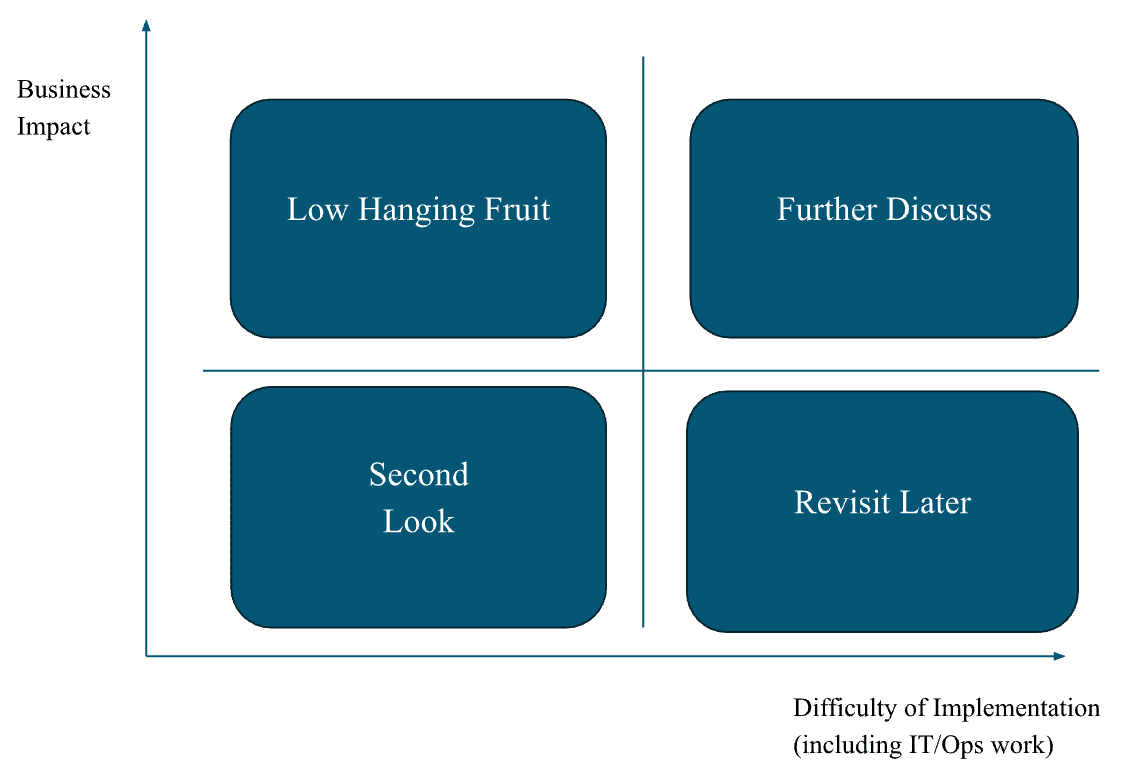
- Low-hanging fruit: Use cases that are easy to implement and have a high business impact should be prioritized first. These offer quick wins with minimal effort.
- Second look: These are easier to implement but have a lower business impact. While not all should be pursued immediately, consider selecting quick, small wins — especially those closer to the top of this quadrant.
- Further discuss: These use cases have a high business impact, but are more complex to implement. Prioritize the simplest ones first. Regular discussions with technical teams can help determine the best approach.
- Revisit later: These use cases are both difficult to implement and have a lower immediate business impact. However, they should be periodically reviewed, as changes in technology or business priorities may make them more viable in the future.
Additionally, you will need to balance between prioritizing a quick win with low effort versus investing in a more complex use case that could yield a greater long-term impact. Regularly updating and reassessing the position of use cases within this framework ensures that your marketing efforts remain aligned with business objectives.
Dig deeper: How shared goals and incentives improve marketing results
The post How to build use cases to break down customer data silos appeared first on MarTech.
# Building Use Cases to Eliminate Customer Data Silos
In today’s digital economy, businesses collect vast amounts of customer data from multiple sources, including websites, mobile apps, social media, customer support interactions, and in-store transactions. However, when this data is stored in separate systems that don’t communicate with each other, it creates **customer data silos**—isolated pockets of information that prevent businesses from gaining a unified view of their customers.
To overcome this challenge, organizations must build **use cases** that help break down these silos and enable seamless data integration. This article explores how businesses can develop effective use cases to eliminate customer data silos and unlock the full potential of their data.
—
## **Understanding Customer Data Silos**
Customer data silos arise when different departments or systems store customer information independently, leading to:
– **Inconsistent customer experiences** – Customers may receive conflicting messages or redundant communications.
– **Inefficient operations** – Teams waste time manually consolidating data from different sources.
– **Limited personalization** – Without a unified view, businesses struggle to deliver personalized experiences.
– **Poor decision-making** – Incomplete or fragmented data leads to inaccurate insights and missed opportunities.
To address these challenges, organizations must define **specific use cases** that drive data integration and improve customer engagement.
—
## **Key Use Cases for Eliminating Customer Data Silos**
### **1. Unified Customer Profiles**
**Problem:** Customer data is scattered across CRM systems, marketing platforms, and customer support databases, making it difficult to get a 360-degree view of each customer.
**Solution:** Implement a **Customer Data Platform (CDP)** or **Master Data Management (MDM)** system to consolidate data from all sources into a single, unified customer profile. This allows businesses to:
– Track customer interactions across multiple touchpoints.
– Improve personalization in marketing and customer service.
– Reduce duplicate records and inconsistencies.
**Example:** A retail company integrates data from its e-commerce platform, loyalty program, and in-store purchase history to create a single customer profile, enabling personalized product recommendations.
—
### **2. Cross-Channel Customer Engagement**
**Problem:** Customers interact with businesses through multiple channels (email, social media, chat, phone), but siloed data prevents a seamless experience.
**Solution:** Use **omnichannel engagement platforms** to synchronize customer interactions across all channels. This ensures that:
– Customer service agents have full context when assisting customers.
– Marketing campaigns are consistent across email, SMS, and social media.
– Customers receive relevant offers based on their past interactions.
**Example:** A bank integrates its call center, mobile app, and website data so that a customer who starts a loan application online can seamlessly continue the process via phone support.
—
### **3. AI-Driven Customer Insights**
**Problem:** Siloed data prevents businesses from leveraging AI and machine learning to generate meaningful insights.
**Solution:** Implement **AI-powered analytics tools** that aggregate and analyze customer data across departments. This enables:
– Predictive analytics for customer behavior and churn prevention.
– Sentiment analysis to understand customer feedback.
– Automated segmentation for targeted marketing campaigns.
**Example:** An e-commerce company uses AI to analyze purchase history, browsing behavior, and customer support interactions to predict which customers are likely to churn and proactively offer discounts.
—
### **4. Personalized Marketing Campaigns**
**Problem:** Marketing teams struggle to create personalized campaigns because customer data is fragmented across different platforms.
**Solution:** Integrate **marketing automation tools** with customer data platforms to enable:
– Dynamic audience segmentation based on real-time data.
– Personalized email and ad campaigns based on customer preferences.
– Automated retargeting for abandoned carts and past purchases.
**Example:** A travel company consolidates customer data from its website, mobile app, and email interactions to send personalized vacation package recommendations.
—
### **5. Streamlined Customer Support**
**Problem:** Customer support teams lack access to complete customer histories, leading to repetitive questions and slow issue resolution.
**Solution:** Connect **helpdesk software** with CRM and other customer data sources to provide agents with a full view of customer interactions. This helps:
– Reduce response times by giving agents instant access to customer history.
– Improve customer satisfaction by avoiding repetitive questions.
– Enable proactive support by identifying recurring issues.
**Example:** A telecom company integrates its support ticketing system with billing and usage data, allowing agents to quickly resolve customer billing disputes.
—
## **Steps to Build Effective Use Cases**
To successfully eliminate customer data silos, businesses should follow these steps when developing use cases:
### **1. Identify Business Goals**
– Define what you want to achieve (e.g., improved customer experience, increased sales, reduced churn

Recent Comments