


AI continues to embed itself into the fabric of business. However, the conversation often neglects a key component in the shadows: people. Training people in prompt engineering and system integrations is not enough.
Today’s “AI experts” are too focused on the technology and process sides of the “People, Process and Technology” paradigm. They assume that improving technology will create business value and optimizing processes will ensure consistency. However, this view is flawed because it overlooks the crucial role of the people who use these systems.
Too often, “experts” advocate silos of competencies. This creates unnecessary and negative organizational impacts.
My message in this article is clear: AI adoption is a critical strategy that must be directed at an organizational level and managed by leaders clearly and cogently.
Why humans matter in the AI ecosystem
No matter how advanced, technology needs human insight to succeed. When organizations focus too little on people, they create systems that don’t match employees’ needs and skills. This misalignment can lead to:
- Resistance from your teams.
- Inequality of job opportunities.
- Decreased morale.
- Ultimately, the underperformance of AI initiatives.
A fundamental shift toward prioritizing people and their competencies is critical.
Soft skills are necessary to deliver equal opportunity
Pew Research Center surveyed more than 11,000 U.S. adults about their use of AI, excitement for the technology and knowledge of where AI is used. The findings show that AI awareness varies widely across gender, ethnicity, age, education and income levels.
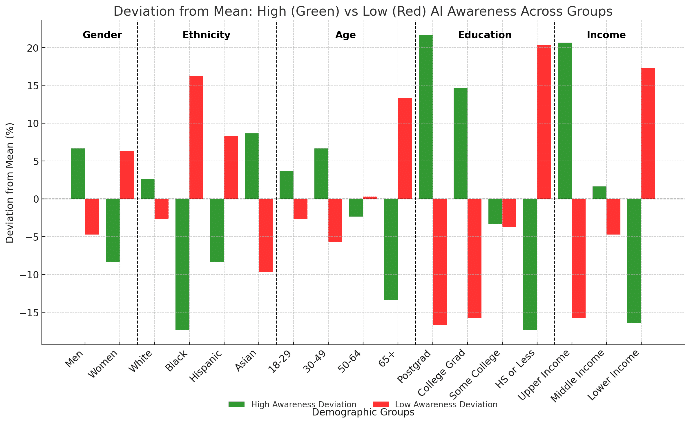
There’s a lot of information in the chart, but the key takeaway is that AI awareness is highly skewed based on gender and ethnicity:
- Men are much more likely to have a greater high awareness, and women have a greater low awareness.
- African American and Hispanic people are more likely to have a low high awareness and a high low awareness.
The message is clear: Organizational leaders must take a proactive role in thoughtfully guiding AI adoption. They must ensure that the soft skills of all team members are considered to prevent inequality in job opportunities.
Dig deeper: Why brands must bridge the knowledge gap in AI adoption
Non-technical functions will drive the most value from AI
Despite what some may think, AI’s success isn’t solely in the hands of technical experts. McKinsey highlights that a remarkable 75% of AI’s value will be realized across five business functions, three of which are non-technical: customer operations, marketing and sales.
Go-to-market (GTM) teams play a key role in delivering value to their organizations. However, this doesn’t mean organizations should focus only on GTM AI strategy. They need a broader, organization-wide strategy with a GTM application.
Soft skills: The heart of AI adoption success
When planning an organization-wide AI program, considering soft skills is essential. These skills are key to successful change management and help teams adjust to AI. They’re the glue that holds technical innovations into a cohesive, functional reality.
Cognitive psychology shows how people interact with AI. Successful AI adoption requires fostering a growth mindset, encouraging curiosity and supporting the mental shifts needed to use AI effectively. When employees feel supported in these areas, organizations can have smoother transitions and greater engagement with AI.
Growth mindset
A growth mindset is the belief that skills and intelligence can be developed through dedication and hard work. This mindset is crucial in an AI-driven organization because it enables employees to view challenges as development opportunities rather than obstacles. Encouraging a growth mindset leads to higher productivity and engagement, as employees are more likely to take initiative, embrace innovative technologies and continuously improve their skills.
About 17% of workers who are more concerned about AI today than last year say they personally know someone whose job was replaced by AI, according to EY. Understanding and cultivating a growth mindset fosters an environment where learning and adaptability become integral to business success.
Employee confidence and resilience
Confidence and resilience involve equipping employees with the ability to adapt and make informed decisions despite uncertainty. In an AI-forward organization, where rapid technological changes are the norm, the capacity to handle ambiguity without undue stress is critical. Up to 75% of employees are concerned AI will make certain jobs obsolete, with many (65%) saying they are anxious about AI replacing their jobs. By building confidence and resilience, organizations ensure that employees remain productive, engaged and capable of navigating challenges while reducing anxiety and creating a more stable and positive work environment.
Dig deeper: A people-friendly approach to adopting AI in marketing
Cognitive flexibility, agility and growth
Cognitive flexibility refers to the ability to adapt thinking and approach based on new information and changing circumstances. This skill is vital in an AI-rich environment, where the agility to shift strategies and embrace novel ideas enhances personal and organizational growth.
By fostering cognitive flexibility, organizations enable employees to innovate and respond proactively to AI-driven insights, making informed decisions that propel business success.
Accountable and responsible decision-making
This competency involves creating frameworks where decisions are made with careful consideration of ethical standards and organizational goals. In the context of AI, responsible decision-making ensures that technology is used wisely and transparently, fostering trust and accountability.
Today, two issues top the list of employee concerns: the quality of AI outputs and the speed at which AI is being adopted. Understanding this process is key for employees to manage AI tools effectively and ethically, ensuring that AI-driven decisions align with broader business values and contribute positively to organizational objectives.
Collaboration skills
Effective collaboration is essential for integrating AI into workflows and harnessing its full potential. This skill entails fostering open communication, teamwork and cross-functional cooperation, bridging departmental silos to create a cohesive AI implementation strategy.
Collaborative skills enable employees to contribute diverse insights and foster innovation, driving collective productivity and ensuring that AI advancements are effectively leveraged across the organization.
Dig deeper: 5 ways to jump start AI adoption
Bringing everyone on the journey
AI adoption shouldn’t polarize a workforce into those who get it and those who don’t. Instead, create a culture of inclusion where every person in the organization feels a part of the transformation. It’s about ensuring everyone is on board, not by compelling them to learn coding languages, but by nurturing an environment where learning, adapting and collaborating across functions is encouraged and valued.
Embracing AI means investing in soft skills and mental readiness to ensure success. By aligning AI with human strengths, businesses can implement it effectively and build a workforce ready to thrive in an AI-driven world.
Dig deeper: AI readiness checklist: 7 key steps to a successful integration
The post How to build AI strategies that prioritize people appeared first on MarTech.
# Developing AI Strategies with a Human-Centered Focus
Artificial Intelligence (AI) has become a transformative force in industries ranging from healthcare and finance to education and entertainment. As organizations increasingly adopt AI to streamline operations, enhance decision-making, and deliver innovative solutions, there is a growing recognition of the need for human-centered AI strategies. These strategies prioritize the well-being, needs, and values of people, ensuring that AI serves as a tool for empowerment rather than a source of harm or inequality. This article explores the principles, benefits, and practical steps for developing AI strategies with a human-centered focus.
—
## **What Is Human-Centered AI?**
Human-centered AI refers to the design, development, and deployment of AI systems that prioritize human needs, ethical considerations, and societal impact. Unlike purely technology-driven approaches, human-centered AI emphasizes collaboration between humans and machines, ensuring that AI systems are transparent, fair, and aligned with human values.
The goal of human-centered AI is not just to create intelligent systems but to create systems that enhance human capabilities, respect individual rights, and promote inclusivity. This approach acknowledges that technology should serve humanity, not the other way around.
—
## **Why Human-Centered AI Matters**
### 1. **Ethical Responsibility**
AI systems can have far-reaching consequences, from influencing hiring decisions to determining access to healthcare. Without a human-centered approach, these systems risk perpetuating biases, violating privacy, or making decisions that lack accountability. A human-centered focus ensures that ethical considerations are embedded in every stage of AI development.
### 2. **Trust and Adoption**
For AI to be widely adopted, users must trust its outcomes. Human-centered AI fosters trust by prioritizing transparency, explainability, and fairness. When users understand how AI systems work and feel confident in their reliability, they are more likely to embrace them.
### 3. **Improved User Experience**
AI systems designed with human needs in mind are more intuitive, accessible, and effective. By focusing on user experience, organizations can create AI solutions that are not only functional but also enjoyable and easy to use.
### 4. **Social Equity**
AI has the potential to either bridge or widen societal gaps. Human-centered AI ensures that systems are designed to promote inclusivity, reduce disparities, and address the needs of marginalized communities.
—
## **Principles of Human-Centered AI**
To develop AI strategies with a human-centered focus, organizations should adhere to the following principles:
### 1. **Transparency**
AI systems should be designed to provide clear explanations of how decisions are made. Transparency builds trust and enables users to understand the logic behind AI-driven outcomes.
### 2. **Fairness**
AI systems must be free from bias and discrimination. This requires rigorous testing, diverse training datasets, and ongoing monitoring to ensure equitable treatment for all users.
### 3. **Accountability**
Organizations must take responsibility for the actions and impacts of their AI systems. This includes establishing mechanisms for oversight, addressing errors, and providing avenues for recourse.
### 4. **Privacy and Security**
Protecting user data is a cornerstone of human-centered AI. Systems should be designed with robust security measures and respect for individual privacy.
### 5. **Inclusivity**
AI systems should be accessible to people of all abilities, backgrounds, and demographics. Inclusivity ensures that AI serves the needs of diverse populations.
### 6. **Collaboration**
Human-centered AI emphasizes collaboration between humans and machines. Rather than replacing human judgment, AI should augment human decision-making and creativity.
—
## **Steps to Develop Human-Centered AI Strategies**
### 1. **Define Clear Objectives**
Start by identifying the specific problems you want AI to solve and the outcomes you aim to achieve. Ensure that these objectives align with human needs and organizational values.
### 2. **Engage Stakeholders**
Involve a diverse group of stakeholders, including end-users, ethicists, domain experts, and policymakers, in the design and development process. Their input can help identify potential risks and ensure that the AI system meets user needs.
### 3. **Conduct Ethical Assessments**
Perform regular ethical assessments to evaluate the potential impact of AI systems on individuals and society. Consider questions such as: Does the system reinforce biases? How does it affect privacy? What are the long-term implications?
### 4. **Invest in Diverse Data**
Bias in AI often stems from biased training data. To mitigate this, invest in collecting and curating diverse datasets that represent a wide range of perspectives and experiences.
### 5. **Prioritize Explainability**
Develop AI systems that can explain their decisions in a way that is understandable to non-technical users. Explainability is critical for building trust and enabling accountability.
### 6. **Test and Iterate**
Before deploying AI systems, conduct extensive testing to identify and address potential issues. Use feedback from users to refine the system and ensure it meets their needs.
### 7. **Establish Governance

Recent Comments