


As customer acquisition costs climb and economic pressures mount, B2B companies must look beyond the classic approach to chasing new accounts. But what if there was a way to unlock significant revenue by shifting focus?
Account-based expansion — targeting growth within existing customer accounts — could be the key to sustainable growth, faster sales cycles and lower acquisition costs. This strategy, often overshadowed by acquisition-focused ABM, is emerging as a powerful engine for long-term success. Here’s why it’s time to rethink your approach to growth.
The 40/40/20 rule: How GTM efficiency shapes SaaS success
Let’s take a closer look at efficiency. In B2B SaaS, efficiency can make or break a company’s financial health, and in today’s economic climate, GTM (go-to-market) efficiency has become a key indicator of overall stability.
There’s even a benchmark to guide this: the 40/40/20 rule. This rule suggests that growing SaaS companies should ideally allocate 40% of their operating expenses toward GTM efforts. However, if your GTM isn’t optimized, that 40% can drive growth or become a costly obstacle. The difference lies in how well you’ve structured and executed your GTM strategy.
At its core, GTM consists of three key areas: customer acquisition, retention and expansion. Marketing, sales, customer success and operations — all elements of GTM — work together to drive revenue growth across these areas.
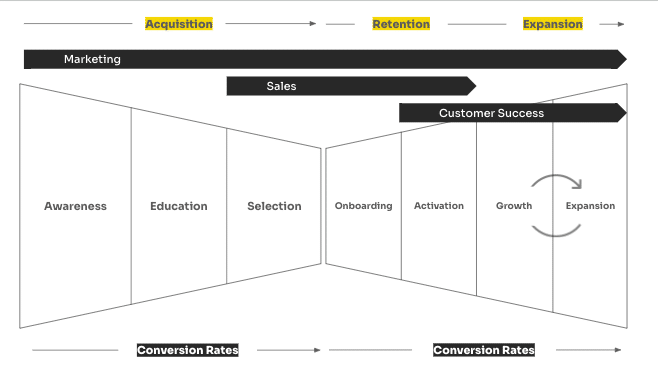
Let’s revisit efficiency across these three stages. For acquisition, we rely on the LTV-to-CAC ratio to gauge whether we’re acquiring customers who bring in more value than it costs to acquire them. In SaaS, a common benchmark is a 5X LTV-to-CAC ratio. If that ratio falls short, we usually focus on lowering CAC.
But what if we looked at the cost of acquiring new accounts, or “new logos,” compared to the cost of expanding existing ones? We might find that expansion is actually more cost-effective, leading us to prioritize increasing LTV over solely lowering CAC.
Despite this perspective, around 80% of marketing leaders I speak with remain focused primarily on new logo acquisition. In today’s economic climate, this misalignment represents a critical oversight in how we approach revenue growth and makes a case for account-based strategies to be deployed more broadly across the expansion side of the funnel.
Dig deeper: Rethinking fit, growth and go-to-market for the modern startup
The current state of account-based marketing
Up to 76% of marketers saw higher ROI with ABM than any other marketing strategy, according to research by the ABM Leadership Alliance and ITSMA. However, this success has created a common blind spot. Most organizations default to using ABM primarily as an acquisition tool, targeting net-new logos with sophisticated (and expensive) marketing plays.
This acquisition-first mindset stems from traditional marketing metrics and organizational structures. Marketing teams are often measured on MQLs, pipeline generation and new logo acquisition. Sales teams chase new logos for commission structures that favor new business. The result is a systemic underinvestment in expansion opportunities left to customer success teams to achieve.
Marketing should contribute to expansion targets
The marketing teams I’ve worked with this year that have implemented a structured expansion approach are generating, on average, 40% more revenue attributed to marketing efforts. While many marketing teams struggle to meet their targets, this strategy presents an incredible opportunity to unlock additional revenue.
Moreover, the costs associated with this approach are typically much lower. There’s no need for expensive ABM platforms or extensive intent data. By targeting existing customers, you can use their marketing funnel engagement data, sales data and product usage data to create tailored growth plans, keeping expenses manageable while maximizing impact.
The math is compelling: while new logo acquisition costs continue to rise (doubling in the last few years), expansion costs, on the other hand, are relatively unknown to marketing but intuitively should be lower. This is a huge opportunity for 2025 and marketers looking to increase their worth to the GTM.
For those not sold yet, consider these advantages of expansion-focused ABM:
- The sales cycle for expanding an account versus acquiring net new is typically shorter (custom reverse funnel analysis can prove this).
- Customer data enables more precise targeting and personalization compared to generic intent data.
- Higher win rate due to known customer behavior and product usage patterns.
- Greater potential for product advocacy and referrals and customer stories for marketing.
Why traditional account management falls short
The conventional customer success model, while valuable for retention, often lacks the sophisticated orchestration needed for strategic growth. Traditional account management typically focuses on reactive support and renewal management rather than proactive expansion opportunities.
The limitations become evident in several areas:
- Reactive engagement versus strategically prioritizing customers by propensity to expand.
- Limited use of intent and behavioral data in the customer success organization.
- Siloed communication between sales, marketing and customer success.
- Inability or hesitation to scale personalized outreach to customers effectively.
- Missing connection between product usage data and expansion strategy from marketing.
Dig deeper: Maximizing your B2B spend: Is account-based marketing worth it?
A framework for account-based expansion
Success in account-based expansion requires a structured framework that combines data intelligence with coordinated execution. Here’s how to build it.
Account segmentation and prioritization
Start by creating a propensity model that considers:
- Current product adoption benchmarks.
- Usage patterns and engagement scores by segments.
- Industry-specific growth potential.
- Customer maturity indicators.
- Some level of intent data that is unique to why your customers grow with you.
- Budget cycles and spending patterns.
Strategic orchestration
Develop an integrated approach that aligns all revenue teams by:
- Map decision-makers and influencers within each account.
- Create account-specific content journeys.
- Establish clear handoff points between teams.
- Define trigger events for expansion plays.
- Build measurement frameworks for attribution.
Technology and data requirements
Your tech stack should enable:
- Real-time usage monitoring and alerting.
- Automated engagement scoring.
- Cross-channel orchestration.
- Personalization at scale.
- Predictive analytics for opportunity identification.
Dig deeper: How ABM systems are evolving to meet changing B2B buying behaviors
Implementing the roadmap
Here’s a practical three-step plan to shift toward an expansion-focused ABM strategy.
Step 1: Alignment
- Audit current account data and establish baseline metrics through reverse funnel analysis.
- Define ideal expansion profiles based on historical data.
- Align sales, marketing and CS on new expansion framework and goals.
- Identify a few core insights that can drive strategy.
Step 2: Platforming
- Implement necessary tech stack integrations.
- Develop initial expansion plays for the top 20% of accounts.
- Create content templates and messaging frameworks.
- Create value-driven content versus promotional.
Step 3: Test and iterate
- Launch pilot program with selected accounts.
- Monitor leading indicators and adjust approach.
- Scale successful plays across the broader account base.
- Gather learnings from the pilot and turn them into tangible insights.
Looking ahead
The future of B2B growth is not in endlessly chasing new accounts but in building sophisticated expansion engines within your existing customer base. As economic pressures push for more efficient growth, companies that excel in account-based expansion will gain a significant competitive edge.
The real question isn’t whether to invest in it but how quickly you can adapt your organization to take advantage of this opportunity. The right technology is available, the financial benefits are clear and now is the perfect time to make this shift.
Dig deeper: The small B2B marketing team’s guide to ABM
The post Why account-based expansion is B2B’s next growth lever appeared first on MarTech.
# How Account-Based Expansion is Driving the Next Phase of B2B Growth
In the fast-evolving world of B2B (business-to-business) marketing and sales, companies are constantly seeking new strategies to drive growth, improve customer retention, and maximize revenue. One of the most promising approaches gaining traction is **Account-Based Expansion (ABE)**. While Account-Based Marketing (ABM) has been a popular strategy for targeting high-value accounts, ABE takes it a step further by focusing on expanding relationships and revenue within existing customer accounts. This shift is proving to be a key driver of the next phase of B2B growth.
In this article, we’ll explore what Account-Based Expansion is, why it’s becoming a critical strategy for B2B companies, and how businesses can implement it to fuel sustainable growth.
## What is Account-Based Expansion?
Account-Based Expansion (ABE) is a growth strategy that focuses on deepening relationships with existing customers to drive additional revenue. Rather than solely focusing on acquiring new customers, ABE emphasizes cross-selling, upselling, and expanding the scope of services or products within an existing account. This approach leverages the trust and familiarity already established with current clients to unlock new opportunities for growth.
ABE can be seen as a natural extension of Account-Based Marketing (ABM), which targets high-value accounts with personalized marketing and sales efforts. While ABM focuses on acquiring and converting new accounts, ABE shifts the focus to nurturing and expanding relationships with existing customers.
### Key Components of Account-Based Expansion
1. **Cross-Selling and Upselling**: ABE involves identifying opportunities to offer additional products or services that complement what the customer is already using. Cross-selling refers to selling related products, while upselling involves encouraging customers to upgrade to a higher-tier product or service.
2. **Customer Success and Retention**: ABE emphasizes the importance of customer success teams in ensuring that customers are satisfied and achieving their goals. Happy customers are more likely to expand their relationship with the company, making customer success a critical component of ABE.
3. **Personalization**: Just like ABM, ABE relies on personalized communication and tailored solutions. By understanding the specific needs, challenges, and goals of each customer, businesses can offer highly relevant solutions that drive expansion.
4. **Data-Driven Insights**: ABE leverages data to identify expansion opportunities. By analyzing customer behavior, usage patterns, and engagement metrics, businesses can pinpoint the right time to introduce new offerings or suggest upgrades.
5. **Collaboration Between Sales, Marketing, and Customer Success**: ABE requires close collaboration between different teams within the organization. Sales, marketing, and customer success teams must work together to identify expansion opportunities, nurture relationships, and deliver value to the customer.
## Why Account-Based Expansion is Crucial for B2B Growth
### 1. **Higher ROI Compared to New Customer Acquisition**
Acquiring new customers is often more expensive and time-consuming than expanding relationships with existing ones. According to research, it can cost five to seven times more to acquire a new customer than to retain an existing one. ABE allows businesses to maximize the lifetime value (LTV) of their current customers, leading to a higher return on investment (ROI).
By focusing on existing accounts, companies can leverage the trust and rapport they’ve already built, reducing the friction and costs associated with customer acquisition. This makes ABE a more efficient and cost-effective growth strategy.
### 2. **Increased Customer Retention and Loyalty**
ABE is not just about driving revenue; it’s also about deepening customer relationships. By consistently delivering value and addressing the evolving needs of customers, businesses can increase customer satisfaction and loyalty. Loyal customers are more likely to renew contracts, purchase additional products, and refer others to the business.
In fact, studies have shown that increasing customer retention rates by just 5% can increase profits by 25% to 95%. ABE helps companies achieve this by focusing on long-term relationships rather than one-off transactions.
### 3. **Maximizing Customer Lifetime Value (CLV)**
Customer lifetime value (CLV) is a key metric for B2B companies, as it represents the total revenue a business can expect from a customer over the course of the relationship. ABE is designed to maximize CLV by continuously identifying opportunities to provide additional value to customers.
By offering new products, services, or upgrades that align with the customer’s needs, businesses can increase the overall revenue generated from each account. This not only boosts profitability but also strengthens the customer relationship.
### 4. **Mitigating Churn Risk**
Churn is a major concern for B2B companies, especially in industries with long sales cycles and high customer acquisition costs. ABE helps mitigate churn risk by proactively engaging with customers and ensuring they are getting the most out of the products or services they’ve purchased.
By regularly checking in with customers, identifying pain points,

Recent Comments