


A major challenge for voice of the customer (VOC) teams is proving their value. Their impact is often marginalized because they struggle to drive action that improves the customer experience. This makes it harder to demonstrate their effectiveness, reducing their visibility and influence.
Why does this happen? Many VOC teams focus too much on metrics and reporting, diverting attention from meaningful action. A more significant issue is their lack of a customer journey management approach. They design feedback mechanisms around internal structures rather than the entire customer journey, overlook how sentiment varies by persona and lack processes to act on insights.
VOC teams that start with the customer journey are more successful in turning insights into action. The most effective leaders follow three key best practices.
1. Tailor CX metrics to stages of customer journeys
A common mistake many VOC teams make is using a single CX metric to measure every aspect of the customer experience. While a topline CX metric provides a common language for the organization, don’t apply it to everything. This metric is typically a lagging, outcome-oriented measure. Identifying leading metrics that influence the topline metric is essential, as they are easier to act on.
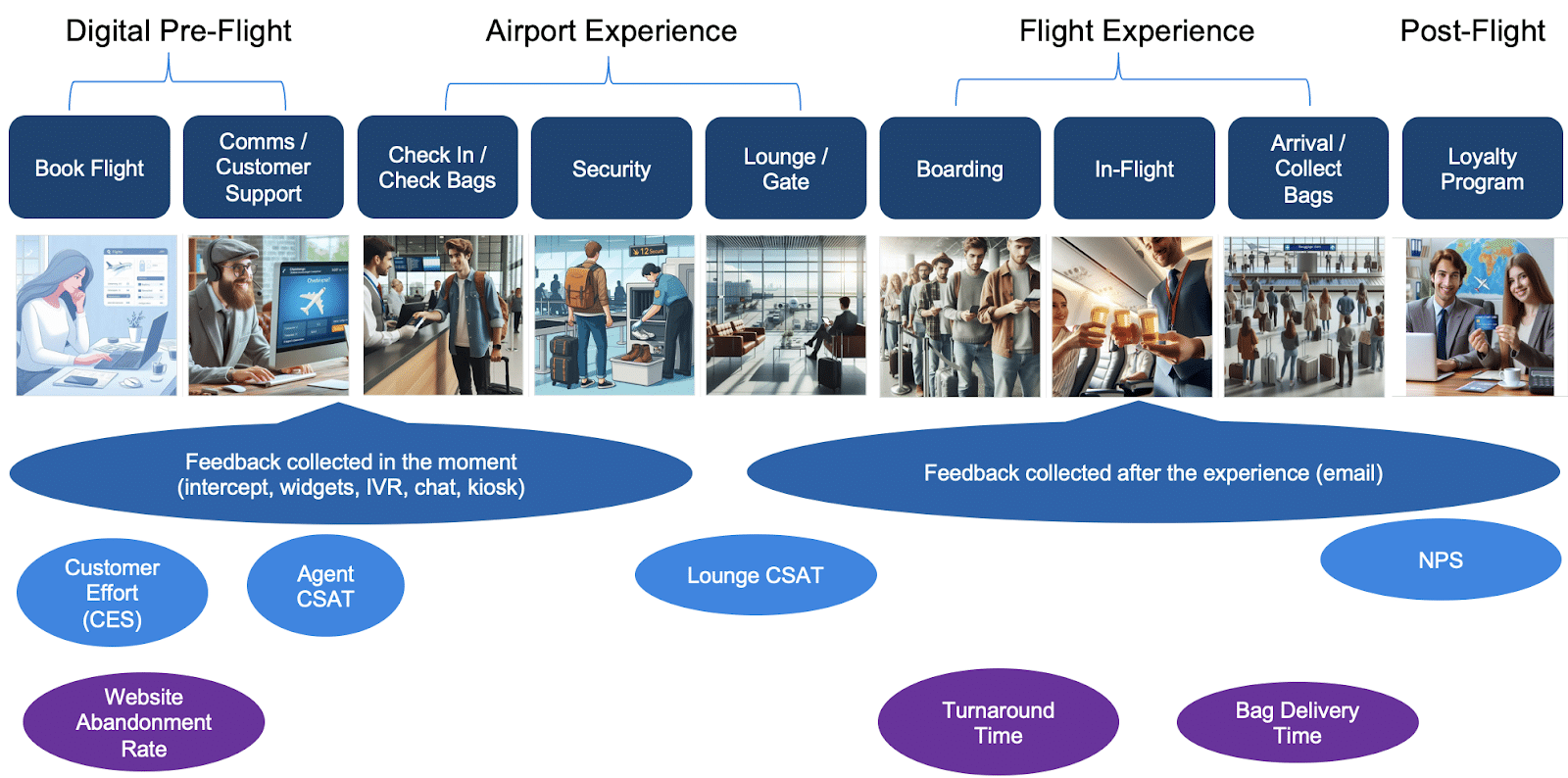
Mapping the customer journey allows you to tailor CX metrics to each stage and select the right action-oriented measure. In some cases, the best metric may come from customer survey feedback, while in others, an observable operational metric may be more effective. Feedback mechanisms should also vary by journey stage. Some touchpoints may not require CX metrics at all. Striking the right balance is easier with a journey management approach.
For example, in an airline customer’s journey, early stages like booking are best suited for in-the-moment feedback. In contrast, post-flight feedback is more valuable for assessing the in-flight experience.
The type of experience also influences the best metric to use:
- Customer Effort Score (CES) is more appropriate for booking.
- Net Promoter Score (NPS) is better for evaluating the loyalty program.
Additionally, specific steps in the journey can be assessed using operational data rather than customer feedback.
Mapping out the customer journey facilitates this tailored approach to feedback and metrics.
Dig deeper: 5 simple ways to improve customer experience
2. Track persona-specific customer sentiment at key moments of truth
Having the right CX metric at each stage of the journey helps identify customer pain points, but the next step is understanding the “why” behind the scores. VOC teams have a wealth of insight in the form of unstructured customer feedback. With advanced text analytics tools and AI, it’s easier than ever to categorize large volumes of feedback into key themes. However, while these models are powerful, the insights they generate are often too high level to be actionable.
A journey management approach solves this problem by identifying key moments of truth — points where the customer journey could shift based on the experience — and tracking sentiment at these moments.
But tracking overall customer sentiment isn’t enough. Customers have different needs and expectations, so you should create personas to segment customers accordingly. Sentiment tracking should then be broken down by persona at each journey stage.
For example, consider an airline tracking customer sentiment across different personas. The dotted line in the illustration below represents overall customer sentiment. At first glance, sentiment appears mostly neutral across journey stages. However, breaking it down by persona reveals key differences.
- Road warriors are dissatisfied with customer support.
- Family travelers are unhappy with aspects of the in-flight experience.
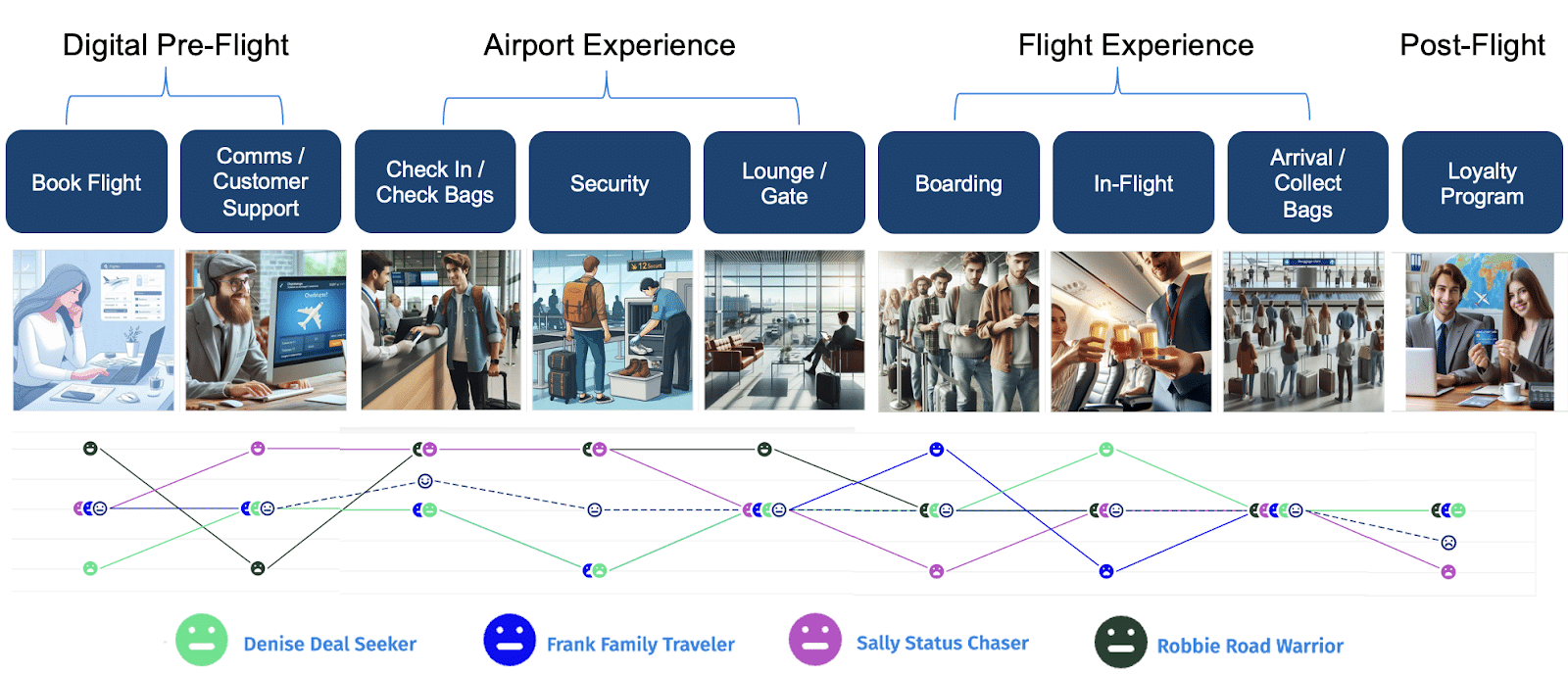
Diving into key themes for these personas at those specific journey stages can uncover pain points that are much easier to address.
Dig deeper: How to un-silo your organization and be more customer-centric
3. Develop closed-loop processes to act on insights at each journey stage
Understanding persona-specific sentiment at key moments of truth helps identify and prioritize recommended actions. However, it is equally important to develop closed-loop processes to ensure the actions are carried out.
The journey map should incorporate recommended actions aligned with journey stages and personas. This process helps identify the right internal stakeholders to drive initiatives forward.
These initiatives should be linked to project management tools so you can assign owners and track progress. Initiative owners should also be involved in the journey mapping process to understand how their efforts impact the broader customer experience.
Dig deeper: 5 big ways to turn up the voice of your customer in your marketing
Operationalizing journey management
Building a journey management approach is a journey in itself, and you’ll need to iterate and build over time. When you complete initiatives — and hopefully improve the customer experience — don’t keep those wins to yourself. Share the impact on CX metrics and customer sentiment across your organization to build visibility and momentum.
Make sure to update your journey maps as you go, reflecting the improvements you’ve made. Celebrating progress helps keep teams engaged and motivated to tackle the next opportunity to enhance the customer journey.
The post 3 ways to boost your VOC program’s value through journey management appeared first on MarTech.
# How to Enhance Your VOC Program’s Value with Effective Journey Management
A Voice of the Customer (VOC) program is a powerful tool for understanding customer needs, expectations, and pain points. However, to maximize its value, organizations must go beyond simply collecting feedback—they must integrate effective **journey management** into their VOC strategy. By aligning VOC insights with customer journey mapping, businesses can drive meaningful improvements, enhance customer experiences, and boost loyalty.
In this article, we’ll explore how journey management can enhance your VOC program and provide actionable steps to improve its effectiveness.
—
## **Understanding VOC and Journey Management**
### **What is a VOC Program?**
A **Voice of the Customer (VOC) program** is a structured approach to gathering, analyzing, and acting on customer feedback. It helps organizations understand customer perceptions, identify pain points, and make data-driven decisions to improve products, services, and experiences.
### **What is Journey Management?**
**Journey management** involves mapping and optimizing the end-to-end customer experience across multiple touchpoints. It focuses on understanding how customers interact with a brand, identifying friction points, and ensuring a seamless and satisfying experience throughout the journey.
When VOC insights are integrated with journey management, businesses can move beyond isolated feedback collection and take a **holistic approach** to improving customer experiences.
—
## **How Journey Management Enhances Your VOC Program**
### **1. Aligning Feedback with Customer Journeys**
Traditional VOC programs often collect feedback at specific touchpoints (e.g., post-purchase surveys or support interactions). However, customer experiences are **not isolated events**—they are part of a broader journey.
By mapping VOC feedback to different stages of the customer journey, organizations can:
– **Identify recurring pain points** across multiple touchpoints.
– **Understand the root causes** of customer dissatisfaction.
– **Prioritize improvements** based on journey impact rather than isolated feedback.
For example, if multiple customers report frustration with onboarding, journey mapping can reveal whether the issue stems from unclear instructions, lack of support, or technical difficulties.
### **2. Moving from Reactive to Proactive Improvements**
Many VOC programs focus on **reactive** improvements—addressing issues after customers complain. Journey management enables a **proactive** approach by identifying potential friction points before they escalate.
By continuously monitoring customer journeys, businesses can:
– Detect early warning signs of dissatisfaction.
– Implement preemptive solutions to prevent negative experiences.
– Reduce customer churn by addressing pain points before they lead to attrition.
### **3. Enhancing Personalization and Customer Engagement**
Effective journey management allows businesses to tailor experiences based on customer needs and behaviors. By integrating VOC insights into journey analytics, organizations can:
– Deliver **personalized interactions** based on customer preferences.
– Optimize communication strategies for different journey stages.
– Improve self-service options by addressing common customer frustrations.
For instance, if VOC data shows that customers struggle with a particular feature, businesses can proactively offer in-app guidance or targeted support content.
### **4. Measuring the Impact of Customer Experience Initiatives**
One of the biggest challenges in VOC programs is demonstrating ROI. Journey management helps bridge this gap by linking customer feedback to business outcomes.
By tracking key metrics across the customer journey, organizations can:
– Measure the effectiveness of experience improvements.
– Identify which changes have the most significant impact on customer satisfaction.
– Justify investments in CX initiatives with data-driven insights.
For example, if a company improves its onboarding process based on VOC feedback, journey analytics can track whether customer retention and satisfaction scores improve as a result.
—
## **Steps to Integrate Journey Management into Your VOC Program**
### **1. Map the Customer Journey**
Start by creating a **detailed customer journey map** that outlines key touchpoints, interactions, and emotions throughout the experience. Identify critical moments where VOC feedback can provide valuable insights.
### **2. Collect Feedback at Key Journey Stages**
Instead of gathering feedback only at isolated points, ensure you capture customer sentiment at different journey stages, such as:
– Awareness (e.g., website experience)
– Consideration (e.g., product research)
– Purchase (e.g., checkout process)
– Onboarding (e.g., first-time use)
– Support (e.g., customer service interactions)
– Retention (e.g., renewal or repeat purchase)
### **3. Use Advanced Analytics to Identify Patterns**
Leverage AI-driven analytics and sentiment analysis to uncover trends in customer feedback. Identify recurring pain points and opportunities for improvement across different journey stages.
### **4. Implement Continuous Improvement Loops**
VOC and journey management should be **ongoing processes**, not one-time initiatives. Establish a continuous feedback loop where insights drive action, and improvements are monitored for effectiveness.

Recent Comments