

It is 2024, and we’ve all heard how AI can improve our email marketing efforts. But as we dive into generative AI tools like ChatGPT, it doesn’t take long to realize AI can yield lackluster results, inconsistent and off-brand content and campaigns that feel average.
As AI use in business grows, too many companies and solo entrepreneurs try to use it to replace jobs. They become obsessed with how it can create productivity. Yet, it’s important to recognize AI’s proper role — a technology that saves you time and grows the business by enhancing your work, not entirely replacing it.
With each new AI tool for email marketers, it is crucial the content and campaigns created with them maintain a personal touch and not diminish the brand experience.
Why making your email efforts impersonal is bad for business
Let’s take a look at Chick-fil-A and McDonald’s. They are both fast food companies using AI technology during the food ordering process.
McDonald’s uses technology to reduce employee interaction. When you enter a McDonald’s, you’re greeted by a kiosk for placing your order, not an employee. In the drive-thru, the first question might be, “Did you use the app?”
McDonald’s encourages customers to interact less with their staff.
In contrast, Chick-fil-A equips employees with handheld devices and puts its people outside for face-to-face greetings. Customers can place their orders even without entering the restaurant. This approach enhances the customer experience with AI.
As you can see, one has used AI to make their process less personal, while the other created a much more enjoyable human-to-human experience. How does that translate to sales?
Chick-fil-A dominates over McDonald’s with average store sales of $9.3 million, compared to the Golden Arches’ $3.7 million. This is impressive, considering Chick-fil-A is only open six days a week compared to McDonald’s’s seven-day workweek.
In 2020, a report by experience management firm Walker predicted customer experience would overtake price and product as the key brand differentiator. The research seems to have come true. Just look at the example above.
Instead of using AI solely in ways that benefit our companies, we need to use it to create a more enjoyable human experience through the content we create.
How to use AI in email marketing while ensuring a human experience
Generative AI
When you think of AI in email marketing, you probably think of using it to write email content. Tools like ChatGPT have a lot of potential for this.
- Fully written email campaigns.
- Subject line generation.
- Rewriting drab prompts and templates.
- Summarizing bulk messages.
- Sequence framing and outlines.
But the words in your emails reflect your brand’s identity. It’s important to use tools like ChatGPT to improve writing, not to do all of it for you.
Use it to first brainstorm ideas, then outline and draft. After the draft, refine and edit without AI. At this stage, you have to focus on personalization and brand voice. When that draft is done you can run it through AI which can spot spelling and grammatical problems, format it and be ready for your email service provider.
Let’s look at an example of a ChatGPT response. The prompt was to write a sales email for a new product in the pickleball industry.
Subject Line: Discover the Game-Changer: Our New Pickleball Paddle!
Hi [Recipient’s Name],
We’re excited to introduce our latest innovation: the ProX Pickleball Paddle! Designed for players of all levels, the ProX Paddle offers:
Superior Control: Enhanced grip and lightweight design for precise shots.
Durability: Built to withstand intense matches and practice sessions.
Performance: Engineered for power and accuracy to elevate your game.Ready to take your pickleball skills to the next level? Get your ProX Paddle today and dominate the court!
Order now and enjoy a special launch discount of 15%! [Insert Link]
See you on the court!
Best,
[Your Name]
[Your Company]
[Contact Information]P.S. Act fast — this offer is only available for a limited time!
How to humanize this newsletter
- Shorten the subject line.
- Add a photo or short video of people using the product.
- Add more language about who is the perfect customer for this product.
- Share with the reader the exact time the special offer expires.
Now, let’s look at this same example when edited by a human using the above tips:
Subject: game changer? You be the judge!
Hi [Recipient’s Name],
Okay! So we’ve been hinting for the last month or so and we’re finally ready to reveal our latest innovation: the ProX Pickleball Paddle! Designed for players of all levels, the ProX Paddle offers:
Superior Control: Enhanced grip and lightweight design for precise shots.
Perfect for people who like to play pickleball all afternoon or for those just starting to figure out that perfect grip.Durability: Built to withstand intense matches and practice sessions.
No switching out paddles halfway through a session or running to the sporting goods store once a month.
Performance: Engineered for power and accuracy to elevate your game.
Who doesn’t need more of that?Let’s take your pickleball skills to the next level, [Recipient’s Name].
Of course, since you’re on our email list, you are getting first dibs on the ProX Paddle with a special launch discount of 15%! [Insert Link] This discount is valid through Friday, the 26th.
[INSERT IMAGE WITH CLICKABLE LINK TO BUY]
See you on the court!
[Your Name]
[Your Company]
[Contact Information]P.S. If you click right here, that email-list only discount is automatically applied. No coupon code needed!
As you can see, using ChatGPT to stop you from writing from scratch is great. But we must take what ChatGPT gives us and make it complete by editing.
Dig deeper: 3 ways email marketers should actually use AI
Analytical AI
Marketers are under more pressure than ever — faster deadlines, stricter budgets and fewer resources. Fortunately, AI tools are helping engagement metrics and sales grow steadily.
Analytical AI tools within an email service provider can identify:
- Your most engaged customers.
- Customers that need to be re-engaged.
- Ideal times to reach out to past customers and potential leads.
These are essential to growth in this modern, fast-paced/low budget era. Once identified, the AI sorts these customers and leads into email segments and can engage with personalized content.
For example, Black River Farm and Ranch uses AI segmentation to identify first-time campers and invite them on a personal tour of the campus.
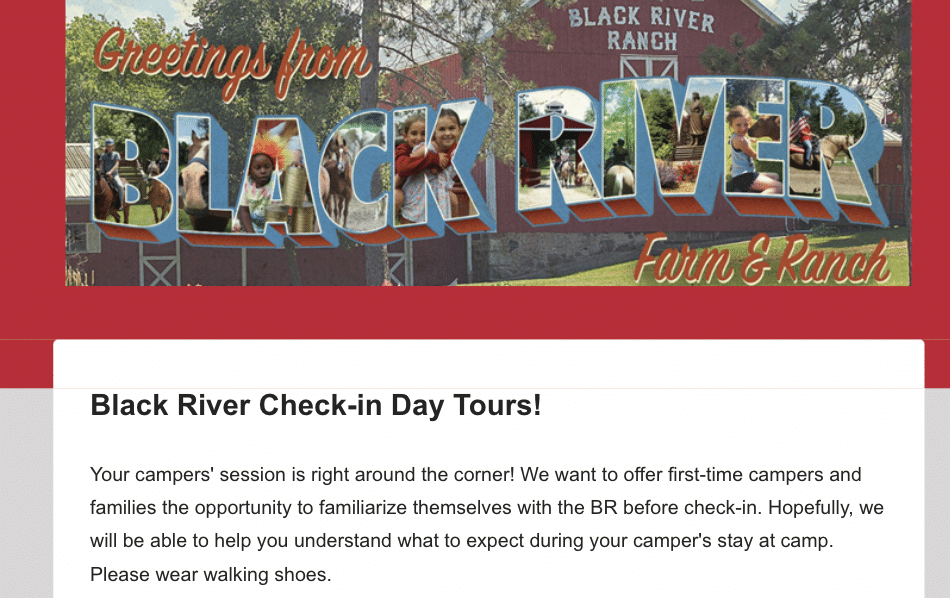
On the customer service side, this ensures the customers get a personalized experience and feel great about their purchase right from the start. In return, this type of email helps with customer retention. After all, the best customer is a repeat customer.
How to humanize this email
- After AI has sorted these customers for you, ensure your content has some personalization.
- Add the name of the session the camper is attending or the dates.
- Consider addressing the camper or camper’s guardians by name in the email.
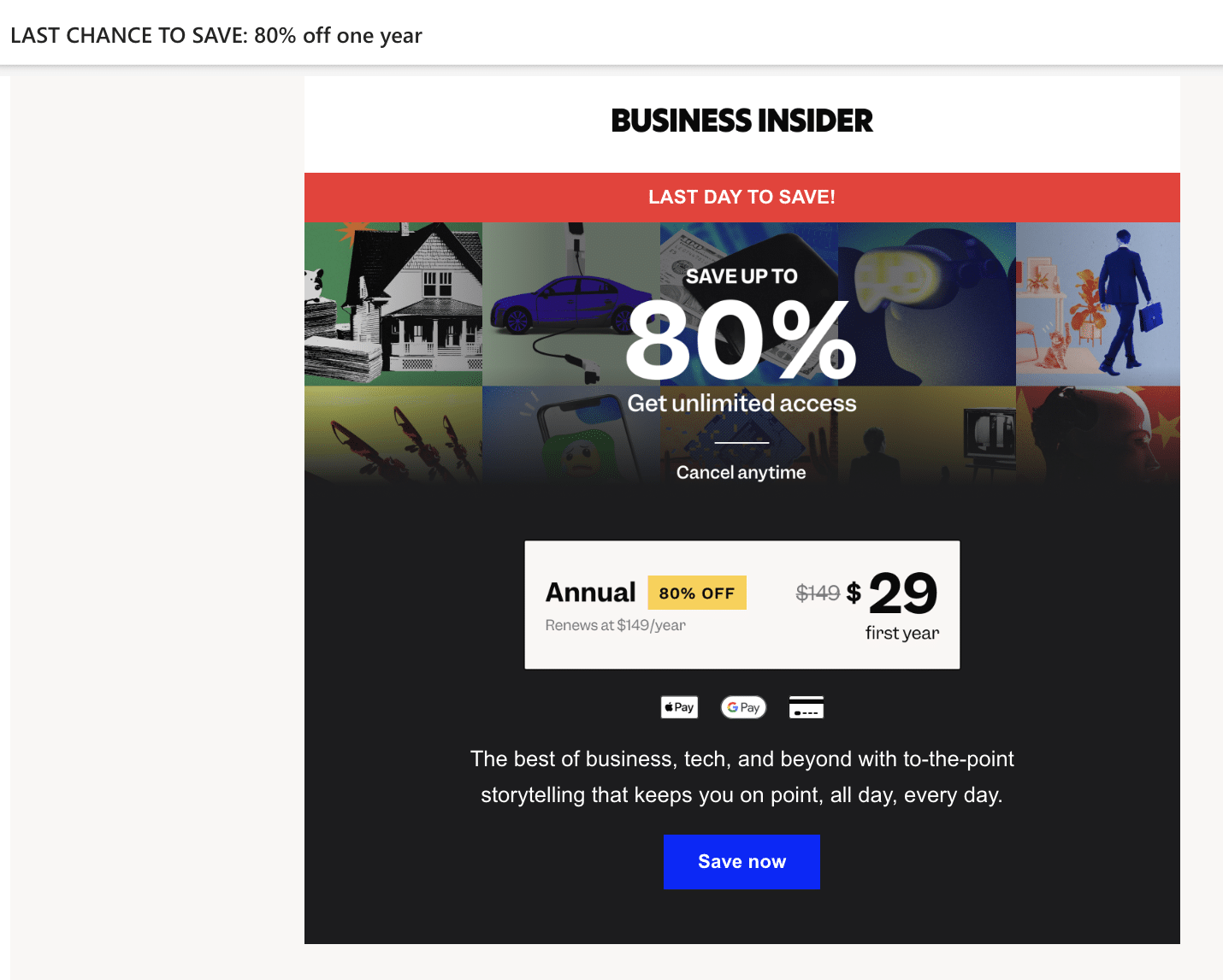
Here is another example from Business Insider. This email was sent to a paid subscriber who had canceled their subscription within the last seven days. They used AI to identify that customer and sent out a limited offer.
How to humanize this ‘last chance’ email
This is a great “buy-back” email. However, the brains behind this campaign could have gone just an extra inch (because who has the time or the budget to go the extra mile?) to ensure a sale by adding a bit of a personal touch to this email.
Especially for a large brand like this, a quick and simple personalization at the top of the email will go a long way in gaining more attention and bringing back customers.
Even the least savvy consumer can tell this is a mass-produced email and possibly completely AI-generated.
A quick personalization at the top of the email is suggested here.
- “FNAME! Business Insider has a deal just for you but today is the last day to save!”
Another suggestion might be:
- “FNAME! We know you canceled but we’d like to offer you something one last time.”
The email could go even further and offer reasons they believe the customer canceled:
- “Purse strings tight right now but still need Business Insider to be on point with business and tech? We get it, FNAME. Here’s a last chance offer to save 80% until the end of the day.”
4 tips for using AI in your email marketing campaigns
1. Use AI to produce ideas, not full emails
It can be tempting to insert a prompt into ChatGPT or Gemini and copy and paste its answer into your email newsletters and campaigns. However, doing so will result in generic content that receives almost no positive feedback from potential and current customers.
Instead, AI can be used to generate ideas, outlines and rough drafts. Always edit and customize AI-generated content according to your company’s brand voice, emphasizing a human-to-human connection.
2. Ensure relevance and personalize
Have I mentioned how impersonal and generic AI-generated content can be? When creating campaigns or outlines with AI, don’t be afraid to differentiate from what the AI source is giving you. Keep your brand in mind and personalize it with names, images and other data about the reader.
Also, ensure it is relevant to your reader. Take what you’ve learned from analytical AI and decide what kind of messages, sales and stories need to be sent to each segment of your list.
Even if you’ve entered all the information into your AI tool, it’s always a good idea to double-check to ensure your campaigns are relevant to the reader and personalized for the best experience.
Dig deeper: 3 keys for email marketing in 2024: AI, change, learn
3. Fact-check
AI might not always be right, especially with content creation. Fact-check what it gives you to ensure the information you send is 100% accurate.
4. Use it to enhance existing strategies
AI has made a complicated marketing strategy like email much easier in the last year alone. It’s an amazing tool, but beware! AI-created content should enhance, not replace, what you are already doing.
For example, if you’re writing a new launch campaign for a new product, instead of asking ChatGPT to write each email, ask it for five new hooks that would appeal to your ideal buyer. Or ask it for the top-performing launch emails of the previous year.
AI-assisted, human-refined: The future of email marketing
Using AI in your email marketing efforts will create more effective campaigns and save you much creative time. However, it’s important to not computer-generate humans out of the whole experience. Customers still crave a human experience, so be sure to use AI to enhance what you’re already doing within your email marketing efforts, not completely replace it.
Dig deeper: From campaigns to conversations: The future of email marketing
The post How to use AI in email marketing without losing the human touch appeared first on MarTech.
**Integrating AI in Email Marketing While Maintaining a Personal Touch**
In the ever-evolving landscape of digital marketing, email remains a steadfast and powerful tool for businesses to connect with their audience. However, the sheer volume of emails that consumers receive daily poses a significant challenge: how can businesses ensure their messages stand out and resonate on a personal level? Enter Artificial Intelligence (AI). By integrating AI into email marketing strategies, businesses can achieve a delicate balance between automation and personalization, ultimately enhancing customer engagement and driving conversions.
### The Role of AI in Email Marketing
AI has revolutionized various aspects of email marketing, from content creation to delivery optimization. Here are some key areas where AI is making a significant impact:
1. **Segmentation and Targeting**: AI algorithms can analyze vast amounts of data to segment email lists more effectively. By examining user behavior, preferences, and past interactions, AI can create highly targeted segments, ensuring that each recipient receives content that is relevant to them.
2. **Personalized Content**: AI can generate personalized email content by analyzing individual user data. This includes personalized subject lines, tailored product recommendations, and customized offers. Such personalization increases the likelihood of engagement and conversion.
3. **Predictive Analytics**: AI can predict future behaviors based on historical data. For example, it can identify the best times to send emails to individual recipients, predict which products a customer is likely to purchase next, and even forecast customer churn. This allows marketers to take proactive measures to retain customers.
4. **A/B Testing and Optimization**: AI can automate A/B testing processes, quickly identifying which email variations perform best. It can also continuously optimize email campaigns in real-time, adjusting elements such as subject lines, images, and call-to-action buttons to maximize effectiveness.
5. **Natural Language Processing (NLP)**: NLP enables AI to understand and generate human-like text. This can be used to create more engaging and conversational email content, making automated emails feel more personal and less robotic.
### Maintaining a Personal Touch
While AI offers numerous benefits, it is crucial to ensure that the personal touch is not lost in the process. Here are some strategies to maintain authenticity and human connection in AI-driven email marketing:
1. **Human Oversight**: While AI can handle many tasks autonomously, human oversight is essential to ensure that the content aligns with the brand’s voice and values. Marketers should review and fine-tune AI-generated content to maintain a consistent and authentic tone.
2. **Storytelling**: Incorporate storytelling elements into your emails. Share stories about your brand, customers, or employees to create an emotional connection with your audience. AI can assist in identifying which stories might resonate most with different segments.
3. **Customer Feedback**: Use AI to analyze customer feedback and sentiment. This can help you understand how your audience perceives your emails and make adjustments accordingly. Encourage customers to share their thoughts and experiences, and use this feedback to improve future campaigns.
4. **Dynamic Content**: Utilize dynamic content blocks to personalize emails further. For example, you can include personalized greetings, product recommendations based on browsing history, or location-specific offers. AI can help automate this process, ensuring each email feels unique to the recipient.
5. **Empathy and Emotion**: Train your AI models to recognize and respond to emotional cues. For instance, if a customer expresses frustration in a previous interaction, the AI can tailor the tone of the next email to be more empathetic and supportive.
6. **Transparency**: Be transparent with your audience about the use of AI. Let them know that AI is being used to enhance their experience, but also emphasize the human element behind your brand. This builds trust and reassures customers that they are not just interacting with a machine.
### Conclusion
Integrating AI into email marketing offers a wealth of opportunities to enhance personalization, optimize campaigns, and drive better results. However, it is essential to strike a balance between automation and the personal touch that makes email marketing so effective. By combining the power of AI with human creativity and empathy, businesses can create compelling and personalized email experiences that resonate with their audience and foster long-term relationships. As AI technology continues to advance, the potential for even more sophisticated and personalized email marketing strategies will only grow, making it an exciting time for marketers to innovate and connect with their customers in meaningful ways.

Recent Comments