
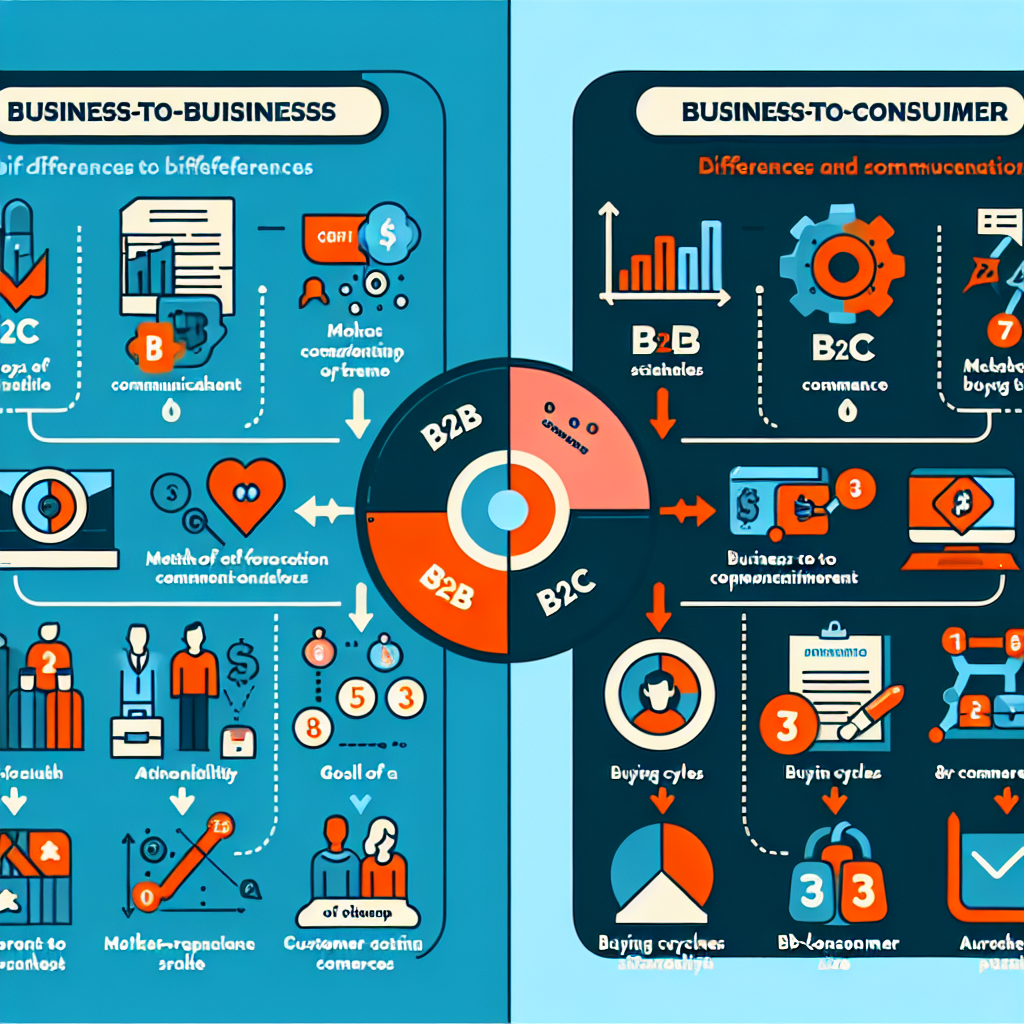
It’s frustrating to hear some marketers dismiss the differences between B2B and B2C by claiming, “It’s all business to human.” While it’s true all marketing ultimately targets people, this oversimplification ignores the significant distinctions between the two disciplines. Just as marketing luxury goods differs from selling unbranded jeans, B2B and B2C require unique approaches — particularly regarding the marketing technology and strategies deployed in campaigns.
The differences are significant. They affect how people make buying decisions, the length of sales cycles, and the emotions involved. Understanding these distinctions is essential for marketers to succeed in their respective domains.
5 reasons B2B isn’t B2C
1. B2B purchases are usually made by a group rather than an individual
In B2B marketing, addressing the diverse needs of a buying committee is a clear challenge. This poses a significant hurdle for marketers, as even the most advanced martech solutions struggle to provide a comprehensive view of the buying committee.
However, this complexity is why tools like marketing automation are more widely utilized in B2B than B2C. They are essential for managing intricate buying processes, and the abundance of data in B2B makes them far more effective.
2. B2B purchases have long sales cycles
While some consumer purchases have long sales cycles, they rarely extend to the lengths seen in B2B. We worked with a company that sold baggage handling systems to airports, where sales cycles ranged from six to 20 years. Managing and engaging customers through such extended buyer journeys is one of B2B marketing’s biggest challenges.
3. Organizations implement systems and processes to make purchases logical
In B2B, endless spreadsheets, scorecards and analytics assess the cost and benefits of products and evaluate the vendors themselves. If the right information isn’t presented in a compelling way, a potential customer might deem your company the wrong choice.
This is so different from B2C. I’ve never built a spreadsheet to decide which chocolate bar or business suit to buy! From a martech point of view, delivering the right technical information to customers is a critical part of B2B.
Dig deeper: Not all B2B and B2C categorizations are alike
4. The emotional drivers in B2B differ from B2C
Consumer purchases are often driven by emotional factors such as status or the desire to reduce stress. In B2B, the emotional drivers are very different, with fear of making the wrong decision a major factor. Although deploying risk-reduction strategies is an element of buying in both situations, it’s much more important in B2B.
You buy tickets to see bands, films or shows because you’re excited about the possibility of how good it is and not because they are the least likely to disappoint. In B2B, sometimes over-selling means customers perceive a high risk of disappointment and avoid the product. In B2C, if the customer believes you, that’s what matters — unless you’re worried about repeat purchases.
There are indeed some areas where risk reduction is important in B2C. Airlines are a good example. No one wants to go on holiday in a plane that might crash. However, marketers in these sectors haven’t done a great job, with most of the competition focusing on price.
In the U.K., marketers decided to act on research indicating that British Airways was perceived as “stuffy.” They replaced the traditional flag design on the aircraft tailplanes with various designs to refresh the brand. However, it sparked a backlash from many consumers who valued the flag, distinguishing the national carrier from other airlines.
Ironically, the redesign created an unintended perception that the planes were less safe without the familiar flag. Perhaps B2C marketers should remember that airline passengers don’t think thrilling, surprising and exciting are positives, particularly the quarter of the population with anxiety over flying.
5. The value of B2B sales is much higher than B2C
The high value of B2B sales drives marketers to invest significant time in understanding customers’ needs and crafting personalized content for them. With account-based marketing, this personalization can even target a single individual. In contrast, B2C operates on a much lower value per transaction but caters to a vastly larger audience. For martech, the personalization demands in B2B are far higher, requiring extensive data to profile and engage each individual effectively.
3 ways B2B overlaps with B2C
It’s a mistake to assume that B2B is entirely different from B2C, as both ultimately involve humans. B2B marketers should reflect on whether they’re delivering the same engaging experiences that B2C marketers create.
We only have ourselves to blame when we deliver unemotional campaigns that don’t inspire buyers. This lack of connection is why B2B marketing faces criticism. To improve, we must recognize the similarities between the two disciplines and strive to bring the same level of creativity and emotional resonance to our campaigns.
1. It really is all ‘business-to-human’
Despite organizations’ attempts to implement systems and processes to remove emotion from purchases, humans must be involved. This means that decisions are never completely logical: You will lose sales if you don’t trigger positive emotions in potential customers.
2. B2B customers’ motivations are soft, not hard
Those processes don’t change the fact that everyone in the buying committee has factors motivating them to make a particular decision. It could be a wish for status, career progression or development of skills that makes one vendor seem more attractive than others. How good are B2B marketers at gathering this data We could learn something from consumer marketers here.
3. Expectations are changing
About 80% of B2B buyers now expect the same buying experience as B2C customers, according to research by Gitnux. Your B2B customers don’t want the stuffy, formal and frankly boring approaches that worked 50 years ago. They want creative, engaging and helpful campaigns.
B2B isn’t B2C. However, B2B is changing. So it’s important to understand that what happens in consumer marketing will impact the business-to-business space. Expectations for creativity, engagement and personalization are growing in B2B customers and doing what worked yesterday will end many B2B marketing careers tomorrow.
Dig deeper: Why B2B marketing must adopt B2C tactics
Unpacking the realities of B2B and B2C marketing
Despite the changes, you cannot drop a B2C campaign into a B2B martech stack and generate results. B2B marketers need to deliver different information to larger groups of people involved in the purchase decision. They must do this while managing the drivers that impact people at work and the extremely long sales cycles. Let’s celebrate the diversity of the two marketing disciplines while sneakily copying the best aspects of B2C campaigns to ensure B2B marketing doesn’t get left behind!
The post 5 ways B2B differs from B2C — and 3 ways they align appeared first on MarTech.
# Key Differences and Similarities Between B2B and B2C: 5 Distinctions and 3 Commonalities
In the world of commerce, businesses are often categorized into two primary models: **Business-to-Business (B2B)** and **Business-to-Consumer (B2C)**. While both models involve the exchange of goods or services, they cater to different audiences and operate under distinct principles. Understanding the key differences and similarities between B2B and B2C is crucial for businesses aiming to optimize their strategies, marketing, and customer engagement. In this article, we will explore **five key distinctions** and **three commonalities** between B2B and B2C.
—
## **5 Key Distinctions Between B2B and B2C**
### 1. **Target Audience**
– **B2B**: In the B2B model, businesses sell products or services to other businesses. The target audience consists of companies, organizations, or professionals who need specific solutions to improve their operations, productivity, or profitability.
– **B2C**: In contrast, B2C companies sell directly to individual consumers. The target audience is the general public, and the focus is on meeting personal needs, desires, or lifestyle preferences.
### 2. **Decision-Making Process**
– **B2B**: The decision-making process in B2B transactions is typically more complex and involves multiple stakeholders. Decisions often require approval from various departments (e.g., procurement, finance, and management), and the process can take weeks or months.
– **B2C**: In B2C, the decision-making process is generally quicker and more straightforward. Consumers often make individual purchasing decisions based on personal preferences, emotions, or immediate needs. Impulse buying is more common in B2C than in B2B.
### 3. **Sales Cycle Length**
– **B2B**: The B2B sales cycle tends to be longer due to the complexity of the products or services, the need for customization, and the involvement of multiple decision-makers. B2B transactions often require detailed proposals, negotiations, and contracts.
– **B2C**: The B2C sales cycle is typically shorter. Consumers can make decisions quickly, and purchases are often completed in a matter of minutes or hours, especially in e-commerce settings. The focus is on convenience and ease of purchase.
### 4. **Marketing Approach**
– **B2B**: B2B marketing is more relationship-driven and focuses on building long-term partnerships. Content marketing, case studies, whitepapers, and industry-specific events are common tactics. The messaging is often more technical and emphasizes ROI (Return on Investment), efficiency, and expertise.
– **B2C**: B2C marketing is more transactional and emotion-driven. It often relies on mass marketing techniques, such as social media, influencer marketing, and advertising campaigns. The messaging is typically more focused on entertainment, convenience, and personal satisfaction.
### 5. **Product Complexity and Customization**
– **B2B**: B2B products and services are often more complex and may require customization to meet the specific needs of the client. For example, enterprise software, industrial machinery, or consulting services often need to be tailored to the buyer’s requirements.
– **B2C**: B2C products are generally standardized and designed for mass consumption. While there may be variations in style, color, or size, the level of customization is far less than in B2B. B2C products are typically ready for immediate use by the consumer.
—
## **3 Commonalities Between B2B and B2C**
### 1. **Customer-Centric Focus**
Both B2B and B2C models prioritize the customer, though the nature of the customer differs. In both cases, businesses must understand their audience’s needs, preferences, and pain points to deliver value. Whether it’s a business buyer looking for efficiency or a consumer seeking convenience, the ultimate goal is to provide a solution that meets the customer’s expectations.
### 2. **Importance of Trust and Credibility**
Trust is a critical factor in both B2B and B2C transactions. In B2B, trust is built through long-term relationships, proven expertise, and reliable service. In B2C, trust is often established through brand reputation, positive reviews, and customer service. In both cases, businesses must work to maintain credibility and foster trust to ensure customer loyalty and repeat business.
### 3. **Digital Transformation**
Both B2B and B2C companies are increasingly embracing digital transformation to enhance their operations, marketing, and customer engagement. E-commerce platforms, social media, data analytics, and automation tools are being used by both models to streamline processes, personalize experiences, and improve customer satisfaction. The rise of digital marketing, in particular, has blurred the lines between

Recent Comments