

While 99% of marketers say they’re personally using AI, 67% say a lack of training remains a barrier to its adoption at work — three percentage points higher than in 2023, according to a new survey by The Marketing AI Institute.
Just over a third of respondents (36%) said AI is now infused into their daily workflows — up 7 percentage points from last year, according to the 2024 State of Marketing AI Report. The number of people who “couldn’t live without AI,” jumped from 6% in 2023 to 15% today.
When asked if their organization offered AI training for the marketing team, 75% either said no (47%), that it’s in development (24%), or they’re not sure training exists (4%).
Familiarity breeds understanding
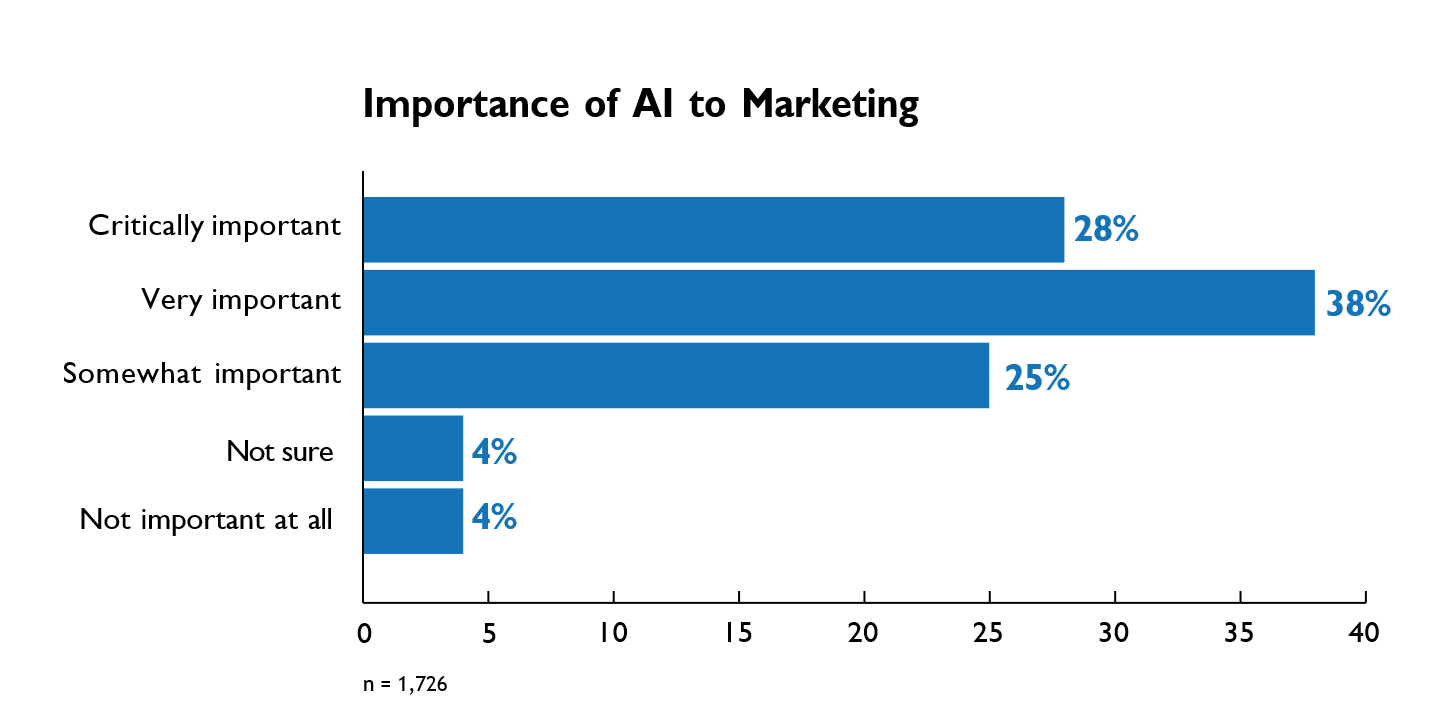
Despite the lack of training, use of the technology is improving peoples’ skills, as 61% reported they now have an intermediate-level understanding of AI, up from 54% in 2023; 16% said they have an advanced understanding, compared to 11% last year.
AI adoption by organizations continues to grow, with 51% reporting their marketing teams are piloting or scaling AI, compared to 42% last year.
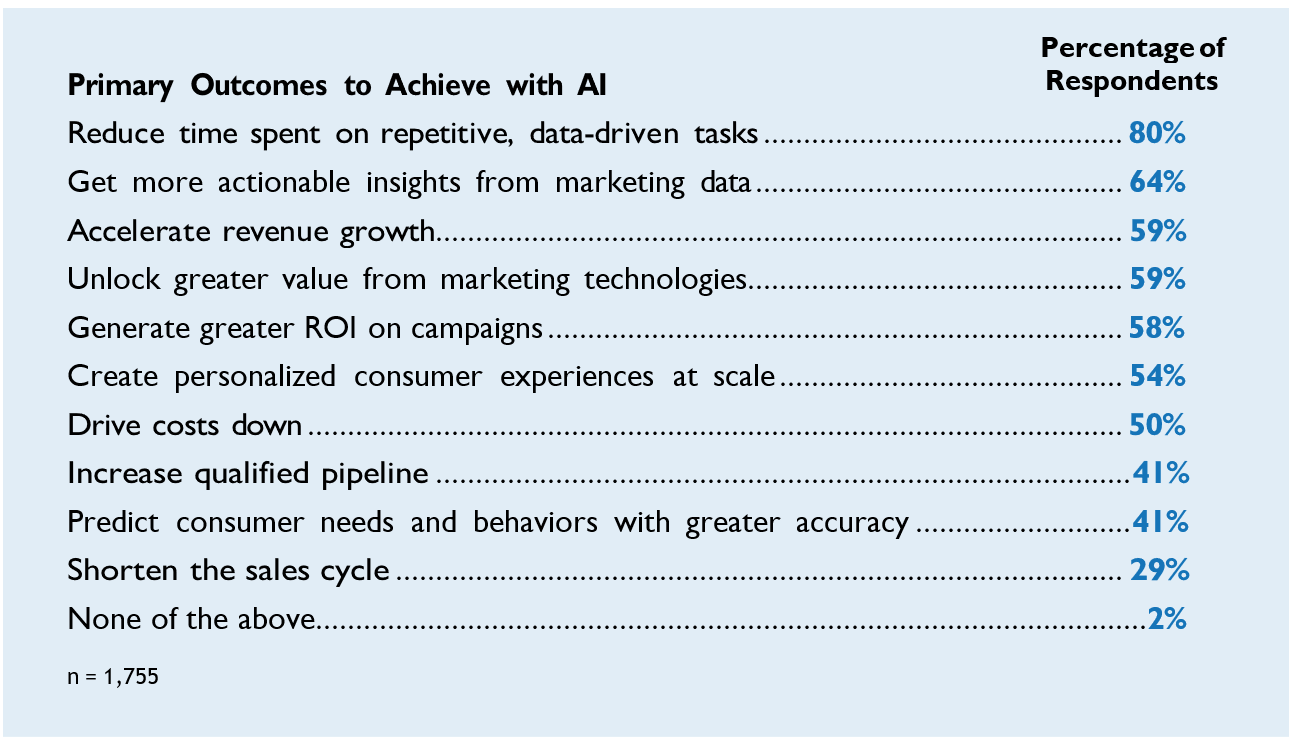
Marketers really, really want AI to free up time: 80% said they want the technology to “reduce time spent on repetitive, data-driven tasks.” That’s 14 percentage points more than the next item on the list of things they want AI to deliver: “more actionable insights from marketing data.”
A whopping 78% believe that in the next three years, AI will handle more than a quarter of their marketing tasks; 34% expect at least half of their marketing tasks to be automated in the same timeframe.
More AI, fewer jobs?
Marketers are more pessimistic than ever about AI’s impact on marketing jobs, but there’s a surprising split in opinion between executives and those who use it.
Overall, 47% believe AI will eliminate more jobs than it creates in the next three years, seven percentage points higher than in 2023. Unsurprisingly, the number of people who think more jobs will be created rather than eliminated fell to 31%, five percentage points lower than last year.
Dig deeper: Why traditional marketing systems can’t keep up with AI and what to do about it
The people most likely to believe AI will eliminate more jobs are the people using it least: executives. More than half of CEOs/Presidents, CMOs and other C-suite types expect the technology to disrupt employment. However, only 40% of managers and entry-level employees think this will happen.
The survey gave people the opportunity to write in their concerns about AI. Many are worried that AI is developing and being deployed so fast that they won’t be able to keep up with it. Here’s some of what they wrote.
- “How fast everything is able to move now, allowing (ironically) little time for strategic or out-of-the-box thinking.”
- “The speed of change into an unknown, unregulated space, in which no one knows the limits of AI (and some won’t care) which supplants our natural, evolved and profoundly human sense of the world and our relationship to it.”
- “That it advances faster than we, as humans, can follow with.”
- “I’m concerned that the company I work for will fall behind because they are afraid of AI.”
- “How fast it is coming at us; separating the hype from reality; balancing the need to stay updated and learn/deploy without wasting time and cash on tech that will be obsolete — that is, understanding it will take time for the major players to emerge and some features will be ‘baked in’ to larger platforms. In short, confusing marketplace rn.”
Methodology
The survey is based on responses to 25 questions about AI and its role in marketing and business, as well as information on the demographics of the survey takers. Respondents were not required to answer all the questions to submit their responses. 1,784 respondents completed at least some of the survey, with the vast majority (73%) completing the full survey.
The highest percentage of respondents (23%) identified as directors. The next highest role was manager (22%), then CEO/President at 20%. The majority (51%) of respondents work at companies with $10 million or more in revenue and 53% of respondents work at organizations with 50 or more employees.
It can be downloaded here. (Registration required.)
The post 67% of marketers say lack of training is primary barrier to AI adoption appeared first on MarTech.
**Majority of Marketers Identify Insufficient Training as Key Obstacle to AI Adoption**
In the rapidly evolving landscape of digital marketing, artificial intelligence (AI) has emerged as a transformative force, promising to revolutionize how businesses engage with consumers, analyze data, and optimize campaigns. Despite its potential, a significant barrier stands in the way of widespread AI adoption among marketers: insufficient training. Recent surveys and studies indicate that a majority of marketers identify a lack of adequate training as the primary obstacle to effectively integrating AI into their strategies.
**The Promise of AI in Marketing**
AI technologies, including machine learning, natural language processing, and predictive analytics, offer a myriad of applications in marketing. These range from automating repetitive tasks and personalizing customer experiences to predicting consumer behavior and optimizing ad spend. For instance, AI-powered tools can analyze vast datasets to uncover insights that would be impossible for humans to discern, enabling more targeted and efficient marketing campaigns.
Moreover, AI can enhance customer service through chatbots and virtual assistants, providing instant responses and support. It can also streamline content creation by generating personalized recommendations and automating social media posts. The potential benefits are substantial, promising increased efficiency, improved customer satisfaction, and higher ROI.
**The Training Gap**
Despite these advantages, a significant portion of marketers remains hesitant to fully embrace AI. According to a recent survey conducted by the Marketing AI Institute, over 60% of marketers cited insufficient training as the main barrier to AI adoption. This training gap manifests in several ways:
1. **Lack of Understanding**: Many marketers lack a fundamental understanding of AI technologies and their applications. Without a clear grasp of how AI works and its potential benefits, marketers are less likely to invest in and adopt these tools.
2. **Skill Deficiency**: Implementing AI requires a specific set of skills, including data analysis, machine learning, and programming. Many marketing professionals do not possess these technical skills, and there is a shortage of training programs that bridge this gap.
3. **Fear of Complexity**: AI can be perceived as complex and intimidating. Marketers may fear that integrating AI into their workflows will require significant time and resources, leading to resistance and reluctance to adopt these technologies.
4. **Inadequate Resources**: Smaller businesses and marketing teams often lack the resources to invest in comprehensive AI training programs. This can result in a knowledge disparity between larger enterprises with dedicated AI teams and smaller organizations.
**Addressing the Training Challenge**
To overcome the training barrier and unlock the full potential of AI in marketing, several strategies can be employed:
1. **Educational Programs**: Companies and educational institutions should collaborate to develop specialized training programs that equip marketers with the necessary AI skills. These programs should cover both theoretical knowledge and practical applications, ensuring that marketers can effectively implement AI tools.
2. **Workshops and Webinars**: Regular workshops and webinars conducted by AI experts can help demystify AI technologies and demonstrate their practical benefits. These sessions can provide hands-on experience and foster a deeper understanding of AI applications in marketing.
3. **Online Courses and Certifications**: Online platforms offering AI courses and certifications can make training more accessible to marketers worldwide. These courses can be tailored to different skill levels, from beginners to advanced practitioners.
4. **In-House Training**: Organizations can invest in in-house training programs, bringing AI experts to train their marketing teams. This approach ensures that training is aligned with the specific needs and goals of the organization.
5. **Mentorship and Collaboration**: Encouraging collaboration between marketing professionals and data scientists or AI specialists can facilitate knowledge transfer and skill development. Mentorship programs can also provide ongoing support and guidance.
**Conclusion**
As AI continues to reshape the marketing landscape, addressing the training gap is crucial for its successful adoption. By investing in comprehensive training programs and fostering a culture of continuous learning, marketers can overcome the obstacles to AI integration and harness its full potential. The future of marketing lies in the seamless blend of human creativity and AI-driven insights, and bridging the training gap is the first step towards realizing this vision.

Recent Comments