

The popular online video platform TikTok went dark over the weekend, as a law that banned the app in the U.S. went into effect.
By Sunday afternoon, U.S. Eastern Time, the TikTok website was back to showing short-form videos to U.S. users, though the TikTok mobile app was unavailable on app stores like Google Play, which displayed the message below.
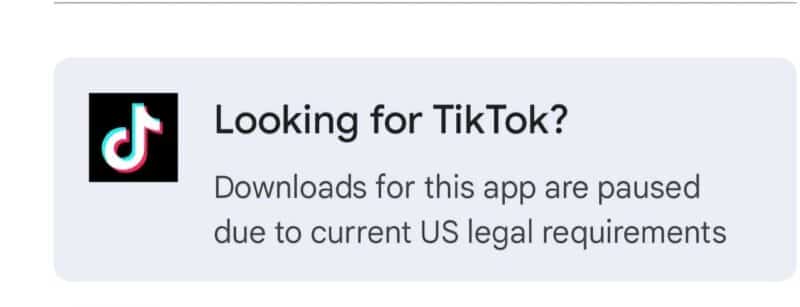
The law banning TikTok, which was overwhelmingly approved by the U.S. Congress last year, was upheld by the U.S. Supreme Court on Friday, setting the stage for the TikTok app to become unavailable for download.
It was no coincidence the law took effect on the last day of the Biden administration. TikTok itself, in a message that appeared for users trying to access its website over the weekend, held out hope the incoming Trump administration, which takes control of the Executive Branch of the U.S. government on Monday, would help the platform make a comeback.

MarTech took the pulse of the community to see how marketers feel about this unprecedented action. Many of the marketers who shared their opinions expected TikTok to return in some form under U.S. ownership. But they also mentioned the deep impact the ban will have on influencer marketing and creators.
Michele Nieberding, Director of Product Marketing for MetaRouter, said social media platforms evolve and die, mentioning Vine and MySpace as social media platforms of the past.
I think this is an opportunity, not just to diversify, but to innovate. This isn’t just about finding the next TikTok, it’s about imagining what could exist instead. Could we see the rise of AI-powered personal content channels? Decentralized creator cooperatives? Mixed reality social platforms?
Chris Brownlee, VP of Product at Yext, also discussed how apps give way to new apps.
If TikTok disappears, Gen Z won’t stop searching — they’ll simply look elsewhere. Apps like RedNote are reporting a surge in downloads, while many users are turning to Instagram Reels, YouTube Shorts, Reddit and review sites as alternative ways to find information. Not forgetting the growing wave of AI-powered search, from Open AI’s SearchGPT to Google’s Gemini.
Mike Donoghue, CEO and co-founder of Alpha Group, was one of a number of marketers who said that even if TikTok returns, as many expect it will, it may not be the same.
Depending on the iteration of TikTok that comes back (and it will) I think it will be hard to replicate the virality slot machine of TikTok 1.0.
Normally I would suggest that TikTok’s loss is Meta’s gain but the combination of scaled back creator programs, constantly shifting algorithms and shuttered moderation functions make it increasingly unlikely IG, FB and WhatsApp will be a safe harbor for creators and their audiences.
Griffin Haddrill, co-founder of LV8, Mirage and VRTCL, said the TikTok community of creators and viewers is likely to spread out across existing social platforms.
I believe ‘viral’ and social marketing will fragment into distinct niches across platforms like Instagram, X, YouTube and Snapchat. I think in the short term, trends will become more platform specific, either thriving or fading within their own ecosystems, with less crossover to others. Users across platforms will essentially be speaking different languages – similar to the divide between Android and Apple users, or PC and Mac.
Ryan Jones, Marketing Manager at SEOTesting, also expects TikTok to return and for creators to head to other platforms until that happens. As for marketers:
Marketers will fall into what they always do: testing. They will continue to test new and upcoming social media platforms, reverting to ‘old favorites’ and experimenting with what works on the latest platforms they invest time in.
Claudia Ratterman, Director Analyst in the Gartner Marketing Practice, expects Meta to be the winner in terms of ad spend, at least in the short term.
Instagram has higher engagement than Facebook, so most ad spend will likely move there. However, YouTube has a big opportunity to grow both YouTube Shorts and its main platform – particularly for B2B advertisers, who favor flexibility when it comes to shorter- and longer-form content. Brands shouldn’t put all their eggs in one basket with Instagram, it’s as important as ever to diversify.
Stefan Lubinski, a growth consultant, coach and producer, also sees a huge opportunity for Google’s YouTube and Meta’s Instagram properties.
This is basically a golden ticket for YouTube and Instagram to step up their game. They need to roll out the red carpet for creators with better exposure (algorithm love) and fatter revenue shares (money love). And for all those brands throwing cash at TikTok influencers? They’re gonna need to scramble to rebuild their influence networks on these other platforms. It’s like marketing musical chairs, but with billions of dollars at stake.
Len Devanna, Vice President of Customer Experience at Cortico-X, is one of the marketers to mention that all involved — brands, creators and agencies — are getting another lesson on relying too heavily on a single platform.
If TikTok were to go dark this Sunday, it would reflect the risk of relying too heavily on any single platform — similar to what we’ve seen with Twitter’s rapid decline. Creators, brands, and consumers will adapt, but the immediate disruption will be significant. For creators, it’s not just about losing an audience — it’s about losing the discovery engine that TikTok uniquely provides. While platforms like Instagram Reels and YouTube Shorts will likely absorb some of the spillover, neither replicates TikTok’s combination of engagement and virality.
Anthony Poliseno, CMO of Magnolia, is keeping an eye on new platforms that could replace TikTok.
The gap will be filled, and I’m inclined to think that it will be in the form of a new contender like Red Note rather than a return of marketing spending to Facebook or X. For global consumer brands doing business in Asia, South America and Europe, TikTok will still be a primary channel — and as we see today, that content will continue to make its way to platforms like Instagram and YouTube if it’s viral or compelling enough.
Molly St. Louis, Co-Founder of Mosaic Group Media, said it’s going to take time for TikTok creators to recover their numbers and income on other platforms.
Influencers will find new platforms (and hopefully diversify), taking some time to get back up to their former engagement numbers. And we’ll be back in business. Marketers (especially influencers) are nothing if not resilient and creative. We’ll find another window to go through when this door closes, and it might lead to some interesting innovations.
Jennie Smythe, founder & CEO, Girlilla Marketing, said that too many brands and creators are reliant on platforms they do not control.
Like every other part of your digital footprint, today’s news is just a reminder how important it is to not be reliant on any thir-party platform for anything. They come, they go… sometimes very unfortunately. Be sure to always keep your digital valuables backed up and as always, your owned properties (website, email, text list) in order.
Nicole Perrin, EVP of Business Intelligence at Advertiser Perceptions, said many advertisers were taking the potential for a ban seriously as the date approached.
When we surveyed for our Macroeconomic Effects & Perceptions report in December 2024, 62% of advertiser respondents believed it was at least somewhat likely that TikTok would be banned in the U.S. in 2025, including 23% who considered it very likely. Among those who reported buying ads on TikTok as of December, 41% said they were scaling back on ads while 21% were pausing ad activity until they knew more about the outcomes from the ongoing litigation.
The post The marketing community reacts, as the clock runs out on TikTok (for now) appeared first on MarTech.
**Marketing Experts Respond to TikTok’s Uncertain Future as Deadline Looms**
In recent years, TikTok has emerged as a dominant force in the social media landscape, captivating over a billion users worldwide with its short-form videos, viral trends, and innovative algorithm. For marketers, the platform has become a goldmine for reaching younger audiences, fostering brand engagement, and driving sales. However, TikTok’s future in key markets, particularly the United States, has been clouded by regulatory scrutiny and geopolitical tensions. As the deadline for potential bans, divestitures, or other government actions looms, marketing experts are weighing in on the implications for brands and the broader advertising ecosystem.
### The Uncertain Future of TikTok
TikTok, owned by Chinese tech giant ByteDance, has faced mounting pressure from governments concerned about data privacy, national security, and the platform’s ties to China. In the United States, lawmakers and regulators have proposed various measures, including an outright ban, restrictions on app downloads, or a forced sale of TikTok’s U.S. operations to an American company. Similar concerns have been raised in other countries, including the United Kingdom, Canada, and Australia.
As the deadline for a decision approaches, the uncertainty surrounding TikTok’s future has left marketers in a precarious position. Many are grappling with how to allocate resources, maintain audience engagement, and prepare for potential disruptions to their campaigns.
### Marketing Experts Weigh In
Marketing professionals and industry experts have been closely monitoring the situation, offering insights into how brands can navigate this period of uncertainty. Here’s what they have to say:
#### 1. **Diversify Your Social Media Strategy**
One of the most consistent pieces of advice from marketing experts is to avoid putting all your eggs in one basket. While TikTok has been a powerful platform for reaching Gen Z and millennial audiences, relying solely on it can be risky given the current climate.
“Brands need to diversify their social media strategies to mitigate the impact of a potential TikTok ban,” says Sarah Mitchell, a digital marketing consultant. “Platforms like Instagram Reels, YouTube Shorts, and Snapchat Spotlight offer similar short-form video formats and can serve as viable alternatives.”
#### 2. **Focus on Owned Media**
Another key recommendation is to invest in owned media, such as websites, blogs, and email lists, which are not subject to the whims of external platforms or regulatory actions.
“Social media platforms come and go, but your owned media is forever,” explains James Carter, a content marketing strategist. “Brands should use TikTok to drive traffic to their own digital properties, where they have full control over the user experience and data.”
#### 3. **Leverage Influencer Partnerships**
Influencers have been a cornerstone of TikTok’s success, helping brands connect with audiences in authentic and creative ways. Even if TikTok’s future is uncertain, the relationships built with influencers can extend to other platforms.
“Influencers are not tied to a single platform,” notes Emily Rodriguez, an influencer marketing specialist. “If TikTok disappears, many creators will migrate to Instagram, YouTube, or other channels. Brands should maintain strong relationships with influencers and be prepared to follow them to new platforms.”
#### 4. **Monitor Regulatory Developments**
Staying informed about the latest regulatory developments is crucial for marketers navigating this uncertain period. Many experts recommend working closely with legal and compliance teams to understand the potential implications of a TikTok ban or other government actions.
“Marketers need to be proactive, not reactive,” says David Kim, a social media strategist. “Keep an eye on the news, consult with legal experts, and have contingency plans in place.”
#### 5. **Experiment with Emerging Platforms**
As TikTok’s future hangs in the balance, newer platforms like BeReal, Triller, and Clapper are gaining traction. While these platforms may not yet have TikTok’s scale, they offer opportunities for early adopters to experiment and build a presence.
“Emerging platforms are a playground for innovation,” says Laura Bennett, a marketing professor at NYU. “Brands that are willing to take risks and experiment with new channels can gain a competitive edge.”
### The Broader Implications for Digital Marketing
TikTok’s uncertain future is a stark reminder of the volatility of the digital marketing landscape. Platforms rise and fall, algorithms change, and regulatory environments evolve. For marketers, adaptability is no longer optional—it’s essential.
“This situation underscores the importance of agility in marketing,” says Carter. “Brands that can pivot quickly, experiment with new strategies, and stay ahead of trends will be better positioned to weather disruptions.”
### Conclusion
As the deadline for a decision on TikTok’s future approaches, marketers are bracing for potential changes while exploring alternative strategies. Whether TikTok remains a key player or exits the stage, the lessons learned during this period of uncertainty will shape the future of digital marketing.
For now, brands should focus on diversifying their strategies,

Recent Comments