

The martech landscape is expanding and AI is the prime driving force. That’s the topline news from the “Martech 2024” report released today. And, while that will get the headline, the report contains much more.
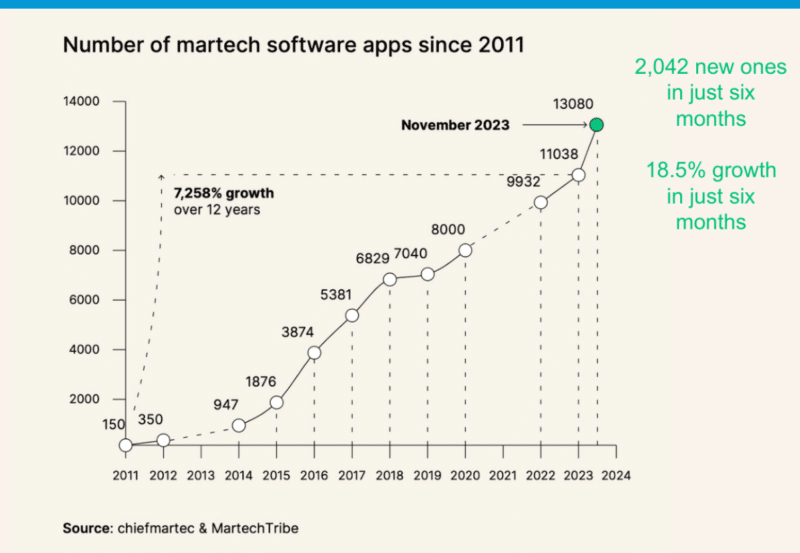
Since the release of the most recent Martech Landscape in May 2023, 2,042 new marketing technology tools have surfaced, bringing the total to 13,080 — an 18.5% increase. Of those, 1,498 (73%) were AI-based.
“But where did it land?” said Frans Riemersma of Martech Tribe during a joint video conference call with Scott Brinker of ChiefMartec and HubSpot. “And the usual suspect, of course, is content. But the truth is you can build an empire with all the genAI that has been surfacing — and by an empire, I mean, of course, a business.”
Content tools accounted for 34% of all the new AI tools, far ahead of video, the second-place category, which had only 4.85%. U.S. companies were responsible for 61% of these tools — not surprising given that most of the generative AI dynamos, like OpenAI, are based here. Next up was the U.K. at 5.7%, but third place was a big surprise: Iceland — with a population of 373,000 — launched 4.6% of all AI martech tools. That’s significantly ahead of fourth place India (3.5%), whose population is 1.4 billion and which has a significant tech industry.
Dig deeper: 3 ways email marketers should actually use AI
The global development of these tools shows the desire for solutions that natively understand the place they are being used.
“These regional products in their particular country…they’re fantastic,” said Brinker. “They’re loved, and part of it is because they understand the culture, they’ve got the right thing in the language, the support is in that language.”
Now that we’ve looked at the headline stuff, let’s take a deep dive into the fascinating body of the report.
The report: A deeper dive
Marketing technology “is a study in contradictions,” according to Brinker and Riemersma.
In the new report they embrace these contradictions, telling readers that, while they support “discipline and fiscal responsibility” in martech management, failure to innovate might mean “missing out on opportunities for competitive advantage.” By all means, edit your stack meticulously to ensure it meets business value use cases — but sure, spend 5-10% of your time playing with “cool” new tools that don’t yet have a use case. That seems like a lot of time.
Similarly, while you mustn’t be “carried away” by new technology hype cycles, you mustn’t ignore them either. You need to make “deliberate choices” in the realm of technological change, but be agile about implementing them. Be excited by martech innovation, in other words, but be sensible about it.
The growing landscape
Consolidation for the martech space is not in sight, Brinker and Riemersma say. Despite many mergers and acquisitions, and a steadily increasing number of bankruptcies and dissolutions, the exponentially increasing launch of new start-ups powers continuing growth.
It should be observed, of course, that this is almost entirely a cloud-based, subscription-based commercial space. To launch a martech start-up doesn’t require manufacturing, storage and distribution capabilities, or necessarily a workforce; it just requires uploading an app to the cloud. That is surely one reason new start-ups appear at such a startling rate.
Dig deeper: AI ad spending has skyrocketed this year
As the authors admit, “(i)f we measure by revenue and/or install base, the graph of all martech companies is a ‘long tail’ distribution.” What’s more, focus on the 200 or so leading companies in the space and consolidation can certainly be seen.
Long-tail tools are certainly not under-utilized, however. Based on a survey of over 1,000 real-world stacks, the report finds long-tail tools constitute about half of the solutions portfolios — a proportion that has remained fairly consistent since 2017. The authors see long-tail adoption where users perceive feature gaps — or subpar feature performance — in their core solutions.
Composability and aggregation
The other two trends covered in detail in the report are composability and aggregation. In brief, a composable view of a martech stack means seeing it as a collection of features and functions rather than a collection of software products. A composable “architecture” is one where apps, workflows, customer experiences, etc., are developed using features of multiple products to serve a specific use case.
Indeed, some martech vendors are now describing their own offerings as composable, meaning that their proprietary features are designed to be used in tandem with third-party solutions that integrate with them. This is an evolution of the core-suite-plus-app-marketplace framework.
That framework is what Brinker and Riemersma refer to as “vertical aggregation.” “Horizontal aggregation,” they write, is “a newer model” where aggregation of software is seen not around certain business functions (marketing, sales, etc.) but around a layer of the tech stack. An obvious example is the data layer, fed from numerous sources and consumed by a range of applications. They correctly observe that this has been an important trend over the past year.
Build it yourself
Finally, and consistent with Brinker’s long-time advocacy for the citizen developer, the report detects a nascent trend towards teams creating their own software — a trend that will doubtless be accelerated by support from AI.
So far, the apps that are being created internally may be no more than “simple workflows and automations.” But come the day that app development is so democratized that it will be available to a wide range of users, the software will be a “reflection of the way they want their company to operate and the experiences they want to deliver to customers. This will be a powerful dimension for competitive advantage.”
Constantine von Hoffman contributed to this report.
The post AI driving an exponential increase in marketing technology solutions appeared first on MarTech.
The world of marketing technology solutions has been experiencing exponential growth in recent years, and a significant driver of this growth is the advancements in artificial intelligence (AI). AI has revolutionized the way marketers approach their strategies, enabling them to analyze vast amounts of data, personalize customer experiences, and automate repetitive tasks.
One of the most significant impacts of AI on marketing technology solutions is the ability to analyze and interpret large sets of data quickly and accurately. With AI-powered analytics tools, marketers can gain insights into customer behavior, preferences, and trends, allowing them to make data-driven decisions. This has led to more targeted and effective marketing campaigns, resulting in higher conversion rates and increased ROI.
Personalization is another area where AI has had a significant impact. With AI, marketers can create personalized experiences for customers by analyzing their behavior and preferences. This level of personalization was not possible before the advent of AI, and it has led to increased customer engagement and loyalty.
AI has also enabled marketers to automate repetitive tasks, freeing up time for more strategic activities. For example, AI-powered chatbots can handle customer inquiries and support, while AI-driven email marketing tools can send personalized messages to customers based on their behavior and preferences.
The growth of marketing technology solutions powered by AI has also led to the emergence of new job roles and skill sets. Marketers now need to have a good understanding of AI and data analytics to make the most of these tools. This has led to an increased demand for professionals with these skills, and many companies are investing in training and development to ensure their teams are equipped to handle the new technology.
Overall, the advancements in AI have had a profound impact on the marketing technology solutions industry. With the ability to analyze data, personalize experiences, and automate tasks, marketers can now create more effective and efficient campaigns. As AI continues to evolve, we can expect to see even more innovative marketing technology solutions emerge, further driving growth in this exciting industry.

Recent Comments