

Artificial intelligence. It is everywhere, or so it would seem.
I was at a recent marketing conference and as I scanned the agenda more than half of the sessions, including my own, had AI in the title or in the session description. Two of the keynotes that I attended mentioned AI and the one was entirely on AI.
While AI is all the rage, if you are not using it. there is no reason to feel left out. It is not going anywhere, and rushing to the new shiny object because everyone else is using it does not guarantee you will improve your marketing or get your organization any closer to growth.
Regardless, Gartner reports that 63 percent of marketing leaders plan to invest in generative AI in the next 24 months. This, despite the fact that these same leaders report only using one-third of the capabilities of their current technology. Certain proof that history does repeat itself.
I am not here to dissuade anyone from using AI. In fact, we use it across our organization and it is foundational to how we support our clients. However, I am here to make the case for better utilization of AI which will improve the value you get from it and I believe will better position marketing to be a growth driver for your organization.
Use AI to understand your data and your customers
In virtually every conversation that I have with prospective clients, marketing executives, and others in the industry, the prevailing use cases for the utilization of AI revolve around generative AI. While this can certainly make life easier, only harnessing AI for generative tasks is like purchasing a Ferrari and using it as a golf cart. (Side note: you can actually get a golf cart that looks like a Ferrari).
I submit that you will get more value from generative AI if you first start using AI to better understand your data and get closer to your customers.
As I discussed in a previous article, one of the best ways to create sustainable growth for your organization is to have engagement at every stage of the customer journey. However, in order to create this kind of engagement, you have to understand your customers – what they need and want at every stage of that journey. It is important to remember that in the B2B context, we are marketing to people. They have their own bias, motivations, and feelings and make decisions based on emotions. Additionally, you need to apply this across your various customer segments as not all customers are created the same.
With AI, we now have the ability to understand individual motivations (think buying committees), cognitive style, preferred language, etc. AI delivers insight into the thinking process of people and how they think.
This is the kind of insight that in years past would take weeks, if not months to generate, but with the AI tools at our disposal today, we have the ability to generate these kinds of insights in a matter of hours and days — and do so dynamically.
Dig deeper: Artificial Intelligence: A beginner’s guide
The AI Utilization Process
I hope by now you are a believer in using AI for data and insights, but like all technology, in order to get value from it you must have a defined strategy and process, lest you become one of the 33% that are not getting full utilization from their technology investments.
In short, the best way to get the most from your AI investment for those 63% of marketing leaders who plan to invest is to have a process that starts with your customer data (and you must ensure that you have data integrity).
Within our organization, we refer to this as the AI Utilization Process.
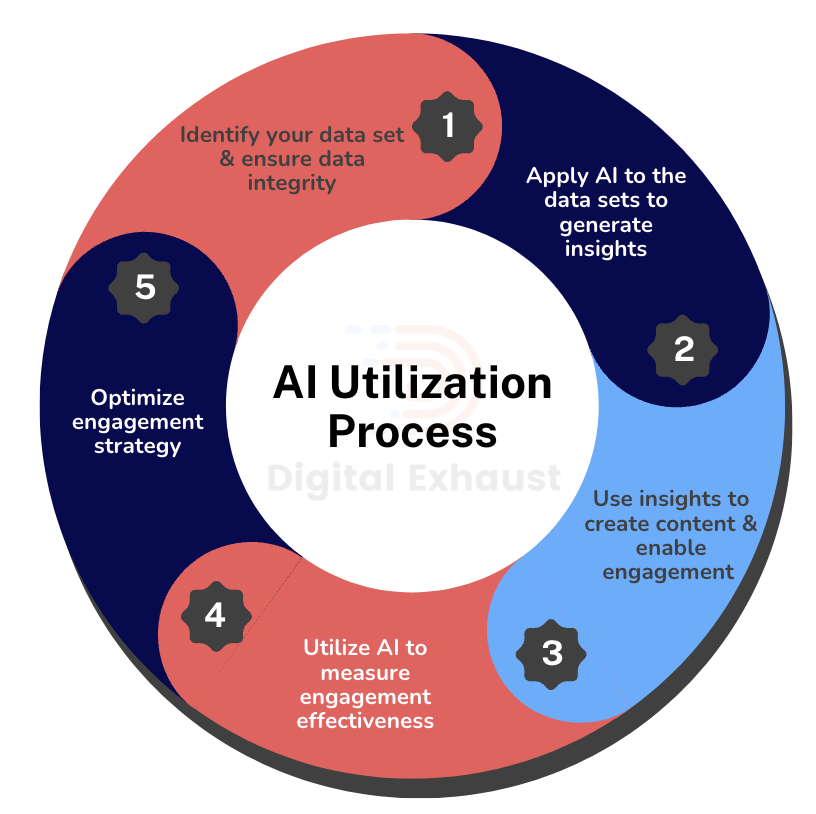
As you can see, the whole idea is to generate insights from your customer data that will then enable you to create the right kind of content (generative AI to create relevant and contextual content) that drives engagement at every stage of the customer journey. You can generate this insight by integrating your CRM with any number of AI tools that enables dynamic insights. Additionally, you can upload a database or list of contacts into these tools and begin developing the insights that will get you closer to them and offer a deeper understanding of how they operate throughout their journey.
AI can then be deployed to measure the performance of your engagement strategies in real-time and enable you to continually optimize the engagement to enhance performance. This is going far beyond vanity metrics of opens, clicks, and visits. AI provides the opportunity to deliver dynamic campaigns that can be optimized continually to deliver the highest return on investment.
It will be interesting to see how the 63% who plan to invest in generative AI fare down the road as the track record of getting value from technology investments is not favorable. However, I do believe that marketing organizations can change the narrative and use AI in a way that guides and directs how they use generative tools in the future.
In fact, I believe this is imperative if we expect AI investment to be a mainstay in B2B.
The post Getting the most from your AI investment appeared first on MarTech.
Artificial Intelligence (AI) has become an essential tool for businesses looking to stay competitive in today’s fast-paced market. With the ability to automate tasks, analyze data, and make informed decisions, AI can help companies improve efficiency, reduce costs, and increase revenue. However, implementing AI technology can be a significant investment, and it’s essential to maximize the return on that investment to ensure its success. Here are some strategies to help you get the most out of your AI investment.
1. Define clear goals and objectives
Before implementing AI technology, it’s crucial to have a clear understanding of what you want to achieve. Whether it’s improving customer service, increasing sales, or reducing operational costs, having specific goals and objectives will help you measure the success of your AI investment and make necessary adjustments along the way.
2. Choose the right AI technology
There are various AI technologies available, each with its strengths and weaknesses. It’s essential to choose the right technology that aligns with your business goals and objectives. For example, if you’re looking to improve customer service, you may want to invest in chatbots or virtual assistants. If you’re looking to analyze large amounts of data, you may want to invest in machine learning algorithms.
3. Invest in quality data
AI technology relies on data to make informed decisions. The quality of the data you provide will directly impact the effectiveness of your AI investment. It’s essential to invest in quality data sources and ensure that your data is clean, accurate, and up-to-date.
4. Train your team
Implementing AI technology requires a certain level of expertise. It’s essential to train your team on how to use the technology effectively. This may involve hiring new talent or providing training for existing employees. Investing in your team’s skills will help ensure that your AI investment is used to its full potential.
5. Monitor and measure performance
Once your AI technology is implemented, it’s essential to monitor and measure its performance regularly. This will help you identify areas where the technology is performing well and areas where improvements can be made. By continuously monitoring and measuring performance, you can make necessary adjustments to maximize the return on your AI investment.
6. Stay up-to-date with AI advancements
AI technology is constantly evolving, and it’s essential to stay up-to-date with the latest advancements. This will help you identify new opportunities to improve your business processes and stay ahead of the competition.
In conclusion, maximizing the return on your AI investment requires careful planning, choosing the right technology, investing in quality data, training your team, monitoring performance, and staying up-to-date with advancements in AI technology. By following these strategies, you can ensure that your AI investment delivers the results you’re looking for and helps your business stay competitive in today’s market.

Recent Comments