


Oracle this week unveiled new AI-powered capabilities for Oracle Fusion Cloud Service and Oracle Fusion Cloud Field Service. The ambitious aim is to automate the entire customer service lifecycle. These enhancements come at no additional charge, said Jeff Wartgow, VP of product management, CX Service at Oracle: “Oracle does not believe in charging for AI advancements within applications. If you buy a license to Oracle Service, this is included in the license. We want service costs to go down for our customers, not up.”
At a press briefing, Wartgow made it clear that Oracle is not just tweaking capabilities within its service and field service clouds, but is on a journey to radically transform them. The future of service, according to Wartgow, is “perpetual automation” which he sees arriving in four phases:
- Improving self-service with conversational AI.
- Improving human service productivity with AI assistance.
- Improving execution by automating service and field service processes.
- Transforming service with automated execution plans.
It would probably be fair to say that No. 1 above is increasingly common and No. 2 has seen some adoption. The final phase comes close to putting service almost entirely in the virtual hands of AI, and that might not be just around the corner.
“We are striving for complete, total, perpetual service automation,” said Wartgow. “We are looking at creating processes that automate, quite literally, all your customer service. Let the robots take care of it all.” One motivation is the pressure on the human service teams. Contact centers are understaffed, he said, agents are feeling “acute stress” — and it’s widely recognized that human agents often churn before they’ve been on the job long enough to perform optimally.
“Instead, you have all these automated service tools available, like the ones coming out from Oracle, that are 96% cheaper, that you can deploy anywhere, that don’t eat and don’t sleep and speak all the different languages. There’s a better solution right in front of you,” said Wartgow.
Specific product announcements. This week’s announcements included:
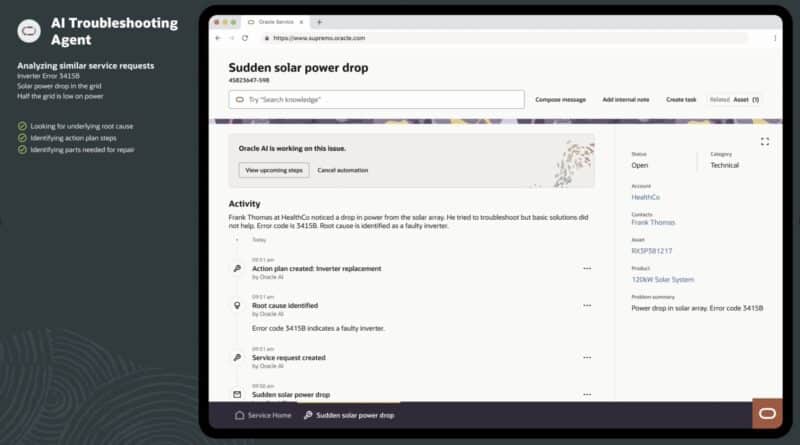
- Automated Service Agent. This AI agent will help service reps understand customer issues and cut resolution time. The agent is expected to have command of context, customer history and internal information relevant to the issues, eliminating the need for the human agent to research the issue from the ground up. [Note: Terminology in this space is evolving; other vendors would call this a copilot.]
- Call and chat summarization. This new summarization capability will use genAI to transcribe and summarize customer interactions.
- Field service knowledge search augmentation. This is aimed at improving the efficiency of field service agents, using genAI to produce succinct, actionable plans based on its automated review using knowledge-based articles and other resources.
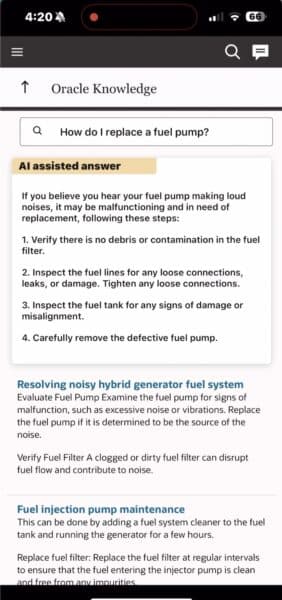
While the new capabilities are exciting, we wondered if some aspects were a little utopian. GenAI, after all, does make mistakes. What if it makes a recommendation to a field service agent, based on its scanning of countless knowledge base documents, to undertake an action that is not suitable for the task — or even dangerous?
“You’re still going to need a trained field service agent to do a lot of this stuff,” Wartgow responded. “It’s going to need the judgment of the field service tech. ‘It tells me to drain the fluid before I turn off the engine? I am not going to do that.’ But they can make a note and genAI will update that, correct it. The field service techs will constantly retrain the model.”
The AI, in other words, will capture the knowledge of experienced agents and be able to pass it on to newer employees.
Why we care. The customer experience space is moving and mutating at breakneck speed right now. Just a few years ago, some of the big vendors stopped talking about their marketing clouds and started referring to their CX clouds — because, after all, they were now offering customer service as part of the suite. Was that much more than just relabeling? And were vendors content with the formula sales + marketing + service = CX? Possibly so.
Thanks to rapid developments in the generative AI space, service is emerging as an area critical to a customer’s experience of a brand. This is not to reduce CX to customer service but to see customer service rising, as it were, in the ranks. Announcements this week, including this Oracle news, show the possibility of AI completely transforming the customer’s most direct interactions with the brand.
Dig deeper: What Oracle’s exit from advertising means for the adtech space
The post Oracle aims to automate the complete customer service lifecycle appeared first on MarTech.
**Oracle Plans to Fully Automate the Customer Service Lifecycle: A Glimpse into the Future of Customer Experience**
In an era where customer expectations are rapidly evolving, businesses are increasingly turning to technology to provide seamless, efficient, and personalized customer experiences. Oracle, a global leader in enterprise software and cloud solutions, is at the forefront of this transformation. The company has announced ambitious plans to fully automate the customer service lifecycle, leveraging cutting-edge technologies such as artificial intelligence (AI), machine learning (ML), and cloud computing. This initiative promises to revolutionize the way businesses interact with their customers, offering faster resolutions, enhanced personalization, and reduced operational costs.
### The Need for Automation in Customer Service
Customer service is a critical component of any business, but it is also one of the most resource-intensive. Traditional customer service models often rely on human agents to handle inquiries, complaints, and support requests. While human interaction is essential for complex issues, many routine tasks—such as answering frequently asked questions, processing returns, or updating account information—can be automated.
Automation in customer service is not just about reducing costs; it’s about improving the overall customer experience. Customers today expect quick, accurate, and personalized responses, and they are less tolerant of long wait times or repetitive interactions. By automating key aspects of the customer service lifecycle, businesses can meet these expectations while freeing up human agents to focus on more complex and value-added tasks.
### Oracle’s Vision for Fully Automated Customer Service
Oracle’s vision for fully automating the customer service lifecycle is built on its existing suite of cloud-based customer experience (CX) solutions, which include Oracle Service Cloud, Oracle Digital Assistant, and Oracle Fusion Cloud CX. These solutions are designed to integrate seamlessly with other enterprise systems, enabling businesses to deliver consistent and personalized customer experiences across all channels—whether it’s through email, chat, social media, or phone.
Oracle’s automation strategy is centered around three key pillars:
1. **AI-Powered Self-Service**: Oracle plans to enhance its AI-driven self-service capabilities, allowing customers to resolve issues on their own without needing to interact with a human agent. This includes the use of intelligent chatbots, voice assistants, and virtual agents that can handle a wide range of customer inquiries, from troubleshooting technical issues to processing refunds. These AI-powered tools are designed to learn from each interaction, becoming more accurate and efficient over time.
2. **Predictive Analytics and Machine Learning**: Oracle’s automation strategy also involves the use of predictive analytics and machine learning to anticipate customer needs and proactively address issues before they arise. For example, by analyzing customer behavior and historical data, Oracle’s systems can predict when a customer is likely to encounter a problem and offer a solution in advance. This not only improves customer satisfaction but also reduces the volume of incoming support requests.
3. **End-to-End Process Automation**: Oracle aims to automate the entire customer service lifecycle, from the initial inquiry to the final resolution. This includes automating back-end processes such as ticket routing, escalation, and follow-up, as well as integrating with other business systems like CRM, ERP, and supply chain management. By automating these processes, Oracle enables businesses to provide faster, more efficient service while reducing the risk of human error.
### Benefits of Full Automation for Businesses and Customers
The benefits of fully automating the customer service lifecycle are significant for both businesses and their customers.
1. **Improved Efficiency**: Automation allows businesses to handle a larger volume of customer inquiries without the need for additional staff. Routine tasks can be completed in seconds, freeing up human agents to focus on more complex issues. This leads to faster response times and higher overall efficiency.
2. **Cost Savings**: By reducing the need for human agents to handle routine inquiries, businesses can significantly lower their operational costs. Additionally, automation reduces the risk of errors, which can lead to costly rework or customer dissatisfaction.
3. **Personalization at Scale**: Oracle’s AI and machine learning capabilities enable businesses to deliver highly personalized experiences to each customer, even at scale. By analyzing customer data and behavior, Oracle’s systems can tailor responses and recommendations to meet the unique needs of each individual.
4. **Enhanced Customer Satisfaction**: Automation allows businesses to provide faster, more accurate, and more consistent service, which leads to higher levels of customer satisfaction. Customers appreciate the convenience of self-service options and the ability to resolve issues quickly without having to wait on hold or repeat information to multiple agents.
5. **Proactive Problem Solving**: With predictive analytics, businesses can identify potential issues before they impact the customer, allowing them to take proactive measures to prevent problems from occurring. This not only improves the customer experience but also reduces the overall volume of support requests.
### Challenges and Considerations
While the benefits of automation are clear, there are also challenges that businesses must consider when implementing fully automated customer service solutions.
1. **Maintaining a Human Touch**: While automation can handle many

Recent Comments