

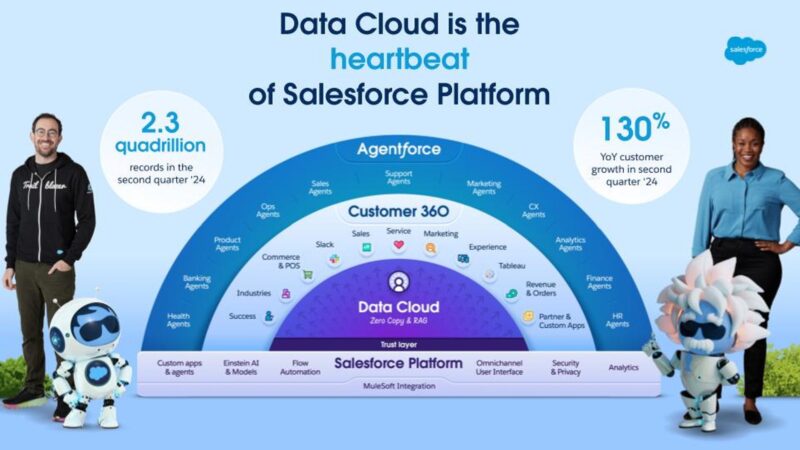
“Data Cloud is the heartbeat of the Salesforce platform,” said Rahul Auradkar, using Salesforce’s new mantra. “Data Cloud is the core of how Agentforce works,” he added.
Auradkar, EVP and GM, Unified Data Services (Data Cloud) and Einstein at Salesforce was speaking remotely to the press on the eve of Dreamforce — and he had new Data Cloud capabilities to announce:
- The ability to handle new unstructured data types, including audio and media such as webinars and calls.
- Fifty new connectors for apps like Square, Stripe, Meta and Splunk, growing the connector ecosystem that also supports many data lakes, warehouses and third-party systems.
- A sub-second real-time pipeline for data to pass through, from ingestion to activation “and everything in between” to power Einstein personalization.
Auradkar also described the fast-evolving Data Cloud as “the biggest upgrade to the Salesforce platform in our history.”

Data Cloud, meet Agentforce. Salesforce is also emphasizing the close coordination between the Data Cloud CDP and Agentforce, its new AI agent presented as an evolution beyond the AI copilot. Data Cloud now surfaces insights from unstructured audio and video data to Agentforce, giving it a more complete context for its actions.
Similarly, when a customer engages with an Agentforce agent, Data Cloud surfaces insights and context from email correspondence, past service events, voicemails, etc., to help Agentforce understand the customer’s needs.
Data Cloud also recommends next-best steps for Agentforce, like generating follow-up emails or delivering chat summaries to human representatives.
Dig deeper: Salesforce launches new, ‘more trustworthy’ generation of AI bots
Shout out to the data lakes. Data Cloud not only works on data already housed in Salesforce applications. It also has “zero copy” capabilities to draw on data from third-party networks such as Databricks and Snowflake. The emphasis on these capabilities reflects the trend toward enterprises relying on data lakes and warehouses to store customer and enterprise-wide data.
Asked whether Data Cloud was a competitor to cloud-based data lakes like Databricks and Snowflake, Auradkar said: “We co-exist with them.” He also emphasized that Data Cloud not only represents the biggest upgrade to the Salesforce platform; “It’s also an upgrade to Databricks and Snowflake.”
Why we care. It’s not a surprise given Marc Benioff’s impassioned touting of Data Cloud over the past year, but Salesforce is clearly intent on insisting this is not just a smart CDP activating a troop of bots, but a radical transformation of its offering. Certainly, the recent announcements, including today’s, do represent more significant changes than tinkering with various versions of Customer360 applications. We’ll wait to see just how powerful these new capabilities are — and how Adobe and Oracle respond.
Huge AI investment through Salesforce Ventures. Another Dreamforce announcement worthy of note is the new $500 million AI fund administered by Salesforce Ventures. That brings the total funding for AI start-ups to $1 billion over the past eighteen months.
“Salesforce Ventures is a leader in helping startups scale market-changing innovations in the cloud, and
we’re expanding on that heritage to bring the power of AI to all parts of the enterprise,” said John
Somorjai, president of Salesforce Ventures in a release. “The first $500 million we invested in this technology has powered growth across our AI ecosystem, and we’ll continue to incorporate learnings from across our business, partners, and customers to help build the AI leaders of tomorrow.”
The post Data Cloud represents the ‘biggest upgrade’ in Salesforce history appeared first on MarTech.
**Salesforce Unveils Data Cloud: The Most Significant Upgrade in Company History**
In a groundbreaking move that promises to reshape the landscape of customer relationship management (CRM) and enterprise data handling, Salesforce has unveiled its latest innovation: Salesforce Data Cloud. Touted as the most significant upgrade in the company’s history, Data Cloud is set to revolutionize how businesses manage, analyze, and leverage their data to deliver personalized customer experiences at scale.
### What is Salesforce Data Cloud?
Salesforce Data Cloud is a real-time data platform designed to unify and harmonize vast amounts of data from disparate sources, providing businesses with a comprehensive 360-degree view of their customers. Powered by artificial intelligence (AI) and machine learning (ML), Data Cloud enables organizations to ingest, store, and analyze data in real-time, allowing them to make faster, more informed decisions.
The platform is built on Salesforce’s Hyperforce architecture, which ensures scalability, security, and performance. Data Cloud integrates seamlessly with Salesforce’s existing suite of products, including Sales Cloud, Service Cloud, Marketing Cloud, and Commerce Cloud, making it easier for businesses to connect their data across different departments and functions.
### Key Features of Salesforce Data Cloud
1. **Real-Time Data Ingestion and Processing**
One of the standout features of Data Cloud is its ability to process data in real-time. Whether it’s customer interactions, transactional data, or behavioral signals, Data Cloud can ingest and process this information as it happens. This allows businesses to respond to customer needs instantly, providing personalized experiences that are more timely and relevant.
2. **Unified Customer Profiles**
Data Cloud consolidates data from multiple sources—such as CRM systems, social media platforms, e-commerce websites, and IoT devices—into a single, unified customer profile. This gives businesses a holistic view of each customer, enabling them to deliver more personalized interactions and targeted marketing campaigns.
3. **AI-Powered Insights**
Leveraging Salesforce’s Einstein AI, Data Cloud provides predictive analytics and actionable insights. Businesses can use these insights to anticipate customer behavior, optimize marketing strategies, and improve customer service. For example, Einstein can predict which customers are most likely to churn or which products a customer is likely to purchase next, allowing businesses to take proactive measures.
4. **Scalability and Flexibility**
Built on Salesforce’s Hyperforce platform, Data Cloud is designed to scale with the needs of businesses, whether they’re small startups or large enterprises. The platform supports multi-cloud environments, allowing businesses to integrate data from various cloud providers like AWS, Google Cloud, and Microsoft Azure. This flexibility ensures that businesses can manage their data regardless of where it resides.
5. **Data Privacy and Compliance**
In an era where data privacy regulations like GDPR and CCPA are becoming increasingly stringent, Salesforce Data Cloud comes equipped with robust data governance and compliance features. Businesses can manage customer consent, anonymize sensitive data, and ensure that they are adhering to regional and industry-specific regulations.
6. **Seamless Integration with Salesforce Ecosystem**
Data Cloud is designed to work seamlessly with Salesforce’s existing products. Whether you’re using Sales Cloud to manage leads, Marketing Cloud to run campaigns, or Service Cloud to handle customer inquiries, Data Cloud ensures that all of your data is connected and accessible in real-time. This integration allows businesses to break down data silos and create a more cohesive customer experience.
### Why is Salesforce Data Cloud a Game-Changer?
Salesforce Data Cloud represents a paradigm shift in how businesses approach data management and customer engagement. Here are some of the key reasons why this upgrade is being hailed as a game-changer:
1. **Real-Time Personalization at Scale**
In today’s fast-paced digital world, customers expect personalized experiences in real-time. Data Cloud enables businesses to deliver on this expectation by providing up-to-the-minute insights into customer behavior. Whether it’s recommending a product based on recent browsing history or sending a personalized offer after a purchase, Data Cloud allows businesses to engage with customers in a more meaningful way.
2. **Breaking Down Data Silos**
One of the biggest challenges businesses face is the fragmentation of data across different systems and departments. Data Cloud solves this problem by unifying data from multiple sources into a single platform. This not only improves data accuracy but also enables businesses to make more informed decisions based on a complete view of their customers.
3. **Empowering AI and Machine Learning**
The integration of AI and machine learning into Data Cloud allows businesses to unlock the full potential of their data. With Einstein AI providing predictive analytics and actionable insights, businesses can move from reactive to proactive decision-making. This can lead to improved customer retention, increased sales, and more efficient operations.
4. **Enhanced Customer Trust and Compliance**
As data privacy becomes a growing concern for consumers, businesses need to ensure that they are handling customer data responsibly. Data Cloud’s built-in compliance features help businesses manage customer consent and adhere to

Recent Comments