
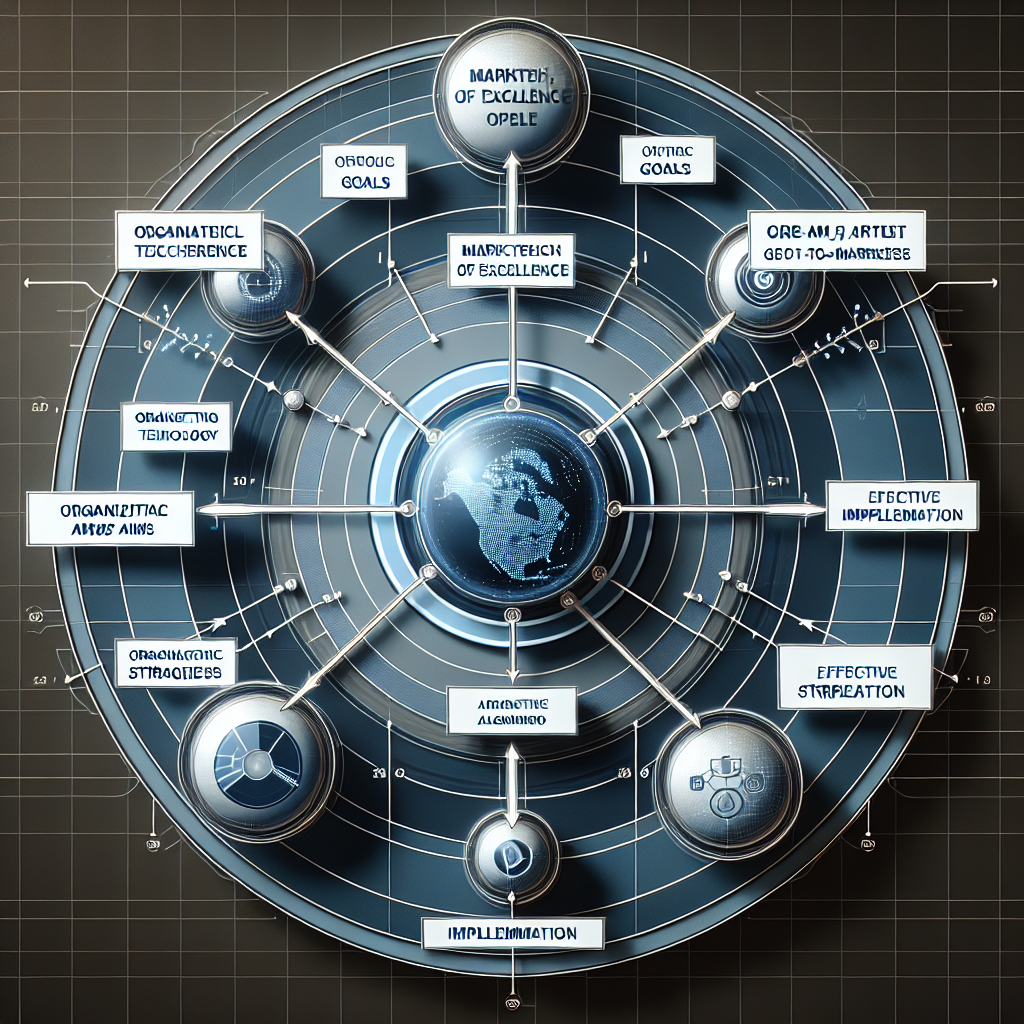

Establishing a martech center of excellence (COE) is essential for navigating modern marketing challenges. Think of it as the core of your marketing strategy, where all tools and processes support your business goals.
But how do you ensure your martech efforts are in lockstep with the goals of different organizational and go-to-market functions? The answer is in understanding the unique challenges and opportunities each function faces and positioning martech as a strategic enabler.
The role of a martech COE in driving strategic alignment
Every organization is different. Take a tech company focused on early adopters. It might use martech to disrupt the status quo and capture market share quickly. Compare that with a traditional industry player that uses martech to deepen customer relationships and create exceptional experiences. A one-size-fits-all approach to martech doesn’t work.
Creating a successful martech strategy involves combining a clear understanding of the market with the ability to adapt. Whether it’s targeting specific regions, industries or customer segments, martech’s role is to act as a bridge between business objectives and customer engagement.
Dig deeper: Harnessing martech insights: A roadmap to customer-centric business strategies
Key go-to-market functions and their goals
Before exploring how martech can boost business goals, it’s important to understand an organization’s different go-to-market functions and their common objectives.
1. Demand generation
- Role: Drive awareness and interest through targeted campaigns.
- Sample goals:
- Increase lead generation by 25% each quarter.
- Improve the conversion rate of leads to opportunities by 15%.
- Boost engagement rates on key channels by 30%.
2. Field marketing
- Role: Tailor marketing strategies for specific geographies or customer segments, aligning sales and marketing efforts.
- Sample goals:
- Host 10 regional events to generate new sales opportunities.
- Increase regional sales pipeline by 20%.
- Achieve a 30% attendee-to-lead conversion rate at events.
3. Customer success
- Role: Ensure customers achieve their desired outcomes and maintain long-term loyalty.
- Sample goals:
- Achieve a 90% customer satisfaction score (CSAT).
- Increase retention rates by 15% year over year.
- Reduce churn by 10% through proactive engagement.
4. Sales and support
- Role: Streamline the customer acquisition process while providing exceptional post-sale support.
- Sample goals:
- Shorten the sales cycle by 20%.
- Achieve a 95% first-response rate within 2 hours for support queries.
- Increase cross-sell and upsell revenue by 25%.
5. User groups and events marketing
- Role: Foster community engagement through offline and online events.
- Sample goals:
- Grow user group membership by 40%.
- Increase online community engagement by 30%.
- Host five major user conferences, achieving 85% attendee satisfaction.
6. Partner marketing
- Role: Use partnerships to extend market reach.
- Sample goals:
- Launch three co-marketing campaigns, generating a 20% increase in leads.
- Expand partner-driven revenue by 30%.
- Increase partner engagement and training completion rates by 25%.
7. Product marketing
- Role: Define the positioning and messaging of products or services.
- Sample goals:
- Launch two new product positioning campaigns, increasing market share by 10%.
- Improve product adoption among new users by 20%.
- Enhance sales enablement materials, improving team performance by 15%.
Dig deeper: Why centralizing strategic insights is imperative for CMOs
How martech amplifies go-to-market functions
How can martech elevate each of these functions? Let’s explore how smart martech goals can directly support the broader objectives of each function.
Demand generation: Increasing lead quality with personalization
- Use analytics and segmentation tools to tailor campaigns based on customer behavior, improving lead quality and engagement.
- Use case: Implement predictive analytics to score leads and send personalized messages, resulting in higher-quality leads that convert faster.
Field marketing: Enhancing event follow-ups
- Integrate event management tools with CRM to streamline lead capture and post-event follow-ups.
- Use case: Use mobile event apps for real-time engagement, capturing feedback and integrating it with CRM for immediate action.
Customer success: Reducing churn with AI-driven insights
- Implement platforms that monitor customer usage and trigger interventions for at-risk accounts.
- Use case: Use AI to send personalized onboarding emails, reducing time to value and preventing customer churn.
Sales and support: Improving response times with automation
- Adopt sales enablement and customer support tools to streamline the acquisition process and speed up responses.
- Use case: Use AI chatbots to answer common support queries instantly, freeing up agents to handle more complex issues.
User groups and events marketing: Expanding reach with virtual platforms
- Use community management platforms to grow user engagement and extend event reach.
- Use case: Use online event platforms to host webinars and virtual conferences, increasing attendance and engagement.
Partner marketing: Simplifying collaboration with PRM systems
- Use partner relationship management (PRM) tools to track and enhance partner-driven revenue and engagement.
- Use case: Deploy co-marketing management tools to streamline collaboration and measure the effectiveness of joint campaigns.
Product marketing: Refining messaging with A/B testing
- Use content management systems (CMS) and A/B testing platforms to refine messaging across digital channels.
- Use case: Test different product messages on various platforms, ensuring they resonate with the target audience.
Building a martech roadmap for success
Aligning your martech COE with go-to-market strategies is not just about integrating technology — it’s about creating a cohesive, measurable framework that lets every department achieve its goals. By setting smart, achievable martech objectives, you can ensure your efforts contribute directly to the organization’s overall success.
The key is to recognize martech as a strategic partner, not just a tool. By understanding each function’s unique needs and aligning martech capabilities accordingly, your organization can unlock new levels of efficiency, engagement and growth. Now, it’s time to set the stage for your martech roadmap, laying out the tools and technologies to guide your journey toward marketing excellence.
Dig deeper: Rethinking fit, growth and go-to-market for the modern startup
The post How to align your martech COE with organizational and go-to-market goals appeared first on MarTech.
# Strategies for Aligning Your Martech Center of Excellence with Organizational and Go-to-Market Objectives
In today’s fast-paced digital landscape, marketing technology (Martech) has become a critical enabler for businesses seeking to stay competitive and agile. A well-structured Martech Center of Excellence (CoE) can serve as the backbone for driving innovation, operational efficiency, and customer engagement. However, the true value of a Martech CoE is realized only when it is closely aligned with the broader organizational and go-to-market (GTM) objectives. Without this alignment, even the most sophisticated technology stack can result in wasted resources, fragmented customer experiences, and missed opportunities.
This article explores key strategies for aligning your Martech Center of Excellence with your organization’s overarching goals and GTM strategy to ensure that your technology investments drive measurable business outcomes.
## 1. **Establish a Cross-Functional Governance Framework**
One of the most critical steps in aligning your Martech CoE with organizational objectives is to establish a cross-functional governance framework. This framework should include key stakeholders from marketing, sales, IT, finance, and product teams to ensure that Martech decisions are made with a holistic view of the business.
### Key Actions:
– **Create a Steering Committee:** Form a cross-functional steering committee that meets regularly to review Martech initiatives, prioritize investments, and ensure alignment with organizational goals.
– **Define Roles and Responsibilities:** Clearly define the roles and responsibilities of each team involved in the Martech CoE. For example, marketing may own the strategy, IT may manage the infrastructure, and finance may oversee budget allocation.
– **Establish KPIs:** Develop key performance indicators (KPIs) that reflect both marketing and business outcomes, such as customer acquisition costs, lead conversion rates, and return on investment (ROI) from Martech initiatives.
## 2. **Align Martech Strategy with Business and GTM Objectives**
Your Martech CoE should not operate in a vacuum. It must be tightly integrated with your company’s business strategy and GTM objectives. This requires a deep understanding of the organization’s growth goals, target markets, and customer segments.
### Key Actions:
– **Understand Business Priorities:** Work closely with leadership to understand the company’s short-term and long-term business goals. Whether the focus is on expanding into new markets, increasing customer retention, or launching new products, your Martech strategy should directly support these objectives.
– **Map Martech Capabilities to GTM Strategy:** Identify the specific Martech tools and platforms that will enable your GTM strategy. For example, if your GTM strategy emphasizes personalized customer experiences, investing in customer data platforms (CDPs) and marketing automation tools will be critical.
– **Ensure Flexibility:** As business goals evolve, your Martech stack should be flexible enough to adapt. This may involve choosing scalable, cloud-based solutions that can grow with your business or integrating AI-driven analytics tools that provide real-time insights into changing market conditions.
## 3. **Prioritize Customer-Centricity**
A successful GTM strategy hinges on delivering exceptional customer experiences. Your Martech CoE should prioritize customer-centricity by leveraging technology to create personalized, seamless, and consistent interactions across all touchpoints.
### Key Actions:
– **Leverage Data for Personalization:** Use customer data platforms (CDPs) and analytics tools to collect and analyze customer data from various sources. This will enable you to create personalized marketing campaigns that resonate with individual customers and drive engagement.
– **Ensure Omnichannel Consistency:** Ensure that your Martech stack supports omnichannel marketing, allowing you to deliver consistent messaging and experiences across channels such as email, social media, mobile apps, and websites.
– **Implement Feedback Loops:** Use Martech tools to gather customer feedback in real-time and make data-driven decisions to improve the customer experience. This could involve sentiment analysis, customer surveys, or social listening tools.
## 4. **Focus on Data Integration and Accessibility**
Data silos are one of the biggest barriers to aligning Martech with business objectives. A lack of data integration can lead to fragmented customer views, inefficient processes, and missed opportunities. To overcome this, your Martech CoE must prioritize data integration and accessibility.
### Key Actions:
– **Integrate Data Across Systems:** Ensure that your Martech stack is integrated with other business systems, such as CRM, ERP, and sales platforms. This will provide a unified view of customer data and enable more effective decision-making.
– **Enable Real-Time Data Access:** Invest in tools that provide real-time access to data, allowing marketing teams to make agile decisions based on current insights. This could involve using cloud-based analytics platforms or AI-driven tools that offer predictive insights.
– **Ensure Data Governance:** Implement strong data governance policies to ensure data accuracy, security, and compliance with regulations such as GDPR or CCPA. This will help build trust with customers and avoid potential legal issues.
## 5. **Invest in Training and Change Management**
The success of your Martech CoE depends not only on the technology itself but also on the people who

Recent Comments