

- Part one: The promise
- Part two: The shift
- Part Three: The crossroads
- Part Four: Where do we go From here?
Part one: The promise
The birth of marketing technology brought so much potential to the marketing department.
It was the early aughts. The Internet was booming…The cloud was clouding… Adobe and Salesforce were innovating. And martech was about to turn the world on its head.
I was a young, freshly minted MBA with a background in computer science, and a two-year stint doing software marketing at IBM. I’d just been hired by Red Hat, an upstart open-source company with a lot of momentum.
“Hey kid,” they said. “We just signed up for this Eloqua thing. We need you to set it up, and figure out how we use it.” We were one of Eloqua’s first customers and that’s where my adventure with marketing automation began.
We were doing it all back then, with very little playbook guidance:
- Lead magnets.
- Lead capture forms.
- Lead scoring.
- Lead ranking.
- Lead routing.
- Lead nurturing.
- Tracking prospect activity on our website.
It was empowering. Plus, marketing was getting some extra respect in board meetings.
SiriusDecisions, the analyst firm now part of Forrester, had entered the conversation, pioneering the marketing funnel that became a staple of B2B marketing for the next 15 years.
- MQLs (Marketing Qualified Leads).
- SQLs (Sales Qualified Leads).
- SALs (Sales Accepted Leads).
Marketing/sales alignment was never better. Promotions were earned. Bonuses were claimed. Lead generation was at an all-time high. New sub-niches cropped up in the marketing discipline, around the ecosystems of marketing automation tools like Eloqua, Marketo and eventually HubSpot.
For a while, all was well in B2B marketing. But things slowly started to change.
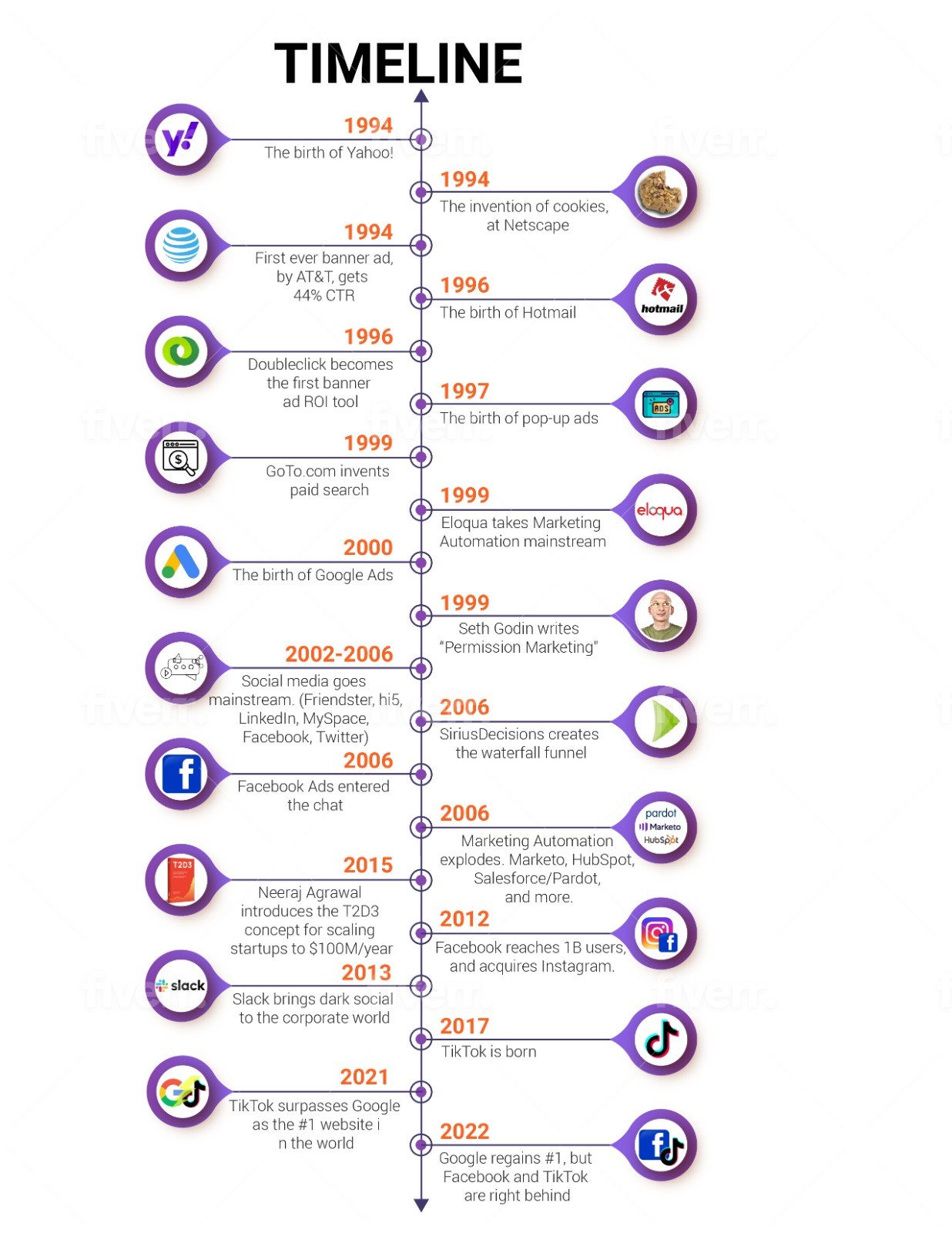
A Marketing Automation Timeline
Part two: The shift
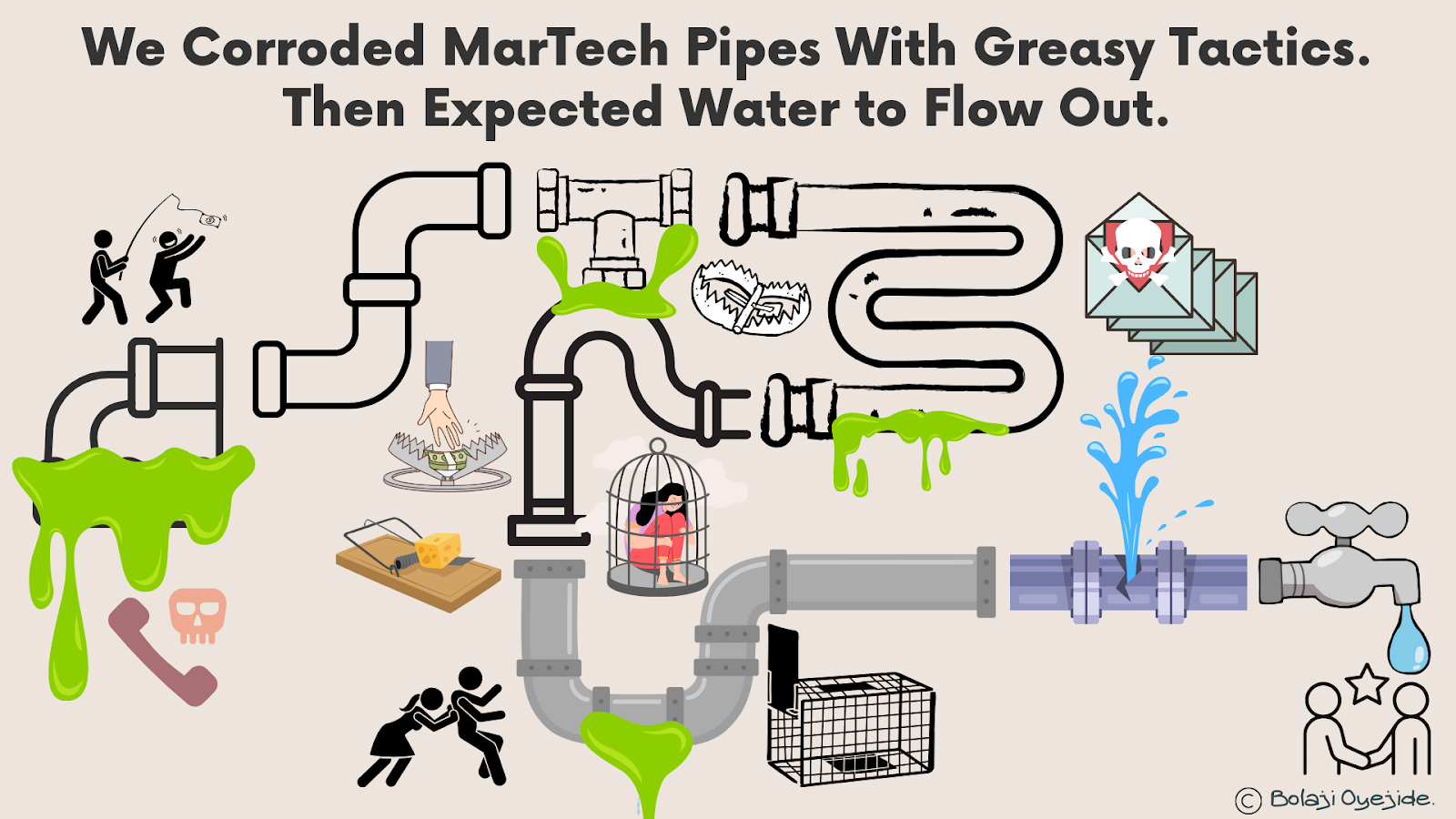
Water flows. But grease corrodes
Was it enough to build the pipes and turn a blind eye to what we put in them? We built the pipes to facilitate efficient pipeline generation. We reveled in the speed and scale our pipes allowed. But management started asking us for more. “Go faster. Drive more. Volume, volume, volume.”
Martech promised:
- Scale. Persuasion at scale. Selling at scale.
- Speed.
- Efficiency.
- Attribution (track everything).
Then came disillusionment.
Prospects became disillusioned by the bait and switch of giving up an email address for ransom, only to be nurture-emailed into oblivion.
Sales became disillusioned at the bait-and-switch of marketing hitting their lead quote up for the month, while sales struggled to reach their pipeline and closed-won because most of the leads had no buying intent.
Marketers became disillusioned as the higher-ups shifted the goal post quarter after quarter, demanding more efficiency, more leads and more volume across the board — even though marketing is not magic, and we were never able to manufacture demand out of thin air.
CFOs, CEOs and investors became disillusioned as the promise of marketing automation, along with sales forecasting models like Predictable Revenue (popularized by Salesforce’s Aaron Ross), made the promise of coin-operated demand generation — a promise that marketing teams ultimately could not fulfill.
The shift
- Performance marketing. Paid ads don’t perform like they used to. Google, LinkedIn and Facebook are driving CPC up. And why not? Worldwide demand, and limited supply. They’ve forged a near monopoly.
- Email nurture fatigue. Prospects are now wise to the lead magnet — future email bait and switch. They can see it coming. And would rather give fake email addresses than offer up access to their inbox.
- A cookieless future. Google is moving away from third-party cookies. That kind of tracking is going away. (I doubt it’s for altruistic reasons.)
- Dark social. Professionals trust search engine results and comparison websites less. They barely trust vendor websites at all. Instead, they rely on their network of peers — which is untrackable.
- SEO is atrophying. Google’s monopoly on search has allowed bad behavior to set in. Zero click search results; ads crowding out organic search results. And now with the advent of AI-generated search results? More erosion.
SEO isn’t dead — far from it — but like performance marketing, it’s much harder to do and delivers much less benefit than it used to.
Part three: The crossroads
In 2024, marketing and martech professionals are at a crossroads. We’re being asked to do and deliver more with less. We’re being asked to not only increase efficiency, which we’ve been doing for over a decade, but now also effectiveness. Not just “more leads,” but now “more leads with real buying intent.”
The problem is that technology alone was never going to deliver us effectiveness. This is where artificial intelligence comes in.
For the past year now, just about every SaaS vendor has started to tout the AI at the heart of their system, even if it’s sometimes smoke and mirrors. But in 2024, there are legitimately AI technologies that are very exciting indeed. Are we as markers about to repeat the same mistakes?
Marketing automation brought us innovation and efficiency at an exponential level 18 years ago. AI is guaranteeing to do that again now. Is that enough? It’s called marketing technology for a reason: The marketing comes first, the technology supports it. We are at the risk of allowing AI-driven technology to lead and turning the keys over for it to do the marketing for us.
We are at crossroads: and we need to decide: Are we markers or technologists? Technology will forever be part of our jobs. We just have to decide whether we serve the technology or the customer.
Dig deeper: Jay Mandel — Looking foward with AI
Part four: Where do we go from here?
Drive efficiency for the 5%
We desperately need martech for the 5% of buyers already in-market. We need to reduce friction and accelerate the buyer’s journey. We need to get them the information they need as efficiently as possible.
Find effectiveness for the 95%
We need a much better answer for engaging with the 95% of our future buyers, who are not yet in-market.
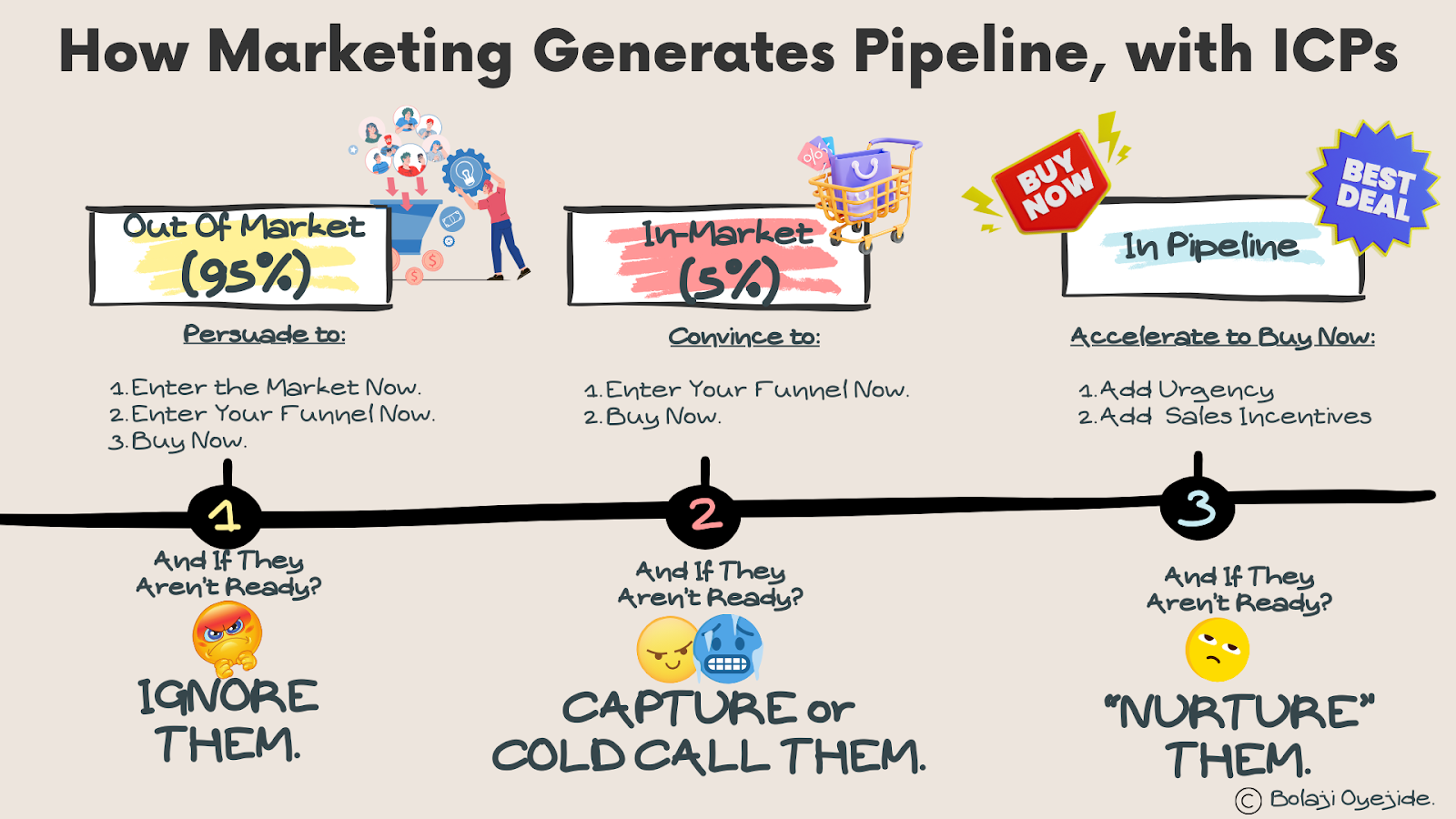
(ICPs: Ideal customer profiles.)
Email nurture and lead scoring aren’t good enough. It was in 2005, but not anymore.
If you could redesign marketing technology from scratch what would it look like? How would you design marketing technology that serves the 5% of ideal prospects who are already in-market? In a way that is prospect versus pipeline-centric? How would you design marketing technology that serves the 95% of ideal prospects who are not in-market today — and may not be for another year or so? In a way that is audience vs. sales-centric?
We’ll examine that in a future article.

Take the MarTech Salary and Career Survey
From AI to layoffs, it’s been quite a year. How has it been for you? Please take our short survey so we can tell you the state of martech salaries and careers.
The post Did martech break B2B marketing? appeared first on MarTech.
The world of B2B marketing has undergone a significant transformation in recent years, thanks in large part to the rise of marketing technology, or martech. Martech refers to the tools and platforms that marketers use to automate, measure, and optimize their marketing efforts. These tools have had a profound impact on the way B2B marketers operate, enabling them to reach their target audiences more effectively and efficiently than ever before.
One of the most significant ways that martech has impacted B2B marketing is through the use of data and analytics. With the help of martech tools, marketers can now collect and analyze vast amounts of data on their target audiences, allowing them to gain a deeper understanding of their needs, preferences, and behaviors. This data-driven approach to marketing has enabled B2B marketers to create more targeted and personalized campaigns, which are more likely to resonate with their audiences and drive conversions.
Another key impact of martech on B2B marketing is the ability to automate many of the tasks that were once done manually. For example, marketing automation platforms can help marketers to automate email campaigns, social media posts, and other marketing activities, freeing up their time to focus on more strategic tasks. This automation has also made it easier for marketers to scale their efforts, reaching larger audiences without having to increase their resources.
Martech has also had a significant impact on the way B2B marketers measure the success of their campaigns. With the help of analytics tools, marketers can now track the performance of their campaigns in real-time, allowing them to make data-driven decisions about how to optimize their efforts. This has led to a more agile approach to marketing, where marketers can quickly adjust their strategies based on the data they collect.
Finally, martech has enabled B2B marketers to create more engaging and interactive experiences for their audiences. With the help of tools like virtual reality and augmented reality, marketers can create immersive experiences that capture the attention of their target audiences and leave a lasting impression.
In conclusion, martech has had a profound impact on B2B marketing, enabling marketers to reach their audiences more effectively and efficiently than ever before. With the help of data and analytics, automation, and interactive experiences, B2B marketers can create more targeted and personalized campaigns that drive conversions and deliver results. As martech continues to evolve, we can expect to see even more exciting developments in the world of B2B marketing.

Recent Comments