


In B2B demand generation, buyer groups are more important than individual buyers. Traditionally, marketers focused on the buyer journey as if a single person handled research, evaluation and final selection. This approach assumed that targeting a CEO, CFO or CMO would likely result in a sale.
However, in large organizations, this isn’t realistic. Typically, multiple people identify the need for a solution, conduct research and consult decision makers. Meetings often involve stakeholders from different departments, so focusing only on key decision-makers may overlook the broader buyer group journey.
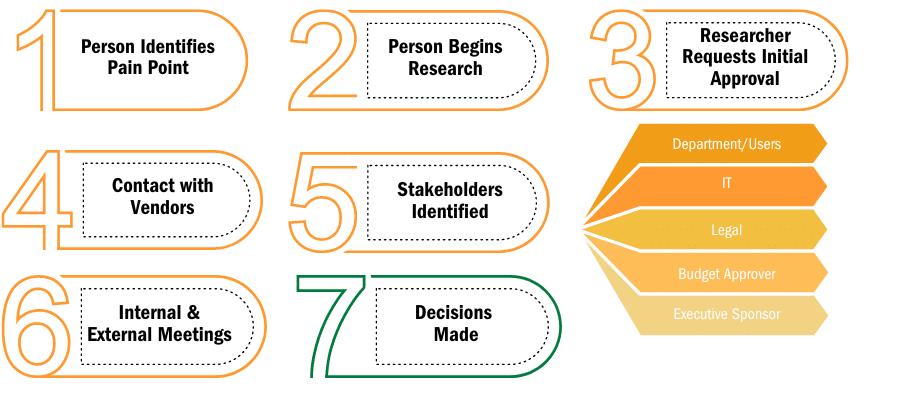
What is a buyer group?
Buyer groups include all key stakeholders in B2B purchase decisions, including people from roles you may not be actively targeting who nonetheless have a say in the final decision (examples here often include legal, IT and/or compliance).
In 2023, the average B2B buyer group consists of a bit more than nine members, per 6sense’s estimates. Each member may have up to 15 interactions with each vendor under evaluation. Notably, over 70% of these interactions occur before any member of the buyer group contacts the sellers.
Dig deeper: New ways to identify B2B buying group members
Why should you consider buyer groups?
The bigger buyer group — the influencers of the sale — do a lot of the work, and sometimes, the person signing the checks is only interested in doing just that. Targeting CFOs alone, for example, could miss the influencers conducting research, determining which vendors are the best fit to solve specific pain points and evaluating who is or isn’t in the budget.
In many B2B marketing teams, everything from advertising campaigns to email lists, social media content, lead generation and sales tasking is fundamentally targeted to the key decision maker: usually the person in the C-suite signing off on the new relationship.
By structuring your digital marketing strategy around that sole buyer, you’re cutting your brand out of the key research phases and missing the opportunity to get your brand into the vendor evaluation phase.
Influencers may not be the right person to sign off on the final agreement, but more often than not, the C-suite isn’t close enough to the pain points to decide which vendor is best positioned to solve a problem. In short, your key messaging to a C-suite member of a buyer committee could be ignored.
Not everyone in the buyer group needs to hear the same message. Think of conversations that happen internally at your company when you’re making decisions about a purchase. IT asks different questions; marketing and legal have their own set of concerns. What if you could target each buyer in the group with a unique message?
Aligning martech to your buyer groups
Many tech tools are evolving for exactly that — the ability to create an account and, within the account, serve different messages to unique buyers that align with their specific pain points or questions.
Some solutions, like account-based marketing (ABM) tools, can do this out of the box and allow you to:
- Select the target account (aligning your ideal customer profile to accounts with intent to buy your services).
- Target key buyers by role or title within that account, even if you don’t know who they are by name.
- Create target messaging and ads specific to what each buyer is focused on according to their role.
Many tools aren’t set up to target multiple buyers simultaneously, but that doesn’t mean you can’t set up some of this process manually. Here are a few examples.
With your sales and CRM teams
Before you align your tech targeting processes to different buyers, ask your selling teams who they tend to see at meetings.
- Are these contacts in your CRM system?
- Does your CRM system capture key contacts on opportunities?
- Could you align your opportunity fields to facilitate the capture of these different buyers by their roles for future use in targeting?
- Does your selling team understand the value of inputting those additional buyers into your CRM?
In lead generation or content syndication
Create content for your different buyer roles and be prepared to generate leads from people at departments or with titles that you may have previously ignored.
Do not create sales follow-ups for these people at their first point of conversion unless they ask for follow-up. At this point, you’re just trying to sort out who is playing what role at a target account.
In email
Consider creating newsletters or email messaging targeted to several job titles or roles — perhaps one for the C-suite, another one for influencers/users and a third for technical specifications.
In content and SEO
Develop content for all your buyers, including Answer Box-oriented content that could be based on questions they may be asking in the research phase. Ensure the content on your site supports 70% of the journey where research is happening without sales engagement.
In sales enablement
If you’re leveraging sales enablement tools, consider creating follow-up cadences for various buyers in the journey. You could potentially exclude the C-suite buyer in initial outbound (given how many of your competitors are also likely targeting them!). You could also consider only including engaged C-suite buyers to preserve your brand affinity.
In events
What is your event strategy and are you positioned to encourage buyers in the research phase to attend? It’s always a bonus to create in-person opportunities to network with the C-suite, but consider the power of creating separate spaces to engage with the types of buyers you would be working with as customers day in and day out.
Dig deeper: How ABM systems are evolving to meet changing B2B buying behaviors
Common pitfalls of marketing to buyer groups
The ability to target by buyer is dependent on:
- Your data.
- Your alignment with the sales team.
- Your budget (if you have to manually expand to other audiences, the advertising costs could increase).
Avoid the temptation to build persona sheets here as well. Pain points are more helpful, as one of the biggest hurdles for B2B marketers to overcome is the status quo. By messaging to pain points, you’re far more likely to convert a buyer who might be experiencing more pain in the status quo than the pain of changing providers.
If you’re tasking your sales team off intent signals, an account task can be a heavier lift than a person task. Consider that a single account task is about the same as three or four-person tasks, and work with your selling team accordingly on the right volume and quality of the task.
Reporting
Reporting on account success rather than person success can be tricky, depending on how your CRM system is set up. If you’re evolving from a lead generation strategy to a demand generation strategy, this is a good time to evaluate whether you’re solely reporting on opportunities generated from specific campaigns (e.g., a webinar, an event or a specific ad), which show only one touch point as influencing an opportunity (obviously not the case!).
For best success, you’re looking to report on the following:
- The account was a member of the audience you were targeting with a multi-channel approach.
- An opportunity was generated that aligned with your marketing message.
- Leading indicators, like engagement with your website, are headed in the right direction for your target accounts.
Expanding to new buyers may initially feel uncomfortable, but the long-term potential of targeting your hidden influencers could yield big payoffs.
The post Why buyer groups matter in B2B demand gen and how to target them appeared first on MarTech.
### The Importance of Buyer Groups in B2B Demand Generation and Strategies for Effective Targeting
In the realm of Business-to-Business (B2B) marketing, demand generation is a critical component for driving revenue and ensuring long-term success. Unlike Business-to-Consumer (B2C) marketing, where the focus is often on individual consumers, B2B marketing typically involves multiple stakeholders and decision-makers within an organization. This is where the concept of buyer groups becomes particularly significant. Understanding and effectively targeting these buyer groups can make a substantial difference in the success of a B2B demand generation strategy.
#### What Are Buyer Groups?
Buyer groups, also known as buying committees or decision-making units (DMUs), are collections of individuals within an organization who are involved in the purchasing decision process. These groups often include various roles such as:
– **Decision Makers**: Individuals with the authority to make the final purchasing decision.
– **Influencers**: People who influence the decision-making process through their expertise or position.
– **Gatekeepers**: Those who control the flow of information and access to other members of the buyer group.
– **End Users**: Individuals who will use the product or service and can provide valuable input on its functionality and usability.
– **Purchasers**: The people responsible for negotiating and finalizing the purchase.
Understanding the dynamics and composition of these buyer groups is essential for crafting a demand generation strategy that resonates with all stakeholders involved.
#### The Importance of Buyer Groups in B2B Demand Generation
1. **Complex Decision-Making Process**: B2B purchases are often complex and involve significant investment. Multiple stakeholders bring diverse perspectives and expertise, making the decision-making process more comprehensive but also more intricate. Recognizing the roles and concerns of each member of the buyer group allows marketers to address their specific needs and objections, thereby facilitating a smoother decision-making process.
2. **Tailored Messaging**: Different members of the buyer group have different priorities and pain points. For instance, a CFO might be concerned with the return on investment (ROI), while an IT manager might focus on the technical compatibility of the solution. By understanding these varied concerns, marketers can create tailored messages that speak directly to each stakeholder, increasing the likelihood of a positive response.
3. **Building Consensus**: In B2B settings, achieving consensus among all stakeholders is crucial. A well-rounded demand generation strategy that addresses the needs and concerns of the entire buyer group can help build this consensus, making it easier to move the purchase decision forward.
#### Strategies for Effective Targeting of Buyer Groups
1. **Persona Development**: Develop detailed personas for each member of the buyer group. Understand their roles, responsibilities, pain points, and decision-making criteria. This will help in creating targeted content and messaging that resonates with each persona.
2. **Content Mapping**: Map content to the buyer’s journey, ensuring that you have relevant materials for each stage of the decision-making process. For example, top-of-funnel content might include educational whitepapers and blog posts, while bottom-of-funnel content could involve case studies and ROI calculators.
3. **Multi-Channel Engagement**: Engage buyer groups through multiple channels such as email, social media, webinars, and face-to-face meetings. Different stakeholders may prefer different channels, so a multi-channel approach ensures broader reach and engagement.
4. **Account-Based Marketing (ABM)**: ABM is a highly targeted approach that focuses on specific accounts and tailors marketing efforts to the unique needs of those accounts. By aligning sales and marketing efforts, ABM can effectively address the concerns of all members of the buyer group within a target account.
5. **Leveraging Data and Analytics**: Use data and analytics to gain insights into the behavior and preferences of buyer groups. This can help in refining targeting strategies and personalizing marketing efforts. Tools like Customer Relationship Management (CRM) systems and marketing automation platforms can be invaluable in this regard.
6. **Sales and Marketing Alignment**: Ensure that sales and marketing teams are aligned and working collaboratively. Sales teams often have direct insights into the needs and concerns of buyer groups, which can inform marketing strategies. Regular communication and feedback loops between sales and marketing can enhance the effectiveness of demand generation efforts.
7. **Customer Testimonials and Case Studies**: Use customer testimonials and case studies to build credibility and trust. Highlight how your product or service has addressed the specific needs of similar buyer groups in other organizations. This can be particularly persuasive for decision-makers who are looking for proven solutions.
#### Conclusion
In B2B demand generation, understanding and effectively targeting buyer groups is crucial for success. By recognizing the diverse roles and concerns of each member of the buyer group, marketers can create tailored strategies that resonate with all stakeholders. Through persona development, content mapping, multi-channel engagement, ABM, data analytics, sales and marketing alignment, and the use of customer testimonials, B2B marketers can enhance their demand generation efforts and

Recent Comments