


This is the third article in a three-part series. The first, on composable CDPs, is here; the second, on composable customer engagement platforms, is here.
In the CDP space, all the talk recently has been about the composable CDP. Not only are there CDPs designed primarily to be composable, like Simon Data, built on Snowflake, but traditional packaged CDPs like ActionIQ are now offering a composable option. In this context, composable means a strong integration with a data warehouse (or “lakehouse”) allowing the CDP to activate data in the warehouse rather than ingest data from the warehouse (and other sources) to create its own, independent, persistent database.
The same trend is seen in the customer engagement space, where platforms like MessageGears, Iterable and Braze pull appropriate data from the warehouse to support personalized, omnichannel customer messaging. It seems clear that these platforms do maintain copies of data from the data warehouse in order to be ready to respond to customer actions in real-time; where swift retargeting in response to customer actions is a perceived need, that data may be stored for a year or two.
What happens when more and more applications adopt this composable structure — marketing automation, for example? In the view of Gartner analyst Ben Bloom, we might see the “unbundling” of apps and data across the board.
Dig deeper: What the composability revolution means for customer engagement
The unbundled martech stack
What does that mean? Martech stacks have traditionally been composed of a series of more or less well-integrated applications, mostly maintaining their own native datasets. DAM has its data, marketing automation has its data, CRM, social media and so on. In a sense, the traditional packaged CDP was intended to ease this problem, acting as a single source of truth for customer data.
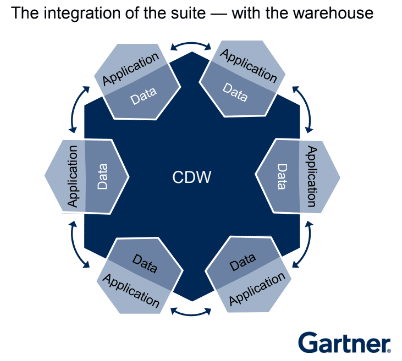
If the trend towards centralizing both customer and other business data in a data warehouse (Amazon Redshift, Google Big Query, Databricks, Snowflake, etc.) continues, we can imagine a stack in which there is one data repository and a series of apps, unbundled from the data, forming a layer “where we do the work,” as Bloom says.
But is this vision of the future (oversimplified, admittedly, but made clear by the representation from Gartner) actually realistic?
Dig deeper: Cloud data warehouses set to disrupt the martech stack
Composable CDPs don’t yet dominate the space
First, it’s worth noting that, for all the widespread discussion of the composable CDP, it doesn’t yet dominate the CDP space. So much was made clear in some recent research from David Raab at the CDP Institute. Just looking at Google search volumes, the term “CDP” is still much more searched than the term “composable CDP.”
“While the CDP industry has definitely stalled, the reason is far from clear,” the Institute says. Composable CDPs may be growing at a slightly faster rate (based on number of employees) than traditional, packaged CDPs, but not enough to explain the slowing down in the traditional CDP market.
The numbers speak for themselves, but don’t demonstrate that composable CDPs won’t dominate the space in the future. They might still be climbing towards the peak on the Gartner hype cycle.
Dig deeper: What the composability revolution means for CDPs
A reality check on ‘unbundling’
Kevin Wang, chief product officer at Braze, a customer engagement platform that can pull data from data warehouses, finds the “unbundled” stack model plausible for some applications — for example, for analytics apps that just need to scrutinize data that previously came from a range of different sources without taking any action. “I don’t think that’s going to be applicable to Braze at all. We do activate data that comes from a data warehouse, but we are ourselves generators of first-party and zero-party data. Also, we need to have data in order to have that real-time responsiveness that is key to the use cases that we make possible.”
Raab’s reaction to the unbundling of apps and data bordered on the incredulous. “Are they really not going to have their own data” Even if an app plugs into the warehouse, it’s still going to make its own copy of some of the data. “The more interesting thing is whether you have a central platform or not,” he said. “It could be a data warehouse or the Salesforce Data Cloud, or the data platform Adobe has, and then you have applications that sit on top of that platform. But that’s an architecture we’ve been dealing with for a long time. That has nothing to do with composability per se. I don’t think everything is going to access the warehouse directly; I’m sure not.”
What we’re dealing with then, yet again, may not be so much a complete overhaul of the martech stack but a swinging pendulum. For years, the martech pendulum swung between all-in-one marketing technology suites and collections of point solutions somehow bolted together (what Pega’s Alan Trefler 10 years ago called the Frankenstack).
Recently, the pendulum became somewhat stable over the middle ground of a central hub (often one of the big suites) with select point solutions plugged in — a situation acknowledged by the growth, for example, of HubSpot’s and Salesforce’s app marketplaces.
What we now have, however, is a new dimension for the pendulum to swing in. Between the app-plus-data world and the utopia, Ben Bloom suggests, of apps and data uncoupled.
The post What the composability revolution means for the martech stack appeared first on MarTech.
**Understanding the Impact of the Composability Revolution on the Martech Stack**
In recent years, the marketing technology (Martech) landscape has undergone significant transformation, driven by the emergence of composability as a key principle in software design and architecture. This “composability revolution” is reshaping how businesses approach their Martech stacks, offering new levels of flexibility, scalability, and efficiency. This article explores the concept of composability, its impact on the Martech stack, and the benefits and challenges it presents to marketers.
### What is Composability?
Composability refers to the design principle where systems are built using interchangeable, modular components that can be easily combined and recombined to meet specific needs. In the context of software, composable architectures allow organizations to select and integrate best-of-breed solutions, rather than relying on monolithic, all-in-one platforms. This approach promotes agility, as businesses can adapt their technology stacks quickly in response to changing market conditions and customer demands.
### The Composability Revolution in Martech
The Martech stack, a collection of technologies used by marketers to optimize and automate their processes, is particularly well-suited to benefit from composability. Traditionally, Martech stacks were built around large, integrated platforms that offered a wide range of functionalities. While these platforms provided convenience, they often lacked the flexibility to adapt to the unique needs of different businesses.
With the composability revolution, marketers can now build their stacks using a variety of specialized tools that integrate seamlessly with one another. This modular approach allows for greater customization and innovation, enabling marketers to tailor their technology solutions to specific goals and strategies.
### Benefits of Composability in the Martech Stack
1. **Flexibility and Customization**: Composable Martech stacks allow businesses to choose the best tools for each function, from customer relationship management (CRM) to analytics and content management. This flexibility enables marketers to create a stack that aligns perfectly with their unique needs and objectives.
2. **Scalability**: As businesses grow and evolve, their technology needs change. Composable stacks make it easier to add or replace components without overhauling the entire system, ensuring that the stack can scale alongside the business.
3. **Innovation and Agility**: With a composable approach, marketers can quickly experiment with new tools and technologies, fostering a culture of innovation. This agility is crucial in a rapidly changing digital landscape, where staying ahead of trends can provide a competitive edge.
4. **Cost Efficiency**: By selecting only the necessary components, businesses can avoid paying for unused features often bundled in monolithic platforms. This targeted approach can lead to significant cost savings.
### Challenges of Implementing a Composable Martech Stack
1. **Integration Complexity**: While composability offers flexibility, it also requires seamless integration between different tools. Ensuring compatibility and smooth data flow between components can be challenging and may require specialized expertise.
2. **Vendor Management**: Managing multiple vendors and ensuring consistent service levels can be complex. Businesses must establish strong relationships and clear communication with each vendor to ensure the stack functions effectively.
3. **Data Security and Privacy**: With multiple tools handling sensitive customer data, maintaining robust security and privacy measures is critical. Businesses must ensure that all components comply with relevant regulations and standards.
4. **Skill Requirements**: Implementing and managing a composable Martech stack requires a skilled team with expertise in integration, data management, and technology strategy. Investing in training and development is essential to maximize the benefits of composability.
### Conclusion
The composability revolution is transforming the Martech landscape, offering businesses unprecedented flexibility, scalability, and innovation. By embracing a modular approach, marketers can build customized stacks that align with their unique needs and adapt to changing market conditions. However, to fully realize the benefits of composability, businesses must address challenges related to integration, vendor management, data security, and skill requirements. As the Martech ecosystem continues to evolve, composability will play an increasingly vital role in shaping the future of marketing technology.

Recent Comments