


What if you could test-drive an entire marketing technology platform and simulate marketing and sales efforts without risking a single dollar?
Thanks to ChatGPT, I did just that. It’s another compelling use case for maximizing the value of generative AI.
CDPs have gained marketers’ attention by unifying customer data and driving smarter marketing. But instead of just reading about the capabilities, I wanted to see it in action. Could ChatGPT simulate a full-scale marketing and sales strategy for a B2B SaaS platform? Spoiler alert: It can, and the results were eye-opening.
Why build a CDP simulator?
A customer data platform (CDP) unifies customer data from various sources — think website interactions, CRM interactions and email engagement — in one platform. This enables a complete view of the customer journey.
But what does that look like in practice?
Rather than theorizing, I used ChatGPT (I’m a paid subscriber, but everything in this post was done using the freely accessible 4o-mini model) to help me build a CDP simulator. First, I generated fake user data for a B2B SaaS platform and ran campaigns across organic social, paid media and owned content. By simulating customer touchpoints like demo requests, webinar sign-ups and content downloads, I aimed to see how a CDP could improve marketing efficiency and drive sales.
Here’s how the experiment unfolded — and what I learned about the value of CDPs — and perhaps more importantly, how to use generative AIs to run simulations for a variety of situations.
Dig deeper: AI in marketing: Examples to help your team today
The prompts
The journey started with a conversation:
I want you to build me a CDP customer data platform simulator. We will create fake user data. Create a sample marketing campaign and use the CDP to simulate scenarios. What questions do you have before we start?
ChatGPT asked me a litany of questions. It wanted me to define audience/user data, data inputs and sources, segmentation and more. To speed up the process, I added some additional context:
Let’s keep this fairly generic. Please generate fake user data, create sample marketing campaigns and use the CDP to simulate scenarios. Add high-level MQL and SQL tracking so we can simulate the difference between marketing and sales activities. You will also execute a mix of organic social media, owned media and paid campaigns.
After reviewing the response, I asked ChatGPT to make a few other assumptions:
The sale cycle is a minimum of three months and a maximum of 18 months. We have an average level of brand awareness and an average level of share voice in the marketplace.
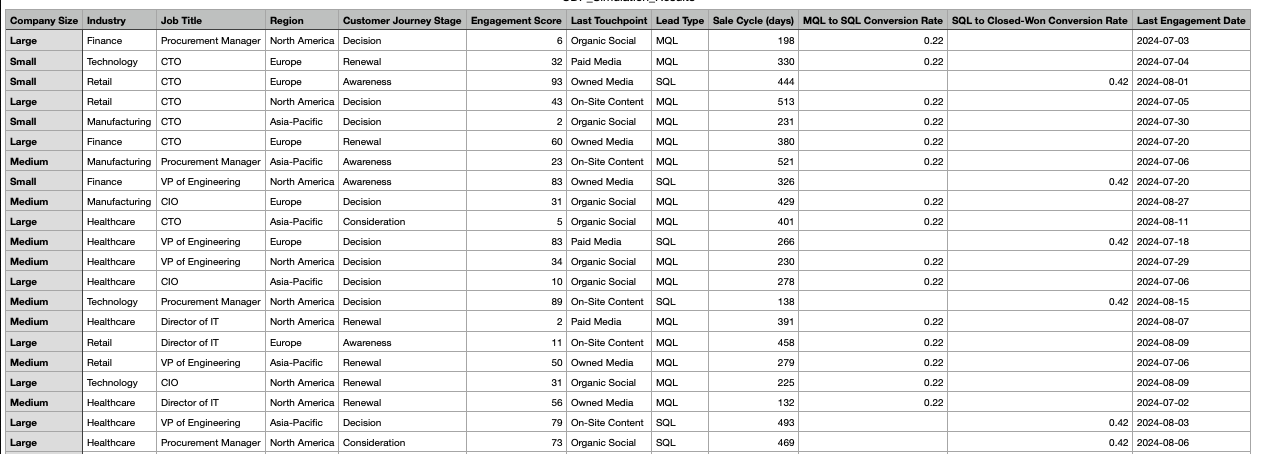
ChatGPT generated fake user data for my simulation.
Simulated marketing campaigns: A look inside
The simulation broke the customer journey into four key stages: Awareness, Consideration, Decision and Renewal. The CDP allowed me to deliver personalized messaging to different stakeholders within the buying committee — think CTOs, procurement managers and directors of IT.
Example 1: Personalized email for an awareness-stage lead
One of our simulated users, a CTO at a medium-sized healthcare company, engaged with our LinkedIn content and downloaded a whitepaper. The CDP classified them as an “Awareness” stage lead, and we sent a personalized email offering a short demo video:
Subject: How [Your SaaS Product] Can Help Transform Healthcare Operations
Content: “Hi [Name], I saw you recently downloaded our whitepaper on healthcare operations. I thought you might enjoy this quick demo on how we’re helping similar companies streamline their workflows.”
According to the simulator, this small touch of personalization led to higher engagement and faster movement from MQL to SQL status.
Highlights and lowlights: Marketing campaign results
The simulation highlighted several benefits of using a CDP to manage marketing and sales processes:
- Personalization at scale: One of the biggest advantages was delivering personalized content at every stage of the customer journey. Decision-stage leads received custom demo invitations, while renewal-stage users got tailored offers based on their previous interactions.
- Multichannel coordination: The CDP enabled us to coordinate campaigns seamlessly across organic social, on-site content and paid media. Retargeting campaigns on LinkedIn and Google Display Network were especially effective at re-engaging decision-makers who hadn’t yet committed.
It was insightful (and fun!) to experiment with the simulation. For example, I asked for a breakdown of engagement scores across various channels and lead types:
Organic social: Underperformed for smaller companies in the awareness stage, but was more effective when supported by email follow-ups.
Paid media: Strong performance for mid-funnel leads, particularly in the decision stage for large companies.
Owned content: Webinars and case studies played a key role in driving MQLs to SQLs, especially in the technology and finance industries.
Our simulation also revealed some areas that need improvement:
Organic social struggles: Organic social content was less effective at driving awareness for smaller companies. These leads often required more personalized outreach to move them through the funnel.
Churn risk at renewal: Smaller companies in the retail and finance industries were at higher risk of churn during the renewal stage. Without strong, personalized renewal offers, these users were more likely to drop off, despite high engagement earlier in the cycle.
Dig deeper: Where to deploy AI for maximum impact
CDP vs. traditional approaches: Key comparisons
I was curious and asked ChatGPT how this same campaign would fare without a CDP in place. Again, the simulator took the question and ran with it.
With a CDP, data is unified and real-time, allowing marketers to create dynamic segments, personalize messaging based on engagement and track MQLs and SQLs with precision.
Traditional marketing often struggles with siloed data and generalized messaging. Without the unified view a CDP provides, marketing efforts are less targeted, and sales cycles tend to drag on longer due to less effective lead nurturing.
Simulations are helpful, but not perfect
Here’s the thing: I intellectually knew all about CDPs before this experiment. I’ve followed insights from leaders like David Raab, kept up with developments in the CDP space on MarTech, and absorbed content from experts like Greg Krehbiel. But despite all of this, I never had the opportunity to get hands-on with a CDP myself. (If you are a vendor, please don’t take this as an invitation!)
My CDP simulator — without a significant investment of time or resources — allowed me to get hands-on and dig into what a marketer might expect while working with these types of platforms. I wanted to see if I understood what vendors say about their platforms and how those features might map into a marketing workflow.
While CDPs were my focus for this exercise, this same approach could be applied to many other technologies — content management, digital asset management, customer experience platforms and more. Running a simulation lets you explore how well you really understand these tools and whether they deliver on their promises.
This exercise also shows that ChatGPT isn’t just for conversations — it can simulate real business scenarios and offer valuable, data-driven insights.
If you’re curious about how martech tools like CDPs could impact your strategy, try running your own simulations. It’s a low-risk way to gather insights and make smarter, more informed decisions. Our free MarTechBot will help you get started right away.
The post How to use ChatGPT to simulate martech tools and marketing strategy appeared first on MarTech.
**Utilizing ChatGPT for Simulating Martech Tools and Developing Marketing Strategies**
In today’s fast-paced digital landscape, marketing technology (Martech) tools have become indispensable for businesses aiming to stay competitive. From customer relationship management (CRM) systems to email marketing platforms, Martech tools help organizations streamline their marketing efforts, analyze data, and optimize campaigns. However, the sheer number of available tools can be overwhelming, and selecting the right combination can be a daunting task. This is where ChatGPT, an advanced language model developed by OpenAI, can play a transformative role. By simulating Martech tools and assisting in the development of marketing strategies, ChatGPT can help businesses make informed decisions and achieve their marketing goals.
### Understanding ChatGPT and Its Capabilities
ChatGPT is a sophisticated AI language model that can generate human-like text based on the input it receives. It can engage in conversations, provide information, answer questions, and even offer creative suggestions. While ChatGPT is not a Martech tool in itself, it can simulate the functionalities of various Martech tools, offering marketers a unique way to explore different strategies and optimize their marketing efforts.
### Simulating Martech Tools with ChatGPT
One of the key advantages of using ChatGPT is its ability to simulate the functionalities of various Martech tools. By leveraging its natural language processing capabilities, ChatGPT can help marketers explore different scenarios, test hypotheses, and make data-driven decisions. Here are some ways ChatGPT can simulate Martech tools:
1. **Customer Segmentation and Persona Development**:
– ChatGPT can assist in creating detailed customer personas by analyzing demographic data, customer behavior, and psychographic information. By simulating customer segmentation tools, ChatGPT can help marketers identify key customer segments and tailor their marketing messages accordingly.
2. **Content Creation and Optimization**:
– Content marketing is a critical component of any marketing strategy. ChatGPT can simulate content creation tools by generating blog posts, social media content, email copy, and more. Additionally, it can provide suggestions for optimizing content based on SEO best practices, ensuring that the content resonates with the target audience and ranks well in search engines.
3. **A/B Testing and Experimentation**:
– A/B testing is a common practice in marketing to determine which version of a campaign performs better. ChatGPT can simulate A/B testing platforms by helping marketers design experiments, generate variations of marketing materials, and analyze potential outcomes. This allows marketers to make informed decisions before launching a campaign.
4. **Predictive Analytics and Forecasting**:
– Predictive analytics tools help marketers forecast future trends and outcomes based on historical data. ChatGPT can simulate these tools by analyzing past campaign performance, market trends, and customer behavior to provide insights into future marketing opportunities and challenges.
5. **Social Media Management**:
– Managing social media accounts and engaging with audiences is a time-consuming task. ChatGPT can simulate social media management tools by generating content calendars, suggesting posting schedules, and even drafting responses to customer inquiries. This allows marketers to maintain a consistent and engaging social media presence.
6. **Email Marketing Automation**:
– Email marketing remains one of the most effective channels for reaching customers. ChatGPT can simulate email marketing automation tools by helping marketers design email campaigns, segment email lists, and create personalized email content. It can also provide insights into optimal send times and subject lines to maximize open rates and conversions.
### Developing Marketing Strategies with ChatGPT
Beyond simulating Martech tools, ChatGPT can also play a crucial role in the development of comprehensive marketing strategies. Here’s how:
1. **Strategic Planning and Brainstorming**:
– ChatGPT can serve as a brainstorming partner, helping marketers generate new ideas for campaigns, promotions, and content. By providing creative suggestions and alternative approaches, ChatGPT can inspire marketers to think outside the box and develop innovative strategies.
2. **Competitive Analysis**:
– Understanding the competitive landscape is essential for any marketing strategy. ChatGPT can assist in conducting competitive analysis by gathering information on competitors, analyzing their marketing tactics, and identifying opportunities for differentiation. This allows marketers to position their brand more effectively in the market.
3. **Customer Journey Mapping**:
– Mapping the customer journey is critical for delivering a seamless and personalized experience. ChatGPT can help marketers create detailed customer journey maps by simulating customer interactions across various touchpoints. This enables marketers to identify pain points and opportunities for improvement in the customer experience.
4. **Campaign Planning and Execution**:
– ChatGPT can assist in the planning and execution of marketing campaigns by providing step-by-step guidance on campaign development, from setting objectives to measuring success. It can also help marketers allocate resources effectively and prioritize tasks to ensure that campaigns are executed efficiently.
5. **Data-Driven Decision Making**:
– Data is at the heart of modern marketing strategies. ChatGPT can help marketers make data-driven decisions by analyzing campaign performance metrics, customer data, and market trends. By providing actionable insights, ChatGPT

Recent Comments