
It’s February, and my request to opt out of my subscription to 2025 is still pending, so I have to continue like the good marketing soldier I am. You, too?
After sharing a key budget strategy move in my last column, I’ll switch gears and rant about a list hygiene practice that doesn’t work and must be stopped.
Rant mode ON.
I recently got this email from a significant seasonal retailer:
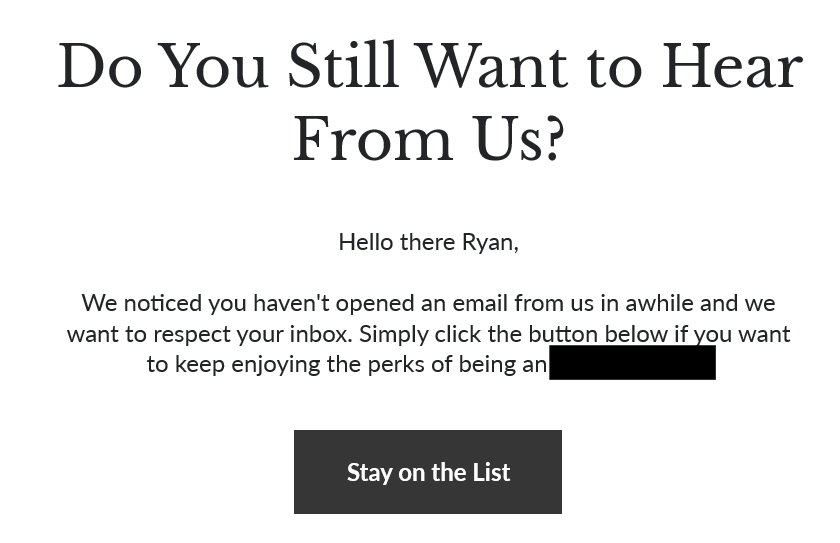
My first response was not, “Gee, I sure do! I’m gonna click that link!” If you know me, you won’t be surprised to learn it was, “Why the #$%^* am I getting this email?”
Two years ago, I bought a high-ticket item from this company, not something I repurchase regularly. I won’t name and shame the brand because I see this happening with other brands. Instead, let’s consider the problems with these emails and why they aren’t the solution to keeping your email list fresh and ISP-friendly.
Re-engagement requests have been popping into my inbox lately, making my marketer’s mind melt. The senders assume I haven’t opened their emails for a while, which is likely wrong.
When you think about clutter in the inbox — and you should because it’s real and it annoys your subscribers – the last thing you want to do is judge the validity of your email based on engagement factors.
Here are three reasons why this email isn’t the solution you think it is.
1. Opens are dead, let them rest in peace
Yes, engagement matters in the wider picture. However, for retailers, especially seasonal retailers, engagement is the same as for all-season brands. It’s not consistent from one quarter to another, or from one campaign to another, so you have to measure it differently.
The open rate is not an intent metric. Haven’t we talked about this enough already? (Answer: Yes, we have.)
At best, the open rate is a directional metric showing you a trend. Apple’s Mail Privacy Protection feature has made opens even more unsustainable as a metric to gauge intent or interest.
A high open rate doesn’t mean anything anymore. Maybe a lot of Apple subscribers opened your email. Maybe a lot of them block images, so the open wouldn’t get recorded. More likely the automatic open jacked up your open rate. Basing customer or re-engagement decisions on this flimsy metric is absurd. If you’re doing this, you need to address it quickly — in this quarter, if possible.
Dig deeper: Email deliverability: What you need to know
That’s true for any ecommerce brand but especially for a seasonal retailer. You have to depend on many other things to determine engagement, like clicks, website visits, and purchases.
If this brand had looked at my purchase history before putting me into a re-engagement program, the data would have shown I paid an enormous amount for a product two years ago. If it had looked at my website visits, it would have detected intent on other products, but not conversion. The consideration and usage cycles for that product are long. So, no, I’m not in the market now, but I might be in a year. For a seasonal retailer, that seems reasonable.
Your re-engagement program needs a good profile of your buyers. That’s not just one flat profile that includes everybody, but a profile that looks at personas and different types of consumers. Consumers are complex. Does your segmentation or definition of engagement match that complexity?
2. Your email isn’t that important
Not every email, that is, and not to every subscriber.
Many email marketers think their emails are works of art. They expect every customer to open and read every email (a misconception that MPP aids and abets). But let’s admit that customers don’t need your products after every send. They won’t open every email unless they love your email or your brand. And if they love your email, they leave a trail of follow-on actions you can track, like clicks, browsing, and buying.
Assuming that I must look at nearly every email you send is arrogant and unreasonable, especially for seasonal business. I don’t think about this brand in July or August, and I might not think about it until December 1st. I’m a dude!
Think of your customers and your personas. Not everybody adheres to your impossibly high definition of active customers or subscribers. That’s why your reporting must go deeper than opens or even clicks. You need to redefine engagement. The open rate as a measure of intent is gone. Expand your horizon about activity, and get serious about finding measures that are more reliable intent signals.
3. I’m not in the mood.
You’re sending customers emails at 5:30 or 6 in the morning. We aren’t in the headspace to click through to a website and browse products we haven’t been interested in. We haven’t had our first coffee of the day yet. We’re heading to the gym. We don’t have our contacts in. Don’t use our lack of action to put us in a re-engagement program and send us nonsensical emails like these.
When I see these emails, those brands are lucky I don’t go on an unsubscribe spree. Especially now that inboxes like Google and Yahoo! Mail make it so easy to opt out in the inbox or at the top of the email, no matter where you’ve hidden the unsub link.
Dig deeper: Are these email subject lines deceptive, clever copywriting or bad data at work?
Instead, take time to build a relationship with your customers that leads you to create more valuable emails. Like the folks at Woot!, the deal-of-the-day website (now part of Amazon) that put Bags o’ Crap on the map years ago. I open Woot!’s emails every day because, well, FOMO. But I don’t open every email from every other sender every day. Not even from American Airlines, and I’ll buy almost anything to get miles.
Inbox clutter will put me in a mood where swiping left on an email to delete is just as easy—or easier—than opening it. Does that mean I don’t like your brand, or that it isn’t the first one I think of when I’m in the market for your products? No.
In fact, for the brand in question here, I often go to its website looking for things—in season.
Your systems should collect that information and add it to my profile so you know I visit even when unprompted by email. That’s more important than whether I opened an email, especially if you can’t be sure I did or didn’t.
Do you need to update your re-engagement automation?
Maybe this brand’s problems are caused by something wrong with the CRM. Maybe jt’s not passing that customer data along to the right places. It happens, right? Maybe it got overlooked when you upgraded a platform.
That’s why you need to audit your automations regularly. They are not “set ’em and forget ’em.” Something might have been missed when MPP finally achieved scale. Look for anything that depends on opens to drive decisions.
Wrapping up
We all need to think about what “engagement” really means. But we also need to think about inbox competition and the data you use to build your emails. One message to everybody doesn’t make your email any more special than the one before or after it in the inbox.
We need to be realistic in our approach. But we also need to be humble enough to accept that we can only influence the measurements of how much our customers like us. We can’t control it.
Customers must be in the right mood to open, click, and buy from your emails. Asking me to re-opt in your emails tells me you don’t know who I am. That’s not going to persuade me to change my non-intent to intent.
Rant mode OFF. On to March and more madness!
Ryan is hosting a Toast my email session and live Q&A at The MarTech Conference. Free registration here.
The post 3 reasons the ‘Do You Want to Hear From Us’ email must die appeared first on MarTech.
# Why the ‘Do You Want to Hear From Us’ Email Should Be Eliminated: 3 Key Reasons
Email marketing is an essential tool for businesses to engage with their audience, build relationships, and drive sales. However, not all email campaigns are effective or well-received by recipients. One particularly problematic type of email is the **”Do You Want to Hear From Us?”** message. While it may seem like a polite way to confirm interest, this type of email often does more harm than good.
Here are three key reasons why the **”Do You Want to Hear From Us?”** email should be eliminated from your email marketing strategy.
## 1. It Creates Unnecessary Friction in the Customer Journey
When a user signs up for a newsletter, downloads a resource, or makes a purchase, they have already expressed some level of interest in your brand. Sending a follow-up email asking if they want to hear from you again creates unnecessary friction in their journey.
Instead of engaging them with valuable content or offers, this email forces them to take an extra step to confirm their interest—something they may not bother doing. As a result, you risk losing potential leads who might have otherwise engaged with your emails.
### **Better Alternative:**
Rather than asking for permission again, assume interest based on their initial action. Instead, send a **welcome email** that provides immediate value, such as a discount code, helpful resources, or a brief introduction to your brand.
—
## 2. It Increases Unsubscribes and Spam Complaints
Many recipients view the **”Do You Want to Hear From Us?”** email as unnecessary or even annoying. Since they may not remember signing up or may not immediately recognize your brand, they could mistake it for spam. This can lead to **higher unsubscribe rates** and even **spam complaints**, which negatively impact your sender reputation and email deliverability.
Additionally, if users ignore the email, your follow-up messages may end up in their spam folder, reducing the effectiveness of your entire email marketing campaign.
### **Better Alternative:**
Instead of sending a vague permission email, focus on **delivering value from the start**. Send engaging content, exclusive offers, or personalized recommendations that make recipients excited to receive your emails.
—
## 3. It Wastes a Valuable Opportunity to Engage
Every email you send is an opportunity to build a relationship with your audience. The **”Do You Want to Hear From Us?”** email wastes this opportunity by offering little to no value. Instead of sparking interest, it often leads to disengagement or deletion.
A more effective approach is to **immediately engage your audience** with compelling content that reinforces why they signed up in the first place. Whether it’s a helpful guide, a special discount, or an invitation to join a community, your first email should make a strong impression.
### **Better Alternative:**
Use a **welcome email series** that nurtures new subscribers with valuable content over time. This could include:
– A **thank-you message** with a special offer
– A **story about your brand** to build connection
– A **curated list of top resources** to help them get started
By focusing on engagement rather than permission, you create a stronger relationship with your audience from the very first interaction.
—
## Conclusion
The **”Do You Want to Hear From Us?”** email is an outdated and ineffective approach to email marketing. It creates unnecessary friction, increases unsubscribes and spam complaints, and wastes a valuable opportunity to engage with your audience.
Instead, businesses should focus on **delivering immediate value** through engaging welcome emails, personalized content, and meaningful interactions. By doing so, you’ll build stronger relationships, improve email deliverability, and ultimately drive better results from your email marketing efforts.
If you’re still using this type of email, now is the time to eliminate it and adopt a more effective strategy that keeps your audience engaged from the start. 🚀

Recent Comments