

How is your marketing team using generative AI? Here are the results of a poll I did earlier this year:
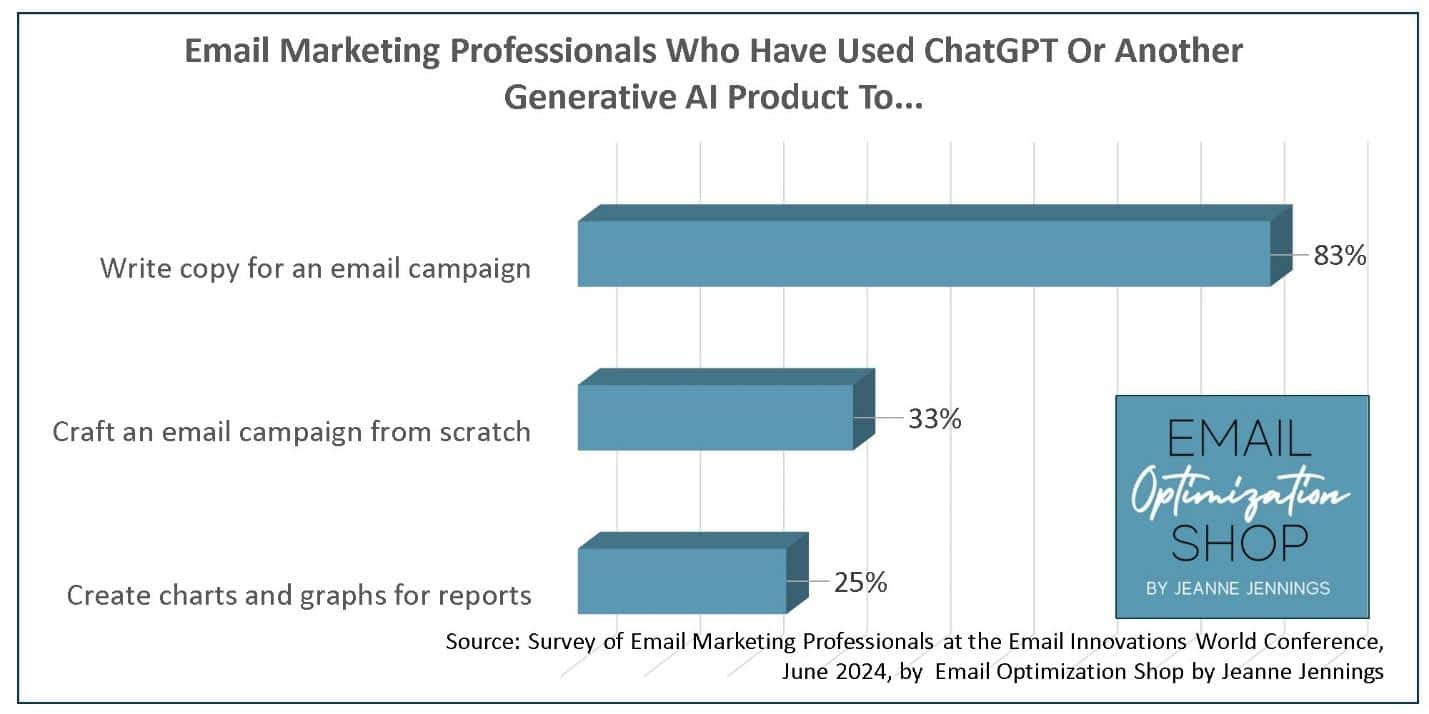
While this poll focused on email marketing professionals, the results align with trends across the broader marketing landscape. But from my experience, copywriting isn’t the most effective use of generative AI.
Here are three areas where generative AI can truly add value — if your marketing team wants to make the most of AI, start here, not with copywriting.
Use case 1: Enhance your marketing foundations
Your marketing team should have foundational information for every campaign they create, such as:
- Features, advantages and benefits (FAB) analysis.
- Potential obstacles and solutions.
- Target audience descriptions.
- Pricing details.
- Offers.
In essence, this is the critical information that forms the basis of the creative brief.
Case study
Earlier this year I was working with a university client and needed a features, advantages and benefits (FAB) analysis for earning an MBA. I earned my MBA (from Georgetown University, Hoya Saxa!), so I could have created this from my own experience. However, I decided to collaborate with the custom “marketing strategist” GPT I created to save time.
I quickly drafted a short, not very detailed, FAB analysis, made a list of relevant web pages from the client’s site and third-party sites about the value of an MBA and shared it all with the AI. Then I asked the custom GPT to enhance and expand on the FAB analysis I had provided.
In less than a minute, I had a high-quality list of 12 features, each with benefits and advantages. I reviewed it and asked the GPT for a few tweaks, but the process was much quicker than it would have been without the AI.
The value AI provides
Many people talk about the value of generative AI in terms of the quantity of information it ingests. For me, it’s in its ability to quickly ingest and synthesize information. We’re directing it to specific, relevant information and asking it to digest it, identify what’s important for the project and deliver the output in a usable format.
For this use case, generative AI increased my productivity while maintaining the quality of the deliverable.
Dig deeper: Data analysis and market research top list of AI use cases
Use case 2: Receive persona feedback on your marketing campaigns
This use case is more fun than the first one. Generative AI can act like a prospect or customer persona and give your marketing team feedback on your campaigns to optimize them as they are creating them.
Case study
Earlier this month, I created a custom “persona” GPT and named it Sarah. I asked for feedback on the FABs my custom “marketing strategist” GPT and I had created for a campaign marketing a mail-order barbeque sampler that serves eight for holiday entertaining.
Sarah liked most of them — but she had four suggestions for improvement.
Some of her feedback was not helpful. For instance, she suggested that we expand the focus of the FABs from winter holiday entertaining to various occasions, like birthday parties and summer get-togethers. But this is specifically a winter holiday campaign, so we disregarded that.
Some of her feedback was very helpful. For instance, the FABs talked about the barbeque being premium, authentic and “the best” of its category. Sarah asked for more details on why this was. She suggested adding information about unique cooking methods, specific ingredients and other things that would strengthen these claims.
I relayed this information to my custom “marketing strategist” GPT, which revised the FABs to address Sarah’s feedback. Then, I ran the revised FABs past Sarah to ensure we addressed her concerns.
The value AI provides
In this case, my custom “persona” GPT identified a blind spot in the FABs — a lack of support for some of our claims. It’s always good to get a second set of eyes on something. Using an AI for this is more cost-effective than using a real person, and it allows us to create a feedback source based specifically on our target audience.
For this use case, generative AI gave me feedback from my target audience to optimize my campaign as we developed it.
Dig deeper: 6 ways to use generative AI for your marketing
Use case 3: Create charts and graphs from raw data in spreadsheets
If charts and graphs are a big part of your marketing team’s jobs, this use case may be helpful. But it makes me sad, as I enjoy creating charts and graphs in Excel.
Case study
I started using AI to create the standard charts and graphs I use to report on campaign performance. It’s pretty easy. I simply upload a spreadsheet to my custom “data scientist” GPT and request the specific charts and graphs I need.
This GPT is designed to follow specific configuration instructions I provided:
- Metrics: A document outlines key metrics, how to calculate them and includes sample data with calculations.
- Examples: Sample charts and graphs serve as models for the desired look and feel of the output.
- Branding: A branding guide, including company colors and logo, ensures consistency in visual elements.
I upload a spreadsheet of raw data and ask for the charts and graphs I need by name. I always make sure the column names align with the provided metrics documents; if any discrepancies arise, the GPT will prompt for clarification.
I always doublecheck the calculations. To date, they’ve always been correct. While accurate, the GPT’s charts and graphs aren’t as visually appealing as I’d like. As an example, here’s the GPT’s version of the bar chart that appears at the beginning of this article:
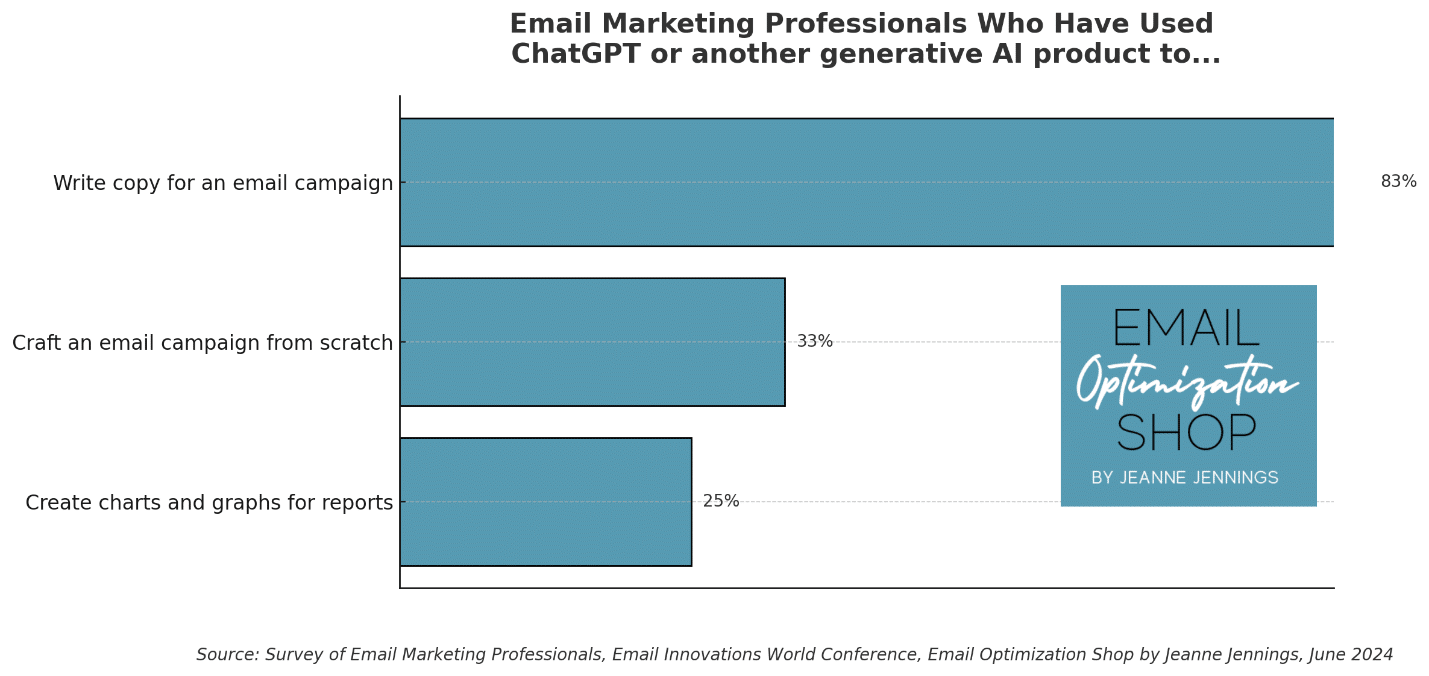
See what I mean? I’ve tried to provide creative guidance to the GPT to get a look and feel closer to what I can get with Excel to no avail.
The value AI provides
I would love AI to be really good at this kind of rote work. It does the job well enough and faster than I could, though not as visually polished. Hopefully, its creative output will improve over time.
For this use case, generative AI saves me time by handling rote work that I would otherwise have to do myself.
Dig deeper: How to use generative AI in copywriting for an A/B testing program
Using generative AI beyond copywriting
AI is this year’s “bright shiny thing.” Instead of buying into the hype or being completely skeptical, your organization should encourage your marketing and other internal teams to find practical, realistic tasks where AI provides value.
Despite what 83% of email marketers do, I don’t see copywriting at the top of the list. The best way to get up the AI learning curve is to experiment and share our experiences.
The post 3 marketing use cases for generative AI that aren’t copywriting appeared first on MarTech.
# 3 Innovative Marketing Applications of Generative AI Beyond Copywriting
Generative AI has rapidly transformed the marketing landscape, offering businesses new ways to engage with customers, optimize campaigns, and create personalized experiences. While much attention has been given to AI’s ability to generate compelling copy, its potential extends far beyond content creation. From designing visuals to optimizing customer interactions, generative AI is revolutionizing marketing in ways that were once unimaginable. In this article, we will explore three innovative marketing applications of generative AI beyond copywriting.
## 1. **AI-Generated Visuals and Design**
In the world of marketing, visuals are just as important—if not more so—than written content. Generative AI has made significant strides in creating high-quality, customized visuals that can be used across various marketing channels. Tools like DALL·E 2, MidJourney, and Runway ML are enabling marketers to generate images, videos, and even 3D models based on simple text prompts.
### How It Works:
Generative AI models are trained on vast datasets of images, allowing them to understand patterns, textures, and styles. When given a prompt, these models can create entirely new visuals that align with the brand’s identity and campaign goals. For example, a marketer could input a prompt like “a futuristic city skyline at sunset” and receive a high-quality, unique image that can be used in social media posts, ads, or website banners.
### Marketing Applications:
– **Custom Ad Creatives**: Marketers can generate unique, eye-catching visuals for digital ads without relying on stock images or expensive design teams.
– **Social Media Content**: AI-generated visuals can be used to create engaging and shareable content for platforms like Instagram, Pinterest, and Facebook.
– **Product Mockups**: Generative AI can create realistic product images or packaging designs, helping brands visualize new concepts before production.
### Example:
Coca-Cola recently partnered with OpenAI to explore how generative AI could be used to create customized visuals for their marketing campaigns. By using AI-generated imagery, the brand was able to produce unique, on-brand visuals that resonated with their target audience.
## 2. **Personalized Customer Interactions and Chatbots**
Generative AI is also revolutionizing customer interactions by powering more intelligent, personalized chatbots and virtual assistants. Traditional chatbots often rely on pre-programmed responses, which can lead to frustrating user experiences. However, with the advent of AI models like GPT-4, chatbots can now engage in more dynamic, human-like conversations, offering personalized recommendations, answering complex queries, and even handling customer complaints.
### How It Works:
Generative AI chatbots use natural language processing (NLP) to understand and respond to customer queries in real-time. These models can analyze customer data, such as past interactions, purchase history, and browsing behavior, to offer tailored responses. For example, if a customer asks for product recommendations, the AI can suggest items based on their previous purchases or preferences.
### Marketing Applications:
– **Customer Support**: AI-powered chatbots can handle a wide range of customer inquiries, reducing the need for human agents and improving response times.
– **Product Recommendations**: By analyzing customer data, generative AI can offer personalized product suggestions, increasing the likelihood of conversions.
– **Lead Generation**: Chatbots can engage with website visitors, qualify leads, and guide them through the sales funnel.
### Example:
Sephora, a global beauty retailer, uses an AI-powered chatbot to offer personalized beauty advice to customers. The chatbot can recommend products based on the user’s skin type, preferences, and past purchases, creating a more tailored shopping experience.
## 3. **Dynamic Content Creation for Email Marketing**
Email marketing remains one of the most effective channels for reaching customers, but personalization is key to its success. Generative AI is now being used to create dynamic, personalized email content that adapts to each recipient’s preferences, behavior, and engagement history. This goes beyond simply inserting a customer’s name into the subject line—AI can generate entire email templates, product recommendations, and even personalized offers based on real-time data.
### How It Works:
Generative AI models can analyze customer data, such as past email interactions, website behavior, and purchase history, to create highly personalized email content. For example, if a customer frequently browses a specific category of products, the AI can generate an email featuring those products, along with personalized discounts or offers. The AI can also optimize the email’s design, layout, and subject line to maximize open rates and engagement.
### Marketing Applications:
– **Personalized Product Recommendations**: AI can generate email content that features products tailored to each recipient’s preferences and shopping history.
– **Dynamic Offers**: Generative AI can create personalized discount codes or promotions based on a customer’s loyalty status, purchase frequency, or cart abandonment behavior.
– **A/B Testing**: AI can automatically generate and test different

Recent Comments