


Businesses need to decrease customer effort if they want to improve the perception of their brand, and better search and AI experiences can help, according to a new report.
The “2025 Coveo Customer Experience Relevance Report” (registration required) examined evolving digital customer experiences and found room for improvement in search results, content recommendations, AI-powered self-help and inconsistent customer experiences across channels.
The report found customer effort is a significant determinant of brand perception and loyalty. In fact, 84% of respondents felt they had to put in a moderate amount or a lot of effort to find information or get help.
Nearly three-quarters (72%) of respondents said the high cost of this effort could lead to them abandoning a brand’s website for competitors or Google.
This customer friction rears its head in five significant areas mentioned in the report.
Dig deeper: How B2B and B2C brands are winning hearts with memory-driven CX
The website search experience
The report identifies search as a strategic differentiator and a primary entry point to the digital experience. When customers have a specific intent on a website, 43% go straight to the search bar. Businesses must invest in a robust, unified search experience that connects all customer journey touchpoints.
Location-aware search is a tool that can significantly enhance the customer experience. Marketing strategies can leverage location-aware search to drive both online and offline conversions.
The role of generative AI in customer experience
Generative AI presents opportunities and challenges for the customer experience. While tools like ChatGPT deliver positive outcomes, its success hinges on reliable data and seamless integration. The report said that generative search is evolving into a central driver of connected experiences, helping customers find what they need, potentially before they even realize it.
However, marketers must understand what the report calls the “Generative AI Paradox,” and balance novelty with relevance and coherence. A significant portion of respondents, 49%, have experienced AI hallucinations (fake answers) while using generative AI tools. Trust in generative AI outputs requires verification and transparency. Forty-two percent of respondents always fact-check a generated answer.
Dig deeper: Why ignoring consumers’ AI concerns is a costly mistake
Personalization in a privacy-conscious world
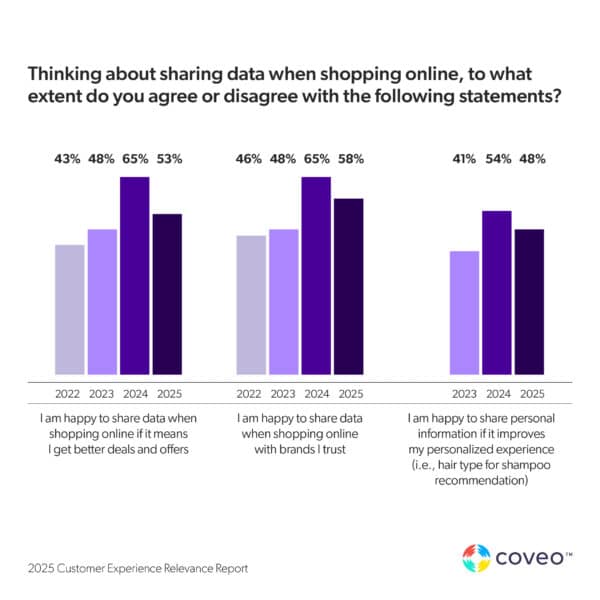
Personalization remains important, but reliance on direct data sharing is decreasing, the report found. While 53% of U.S. and U.K. respondents still say they are happy to share data for better deals and offers, the willingness to share data for any reason is decreasing overall.
Marketers must leverage data like on-site behavior (past searches, browsing patterns, etc.) to provide personalized and relevant recommendations without relying on explicit personal information. Customers’ ability to find what they are looking for in just a few clicks is still the factor with the most significant impact on brand perception (45%).
Self-service expectations
Self-service is gaining preference, the report found, with increased expectations for online information and assistance. While access to a live human agent remains a preferred option, there is a growing expectation for better information and self-assistance online.
This includes seeing answers directly in search results (51%), receiving helpful content recommendations (38%) and having AI-guided assistance within products (29%).
Many channels, one customer experience
Consistency across multiple customer service channels is critical, the report said, as customers use an average of three channels to engage with a company.
Inconsistent communication across departments is a major contributor to customer effort and negatively impacts brand perception. Marketing teams should ensure their efforts align with customer service strategies to ensure a seamless and consistent experience across all touchpoints.
The “Coveo Customer Experience Relevance Report 2025” surveyed two groups of 4,000 adults (age 18 or older) each across the U.S. and U.K. The first group’s responses were captured between Nov. 21, 2024 and Nov. 27, 2024, and quotas were set for gender, age and region at a country level. The second group consisted of adults who use a computer as part of their work in companies with 5,000+ employees. Their responses were captured between Nov. 21, 2024 and Dec. 9, 2024.
The post 5 areas where businesses need to improve their customer experience appeared first on MarTech.
**5 Key Areas Where Businesses Can Enhance Their Customer Experience**
In today’s competitive marketplace, delivering a superior customer experience (CX) is no longer optional—it’s essential. A positive customer experience not only fosters loyalty but also drives word-of-mouth referrals and long-term profitability. Businesses that prioritize CX often outperform their competitors in both customer retention and revenue growth. To help organizations elevate their customer interactions, here are five key areas where businesses can enhance their customer experience.
—
### 1. **Personalization**
**Why It Matters:**
Customers expect businesses to understand their preferences and tailor interactions accordingly. Personalized experiences show customers that they are valued as individuals, not just as transactions.
**How to Improve:**
– Use customer data to offer relevant product recommendations.
– Address customers by name in communications.
– Customize marketing messages based on past behavior and preferences.
– Implement AI-driven tools to deliver real-time, personalized content.
**Example:**
Streaming services like Netflix and Spotify use algorithms to recommend content based on user behavior, significantly enhancing user engagement and satisfaction.
—
### 2. **Omnichannel Support**
**Why It Matters:**
Today’s customers interact with brands across multiple channels—websites, mobile apps, social media, email, and in-store. A seamless experience across all touchpoints is crucial to maintaining consistency and satisfaction.
**How to Improve:**
– Ensure consistent messaging and branding across all channels.
– Integrate customer data so interactions can continue smoothly across platforms.
– Offer support through multiple channels, including live chat, social media, and phone.
**Example:**
Retailers like Nordstrom provide a unified shopping experience, allowing customers to browse online, purchase in-store, and receive support through various channels without disruption.
—
### 3. **Customer Feedback and Engagement**
**Why It Matters:**
Listening to customers helps businesses understand pain points and areas for improvement. Engaging with feedback demonstrates that the company values customer input and is committed to continuous improvement.
**How to Improve:**
– Regularly collect feedback through surveys, reviews, and social media.
– Act on feedback promptly and transparently.
– Involve customers in product development or beta testing.
– Use sentiment analysis tools to gauge customer emotions and trends.
**Example:**
Companies like Starbucks use customer feedback platforms to crowdsource ideas for new products and services, fostering a sense of community and ownership among customers.
—
### 4. **Employee Training and Empowerment**
**Why It Matters:**
Employees are the face of the brand. Well-trained and empowered staff can resolve issues quickly, provide knowledgeable support, and create memorable experiences.
**How to Improve:**
– Invest in regular training programs focused on customer service skills.
– Empower employees to make decisions that benefit the customer.
– Recognize and reward excellent customer service.
– Foster a customer-centric culture throughout the organization.
**Example:**
Zappos is renowned for its customer service, largely due to its culture of empowering employees to go above and beyond to delight customers.
—
### 5. **Speed and Convenience**
**Why It Matters:**
In a fast-paced world, customers value quick and hassle-free interactions. Reducing friction in the customer journey can significantly enhance satisfaction and loyalty.
**How to Improve:**
– Optimize website and app performance for speed and usability.
– Streamline checkout and payment processes.
– Offer self-service options like FAQs, chatbots, and knowledge bases.
– Ensure fast and reliable delivery or service fulfillment.
**Example:**
Amazon’s one-click purchasing and Prime delivery options have set a high standard for speed and convenience in e-commerce.
—
### Final Thoughts
Improving customer experience is an ongoing journey that requires attention to detail, a commitment to innovation, and a deep understanding of customer needs. By focusing on personalization, omnichannel support, customer feedback, employee empowerment, and convenience, businesses can create meaningful interactions that build trust, loyalty, and long-term success. In an era where customer expectations are higher than ever, those who invest in CX will be the ones who thrive.

Recent Comments