

With robust marketing instruments and a vast potential audience, social media represents a treasure trove for enterprises. However, simply having a presence on these platforms is no longer sufficient as organic reach wanes and the competition intensifies. Crafting a distinct identity and fostering a community are essential for businesses aiming to differentiate themselves on social media.
The more you distinguish your brand, the higher your chances of drawing in customers. But for those just starting, the best method to weave social media into your overarching strategy may not be clear. While the significance of social media marketing is widely recognized, it’s merely one component of a broader strategy. A comprehensive approach is necessary, one that utilizes this channel to enhance every other aspect of your business.
We provide an all-encompassing guide to assist you in achieving just that. Let’s explore how to effectively utilize social media for your business.
Advantages of social media for business
The benefits of social media are not uniform across all brands. Nevertheless, here are five advantages that smart social engagement can offer companies.
- Forge meaningful connections: Social media creates a two-way communication avenue between brands and their audience. Utilize it to respond to inquiries, resolve customer service issues, and collect feedback. These exchanges help develop a stronger bond with your audience.
- Highlight your products: From customer reviews to instructional content and more, social media is an excellent platform for showcasing your products. Use this chance to emphasize what makes your product extraordinary and the value it adds for your customers.

Source
- Boost your brand’s visibility and outreach: Social media facilitates product discovery, as illustrated by recent social media statistics. A significant number of potential customers may encounter your brand’s TikTok or Instagram before they visit your website. They might discover your brand through their Explore or For You pages, or via a friend’s or influencer’s post. Therefore, establishing a strong social presence is vital for enhancing your visibility and reach.
- Collect real-time insights: Social media serves as a wealth of transparent data. Understand your audience’s pain points and interests through their discussions. Identify the latest trends in your sector and the most engaging content types. From your audience to your competitors, there’s no superior venue to conduct market research.
Establishing social media objectives for your business
These social media advantages don’t occur by chance. They are the result of a calculated, goal-oriented method of utilizing social media. Thus, it all begins with an objective.
Keep in mind that social media objectives vary since they depend entirely on your business. Additionally, you can set several overlapping goals that influence one another. Your objectives shape everything from your content strategy to which social channels you utilize.
There’s no “correct” way to set goals, although the process can be daunting. Here are some recommendations to assist you:
- Begin with the broad perspective before narrowing it down. Why does your business require a social presence? What resources are necessary to turn those goals into reality?
- Analyze your target audience and customer personas. Consider how your customers engage with social media. Is your audience primarily on TikTok, Instagram, or another platform? What types of content resonate with them? Brainstorm how social media can help you connect with your audience.
- Contemplate your business’ overall marketing strategy and the role social media plays in it.
- Link your social media objectives to measurable metrics and KPIs. This is particularly vital today when marketers are compelled to demonstrate ROI. From engagement to traffic metrics and beyond, there are various elements to monitor.
Sample social media objectives and KPIs for B2B brands
- Brand visibility (growth, engagements) and consideration (link clicks, website traffic)
- Lead acquisition (marketing qualified leads)
- Competitor assessment (share of voice) and market position
- Audience engagement (likes, comments, shares, etc.)
- Enhance customer loyalty (+ CX) and mitigate churn
- Customer service efficiencies (response speed and rates)
- Reputation oversight
- Customer satisfaction
- Positive feedback
- Customer sentiment online
Sample social media objectives and KPIs for B2C brands
- Brand visibility (growth, engagements) and consideration (link clicks, website traffic)
- Identify new sales prospects (conversations to engage with)
- Explore brand expansion opportunities
- Reputation oversight (engaging with inbound messages)
- Boost customer satisfaction
- Encourage customer loyalty
- Product launch evaluation
- Competitive assessment
Creating a social media strategy for your business
After establishing your goals, it’s time to formulate a strategy to achieve them. Let’s break down the crucial steps to establishing a successful social media strategy for your enterprise.
Step 1: Collaborate with pertinent teams
Identify which departments or teams will be most relevant to your social media activities based on your previously outlined goals. For instance, you might have a marketing department overseeing the social media strategy, a customer service department managing responses to customer inquiries, and a sales department nurturing leads through social content.
Engage with each department to ascertain how social media can provide maximum value for them. Inquire what each team wishes to learn from social media. How do they envision utilizing it? How can your brand’s social media presence support them? This will help you create a comprehensive plan that addresses all facets of the business.
Your sales team, for instance, may wish to find and cultivate leads through social media. Your strategy may include pinpointing important purchasing conversations happening on social platforms.
Step 2: Identify key platforms
Conduct audience research to determine which social channels your audience frequents most. Gain insights into the various platforms your audience engages with and how each caters to their specific needs.
This will simplify your social media efforts as you can develop a strategy that effectively addresses each platform in a targeted manner.
Consider these types of questions when determining how these platforms function under team responsibilities: Which platform will facilitate customer support? Will LinkedIn be included to attract potential hires?
Step 3: Establish a dedicated social media team(s)
The pressing question is: Who will implement your social media strategy?
Many organizations utilize social media primarily for marketing. Consequently, the marketing team oversees most social media responsibilities. But what if you also want to employ social media for customer assistance? Or what if your marketing team lacks the expertise to manage sales inquiries?
It’s vital to have a dedicated team to tackle essential social media tasks relevant to each department. You can either create a team responsible for all things social media or integrate social media specialists into various internal teams. The specific social media team structure will depend on what fits best for your organization.
15 social media strategies for your business
1. Be unique
Originality is crucial for standing out on social media. Sure, participating in trends and reinventing popular memes can quickly generate engagement. We aren’t suggesting you completely discard that strategy. However, you need a content strategy tailored specifically to your brand.
In fact, our 2024 Content Benchmarks Report indicates that unique content is what makes a brand unforgettable on social media. Devise creative and innovative ways to convey your message.
2. Exhibit your product/service in action
What original content can you create for social media?
Our 2024 Social Media Content Strategy Report revealed fascinating insights. Original content demonstrating your product or service in action is the chief factor influencing consumers to buy.
Ensure your content is both informative and entertaining. According to the report, 66% of social users find edutainment to be the most engaging type of brand content. We suggest creating original videos to showcase your product’s capabilities. Demonstrations, tutorials, walkthroughs, and tests present excellent ideas for applying edutainment in your next social media posts.

3. Keep audiences entertained
Speaking of entertainment, the majority of social media users aren’t seeking a sales pitch. They primarily want to enjoy some lighthearted content or find enjoyable distractions. Hence, the best approach to capture their attention is by keeping them entertained.
Balance your Feed with content that provides amusement and lightheartedness. To kick things off: consider memes, comedy skits, ASMR content, and polls!

4. Utilize user-generated content effectively
Content produced by your customers serves a dual purpose: it informs others and builds trustworthiness. It can illustrate what your product or service can do in real-life scenarios. Moreover, since the content originates from fellow consumers, it lends an extra layer of credibility.
Additionally, it saves your team from the time-consuming task of creating original content. Balance your Feed with user-generated content featuring your offerings.

5. Foster a human, people-centric social presence
This may seem self-evident.
Nevertheless, busy companies often find themselves resorting to a “copy-and-paste” approach on social media. Comments and captions should feel as though they were crafted by a real individual, not an automated program.
Injecting personality into your posts is a simple way to connect with your audience. Moreover, personalizing your responses to individuals illustrates that you are there to assist them. This is one of the best methods to utilize social media for business to foster connections.
In fact, consumers expect brands to offer personalized replies. As indicated by the 2023 Sprout Social Index™, 70% of individuals anticipate personalized responses for their customer service inquiries.

6. View your social presence as a resource (not just a promotional avenue)
Avoid the pitfall of regarding your social presence as a mere platform for promotions. Cultivating an audience necessitates genuine helpfulness rather than a sales-oriented approach.
Many successful social media practices utilize their accounts as valuable resources. This involves:
- Producing actionable, informative content (e.g., how-tos, tutorial videos)
- Responding to inquiries and providing advice to your audience
- Sharing company updates and keeping customers informed
Consider your social accounts as the initial point of contact with potential customers. Offering resources leaves a more favorable first impression than shouting “BUY NOW!”
7. Maintain consistency
This pertains to both content creation and customer interaction.
Traditional wisdom suggests that social media algorithms favor consistency. Research conducted by Sprout on optimal posting times backs this idea. If nothing else, allowing your social pages to accumulate dust is not a favorable image.
Neither is ignoring your followers. Actively engaging with inquiries and comments is essential. Therefore, monitoring your @tags and social notifications is crucial.
According to the Content Benchmarks Report, this interactive aspect has a greater impact than merely posting frequently. 37% of consumers believe that the most notable brands engage directly with their audiences on social media.
8. Collaborate in social customer service
Many businesses recognize the role of social media in customer care, yet the ownership of responsibilities often remains ambiguous. This can create difficulties in delivering satisfactory customer experiences in social media contexts.
Given that marketing teams primarily manage social media, the task of addressing customer inquiries commonly rests with them. However, if they’re not properly trained in customer care processes, response quality may suffer.
A partnership between the two departments can remedy this prevalent issue. When both teams share responsibilities, it enhances coordination regarding who responds and how to respond, allowing relevant team members to act proactively with minimal back-and-forth. Based on the 2023 Sprout Social Index™, 36% of businesses are implementing this collaborative approach.

9. Involve your C-Suite and staff to amplify your business
As previously mentioned, social media shouldn’t be viewed as an isolated entity.
This also applies to your internal teams. The sooner you secure approval and support from your C-Suite, the better. Brand-building through employee advocacy is another avenue for utilizing social media for business purposes.
Employee advocacy refers to the promotion of a brand by its employees on social media. Rather than solely endorsing products, advocates promote the company as a whole. This entails:
- Sharing insider experiences about the workplace
- Celebrating team achievements and successes
- Amplifying corporate messages and promotions
Chances are you’ve encountered employee advocacy in action on LinkedIn.
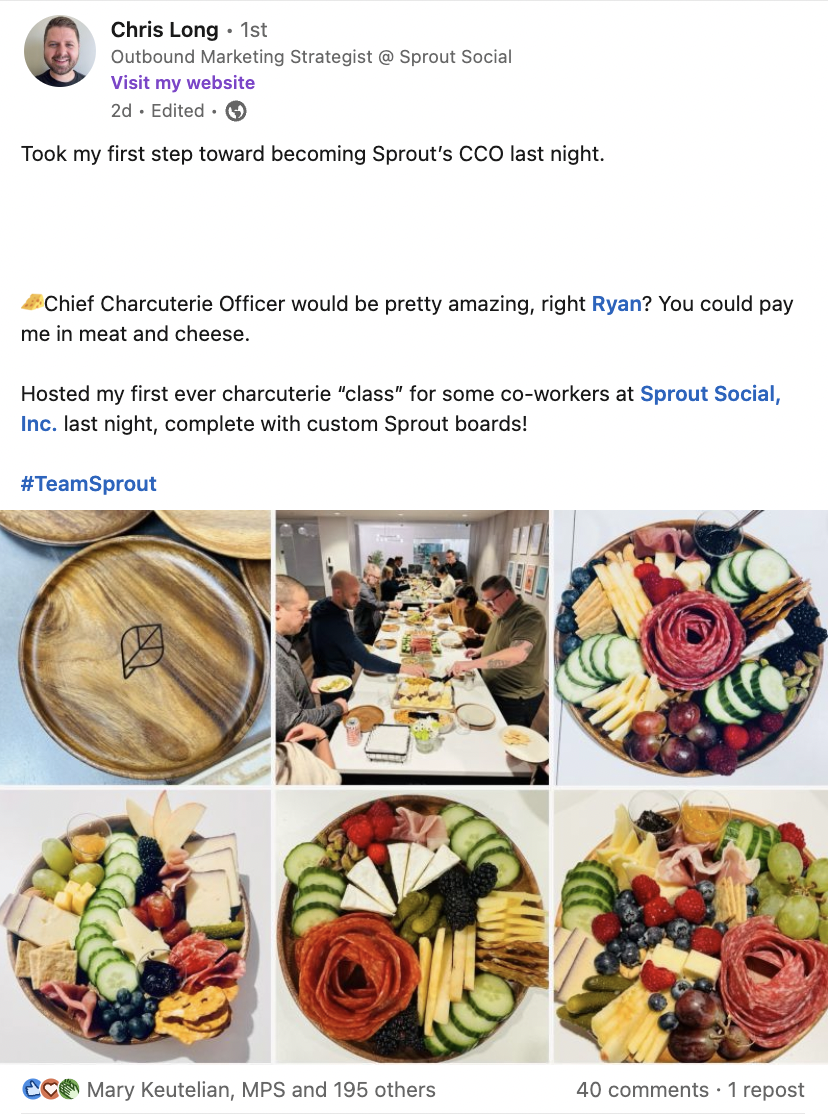
The crowded dynamics of social media mean anything you can do to differentiate yourself is beneficial. Advocacy presents an opportunity to enhance your company’s visibility and reach through social channels.
10. Be ready to experiment with diverse content types
Brands enjoy a wealth of options regarding the kinds of content they can share.
From short-form videos to stories and slideshows, there is no shortage of choices. Different industries and brands excel with various types of social media content.
That said, avoid making assumptions about what performs best.
Just because a competitor shares numerous memes doesn’t necessarily mean you should adopt their approach. Let your own metrics and engagement data steer your content planning.
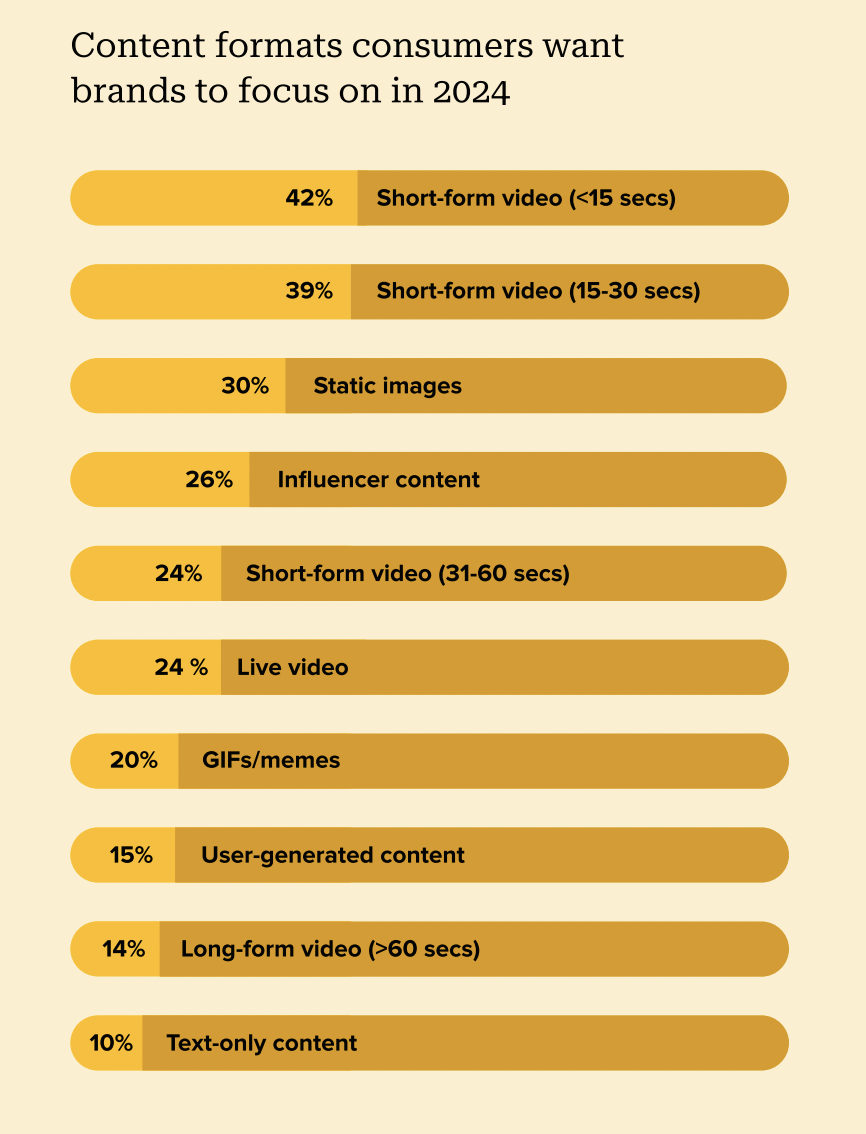
According to our Content Benchmarks Report, consumers prefer brands to prioritize short-form video. The shorter, the better, with 42% favoring videos under 15 seconds, while 39% expect to see videos ranging from 15 to 30 seconds in length.
11. Create attractive ads
Your organic social media initiatives will unlikely yield instantaneous outcomes. Ensure you complement them with strategic paid advertising. Per our Social Media Content Strategy Report, targeted advertising drives consumer purchasing behavior.
Two critical aspects of your social media advertising to perfect are:
- Targeting: Ensure the appropriate audience sees your advertisements, maximizing your ad expenditure. Display ads to users who have previously visited your site or interacted with similar brands. Don’t forget to target them on the appropriate platforms.
- Creativity: Develop ad creative that compels people to engage. Aim for clever (and pertinent) copy along with appealing visuals.

12. Harness influencer collaborations
Influencers boast a following of thousands who appreciate their content and seek their advice. Therefore, their endorsements carry weight. Collaborating with them can significantly increase your exposure and help grow your social media following. It can even influence purchasing decisions, according to the Social Media Content Strategy Report.
Bear in mind that we are in an era that values authenticity, where consumers demand transparency from their favorite influencers. Insights from our 2024 Influencer Marketing Report reveal that 47% of consumers desire genuine interactions from influencers, even when they post sponsored content.
Furthermore, 67% state that the best partnerships between brands and influencers are honest and unbiased.
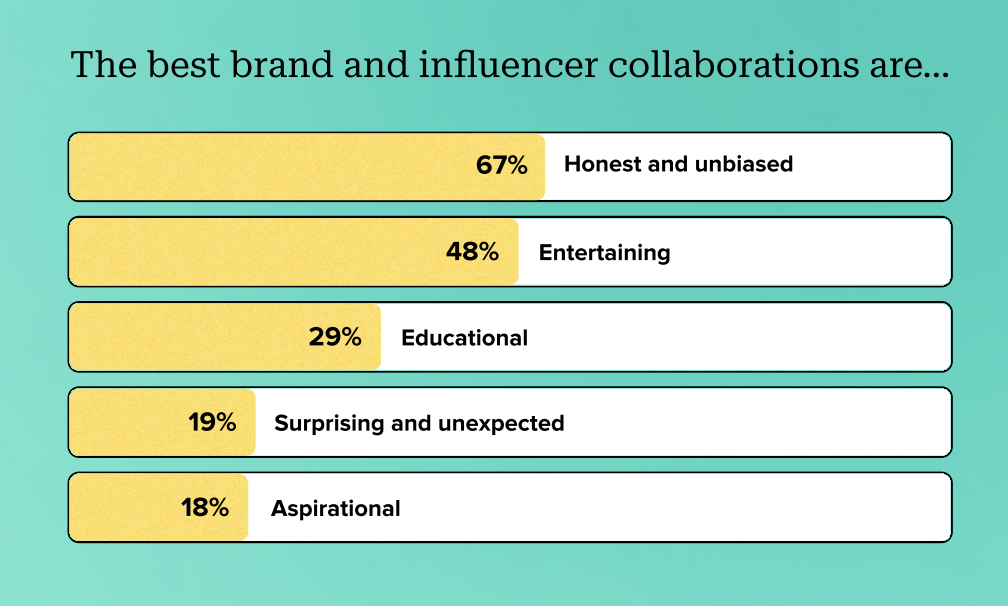
Thus, your collaborations should be authentic, involving influencers who genuinely appreciate your brand and products. Offer them the creative latitude to incorporate their personality and voice into the sponsored content.
13. Embrace transparency
In line with the emphasis on authenticity, it’s vital to weave it into your brand’s broader social media strategy. Consumers increasingly expect brands to be straightforward regarding their practices and principles. According to the 2023 Sprout Social Index™, consumers feel that brands don’t exhibit enough transparency on social media.
Additionally, people want to witness brands discussing how they produce and source their offerings. These expectations resonate with the broader shift toward conscious consumerism. An increasing number of consumers choose to purchase from brands that adhere to sustainable and ethical practices.
Thus, being open about these practices on social media will assist you in attracting customers whose values align with yours.

14. Use AI wisely
Artificial intelligence assists social media teams in executing their strategies more effectively. In fact, 81% of marketers in the 2023 Sprout Social Index™ report that AI has positively influenced their work.
However, 42% of consumers express concerns regarding brands employing AI in their social media communications. Therefore, be cautious about how you integrate AI into your strategies. Focus on utilizing it to enhance backend tasks such as social media analytics, campaign targeting, and sentiment analysis.
15. Develop a corporate communication plan
One final note for those at the enterprise level.
The significance of social media as a communication tool should not be underestimated. Brands have the capacity to reach vast audiences almost instantly. This applies to customers, industry leaders, and competitors alike.
The stakes are high for sizable companies with extensive audiences and stakeholders. Therefore, having a corporate communication plan is essential. In brief, you must establish guidelines for:
- Internal communication, which includes employee engagement and internal marketing
- External communication, such as public relations and public outreach
- Executive communication (e.g., how top leadership communicates about your company on social media)
- Crisis communication to manage controversies and address damage control situations
Having these elements well defined enables brands to maintain consistent messaging. This approach also helps to mitigate miscommunication and avoid potential public relations issues.
Utilize social media marketing tools for your business
The good news is that you’re not expected to manage everything entirely on your own when developing your presence.
A plethora of social media marketing tools are available to assist with the workload. Based on your requirements, consider investing in a combination of the following:
- Scheduling tools that enable you to plan content across various platforms
- Analytics tools that evaluate content effectiveness and engagement (see Sprout Social below)
- Listening and monitoring tools that facilitate audience conversation tracking
Maximizing the tools you use is often beneficial. Fewer tools enable you to maximize their potential and minimize the time spent onboarding.
Here’s a brief overview of the premier social media tools for your brand.
Sprout Social
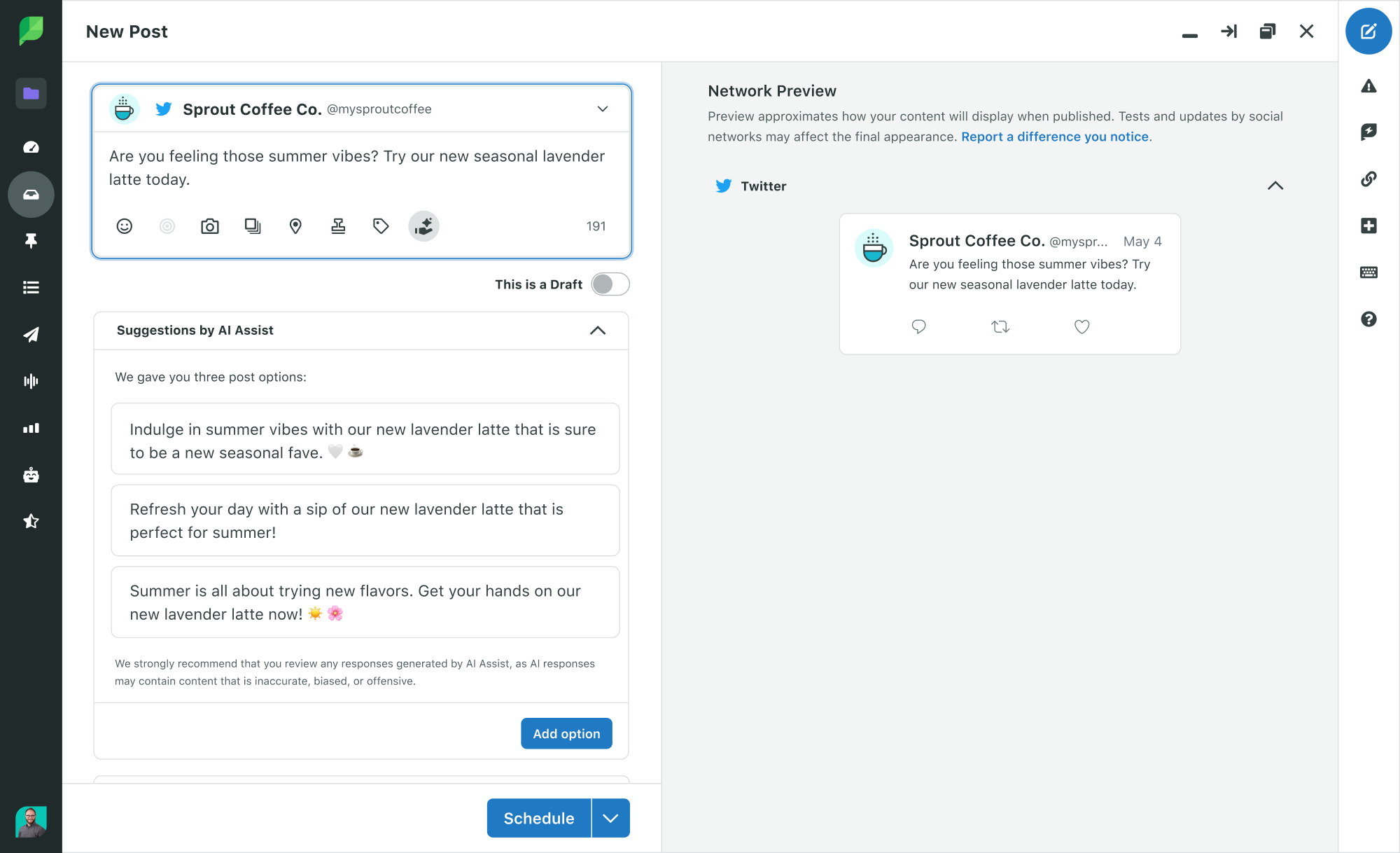
Sprout is a comprehensive social media management platform featuring a full range of social tools and analytics. For instance, the platform simplifies the organization of your content calendar across different platforms. This exemplifies how to save time and prevent tool-hopping.

Sprout’s analytics and dashboards foster a goal-oriented approach to social media for business. Detailed analytics lead to fewer uncertainties and enhanced understanding of your online presence. This encompasses tracking your best-performing content and social channels.
Ultimately, you’ll have continuous insight into what’s effective, what isn’t, and what steps you need to take next.
Sprout’s proprietary AI tools also provide actionable insights to guide your decisions. Receive AI-driven recommendations on how to enhance your content. Concentrate on the most crucial customer care interactions with AI assessing your messages.
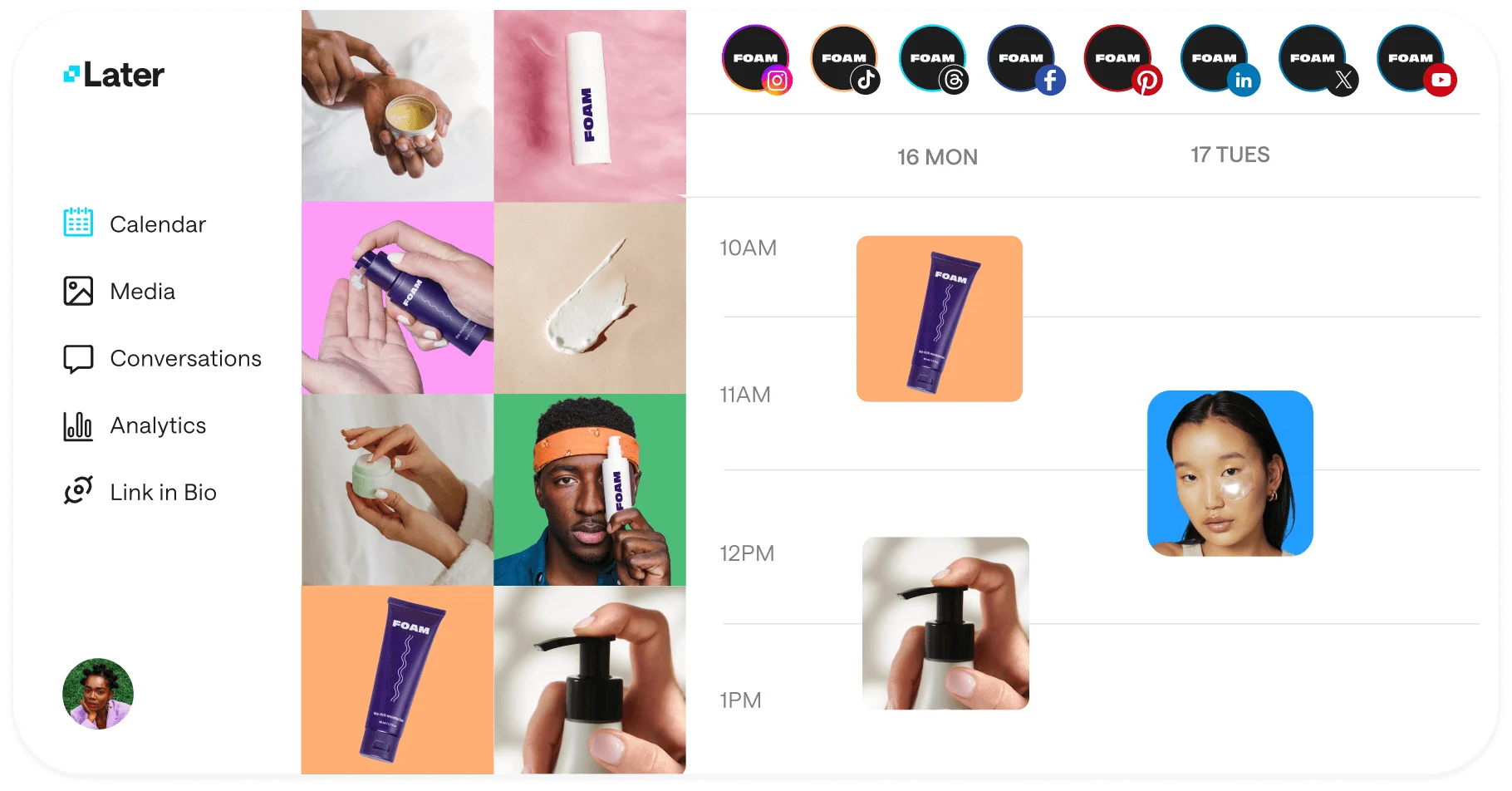
Later
Source: Later
Later enables you to automate numerous facets of your social media engagement. It features a unified calendar for scheduling your content across all social channels. Prepare these posts for automatic distribution at peak engagement times.
The integrated analytics offers powerful insights into your social media performance and areas for improvement. Moreover, the social listening tools assist you in staying updated on trending discussions and monitoring what individuals are saying about particular topics.
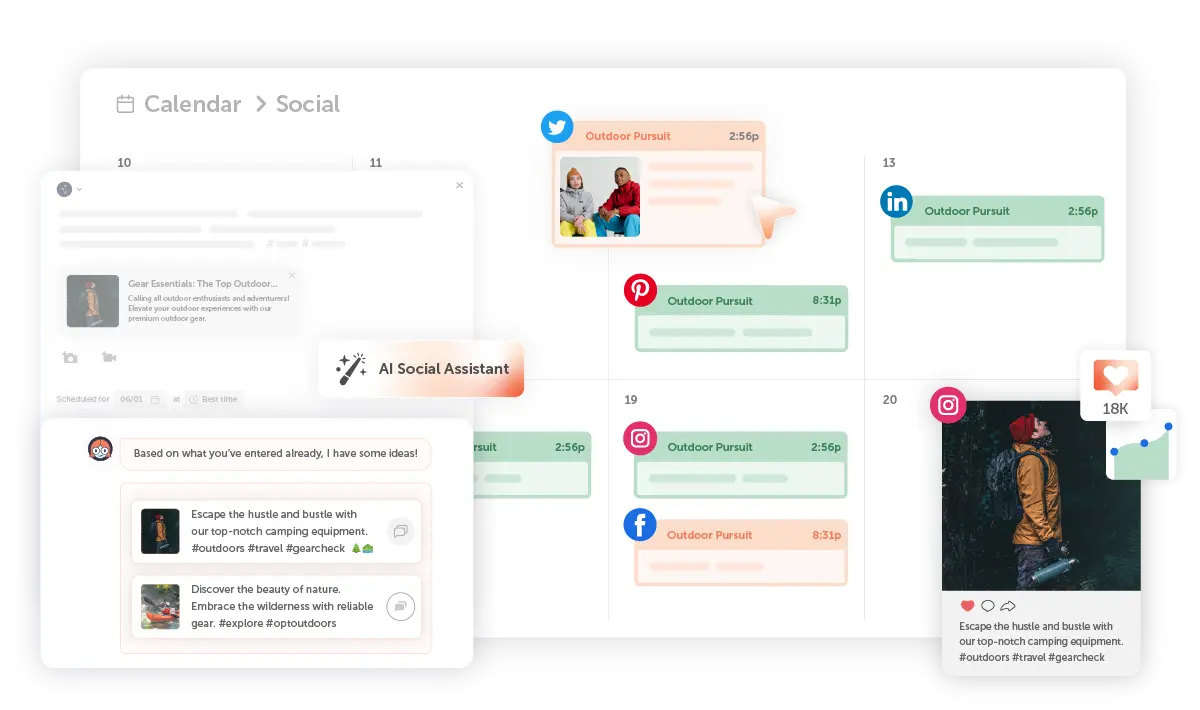
CoSchedule
Source: CoSchedule
CoSchedule serves as a social media scheduling tool with robust publishing capabilities. The social calendar enhances your visibility into your content strategy. It allows you to easily identify gaps and make necessary adjustments to ensure your content is scheduled for optimal release across various social channels.
Tap into the power of social media for business success
An active social media presence is crucial for captivating consumers in an oversaturated marketplace. It’s the platform where your brand can express a distinct personality and resonate with audiences. Utilize the recommendations provided above to embark on your social media journey or strengthen your current strategies.
Sprout simplifies the process with a platform that unifies all your social media management needs. From content creation to trend analysis and everything in between, the platform empowers brands to enhance their presence confidently. Get a tailored demo to discover how Sprout’s extensive features can elevate your strategies.
The post The complete guide to using social media for business appeared first on Sprout Social.

Recent Comments