
Most organizations use email marketing automation, but does your campaign have the right triggers for your marketing funnel and customer journeys? Are there additional automations that could drive more leads, revenue or conversions for your business?
Here’s a blueprint to help you answer those questions — whether you’re optimizing existing automated journeys or setting up your first triggered series.
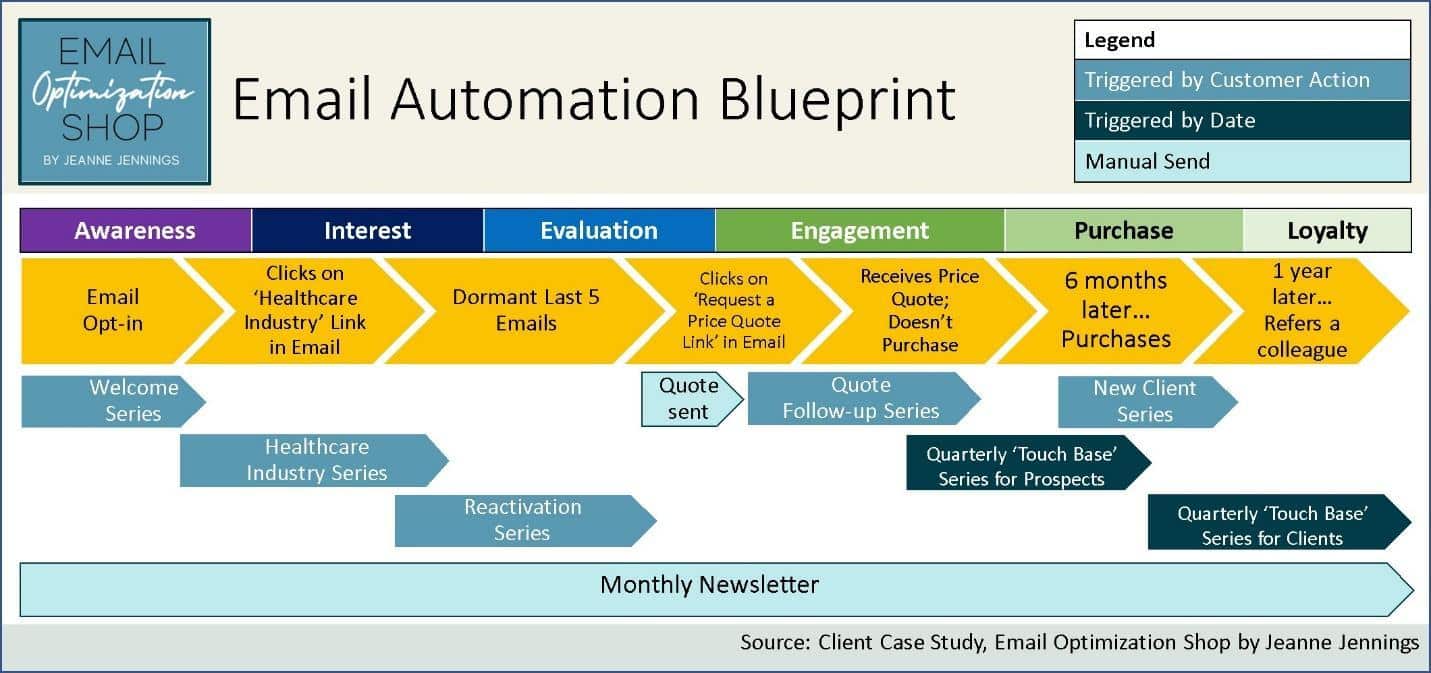
Effective automation starts with a plan. You begin with a simple framework, implement it and then build on it for greater impact.
Dig deeper: Email automation tools for the savvy marketer
Start with your marketing funnel
I still find foundational tools like a marketing funnel are a great starting point for any campaign. This is a pretty traditional B2B marketing funnel. Here’s how you’re probably used to seeing it:
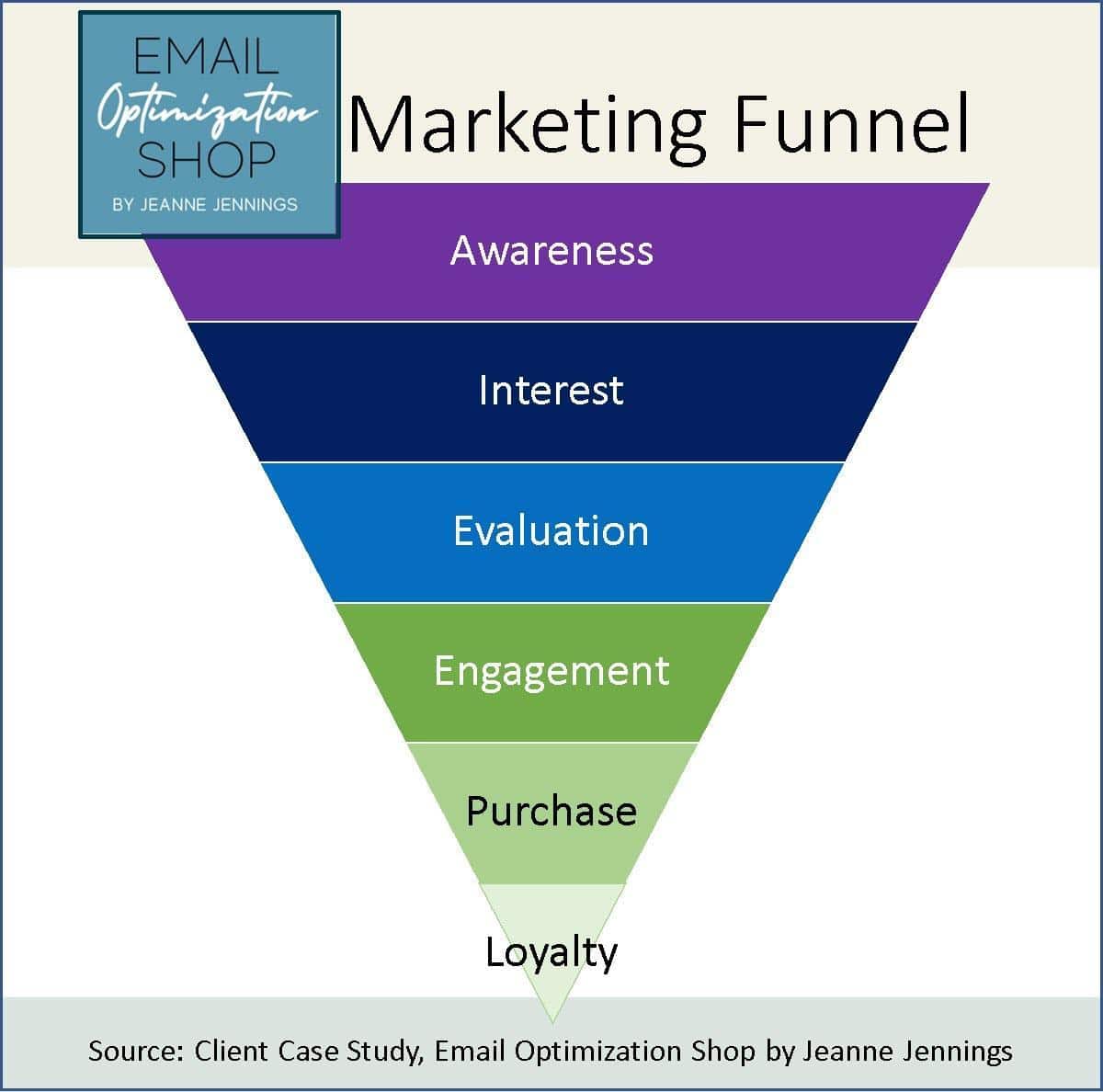
Instead of the usual inverted pyramid, our plan has the funnel stages from left to right at the top of the diagram. The colors in the blueprint match the colors in the inverted pyramid.
These stages help us define the journey as we build the blueprint. When it’s time to implement, the marketing funnel stage will also influence each email series’s message map and content. That’s because prospects at the top of the funnel (awareness and interest stages) have different information needs than prospects in the middle (evaluation and engagement stages).
Overlay your customer journeys
Now, it’s time to think about your customer journeys. The idea isn’t to find the one “perfect” journey but to identify some common actions during it. In the blueprint, the journey is in orange and goes left to right below the marketing funnel bar.
The blueprint’s example is a starting point for an email automation journey, not a comprehensive look. While some journeys are common across automation blueprints, there’s no one-size-fits-all approach.
Dig deeper: 7 creative email automations for non-ecommerce brands
Add in your email program
Our blueprint is focused on email, but it could just as easily be a multi-channel automation, taking into account app notifications, SMS, email, etc. You could even include offline channels (i.e., manual or automated) to get a full picture.
I usually work in tandem on the journey and the email program, so let’s walk through that process together.
Marketing funnel stage: Awareness
- Customer journey step: Email opt-in.
- Email program: Welcome series.
You could argue that an email opt-in is late in the awareness stage or early in the interest stage. That’s fine. It doesn’t change the rest. The email opt-in triggers a welcome series.
Notice I said welcome series, not welcome email. In this case, the client is B2B and their product is more complicated than buying a dress from a retailer. A welcome series lets us introduce and educate about the features, benefits and advantages of our solution.
Marketing funnel stage: Interest
- Customer journey step: Clicks on “healthcare industry” link in email.
- Email program: Healthcare industry series.
You can also design your welcome series to collect additional information on prospects.
In this example, the client clicked on a link about solutions for the healthcare industry, which triggers an email series about how this company services the healthcare industry.
Will we halt the welcome series once the prospect is in the healthcare industry series? Sometimes — it depends on how similar or different the content is.
Marketing funnel stage: Interest/evaluation
- Customer journey step: Dormant last five emails.
- Email program: Reactivation campaign.
Lack of action can also trigger an automated series. Like, when the prospect doesn’t open or click on (i.e., engage with) five emails in a row, they begin to receive a reactivation campaign. We usually halt any other automated series, although they still receive manual sends.
Marketing funnel stage: Evaluation/engagement
- Customer journey step: Clicks on “Request a price quote” link in email.
- Email program: Quote sent.
This is a manual send because it involves custom content and speaking to a sales rep. Could this be automated? Yes, in some cases, it could be.
Marketing funnel stage: Evaluation/engagement
- Customer journey step: Clicks on “Request a price quote” link in email.
- Email program: Quote follow-up series.
Once the quote is sent, the quote follow-up series is triggered. These are usually personalized to look like they are from the sales rep. Automation allows us to provide consistent follow-ups to all prospects, save sales reps time and optimize the series.
Marketing funnel stage: Engagement
- Customer journey step: Receives price quote; doesn’t purchase.
- Email program: Quarterly “touch base” series for prospects.
You can’t win them all. But that doesn’t mean you stop communicating with the prospect. In this blueprint, not buying after receiving a quote shifts the prospect into a quarterly “touch base” series.
This series is also personalized to appear as if it’s coming from a sales rep. Each email delivers value without requiring a purchase, encouraging recipients to engage. Every message includes a call to action to schedule a conversation and a reminder of the solution’s benefits, helping keep the brand top of mind.
Marketing funnel stage: Purchase
- Customer journey step: Six months later… purchases.
- Email program: New customer series.
You can’t win them all right away. Often, by keeping in touch with prospects, you can get the sale later.
Once the client has signed, the new client series is triggered. They get information to help them set up the solution and get up to speed quickly so they can begin recognizing value right away. This doesn’t take the place of live support, but it anticipates and answers many common questions, saving the support team time and giving them a resource to direct customers to for more detail.
Marketing funnel stage: Loyalty
- Customer journey step: Six months later… purchases.
- Email program: Quarterly “touch base’ series for customers.
Similar to the quarterly “touch base” series for prospects, this series is geared toward customers. It’s a quick check-in to see if everything is going well. It’s also an opportunity to ask for testimonials and referrals. Oh, and there’s always content that provides value without a purchase to get the open.
Marketing funnel stage: All
- Customer journey step: All.
- Email program: Monthly newsletter.
Though not automated, the monthly newsletter is a vital part of the email program. Even if a subscriber doesn’t trigger any automated communications, they will still receive this manual send — ensuring no one falls through the cracks.
Now it’s your turn
If you haven’t approached automation this way, now’s the time to start! Try it out and see how it improves your email strategy.
Dig deeper: How data-driven email nurturing transforms the B2B sales funnel
The post An email automation blueprint for smarter customer journeys appeared first on MarTech.
# A Comprehensive Guide to Email Automation for Optimizing Customer Journeys
In today’s fast-paced digital world, businesses must engage with customers in a personalized and timely manner. Email automation has become a powerful tool for optimizing customer journeys, allowing businesses to nurture leads, enhance customer experiences, and drive conversions efficiently. This guide will explore the fundamentals of email automation, its benefits, key strategies, and best practices for maximizing its impact.
## **What is Email Automation?**
Email automation is the process of sending targeted emails to customers and prospects based on predefined triggers, behaviors, or time intervals. Unlike manual email campaigns, automated emails are triggered by specific actions, such as signing up for a newsletter, making a purchase, or abandoning a cart.
By leveraging email automation, businesses can create personalized experiences, improve engagement, and nurture leads through different stages of the customer journey.
## **Benefits of Email Automation**
Implementing email automation offers several advantages, including:
### **1. Increased Efficiency**
Automated emails save time by eliminating the need for manual follow-ups. Once set up, they run in the background, ensuring timely communication with customers.
### **2. Personalization at Scale**
Email automation allows businesses to send personalized messages based on user behavior, preferences, and demographics, leading to higher engagement and conversions.
### **3. Improved Customer Engagement**
By delivering relevant content at the right time, automated emails keep customers engaged, strengthening relationships and brand loyalty.
### **4. Higher Conversion Rates**
Targeted email sequences guide customers through the sales funnel, increasing the likelihood of conversions and repeat purchases.
### **5. Better Data Insights**
Email automation tools provide valuable analytics, helping businesses track open rates, click-through rates, and customer behaviors to refine their strategies.
## **Key Email Automation Strategies for Optimizing Customer Journeys**
To maximize the impact of email automation, businesses must implement strategic workflows tailored to different stages of the customer journey. Here are some essential email automation strategies:
### **1. Welcome Email Series**
A welcome email series is the first interaction a subscriber has with your brand. It sets the tone for future communication and engagement.
**Best Practices:**
– Send a warm and friendly welcome message.
– Introduce your brand, products, or services.
– Offer a special discount or incentive for new subscribers.
– Provide clear next steps, such as exploring your website or following you on social media.
### **2. Lead Nurturing Emails**
Lead nurturing emails help guide potential customers through the decision-making process by providing valuable content and building trust.
**Best Practices:**
– Segment leads based on interests and behaviors.
– Share educational content, case studies, and testimonials.
– Address common pain points and offer solutions.
– Include clear calls-to-action (CTAs) to encourage engagement.
### **3. Abandoned Cart Emails**
Cart abandonment is a common challenge for eCommerce businesses. Automated abandoned cart emails remind customers of their pending purchases and encourage them to complete the transaction.
**Best Practices:**
– Send a reminder email within a few hours of abandonment.
– Highlight the products left in the cart.
– Offer a limited-time discount or free shipping incentive.
– Include a direct link to the cart for easy checkout.
### **4. Post-Purchase Follow-Up Emails**
After a customer makes a purchase, follow-up emails can enhance their experience and encourage repeat business.
**Best Practices:**
– Send an order confirmation and shipping update.
– Provide product usage tips or tutorials.
– Request feedback or reviews.
– Offer personalized product recommendations.
### **5. Re-Engagement Emails**
Inactive subscribers can be re-engaged with targeted email campaigns designed to reignite their interest.
**Best Practices:**
– Identify inactive subscribers and segment them.
– Offer exclusive discounts or incentives.
– Share new product updates or content.
– Ask for feedback on why they disengaged.
### **6. Birthday and Anniversary Emails**
Celebrating customer milestones, such as birthdays or anniversaries, fosters a sense of connection and appreciation.
**Best Practices:**
– Send personalized birthday or anniversary greetings.
– Offer special discounts or gifts.
– Make the email visually appealing and celebratory.
## **Best Practices for Effective Email Automation**
To ensure the success of your email automation campaigns, follow these best practices:
### **1. Segment Your Audience**
Segmentation allows you to send relevant emails to different customer groups based on demographics, behavior, and preferences.
### **2. Personalize Your Emails**
Use dynamic content and personalization tokens (e.g., first name, past purchases) to make emails feel tailored to each recipient.
### **3. Optimize Email Timing and Frequency**
Test different sending times and frequencies to determine what

Recent Comments