


Fact. Inflation fundamentally reshaped the relationship between companies and consumers.
Companies, faced with rising costs, responded with price hikes, product shrinkage and similar tactics, eroding consumer trust.
In response, consumers became more discerning, demanding value and authenticity. This new era of skeptical consumers requires a radical shift in marketing strategy. Marketers must adapt to a world where survival requires a deep understanding of consumer needs; innovation; and a relentless focus on delivering value.
Listen, learn, respond
Last year, there were several incidents where large groups of consumers used social media to complain about brand problems.
For example, Chipotle’s customers used social media to complain about inconsistencies in portion sizes. Their videos amplified the issue and news outlets began reporting on it. Chipotle’s experience, four years ago with a food-poisoning crisis, almost certainly showed the company how to respond. Instead of a press release or polished ad, Chipotle used social media to convey its promise of the larger portions consumers expected. This went a long way toward earning back customer trust.
While only some companies face such a public reckoning as Chipotle, many acknowledge the shifting landscape and adapt their strategies accordingly.
For instance:
- Domino’s CEO pointed out a preference for pickup over delivery due to high delivery costs.
- Whirlpool is trying to come to terms with a decline in appliance upgrades focusing on base functionality or keeping old appliances rather than upgrading.
- Frito-Lay is noticing and adjusting to the fact that customers are no longer buying as many $6 chips.
Kudos to these companies for being honest with themselves and their customers, sharing the truth and defining plans to adapt.
The end of traditional marketing
The marketer I once was, steeped in the confidence of proven strategies and systematic planning, is grappling with a new reality. I entered the workforce as the digital age took hold, witnessing the rapid transformation of marketing strategies and careers. In my career, I have mastered the art of crafting compelling narratives, building brands and driving sales in an era dominated by mass media.
The rapid evolution of the digital landscape undeniably disrupted traditional marketing paradigms. What once were reliable strategies and career paths now feel uncertain. The once-promised stability of the marketing world is now a climate of constant adaptation and reinvention. It’s a challenging reality that many marketers are grappling with.
I recently talked with David Teicher, director of community and content at Brand Innovators. David has extensive experience engaging with thousands of brand marketers.
He said, “Some of the most consistent feedback I get from marketers in this industry is around this senior director/vice president level sweet spot, where people have had what they say is a very clear trajectory that’s led them to this point. And then all of a sudden boom, they hit a wall and that path they’ve been on disappears in front of them.”
The pandemic and subsequent economic challenges forced many companies to focus on short-term survival rather than long-term growth. As a result, marketing roles emphasizing strategic planning are being reduced or eliminated.
These days, marketing has shifted from a discipline based in understanding root causes and addressing underlying consumer needs to a world dominated by quick fixes and tactical maneuvers — often out of necessity.
While marketers aren’t solely responsible for the broader economic challenges, we can contribute to solutions.
A new era of marketing
Teicher’s observations resonate with Carlos Gil’s experience. From pioneering digital strategies at larger companies to building a successful entrepreneurial venture, Gil is a go-getter who never sat on the sidelines. His career has been marked by innovation and resilience. However, in this tough economy, marketing spend is at all-time lows. Apparently, Gil was having trouble making ends meet.
Like many, he faced the difficult decision to refocus his entrepreneurial aspirations and explore more traditional roles. This marked a moment of profound vulnerability, which he courageously shared on LinkedIn and other social platforms.
Gil openly discussed his job search and what he wanted and needed and he was open and honest about his struggle to find work as a highly competent 40-something. He leveraged his strong network and the community he built over many years. He transformed a challenging situation into an opportunity for connection and growth.
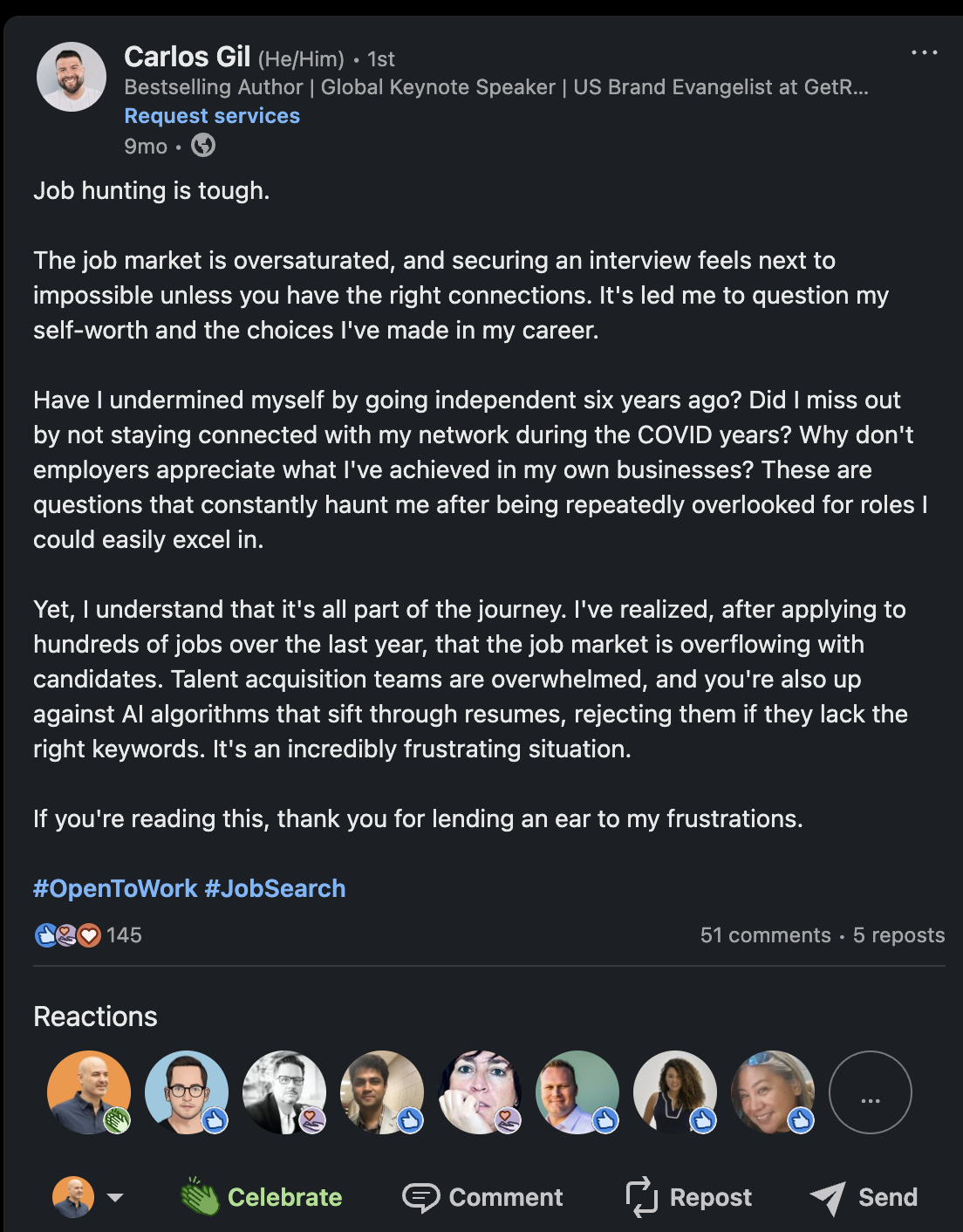
This led him to GetResponse, a Polish email marketing company seeking a marketing leader who could represent the brand as a local face in the United States, form strategic partnerships and drive awareness through public speaking and industry events.
Based on an introduction from a trusted friend and colleague in his community, Gil bypassed the typical application process and got directly in front of the hiring team at GetResponse.
GetResponse wasn’t looking for a “cookie-cutter” marketing professional but someone with a unique blend of corporate and entrepreneurial experience. They recognized Gil’s ability to represent the brand authentically. Gil’s authentic self was a perfect fit and he was hired. In return, GetResponse gained an experienced, versatile marketer capable of driving results and elevating the brand through content and community rather than ads and broadcasting messages.
Gil’s journey is a powerful example of the human-centric approach to leadership and the enduring power of genuine connections. It also underscores a broader shift in the marketing landscape.
Dig deeper: Why community could be the next big thing in marketing
Reclaiming relevance
The future belongs to companies and individuals who can deeply understand and serve specific communities rather than trying to be all things to everyone. Big generalist companies need more focus, authenticity and community connection to resonate in the modern media landscape.
Both traditional media and legacy brands stumbled initially on social platforms, adopting a one-size-fits-all “broadcast” approach. Relying on pre-scheduled content and a top-down communication style, they prioritized reach over engagement, neglecting to foster community.
This disconnect with audiences contributed to the decline of many traditional publishers– like Sports Illustrated and BuzzFeed — highlighting the inadequacy of generic content in an era craving tailored experiences and authentic relationships.
The once-popular notion of “brands as publishers” ultimately fell short, as publishers themselves revealed the challenges of capturing and retaining an audience without meaningful interaction.
Rather than acquiring vast, impersonal audiences, brands should cultivate authentic communities built on mutual respect and value exchange. The term “target audience” is often used in marketing circles to objectify consumers, reducing them to mere demographics. In contrast, fostering deep connections with like-minded individuals creates enduring brand loyalty that surpasses fleeting trends.
By prioritizing genuine engagement over superficial metrics, brands can cultivate thriving communities that feel organic and rewarding for all involved.
The singular focus on short-term gains and customer acquisition in the “performance marketing” era is alienating consumers. Feeling manipulated and undervalued, people are increasingly vocal about their brand preferences. No, I am not interested in another trial for a meal kit service.
Customers reward those who deliver real value and reject those who don’t. The era of one-way, intrusive marketing is over. In essence, the decline of performance marketing is creating a space for companies with a strong sense of deep purpose to thrive. By focusing on long-term value, building authentic relationships and understanding customer needs, these companies can survive and flourish in the new era of consumer-driven marketing. This concept is discussed in Harvard Professor Ranjay Gulati’s book, “Deep Purpose.”
Marketers: Adapt, build, thrive
The marketing landscape is shifting rapidly. What worked yesterday might not work today. To succeed, you need to be flexible and willing to change. Gone are the days of relying on a single job or career path. Building a successful career now often means taking on multiple projects or roles. It’s about creating a diverse income stream and being open to new opportunities.
Don’t be afraid to step outside your comfort zone. Learn new skills, explore different areas of marketing, and network with people in your industry. Continuous learning is essential.
Remember, change can be challenging, but it’s also an opportunity for growth. By embracing adaptability and a willingness to explore new avenues, you can position yourself for long-term success. Persistence, integrity and determination are essential for navigating today’s complex world. True success is not merely measured by metrics but by the depth of human connection, the courage to pursue one’s passions and the fulfillment of one’s potential.
The post Marketers must adapt to a changing world appeared first on MarTech.
**Adapting Marketing Strategies to Evolving Global Trends**
In the dynamic world of marketing, staying ahead of global trends is not just advantageous—it’s essential. As the landscape continues to evolve, businesses must adapt their marketing strategies to remain competitive and relevant. This article explores key global trends impacting marketing and offers insights into how businesses can effectively adapt.
### The Rise of Digital and Mobile Marketing
One of the most significant shifts in recent years is the move towards digital and mobile marketing. With the proliferation of smartphones and the internet, consumers are increasingly engaging with brands online. This trend necessitates a robust digital presence. Companies must invest in creating responsive websites, engaging social media content, and mobile-friendly applications to capture the attention of tech-savvy consumers.
**Adapting Strategy**: Businesses should focus on creating personalized digital experiences. Utilizing data analytics to understand consumer behavior can help tailor marketing efforts to meet the specific needs and preferences of their audience. Additionally, leveraging social media platforms for targeted advertising and influencer partnerships can enhance brand visibility and engagement.
### Sustainability and Ethical Marketing
As awareness of environmental issues grows, consumers are becoming more conscientious about their purchasing decisions. There is a rising demand for sustainable and ethically produced products. Brands that demonstrate a commitment to sustainability not only attract environmentally conscious consumers but also build trust and loyalty.
**Adapting Strategy**: Companies should integrate sustainability into their core values and marketing messages. This can involve adopting eco-friendly practices, using sustainable materials, and transparently communicating these efforts to consumers. Marketing campaigns that highlight a brand’s commitment to social and environmental responsibility can resonate deeply with today’s consumers.
### The Importance of Cultural Sensitivity
In an increasingly globalized world, cultural sensitivity in marketing is more important than ever. Brands that fail to consider cultural nuances risk alienating potential customers or sparking backlash. Understanding and respecting cultural differences can enhance brand reputation and foster positive relationships with diverse audiences.
**Adapting Strategy**: Businesses should conduct thorough market research to understand the cultural contexts of their target markets. This includes local customs, values, and language preferences. Collaborating with local influencers or agencies can provide valuable insights and help tailor marketing messages that resonate with specific cultural groups.
### The Shift Towards Experiential Marketing
Consumers today seek more than just products; they crave experiences. Experiential marketing, which focuses on creating memorable and immersive brand experiences, is gaining traction. This trend emphasizes the importance of engaging consumers on an emotional level and fostering a deeper connection with the brand.
**Adapting Strategy**: Brands can create experiential marketing campaigns by hosting events, pop-up shops, or interactive online experiences. These initiatives should aim to engage consumers’ senses and emotions, leaving a lasting impression. Utilizing virtual and augmented reality technologies can also enhance experiential marketing efforts, providing innovative ways for consumers to interact with brands.
### Data Privacy and Ethical Use of Consumer Data
With the increasing use of data in marketing, concerns about privacy and data protection have come to the forefront. Consumers are becoming more aware of how their data is used and are demanding greater transparency and control. Brands that prioritize data privacy can build trust and differentiate themselves in a crowded marketplace.
**Adapting Strategy**: Businesses should adopt transparent data practices, clearly communicating how consumer data is collected, used, and protected. Implementing robust data security measures and obtaining explicit consent for data collection can help build consumer trust. Additionally, offering personalized experiences without compromising privacy can enhance customer satisfaction and loyalty.
### Conclusion
Adapting marketing strategies to evolving global trends is crucial for businesses aiming to thrive in today’s competitive environment. By embracing digital transformation, prioritizing sustainability, respecting cultural diversity, creating memorable experiences, and safeguarding consumer data, brands can position themselves for success. As global trends continue to evolve, staying informed and agile will be key to navigating the ever-changing marketing landscape.

Recent Comments