

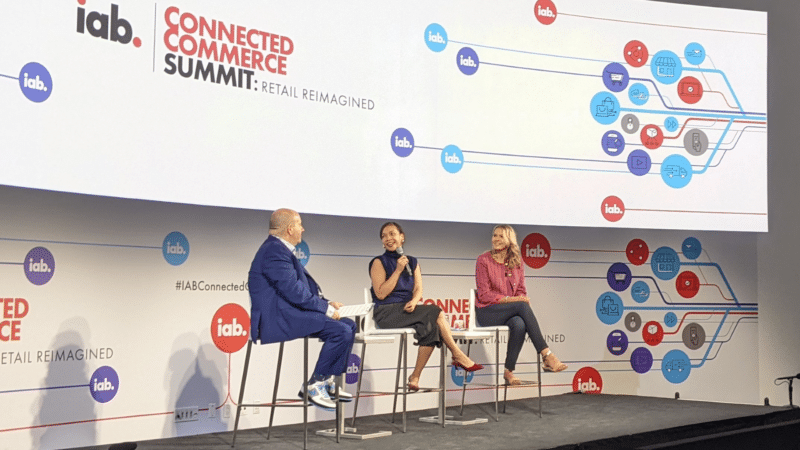
Retail media networks (RMNs) are getting new in-store definitions and standards to help reach customers where they are, and where they shop.
At IAB’s Connected Commerce Summit: Retail Reimagined in New York this week, brands, retailers and tech partners met to discuss the evolution of RMNs, an evolution that is clearly taking place.
“With the integration of advanced analytics, AI and most importantly, the importance of personalized consumer experiences, brands are increasingly leveraging these strategies at every touchpoint from initial awareness to final purchase, making retail media indispensable,” said Jeffrey Bustos, IAB’s VP, measurement addressability data, in a keynote.
IAB unveiled “In-store Retail Media Definitions and Measurement Standards,” a new tool for RMN standardization, at the summit. Last year, IAB introduced RMN guidelines in collaboration with the Media Rating Council. With a report earlier this year, IAB placed further emphasis on the opportunity for RMNs to drive sales in-store.
Dig deeper: How in-store technology will bolster retail media networks
Why we care. The potential for reaching customers through RMNs is real, which is why there’s so much interest in them. Without common standards, each network remains its own walled garden. This makes it challenging for advertisers and agencies to increase the scale and spend on multiple RMNs at one time. If they could, ad spend would likely increase much more.
In-store and omnichannel. Consumer behavior is driving both the advertiser benefits of RMN campaigns and the renewed focus of RMNs on improving in-store experience. Agencies and brands are taking note of customers’ continued interest in visiting brick-and-mortar stores and making purchases there.
These in-store experiences, however, aren’t just offline refuges — they’re part of an omnichannel journey. They are connected, through mobile and other digital channels, with the customer journey, which begins long before the customer enters the store.
Dig deeper: How brands are taking the AI plunge and testing customer experiences
“I think post-pandemic, retail is incredibly omnichannel now,” said Jacquelyn Baker, Global CEO Omnicom Commerce Group. “It was omnichannel before, but ultimately I’m surprised, coming out of pandemic — I knew expectations would accelerate, but I was surprised how much in-store experience didn’t diminish and came back. There’s stickiness to the total experience in the world we’re living in now. Consumers go from physical to digital and physical and back again. It’s interesting that the pendulum didn’t shift in one direction or the other.”
“On one hand everything has changed — consumers changed how they shop, consume content and the type of content they consume,” said Kaisy O’Reilly, SVP, Chief Marketing Officer for shoe designer Stuart Weitzman. “Suddenly consumers spent a lot more time on their mobile phones (after the pandemic began). It’s more difficult for a brand builder…in a world of distractions and dopamine hits, especially for a luxury brand. Nothing has changed for the role of marketers. It remains important that we root ourselves in how people feel when they experience our brands.”
In this always-on omnichannel environment, It’s easier for consumers to jump in and out of the purchase funnel, so it’s important for brands to always be entertaining and helpful when they have a customer’s attention, O’Reilly explained.
Better service for advertisers. Advertisers need to be given the tools to execute successful RMN campaigns. CVS Media Exchange adopted IAB guidelines as it continues to evolve its network and in-store experiences. This year, CVS partnered with The Trade Desk to make self-service campaigning available to advertisers. CVS is also adding video screens to many of its over 9,000 U.S. locations.
“By introducing self-service, we’re empowering advertisers with the tools they need and bringing democratization to retail media,” said Melissa Gallo, head of operations for CVS Media Exchange.
Gallo added that to meet advertiser demands, CVS is working on delivering closed loop measurement and other reportings and dashboards to advertisers.
“Being able to measure and report out on retailer data has been historically held pretty close to the chest,” Gallo said. Customer health data at CVS comes with more regulations than, for instance, purchases at a grocery store, adding further restrictions to data collaborations.
Better measurement out of RMNs and across multiple RMNs will encourage brands to advertise more, especially brands that are already ramping up RMN advertising.
“I feel like for the most part we’ve really leaned into RMNs as a company,” said Pankita Desai, senior director, shopper marketing for Chobani. “We started with testing, however for us there’s a shift in the way we’re approaching RMNs and our budget. We have a really high budget from shopper marketing and less with brand marketing.”
Better reporting, especially on incrementality and effectiveness of ads, would help brand marketing make a case for spending across the full RMN ecosystem, Desai said. That’s why Chobani’s shopper marketing team, with its emphasis on low-funnel advertising, is more active in RMNs for the time being.
Risks to alienating consumers. Those advertisers delivering commerce ads to consumers might be overconfident in the effectiveness of ads, video especially. And there’s a risk in alienating customers, a study by IAB and market research consultancy Alter Agents found.
Nearly all (96%) of 300 marketers surveyed said they found commerce video ads effective at driving purchases. Meanwhile, 71% of the 1,000 consumers surveyed said they feel annoyed or negative toward commerce video ads on a monthly basis. And one-third said they get annoyed weekly by these ads.
Marketers need better alignment with consumer expectations when using RMNs for advertising. First, if they haven’t already, advertisers need to broaden the focus of RMN campaigns on the entire journey, not just on the low part of the funnel.
The study recommended better alignment in these areas of strategy:
- Messaging across the consumer purchase journey.
- Considerations of the consumer mood/mindset.
- Media activation, including length and frequency.
- Leveraging creator-produced content.
In-store definitions and standards. “In-store Retail Media Definitions and Measurement Standards” was released this week by IAB, in a joint initiative with IAB Europe.
The document, open for public comment until Nov. 1, 2024, includes:
- Definitions: Clear terminology for in-store digital retail media components.
- Formats: Recommended formats for in-store advertising placements.
- Store zones: Standardized classification of key areas within stores where media can be deployed (e.g., entry, checkout, aisle).
- Measurement: Guidelines for tracking, reporting, and analyzing campaign performance across various in-store formats.
“We’re hopeful that a focus on continued dialogue and best practices creates a media ecosystem that’s transparent and sustainable for all,” said Bustos.
The post Retail media networks evolve with new in-store measurement standards and omnichannel strategies appeared first on MarTech.
# Advancements in Retail Media Networks: Introduction of In-Store Measurement Standards and Omnichannel Strategies
## Introduction
The retail landscape has undergone a significant transformation in recent years, driven by the rapid adoption of digital technologies, shifting consumer behaviors, and the rise of e-commerce. One of the most notable advancements in this space is the emergence of **Retail Media Networks (RMNs)**, which allow retailers to leverage their physical and digital assets to offer advertising opportunities to brands. These networks have become a crucial part of the marketing ecosystem, enabling brands to reach consumers at key points in their shopping journey.
As RMNs continue to evolve, two major trends are shaping their future: the **introduction of in-store measurement standards** and the development of **omnichannel strategies**. These advancements are helping retailers and brands better understand consumer behavior, optimize marketing efforts, and create seamless shopping experiences across multiple touchpoints.
## The Rise of Retail Media Networks
Retail Media Networks are platforms that enable retailers to monetize their first-party data and digital properties by offering advertising opportunities to brands. These networks typically include a combination of **on-site** (e.g., retailer websites and apps), **off-site** (e.g., social media and programmatic advertising), and **in-store** (e.g., digital signage and point-of-sale displays) advertising options.
Retailers such as **Amazon, Walmart, Target, and Kroger** have been at the forefront of building RMNs, offering brands the ability to target consumers based on their shopping behaviors, preferences, and purchase history. By leveraging first-party data, RMNs provide advertisers with a highly targeted and relevant audience, leading to improved return on ad spend (ROAS) and more effective marketing campaigns.
However, as RMNs expand beyond digital channels and into physical stores, the need for standardized measurement and omnichannel strategies has become more pressing.
## Introduction of In-Store Measurement Standards
While digital advertising has long benefited from robust measurement tools and analytics, in-store advertising has historically lacked the same level of precision. This gap has made it difficult for brands to measure the effectiveness of in-store campaigns and understand how they contribute to overall sales and brand awareness.
To address this challenge, the retail industry is moving toward the **introduction of in-store measurement standards**. These standards aim to provide a consistent framework for measuring the impact of in-store advertising, similar to the metrics used in digital advertising. Key components of these standards include:
1. **Foot Traffic Measurement**: Retailers are increasingly using technologies such as **Wi-Fi tracking, Bluetooth beacons, and computer vision** to measure foot traffic and understand how many consumers are exposed to in-store ads. This data can help brands gauge the reach of their campaigns and assess the effectiveness of different ad placements.
2. **Dwell Time and Engagement**: In addition to measuring foot traffic, retailers are also tracking how long consumers spend interacting with in-store displays and advertisements. This metric, known as **dwell time**, provides insights into consumer engagement and can help brands optimize their messaging and creative assets.
3. **Sales Attribution**: One of the most critical aspects of in-store measurement is understanding how advertising influences purchase behavior. By integrating point-of-sale (POS) data with in-store advertising metrics, retailers can provide brands with a clearer picture of how their campaigns drive sales. This level of attribution is essential for justifying ad spend and optimizing future campaigns.
4. **Cross-Channel Integration**: As part of the push for in-store measurement standards, retailers are also working to integrate in-store data with digital advertising metrics. This integration allows brands to track the entire customer journey, from online research to in-store purchase, providing a more holistic view of campaign performance.
The introduction of these measurement standards represents a significant step forward for RMNs, enabling brands to make data-driven decisions and optimize their in-store advertising efforts.
## The Shift Toward Omnichannel Strategies
In today’s retail environment, consumers no longer shop exclusively in-store or online. Instead, they move fluidly between channels, researching products online, visiting physical stores to see items in person, and making purchases through a variety of platforms. As a result, retailers and brands must adopt **omnichannel strategies** that provide a seamless and consistent experience across all touchpoints.
Retail Media Networks are playing a key role in enabling these omnichannel strategies by offering brands the ability to reach consumers across both digital and physical channels. Some of the key components of omnichannel RMN strategies include:
1. **Unified Customer Profiles**: One of the biggest challenges in omnichannel marketing is understanding the full customer journey across multiple touchpoints. RMNs are addressing this challenge by creating **unified customer profiles** that combine data from in-store interactions, online behavior, and purchase history. These profiles allow brands to deliver personalized and relevant messaging, regardless of where the consumer is in their shopping journey.
2. **Cross-Channel Campaigns**: With the rise of omnichannel

Recent Comments