


Marketing organizations make changes to their martech stacks all the time. After all, there are more than 14,000 martech applications on the market, and licenses are constantly coming up for renewal.
We all know there’s no such thing as a “typical” martech app replacement. If you work in B2B marketing, you’re well aware of the complexity of the B2B purchase process, especially in B2B tech. License renewals are one event that leads to replacing an application, but so do other changes, like new leadership, mergers and acquisitions and more.
The 2024 MarTech Replacement Survey asked marketers about the martech applications they replaced in the previous year. We can use its findings to give us some insight into what happens within marketing organizations when the decision is made to replace an application in the martech stack.
Martech replacements start with marketing management
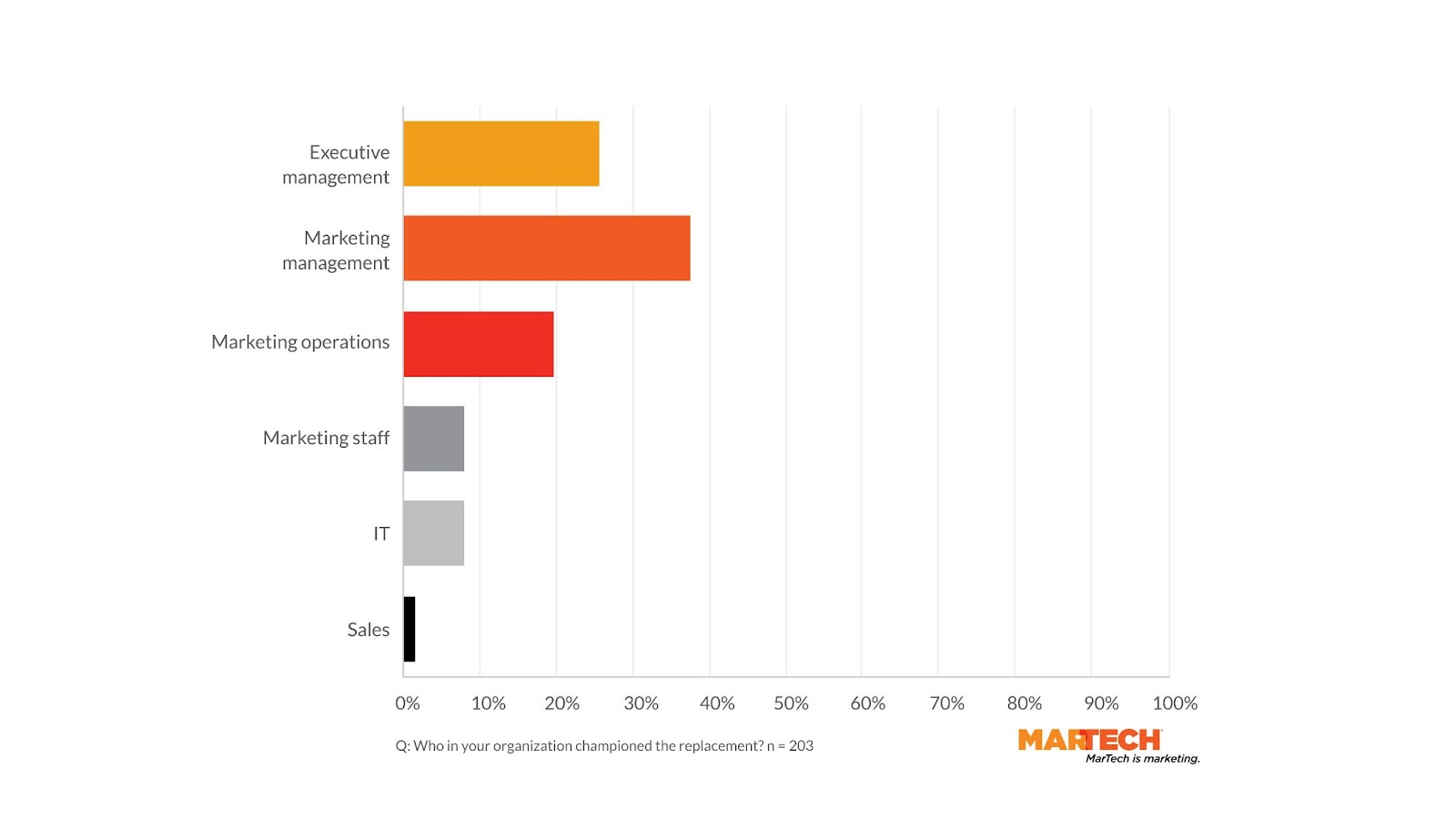
Survey respondents told us the most common champions for martech replacements were people in marketing management. The marketing managers are followed by executive management, then marketing operations. Marketing staff and IT were less likely to champion a change in martech applications.
Martech replacements appear to have a top-down motion, as opposed to a bottom-up motion, where the staff and users of the product push for a replacement. It will vary from organization to organization, of course.
Martech applications get replaced because of the features
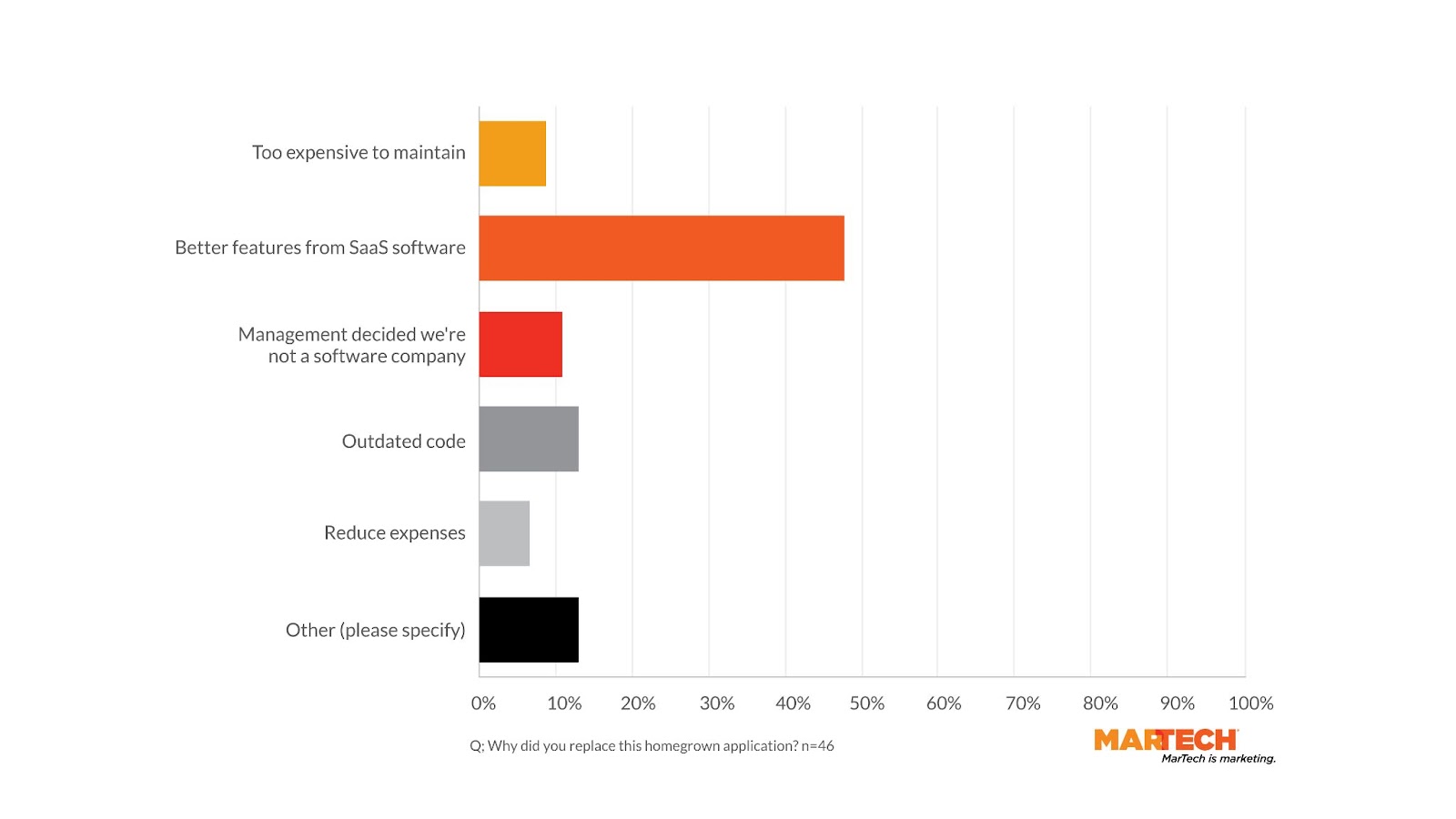
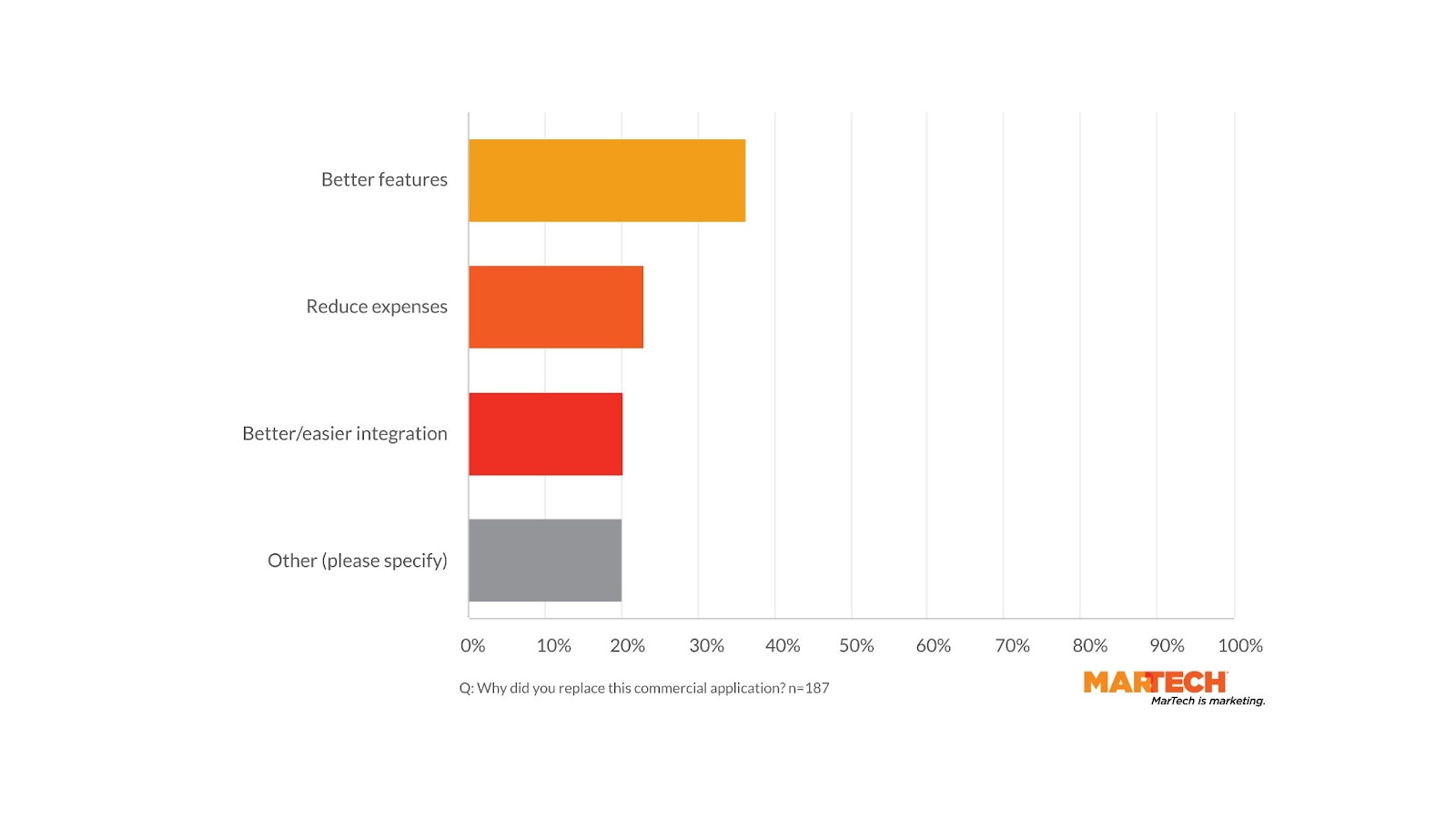
What is it that sends marketing leaders and their staffs looking for replacement to their existing martech applications? It is the features of the application, and this is true whether the application they’re looking to replace is a commercial application or a homegrown application.
In fact, the 2025 MarTech Replacement Survey found homegrown martech applications are becoming a rare breed. In 96% of the replacements respondents reported in the survey, the replacement application was a commercial application. As seen below, respondents cited a number of reasons for replacing homegrown solutions, but features were far and away the No. 1 response.
Features were the top reason to search for replacements when a commercial application was involved as well. But costs and integrations were also considerations.
Cost is the top factor when considering replacement apps
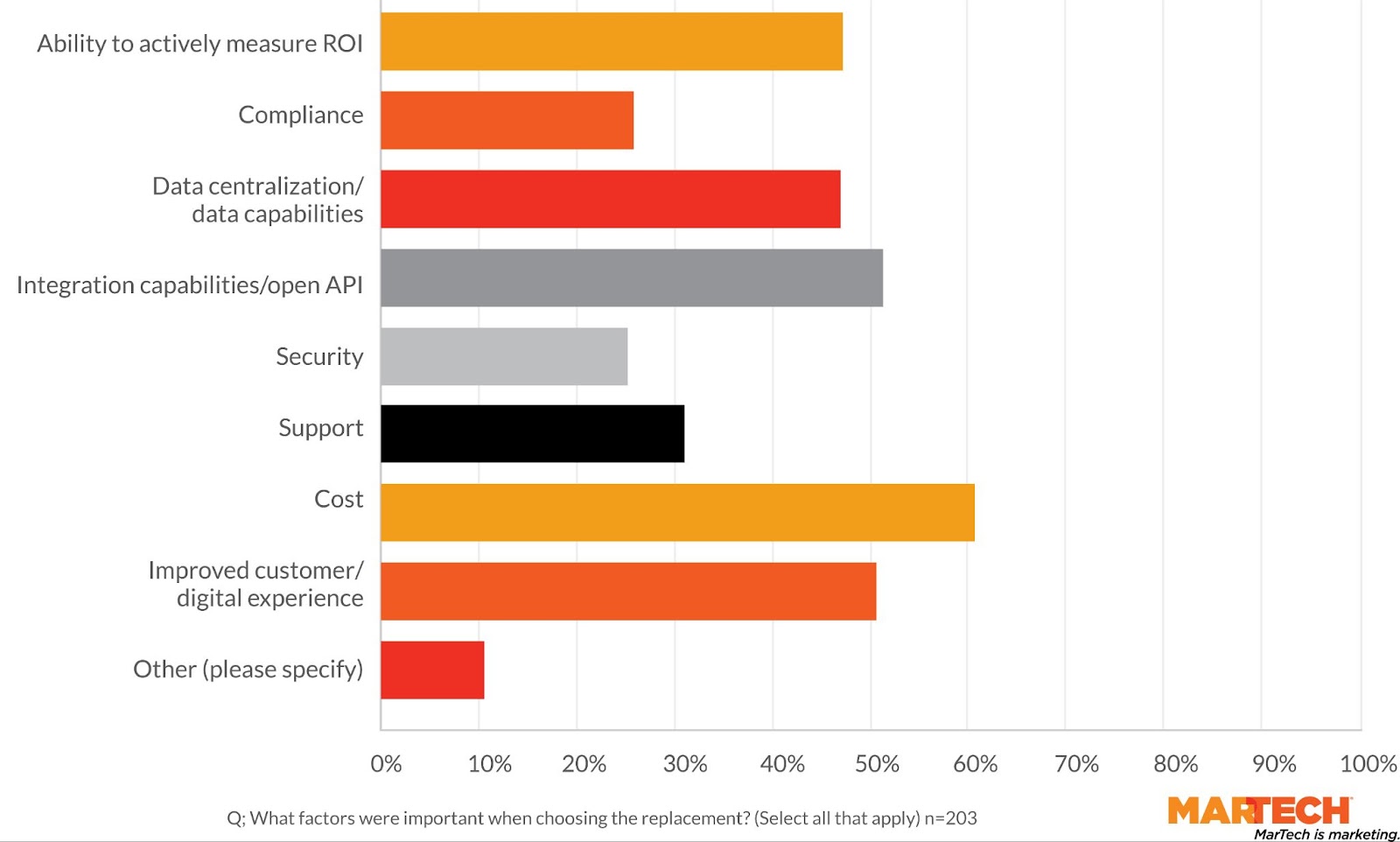
Cost was not the top reason cited by survey respondents when they were looking to replace a martech application, but when it was time to consider replacement apps, cost was the No. 1 factor for survey respondents in 2024.
We can group the most important factors for replacement applications into three categories:
- Financial, including costs and ROI measurement.
- Data, including integrations, APIs and data centralization.
- Improved customer experience.
The replacement process takes about 3 to 6 months
B2B purchase decisions are notoriously complicated. With numerous stakeholders, from the end users to their manager and roles like finance and, legal and procurement that have little relationship with the use of the product, coming to a decision can take months. And the more costly and complex the purchase, the longer it tends to take.
Fortunately for marketers, many of the martech tools available today are SaaS software products used by specific users in marketing or marketing operations.
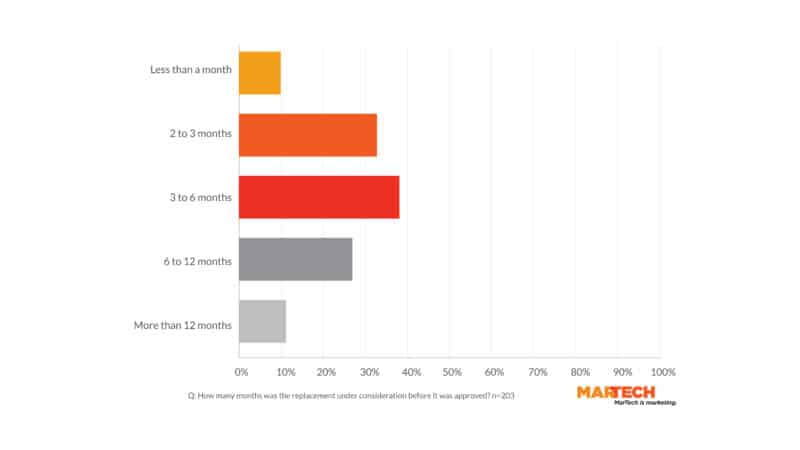
The 2024 MarTech Replacement Survey found the replacement process takes, on average, about three to six months. It’s more likely the process is completed in six months or less than it is to extend beyond six months. This is in line with previous editions of the survey, showing that the timeline is neither slowing or speeding up.
The apps get replaced, but the team remains the same
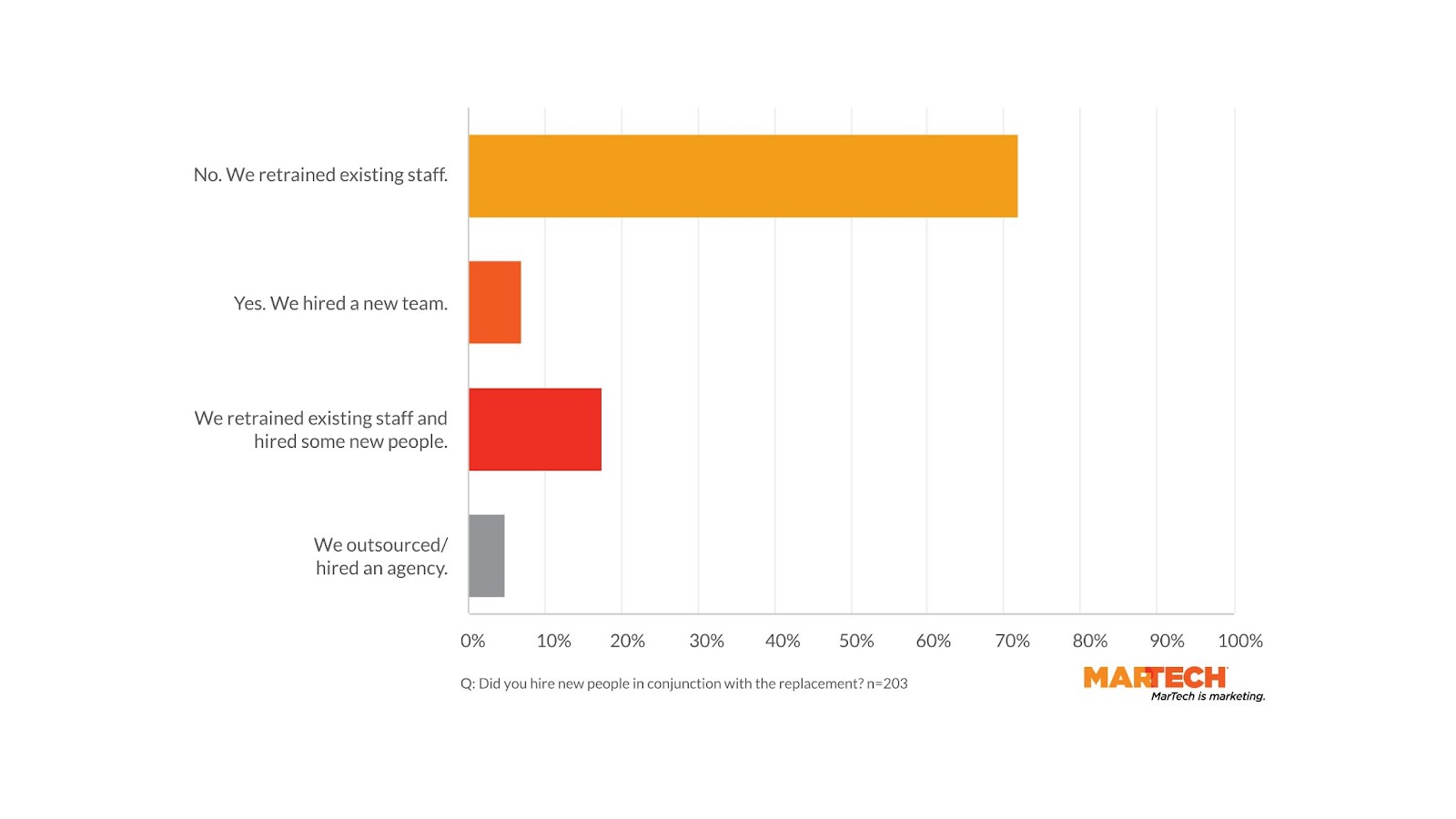
Once a purchase decision is made and the new application is ready for use, marketing teams are re-training the same staff members on the new application. The survey found it’s relatively rare for a new team to be brought in due to a martech solution replacement.
The ‘typical’ martech app replacement looks like this
This is how a martech replacement happens, according to the 2024 MarTech Replacement Survey.
- Marketing management starts the process.
- Software features are what sets the process in motion.
- Costs are the most important factor when looking at replacement applications.
- The replacement process takes about three to six months.
- The new application is used by the same team that used the old application.
Download the full report for the 2024 MarTech Replacement Survey, no registration required.
The post This is what the ‘typical’ martech replacement looks like appeared first on MarTech.
# An Overview of the Standard Martech Replacement Process
## Introduction
In today’s rapidly evolving digital landscape, marketing technology (Martech) plays a crucial role in driving business growth, enhancing customer experiences, and optimizing marketing efforts. However, as businesses grow and the marketing ecosystem becomes more complex, the need to upgrade or replace existing Martech solutions becomes inevitable. Whether it’s due to outdated systems, inefficiencies, or the need for better integration, replacing Martech is a significant undertaking that requires careful planning and execution.
This article provides an overview of the standard Martech replacement process, highlighting key steps, challenges, and best practices to ensure a smooth transition and successful implementation of new marketing technologies.
## What is Martech?
Before diving into the replacement process, it’s essential to understand what Martech encompasses. Martech refers to the suite of tools, platforms, and technologies that marketers use to plan, execute, measure, and optimize their marketing campaigns. These tools can include:
– **Customer Relationship Management (CRM) systems** (e.g., Salesforce, HubSpot)
– **Email marketing platforms** (e.g., Mailchimp, Marketo)
– **Content management systems (CMS)** (e.g., WordPress, Sitecore)
– **Marketing automation tools** (e.g., Pardot, Eloqua)
– **Analytics and reporting platforms** (e.g., Google Analytics, Tableau)
– **Social media management tools** (e.g., Hootsuite, Sprout Social)
As businesses grow, their marketing needs change, and the Martech stack must evolve to keep up with new demands. This often leads to the need for a Martech replacement process.
## Why Replace Martech?
There are several reasons why organizations may choose to replace their existing Martech solutions:
1. **Outdated Technology**: Legacy systems may no longer meet the needs of modern marketing teams, especially in terms of scalability, functionality, or integration with other tools.
2. **Inefficiencies**: Over time, marketing teams may find that their current tools are not delivering the desired results or are creating bottlenecks in workflows.
3. **Integration Issues**: As businesses adopt new tools, they may face challenges in integrating them with existing systems, leading to data silos and fragmented customer experiences.
4. **Cost**: Some Martech solutions can become too expensive to maintain, especially if they are not delivering a strong return on investment (ROI).
5. **Compliance and Security**: With increasing concerns around data privacy and security (e.g., GDPR, CCPA), businesses may need to replace tools that do not meet regulatory requirements.
6. **Customer Experience**: Enhancing customer experience is a top priority for many organizations, and outdated or inefficient Martech can hinder the ability to deliver personalized, seamless experiences.
## The Standard Martech Replacement Process
Replacing a Martech solution is a complex process that requires careful planning, stakeholder alignment, and execution. Below is an overview of the key steps involved in the standard Martech replacement process:
### 1. **Assessment and Discovery**
The first step in the Martech replacement process is to assess the current Martech stack and identify pain points, inefficiencies, and gaps. This phase involves:
– **Auditing existing tools**: Conduct a comprehensive audit of the current Martech stack to understand what tools are being used, how they are being used, and whether they are meeting business objectives.
– **Identifying challenges**: Engage with marketing, sales, IT, and other relevant teams to gather feedback on the limitations of the current tools. Common challenges may include lack of integration, poor user experience, or limited functionality.
– **Defining goals**: Clearly define the goals and objectives for the new Martech solution. This could include improving efficiency, enhancing customer experience, reducing costs, or enabling better data-driven decision-making.
– **Budget considerations**: Establish a budget for the replacement process, factoring in costs such as software licenses, implementation, training, and ongoing maintenance.
### 2. **Vendor Selection**
Once the assessment phase is complete, the next step is to select the right Martech solution(s) to replace the existing tools. This phase involves:
– **Researching vendors**: Research potential vendors that offer solutions aligned with the organization’s goals and requirements. Consider factors such as scalability, ease of use, integration capabilities, and customer support.
– **Request for Proposal (RFP)**: If necessary, issue an RFP to gather detailed information from vendors about their offerings, pricing, and implementation timelines.
– **Demo and Evaluation**: Request product demos from shortlisted vendors to evaluate the user interface, features, and overall fit with the organization’s needs. Involve key stakeholders in this process to ensure alignment.
– **Reference checks**: Reach out to existing customers of the shortlisted vendors to gather insights into their experiences with the product, including implementation challenges and ongoing support.
– **Final selection**: Based on the evaluation, select the vendor(s) that best meet the organization’s needs and budget.
### 3. **Planning

Recent Comments