
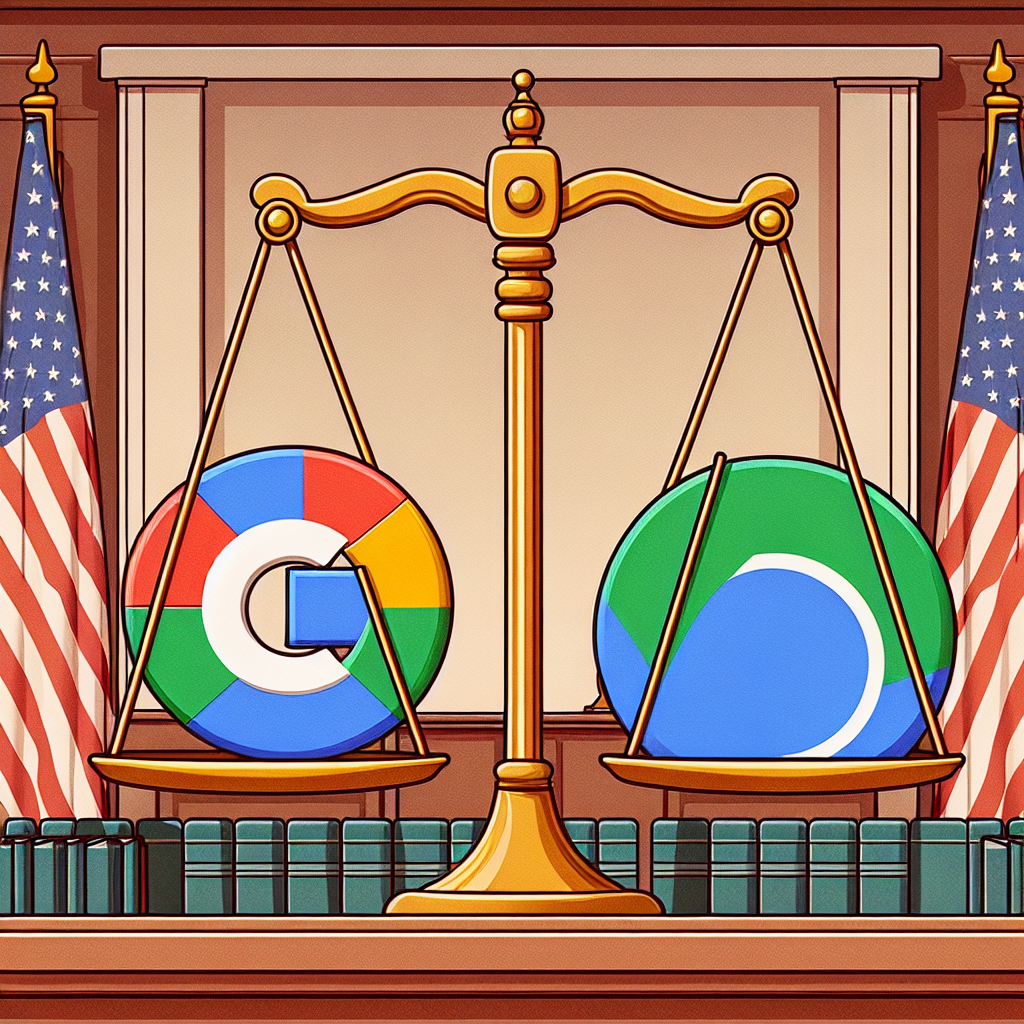

With Google’s antitrust jury trial underway, Google claimed the U.S. Department of Justice has a “narrow view” of the ad tech market and that advertisers and publishers have many alternatives. However, the evidence suggests otherwise.
Dig deeper: EU hits Google with $2.6 billion fine in antitrust case
While many ad tech providers exist, Google dominates key market segments such as ad exchanges, ad networks and demand-side platforms. And, though Google has competitors in the most basic sense of the word (i.e., there are other players in search), the gap between their share of the market and the second largest (Microsoft) is vast and has been for many years.
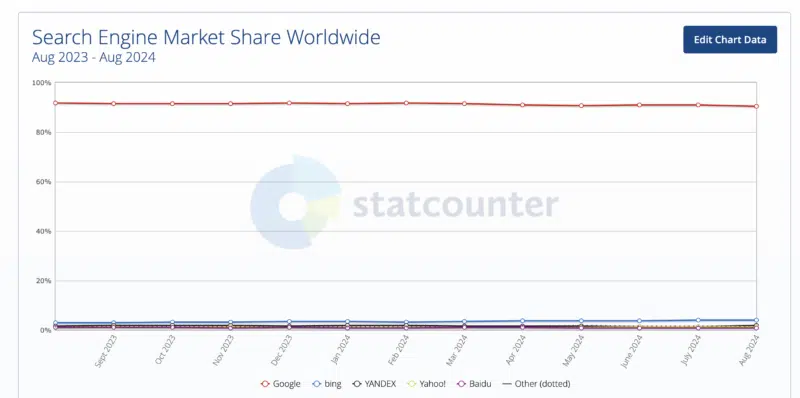
Advertisers and publishers don’t truly have free choice.
- Research shows the majority of digital ad spend flows through Google’s ad tech stack, limiting choices.
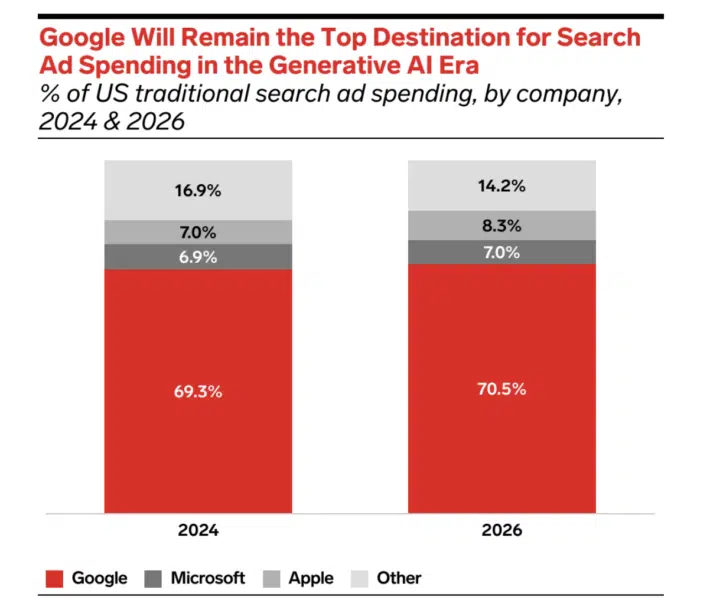
- Michael King of IPullRank presented in a recent SMX conference how it would take 17 years to collect the data Google get in 13 months.
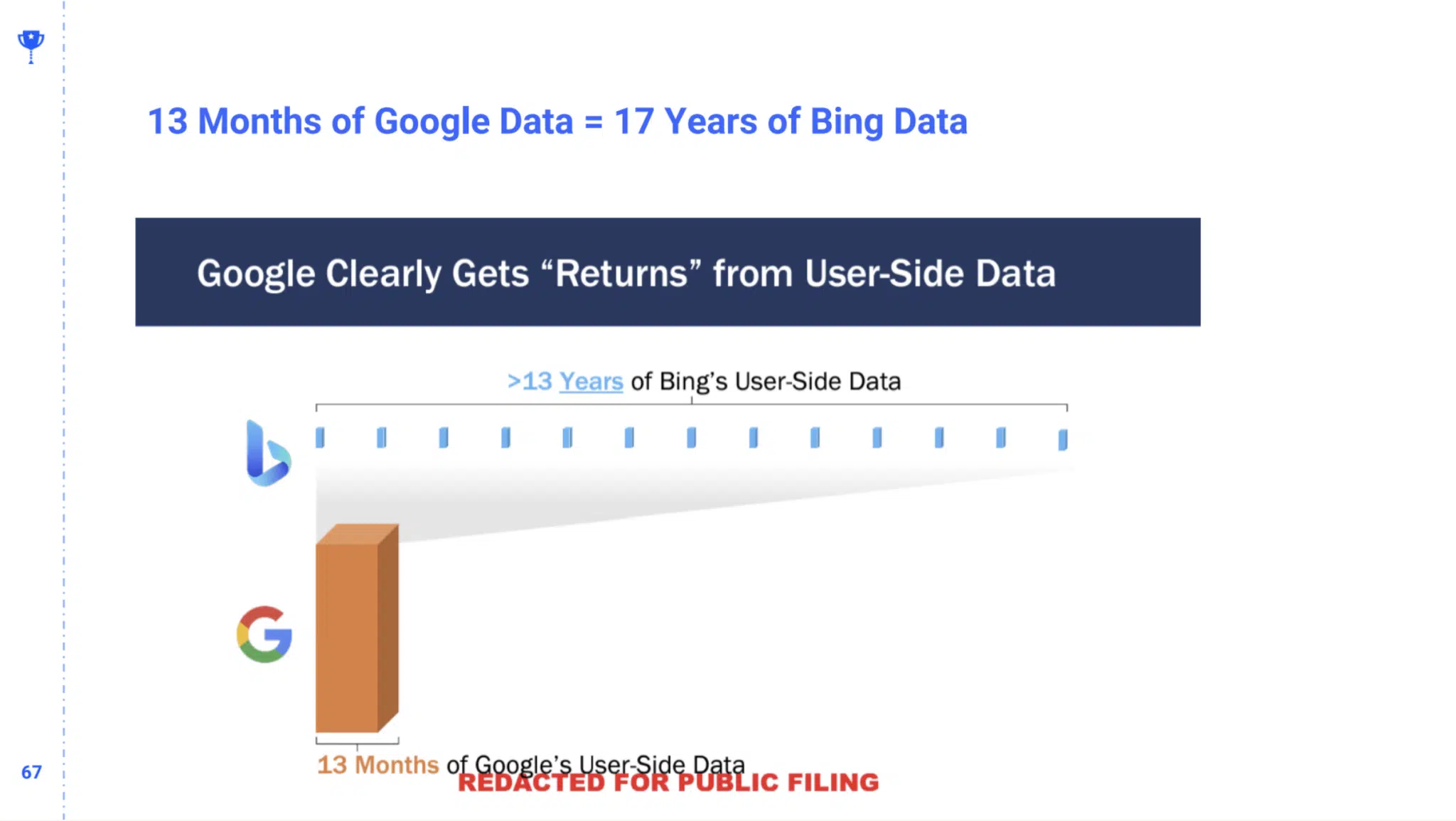
Buying online ads isn’t cheap.
- Several reports this year have shown that advertising costs increased:
- Google search CPCs up 9%, pushing ad spend up 17% – leading to brands looking to diversify their ad spend.
- Report: Google Search CPC up 13% YoY; ad spend growth slowing – where retail alone saw a 5 yr 50% increase in CPC
- Search ad costs rise, conversion rates decline again in 2024 – where CPCc increased across 60% of industries
I asked some experts to discuss this blog post in which Google argued that:
- Several other ad tech companies compete in the space.
- Ad buyers mix and match tools with rivals; therefore, they don’t get all the fees.
- Their fees are lower than the industry average.
- Small businesses will be hurt the most by this case.
Robert Brady founder of Righteous Marketing, said Google is presenting a masterclass of painting oneself in a positive light:
- “The only statement I specifically disagree with is in the second to last paragraph where Google says ‘The ability to buy online ads cheaply and simply…’ Most searches with commercial intent (the ones SMBs want to put their ad on) are not cheap and Google Ads is not a simple platform anymore.
- “What Google doesn’t say is much more salient. They fail to mention their utter dominance of search, which is where you get search intent data.
- “That advantage, having 80%+ of the internet’s search intent data, is what puts every other piece of Google’s ads tools at a significant advantage against even large competitors like Microsoft. And as long as Google can leverage that search intent data in all their other products, they’ll own this industry.”
However, Sam Tomlinson, EVP and Director of Digital Strategy of Warschawski, pointed out several issues with the DOJ’s case:
- He claims this to be an issue with market definition: “Honestly, Google is right on their market definition point. The relevant market should be digital advertising , not some ridiculous thing like “Non-product text based ads” — it would be absurd to say that Amazon has a monopoly on “eCommerce consumer retail”
- He doesn’t believe it is possible to assess what Google’s fees are: “[It’s] very difficult to assess Google’s fees vs. those charged by others due to the sheer volume of points in the value chain where fees can be added, often in non-transparent ways.”
- He thinks SMBs will lose if the DOJ wins SMBs: “End result to SMBs? Probably right, to be honest. That’s not what the ‘Google = evil’ people want to think, but the reality is that breakups would come with massive incremental costs that would be passed onto advertisers.”
Tomlinson said he thinks the system will get healthier if the DOJ wins, but that it will be a painful process:
- “Long run, we’ll probably get a healthier, more transparent ecosystem, but the short-term pain to advertisers (and by extension, publishers) is going to be brutal.”
Between the lines. Google portrays itself as an enabler of the free and open internet, but the DOJ argues its ad tech dominance does the opposite – it limits choice, increases costs and harms publishers.
What’s next. The trial will test whether Google’s defiant claims hold up against the DOJ’s evidence of anticompetitive practices. A positive outcome for the DOJ, as Tomlinson noted, could reshape the digital advertising landscape.
The post Google vs. DOJ: Why Google’s ‘hundreds of competitors’ claim doesn’t add up appeared first on MarTech.
**Analysis: Why Google’s Claim of ‘Hundreds of Competitors’ Fails to Hold Up in DOJ Antitrust Case**
In the ongoing antitrust case brought by the U.S. Department of Justice (DOJ) against Google, the tech giant has repeatedly argued that it faces competition from “hundreds of competitors” in the digital advertising and search markets. Google contends that this competition prevents it from exercising monopolistic control. However, a closer analysis of the market dynamics reveals that this claim may not hold up under scrutiny. The DOJ’s case, which accuses Google of abusing its dominant position in search and search advertising, hinges on the idea that Google’s market power is so overwhelming that it stifles competition and harms consumers. This article examines why Google’s defense of facing “hundreds of competitors” is largely unconvincing in the context of antitrust law and market realities.
### 1. **Market Share and Dominance in Search**
At the core of the DOJ’s case is Google’s dominance in the search engine market. According to StatCounter, as of 2023, Google controls over 90% of the global search engine market. This level of market share is not just significant; it is indicative of a near-monopoly. While Google argues that it competes with other search engines like Bing, Yahoo, DuckDuckGo, and even specialized search tools such as Amazon or Yelp, the reality is that none of these alternatives come close to challenging Google’s dominance.
Bing, the second-largest search engine, holds less than 3% of the market, while DuckDuckGo, which has gained attention for its privacy-focused approach, accounts for less than 1%. These numbers suggest that while alternatives exist, they are not substantial enough to exert meaningful competitive pressure on Google. In antitrust law, the existence of competitors alone is not sufficient to disprove monopoly power; what matters is the ability of those competitors to constrain the dominant firm’s behavior. In this case, Google’s overwhelming market share allows it to set the terms of competition, with little fear of losing users to rivals.
### 2. **Barriers to Entry in Search and Advertising**
Another key factor that undermines Google’s claim of facing “hundreds of competitors” is the high barriers to entry in both the search and digital advertising markets. Google’s dominance is not just a result of its superior product but also of its control over key infrastructure and data. The company has invested heavily in building a vast network of data centers, algorithms, and artificial intelligence (AI) capabilities that make it difficult for new entrants to compete on a similar scale.
Moreover, Google’s control over the Android operating system and its default status as the search engine on Apple devices through lucrative agreements further entrenches its position. These agreements ensure that Google is the default search engine for billions of users worldwide, making it extremely difficult for smaller competitors to gain traction. Even if a new search engine were to offer a superior product, it would struggle to overcome the inertia of Google’s default status and the massive data advantage Google has accumulated over the years.
In the digital advertising space, Google also controls critical infrastructure through its ownership of both the buy-side (Google Ads) and sell-side (AdSense, Ad Manager) platforms. This vertical integration gives Google an unparalleled ability to control pricing, inventory, and data flows, making it difficult for competitors to challenge its dominance.
### 3. **Network Effects and Data Advantage**
Google’s dominance is further reinforced by network effects, which are particularly powerful in the search and digital advertising markets. Network effects occur when the value of a product or service increases as more people use it. In Google’s case, the more users it has, the more data it can collect, which in turn allows it to improve its search algorithms and ad targeting capabilities. This creates a self-reinforcing cycle that makes it difficult for competitors to catch up.
For example, Google’s vast troves of user data allow it to deliver more relevant search results and more effective ads, which attract more users and advertisers. Competitors like Bing or DuckDuckGo simply do not have access to the same volume of data, putting them at a significant disadvantage. This data advantage is a key reason why Google’s claim of facing “hundreds of competitors” is misleading. While there may be many companies offering search or advertising services, none of them can match Google’s ability to leverage data at scale.
### 4. **Consumer Harm and Innovation Stifling**
One of the central questions in any antitrust case is whether the dominant firm’s behavior harms consumers. Google argues that its services are free to users, and therefore, there is no consumer harm. However, the DOJ contends that Google’s monopoly stifles innovation and limits consumer choice. By maintaining its dominance through exclusionary practices, such as paying billions of dollars to be the default search engine on mobile devices, Google effectively prevents competitors from gaining a foothold in the market.
This lack of competition can lead to reduced innovation over time

Recent Comments