

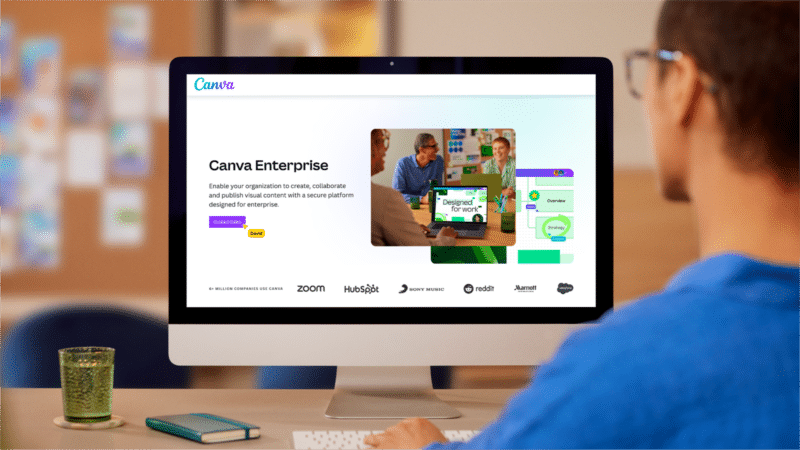
Digital design and collaboration platform Canva hopes a recent price hike won’t hurt it with SMBs as it challenges Adobe in the enterprise market.
“While enterprise users are becoming a bigger focus, individual users and small teams remain a priority,” Canva’s executive creative director Cat van der Werff told MarTech. “[Growing enterprise customers] is about growing the pie, not completely taking it over with one audience or another.”
At the start of September, the company announced a big price increase for team subscriptions. Canva Teams prices are now $100 per person, or $10 a month per person, with a minimum of three people required for a Teams plan. Those prices were quietly changed earlier this year for new customers, but now the company is changing the price for customers who’d previously paid a lower price.
As a result, some Canva Teams users saw subscription prices go from $120 per year for up to five users, to $500 per year. To ease the pain of the increase, Canva is offering a 40% discount for the first 12 months which cuts the cost to $300.
The company says the added value of its new AI-powered Magic Studio and video editing tools makes Canva worth the higher price.
“We deeply value our community and know pricing changes aren’t always easy,” said van der Werff. “To ease this transition, eligible impacted customers will receive 12 months of discounted pricing before the changes take full effect. The cost of Canva Pro remains unchanged and continues to be available for anyone not working in a team.”
She added: “That said, Canva Teams has come a long way since launching in 2020, with major enhancements in team collaboration, brand management and the launch of our expansive Visual Suite. Our original pricing reflected the early stage of this product and has remained unchanged for the last four years. We’re now updating the price for customers on this older plan to reflect our expanded product experience, while those who joined since April are already on the updated rates.”
Simplicity now costs more
Not all customers are convinced.
Rachel Hornstein owns a digital marketing agency, Hornstein Digital, with many SMB clients. The agency uses Canva to do work for clients and sometimes to collaborate with them.
“I provide the tools that I need for my team to get the job done for our clients,” Hornstein said. “The majority of people I work with don’t have a Canva Pro account. They have the free account that they use for random little things here and there.”
She added: “I’m in Canva every single day, whether it’s to make an ad, a logo, a flyer or a social media post,” said Hornstein. “I do a lot of video editing in there — it’s pretty good. I use their stock images, their stock videos. For the ease of use and functionality they have, Canva is really the best thing out there.”
Hornstein was paying a flat $119 annually for Canva Pro. The email she received on August 30 informed her that having multiple team members would result in her being billed $100 per user under the Canva Teams plan. Effectively, the price would go up to $240 for the next 12 months, after which time the price for her team would be $400 — all told, a nearly 300% increase on an account with four team members.
“It’s completely disrupted my business,” Hornstein said. “Whenever I have a social media manager on their team, or anybody working with visuals, I add them to my Canva team for that period of time I’m working with them, so I know they have resources that they’re going to need to do the job I need them to do.”
Hornstein is reluctant to turn to a competitor like Adobe.
“I still don’t want to go the Adobe suite route because not only are they super expensive, but they have an extreme learning curve, which is going to eat up so much of my time,” said Hornstein. “The thing with Canva is it’s quick.”
A hard decision for SMB marketers
Marketing consultant, entrepreneur and MarTech contributor Jay Mandel is facing difficult decisions due to the price change. Tools in Canva Teams or in higher-priced Canva Enterprise packages don’t fit his budget.
“The primary impact is on my team’s ability to collaborate effectively using Canva’s advanced features,” said Mandel. “We will no longer be paying extra for these features and will need to find alternative ways to collaborate that don’t rely on Canva’s specific functionalities.”
He added: “In essence, Canva was refreshing in the way they charged and incentivized teams to work on the platform. Now, by charging per person rather than having a low price for five people, they are forcing businesses to change their workflow or pay up. This is annoying, considering that many businesses started using the platform because of Canva’s liberal pricing model compared to other software providers.”
Charging into a new market
Canva’s recent introduction of Work Kits and native adtech apps is the latest step in serving enterprises. In 2022, it introduced the enterprise-focused Visual Suite, followed by the AI-powered Magic Studio suite in 2023. Since those rollouts, 95% of Fortune 500 companies use Canva, according to the company.
“In our first decade, we focused on empowering individuals to design, and now we’re expanding that vision to empower teams and organizations, too,” said van der Werff. “As we’ve grown, we’ve recognized a major opportunity in helping businesses thrive through effective visual communication, and [the new] campaign reflects that shift.”
This month it rolled out the multichannel campaign “Love Your Work” to increase brand awareness at the corporate level. Thirty-second TV spots and supporting video ads show enthusiastic workers bringing coworkers into the workflow, collaborating with such tools as Canva Docs, Presentations, Video and Whiteboards.
“With ‘Love Your Work,’ we’ve doubled down on the workplace message, while staying true to Canva’s playful tone,” said van der Werff. “We’re an accessible and user-friendly platform and we made sure that spirit shines through in this campaign’s creative direction.”
Canva’s rise to a multi-billion dollar tech company was built with a community of devoted individual users and small teams intent on democratizing digital design. Squeezing small teams with price increases poses the risk of losing some brand love. But Canva has also changed a lot on the product side. Its AI and video editing tools make a strong case that increased value justifies the higher prices.
Dig deeper: How Canva is approaching B2B customers with AI-powered tools
The post As Canva targets enterprises, it risks losing SMBs due to higher prices appeared first on MarTech.
**Canva’s Shift Toward Enterprise Clients Could Alienate Small and Medium Businesses with Rising Costs**
Canva, the popular graphic design platform, has revolutionized the way individuals and businesses create professional-quality visuals without the need for extensive design skills. Since its launch in 2013, Canva has grown exponentially, attracting millions of users worldwide, from solo entrepreneurs to large corporations. However, as the platform continues to expand its offerings and shift its focus toward enterprise clients, there is growing concern that small and medium-sized businesses (SMBs) could be left behind, particularly as rising costs may make the platform less accessible to smaller players.
### Canva’s Evolution: From DIY Design to Enterprise Solutions
Canva started as a user-friendly tool aimed at democratizing design. Its drag-and-drop interface, coupled with a vast library of templates, images, and fonts, made it an instant hit among small businesses, freelancers, and non-designers. The platform allowed users to create everything from social media posts to marketing materials, presentations, and even websites, all without the need for expensive software or professional designers.
Over time, Canva has expanded its offerings to include more advanced features such as team collaboration tools, brand kits, and integrations with other software platforms. In 2021, Canva introduced **Canva for Enterprise**, a suite of tools designed specifically for large organizations with complex design needs. This move signaled a shift in the company’s strategy, as it began to target larger, more lucrative clients.
### The Appeal of Enterprise Clients
Enterprise clients offer several advantages for a company like Canva. First and foremost, they represent a more stable and predictable revenue stream. Large organizations are often willing to pay a premium for tools that streamline their workflows, enhance collaboration, and maintain brand consistency across teams. By offering enterprise-level features such as advanced security, dedicated customer support, and custom branding solutions, Canva can command higher subscription fees from these clients.
Additionally, enterprise clients often require long-term contracts, which provide Canva with a more reliable source of income compared to the month-to-month subscriptions favored by smaller businesses. This shift toward enterprise clients is not unique to Canva; many SaaS (Software as a Service) companies have made similar moves as they seek to scale their businesses and increase profitability.
### The Impact on Small and Medium Businesses
While Canva’s enterprise ambitions make sense from a business perspective, they could have unintended consequences for its core user base: small and medium-sized businesses. SMBs have been the backbone of Canva’s success, relying on the platform’s affordability and ease of use to create professional designs without breaking the bank. However, as Canva continues to prioritize enterprise clients, there are concerns that the needs of smaller businesses may be overlooked.
One of the most significant concerns is the potential for rising costs. Canva’s free tier has always been one of its biggest draws, offering a wide range of features at no cost. However, many SMBs have opted for the **Canva Pro** subscription, which provides additional features such as access to premium templates, unlimited storage, and the ability to create brand kits. At $12.99 per month (or $119.99 annually), Canva Pro has been an affordable option for small businesses looking to elevate their design capabilities.
As Canva invests more resources into developing enterprise-level features, there is a risk that the cost of its Pro plan could increase, making it less accessible to smaller businesses. Additionally, some features that were once available to Pro users could be moved to higher-priced tiers, further limiting the value of the Pro subscription for SMBs.
### The Risk of Alienation
If Canva’s pricing structure becomes less favorable for small and medium businesses, it could lead to a sense of alienation among its core user base. Many SMBs have come to rely on Canva as an essential tool for their marketing and branding efforts. If they feel that the platform is no longer catering to their needs or that they are being priced out, they may begin to explore alternative solutions.
There are already several competitors in the design space, such as **Adobe Spark**, **Crello**, and **Visme**, that offer similar features at competitive price points. While Canva currently enjoys a strong market position, it cannot afford to take its SMB customers for granted, especially as the design software landscape becomes increasingly crowded.
### Balancing Enterprise Growth with SMB Retention
To avoid alienating its small and medium business customers, Canva will need to strike a delicate balance between catering to enterprise clients and maintaining its appeal to SMBs. One potential solution could be to introduce tiered pricing that offers more flexibility for smaller businesses. For example, Canva could create a “Pro Lite” plan that offers essential features at a lower cost, ensuring that SMBs can continue to access the platform without feeling the financial strain.
Additionally, Canva should continue to invest in features that specifically benefit SMBs, such as tools for social media marketing, e-commerce, and content creation. By demonstrating that it remains committed to serving the needs of

Recent Comments