


Should product-led growth (PLG) be your No. 1 pick as your go-to-market (GTM) motion? Should it be blended with other motions like inbound, outbound, social media, community and events? Should the makeup of that blend change with time? Or is PLG just one of the latest terms people like to throw around?
In fact, PLG as a strategy (if not a term) arguably dates back more than 20 years to when Atlassian (Jira, Trello, etc.) went to market with a product-led process that, for a decade, obviated the need for a sales team. It was obvious to users that the products solved problems; the users tried them; the users didn’t need to be “sold” them.
Current interest in the motion comes against a backdrop of faltering traditional B2B strategies like demand gen and lead gen. Mark Stouse, founder and CEO of ProofAnalytics.ai told us about interviewing hundreds of CEOs and CFOs about GTM for a forthcoming book. “One observation that becomes clear in those interviews is that they believe that the average B2B marketer has absolutely no idea of what works and what doesn’t work. You can see a pattern of what one CFO called ‘all these enthusiasms.’”
PLG is a current enthusiasm. Rightly so?
One motion among several
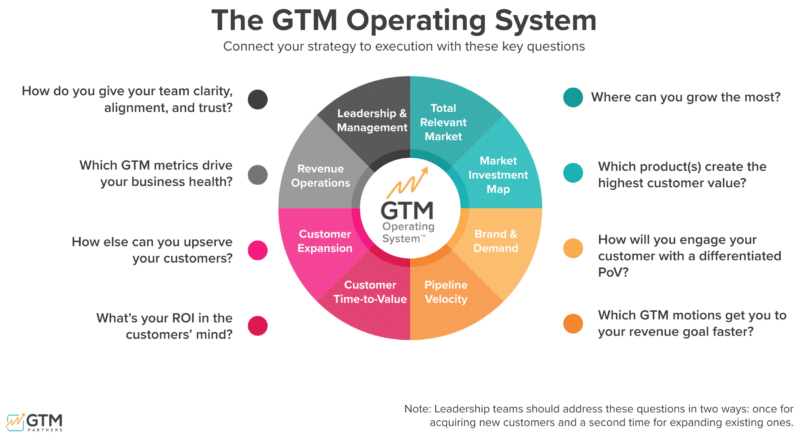
PLG is one of a number of recognized GTM motions. Lists vary, of course. Sangram Vajre’s startup consultancy GTM Partners used to reel off seven:
- Inbound-led.
- Outbound-led.
- Product-led.
- Channel-led.
- Event-led.
- Community-led.
- Ecosystem-led.
Subsequently ecosystem fell from the roster and they now list six. But one could easily add to the list — partner-led, for example.
In its purest form, product-led GTM lets the product speak for itself. By reducing or even eliminating the roles of sales, marketing and advertising, it looks like an obvious cost-saver. Of course, it’s rarely found in that pure form.
Indeed, Stouse likes to collapse it into the more general concept of customer experience. “From a vendor perspective, I understand why it’s called ‘product led,’ but I think that from a customer perspective what you’re looking for is an experience that allows you to convince yourself that this is the way to go,” Stouse said. “There’s software out there that is kind of meh, but because of the overall CX around it does really well.”
The roots are in software
After several conversations, we were left in no doubt that PLG plays best in the technology space and specifically in the SaaS space. On the one hand, brands like Slack, Uber and Zoom are obvious examples of (primarily) product-led success stories. People try the products, they like them, they tell their peers. But then, many would see Slack, Uber and Zoom as, fundamentally, software companies.
The people we spoke to seemed to believe that PLG can make sense in many industries. Wes Bush, CEO and founder of ProductLed and author, most recently, of “The Product-Led Playbook,” told us: “It can work in any vertical.” Stouse, at least, came up with a memorable example: hotels and hospitality. He quoted a marketing executive at Four Seasons: “We sell trip insurance. If you pay what we charge we guarantee you a superb experience.” He also referred to the incredible product-led experience of shopping at Hermès. Bush suggested perfume and cologne: Try before you buy.
At the same time, Stouse insisted it’s not that simple. “If you build it and it’s awesome, they will come. That’s just not the case. The product does not sell itself.”
Choosing your GTM motion
As you’d expect from someone who is the author of three books on the subject, Bush is bullish about the product-led motion. “What people are looking for is efficiency, it’s not about grow at all costs.” In a PLG environment: “The product will do the majority of the onboarding, it will upgrade people, it will take care of most support issues that would be human-led in a sales-led company. The biggest metric we look at is revenue per employee. In a product-led company it can be really high, just because the product is doing the majority of the work.”
The product itself can be used to acquire, engage and monetize users. As with perfume, so with software: “To embrace it fully, I believe you have to have the try before you buy experience because people want to be able to make educated decisions,” said Bush. This is reflected in the widespread trend for software vendors (whether considered product-led or not) to offer freemium versions of their tools before asking for a subscription.
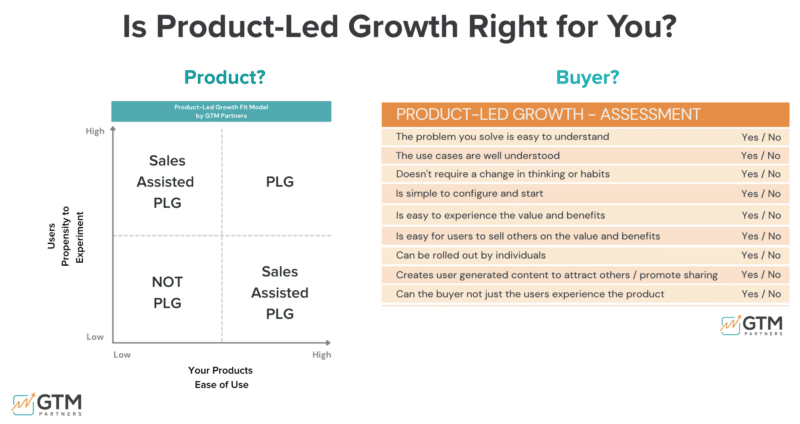
But even Bush admits it’s not for everyone. “If you are looking at solving complex, advanced problems in your market, that’s usually more of a sales-led play; a salesperson can add a ton of value,” he admitted. Nevertheless, his sweet spot is startups that are willing to try a product-led strategy. “Where I fit into the GTM space is, I help people build product-led as their first GTM motion. That’s getting them from like $1 to $10 million in recurring revenue.”
He added, at that stage GTM options can diversify: “Let’s explore, let’s open this up, add on, say, sales. Don’t try too many different GTM motions because each one comes with a lot of capabilities you have to develop.”
Dig deeper: Rethinking fit, growth and go-to-market for the modern startup
Or should that be GTM motions?
In contrast, Mark Stouse is all about diversification. Proof Analytics, the company he created, promised to help marketers “plan, predict, prove & pivot your go-to-market investments in real time” (emphasis in original). The concept of proof here signals that GTM decisions should be based on sophisticated math.
For Stouse, choice of GTM motions is an outside-in question. “It starts with the marketplace and the customers and moves in to the vendor,” he said, “and we’re talking about the need to understand how to place our bets most effectively at any given time with the situations swirling around us. PLG as a component can be super-effective for a business but I think this is all ultimately about CX. Every single thing that you can identify that touches a customer, makes them want to buy/not buy, renew/not renew, is part of CX.”
GTM, Stouse believes, should be subject to constant, measurement-led optimization. “We live in a highly probabilistic, multi-variable world and it’s always many things, some of which we control, most of which we don’t control, that cause things to happen the way they do,” he insisted. People who place all their bets on one motion like PLG? “They’re putting their idea at the center when it’s not. They’re trying for a level of determinism that just isn’t real.”
Math or strategy?
As became clear in a spirited exchange on LinkedIn, Sangram Vajre takes a different view. “What I’m observing is that most companies over the last couple of decades have been very oriented towards doing a spreadsheet-oriented sort of strategy, because it’s easy to do that,” Vajre explained. “They would raise money based on that, they would hire based on that, but if it’s immediately not working within six months they’ve spent all the money. There are too many people I know that have fallen into that trap.”
Sangram would acknowledge that Stouse isn’t using spreadsheets, but: “The math-to-strategy is my biggest pet peeve right now. It’s no longer the right way to go about it; you need to go from strategy to math.” Nevertheless, he agrees that there’s no case for abandoning metrics. “Math is needed, absolutely,” he said, “but if the strategy is missing no amount of math is going to solve for it.”
Dig deeper: Product-led growth: 3 important lessons from the front line
PLG or not PLG?
Three points of view. Bush is advocating for a product-led motion, not for all businesses, but for the types of clients he attracts; and although he sees PLG as effective across verticals, he admits his business’s “beachhead” is tech startups.
Vajre lays out a buffet of possible GTM motions. Many businesses adopt more than one. Salesforce and HubSpot, he points out, are skilled at all six motions listed by GTM Partners, but then they are mature organizations with large budgets. “In the early days,” he says, “you have to pick your lane of genius.” And you pick it, he argues, based not on numbers but on a strategic conception of where you are and where you want to be.
Stouse too would not restrict GTM choices, although he would base them on AI-powered analytics, but he does seem to harbor a special skepticism about PLG. “Where you see PLG the most is in tech,” he said. “I don’t think it’s an accident that we’re talking about companies founded by smart people who had what they thought was a disruptive idea. Is it self-validation to call it product-led growth? Well, sure, that’s a substantial ego statement.”
The post Is product-led growth a GTM silver bullet? appeared first on MarTech.
**Evaluating Product-Led Growth as a Go-to-Market Strategy**
In today’s fast-paced digital landscape, companies are constantly seeking innovative ways to acquire, retain, and expand their customer base. One strategy that has gained significant traction in recent years is **Product-Led Growth (PLG)**. In contrast to traditional sales-led or marketing-led approaches, PLG places the product itself at the center of the customer acquisition, retention, and expansion process. This article will explore the fundamentals of Product-Led Growth, its advantages and challenges, and how companies can evaluate whether PLG is the right go-to-market strategy for their business.
### What is Product-Led Growth?
Product-Led Growth is a business strategy where the product serves as the primary driver of customer acquisition, conversion, and retention. In a PLG model, users experience the value of the product directly, often through free trials, freemium models, or self-service onboarding. The product essentially “sells itself” by delivering immediate value to users, which encourages them to convert into paying customers or upgrade to premium features.
Companies like Slack, Dropbox, Zoom, and Atlassian are often cited as prime examples of successful PLG companies. These companies have built products that are easy to adopt, provide immediate value, and encourage viral growth through user referrals and network effects.
### Key Characteristics of Product-Led Growth
1. **Self-Service Onboarding**: Users can sign up, explore, and use the product without needing to interact with a sales representative. The product is intuitive enough for users to navigate on their own.
2. **Freemium or Free Trial Models**: Many PLG companies offer a free tier or trial period, allowing users to experience the product’s core value before committing to a paid plan.
3. **Product as the Primary Marketing Tool**: The product itself becomes the primary channel for growth. Users are encouraged to share the product with others, leading to organic growth through word-of-mouth and network effects.
4. **Data-Driven User Insights**: PLG companies rely heavily on product usage data to understand user behavior, identify friction points, and optimize the user experience. This data also helps in identifying potential upsell or cross-sell opportunities.
5. **Low Customer Acquisition Cost (CAC)**: Since the product is the primary driver of growth, PLG companies often have lower CAC compared to traditional sales-led models, where significant resources are spent on marketing and sales teams.
### Advantages of Product-Led Growth
1. **Scalability**: PLG models are inherently scalable. Since the product drives growth, companies can acquire users at scale without needing to proportionally increase sales or marketing efforts. This allows for rapid expansion, especially in SaaS (Software as a Service) markets.
2. **Lower Customer Acquisition Costs**: By reducing reliance on sales teams and traditional marketing channels, PLG companies often experience lower CAC. The product itself becomes the primary acquisition tool, reducing the need for expensive advertising or outbound sales efforts.
3. **Faster Time to Value**: In a PLG model, users can experience the value of the product almost immediately. This reduces the friction associated with long sales cycles and complex onboarding processes, leading to faster conversions.
4. **Higher Retention and Customer Lifetime Value (CLTV)**: When users experience value early and often, they are more likely to stick around. PLG companies often see higher retention rates and longer customer lifetimes, which translates to higher CLTV.
5. **Viral Growth Potential**: Many PLG products are designed to encourage collaboration and sharing, which can lead to viral growth. For example, Slack’s team-based communication platform naturally encourages users to invite colleagues, leading to organic growth through network effects.
### Challenges of Product-Led Growth
1. **Product Complexity**: Not all products are suited for a PLG model. Complex enterprise solutions that require extensive customization or onboarding may struggle to adopt a self-service approach. In such cases, a sales-led approach may be more effective.
2. **Initial Product Investment**: For PLG to succeed, the product must be exceptional. This often requires significant upfront investment in product development, user experience (UX) design, and continuous iteration based on user feedback. Companies that fail to deliver a seamless, intuitive experience may struggle to convert free users into paying customers.
3. **Freemium Pitfalls**: While freemium models can drive user acquisition, they can also lead to a large base of non-paying users. If the free tier offers too much value, users may have little incentive to upgrade to a paid plan. On the other hand, if the free tier is too limited, users may abandon the product before experiencing its full potential.
4. **Limited Control Over the Sales Process**: In a PLG model, the product takes center stage, which means companies have less direct control over the sales process. This can be

Recent Comments