
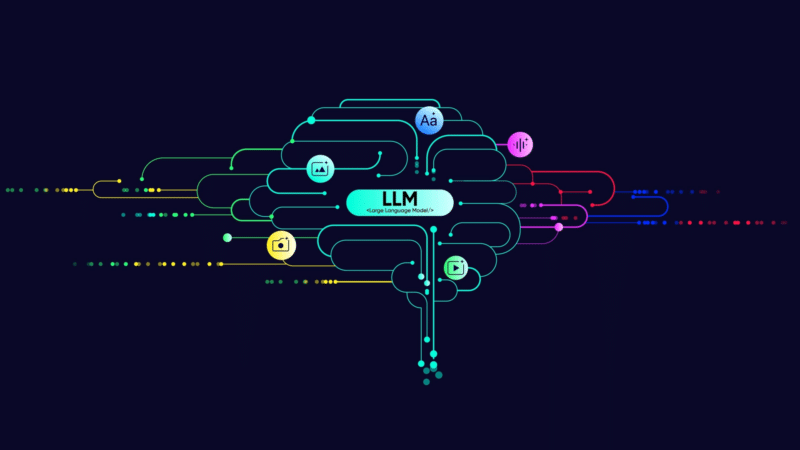
As businesses aim to deliver consistent, personalized engagement across multiple channels, a brand LLM stands out as a transformative solution.
Powered by generative AI, a brand LLM ensures customer interactions remain consistent, compliant and personalized at scale, effectively shaping every touchpoint to reflect the company’s identity.
What is a brand LLM?
A brand LLM (large language model) is a generative AI-powered system fine-tuned to embody a company’s brand identity, values, guidelines and content standards.
It acts as a centralized, dynamic resource for creating, managing and delivering consistent and personalized brand content across all customer interactions and engagement channels.
3 reasons why your company needs a brand LLM
Modern brands must balance consistency, compliance and personalization to stay competitive. Traditional methods of managing brand assets no longer meet these demands. A brand LLM addresses these challenges in three critical ways.
1. It becomes your company’s most valuable asset
A brand LLM encapsulates everything your company brand represents, forming the foundation for every customer interaction. Up to 90% of S&P companies’ value is tied to intangible assets like “future customer intentions to buy,” as opposed to tangible assets like buildings and inventory.
Managing your brand goes beyond merely storing assets on a shared server. It’s about shaping preferences in customers’ minds and hearts.
2. It ensures compliance and consistency across markets
A brand LLM ensures every interaction aligns with local laws, product variations and brand guidelines. For instance:
- Displaying a car door knob color on an ad that isn’t for sale in a country hinders sales.
- A tagline that isn’t translated into French can lead to a lawsuit.
A brand LLM automates compliance and ensures consistency across all markets.
3. It unlocks unprecedented personalization
A brand LLM enables unprecedented personalization by making real-time customization of copy, images and videos possible. While text personalization is now common in campaigns, visuals often remain static. The potential for fully personalized visuals at scale is still untapped. A brand LLM also helps navigate the fine line of hyper-personalization, ensuring it avoids the “creepy factor” by knowing when not to personalize.
While the benefits of a brand LLM are clear, realizing its full potential requires integrating it seamlessly into your existing infrastructure. This is where the connection between the data and content layers becomes critical.
When the data layer meets the content layer
Many brands excel at collecting and interpreting customer data but still struggle with poor content delivery. Most brands have a data layer that efficiently collects, processes and streams audience insights into engagement channels.
In contrast, the content layer, which handles customer-facing elements like copy, images and videos, remains siloed, fragmented and manual. While the data layer is nearly seamless, the content layer faces significant integration challenges.
This gap is especially evident in time-sensitive campaigns across complex markets with multiple segments, languages, and currencies. For example:
- A delayed product image can cost a tech manufacturer millions in lost revenue and digital shelf space.
- A real-time, hyper-personalized in-basket offer is crucial for keeping customers engaged in an ecommerce environment.
Why the content layer is broken
The content layer is often non-existent or, at best, broken. While the data layer seamlessly processes information through tightly integrated steps using APIs and (reverse) ETL mechanisms, the same level of integration is lacking in the content supply chain.
The systems and elements in the content layer are either not integrated or poorly integrated.
- Corporate identity: Guidelines for house style and brand identity.
- Creative design software: Design software for asset creation.
- Digital asset management (DAM): Storage for brand and campaign media
- Web2Publish (W2P): Templatized collateral production.
- Product information management (PIM).
- Content management systems (CMS).
- Digital eXperience platforms (DXP).
- Data management (MDM): Corporate entity definitions.
- Engagement channels: Email, push, SMS, chat, in-app and more.
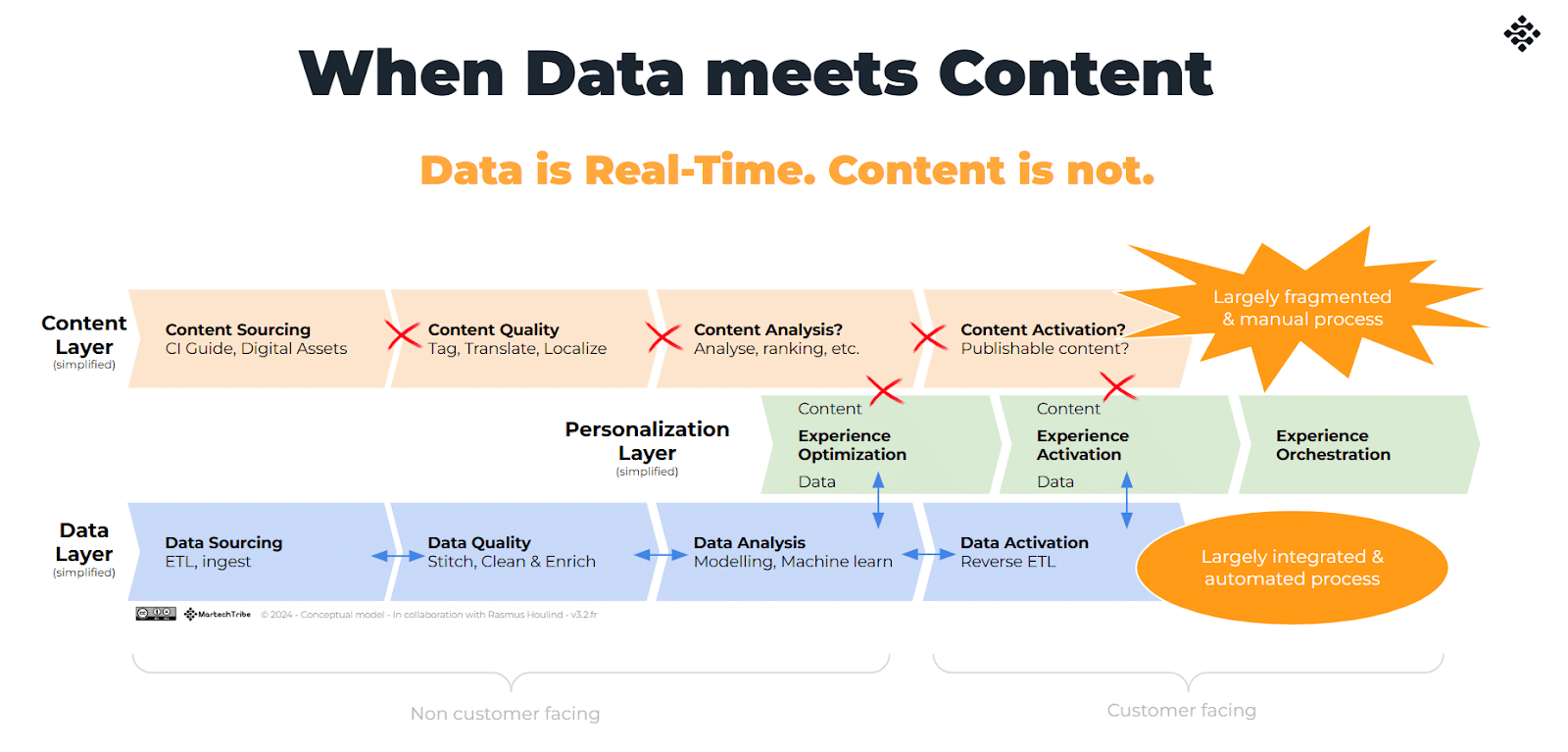
The challenge isn’t due to content vendors doing a poor job. Instead, rendering content in real-time is complex due to three major obstacles.
- Creativity: Human creativity is hard to mimic for computers, hence the laborious manual work. (Consider internal studios.)
- Computing power: Rendering large files, such as image and video assets, requires significantly more processing power than numeric data. (Think about the size of Photoshop, MOV or MP4 files.)
- Integration: Seamlessly transferring large content files across systems is still a manual process. (Think WeTransfer or WeSendIt.)
These challenges left the content layer immature for decades, making it difficult to realize its full potential — until now.
Generative AI changes the game, providing the creativity, computational power and integration needed to revolutionize the content layer.
How to build a content layer with generative AI
To shape their content layer, brands should start by understanding the importance of the master file.
The master file is the original, highest-quality version of a digital asset — uncompressed, high-resolution and complete with metadata (EXIF, IPTC, XMP). It serves as the source for creating derivative versions for web, print or social media.
However, regional adaptations often dilute the brand and message, which has led to the long-standing best practice of restricting master file access to trained creatives in studios.
“Don’t share the master file.”
– John van Tuyll, Global Brand Marketing Operations, Adidas
Now, with generative AI, the concept of the master file can evolve. Instead of using static master files, brands can create a brand LLM that serves as the dynamic source for content creation.
There are multiple brand LLM use cases in daily marketing activities. Maybe the brand LLM is used in its own user interface where content can be uploaded or accessed via an API to render a specific output. The output could look like this.
- Annotating brand materials to ensure compliance and consistency.
- Suggesting adaptations to boost conversion rates or meet local regulations (a use case recently launched by Jasper.ai).
- Optimizing brand materials for data-driven, high-performance campaigns.
- Producing real-time content for collateral and campaigns.
- Activating channel-specific content tailored to audience parameters and streamed directly via engagement solutions to customers.
Dig deeper: The opportunities for AI in digital asset management
How to create brand master LLMs
Brands can build a brand LLM by integrating customer and brand data into AI systems. This can be achieved in four ways.
- Fine-tuning pre-trained models: Customize existing LLMs with your brand’s content.
- Prompt engineering: Create prompts to align AI outputs with your brand’s tone.
- Embedding custom data: Include resources like product catalogs or FAQs.
- API integration: Use APIs like OpenAI’s GPT to embed LLM functionality into workflows.
These methods can work together in a retrieval-augmented generation (RAG) framework, which retrieves relevant data, applies prompts and generates brand-specific outputs. This approach ensures real-time adaptability for applications like customer support or campaign management.
“Generating new content directly with an LLM delivered significantly better results compared to starting with derivative assets.”
– Rasmus Houlind, Agilic
By managing content using a brand LLM, companies can prioritize and streamline their existing content, producing relevant messages at the right time and place.
What your brand LLM should cover
When fine-tuning your Brand LLM, include the following levels:
Brand level
Define your brand identity and reputation, using guidelines or positioning it as a relatable personality. Customers connect emotionally with brands, often viewing them as extensions of their founders’ intentions.
Campaign level
Outline (single-minded) value propositions, messaging, tone and media mix strategies. Campaigns bridge brand identity with actionable tactics to influence customer attitudes and behaviors.
Collateral level
Specify prompts for assets like product shots, logos and taglines. This level ensures consistency and evaluates effectiveness through return-on-content metrics.
Content level
Address co-branded materials, third-party collaborations and snackable content for digital platforms. This ensures your brand scales seamlessly across various use cases.
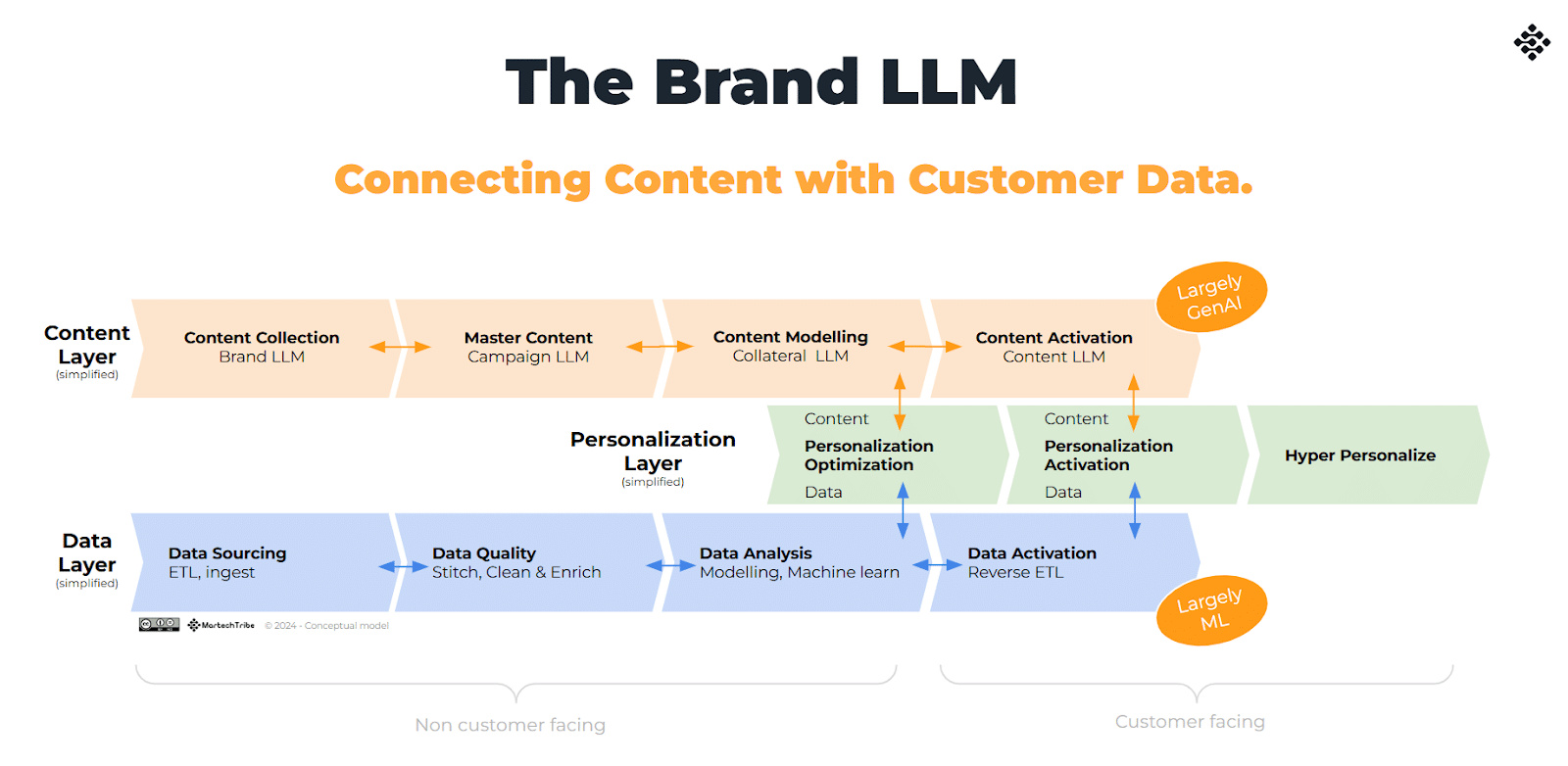
By tackling these levels, a brand LLM evolves into a structured, comprehensive solution for real-time, integrated cross-channel content creation. This unlocks the previously untapped competitive advantage of delivering the right content at the right time to the right person. What is “right” is now defined by insights from the data layer, combined with generative AI’s analysis of the highest return on content.
Dig deeper: A co-pilot approach to genAI (with prompt examples)
The post Why your company needs a brand LLM to thrive appeared first on MarTech.
**How a Brand-Specific LLM Can Drive Your Company’s Success**
In today’s fast-evolving digital landscape, businesses are constantly searching for innovative tools to gain a competitive edge. One of the most transformative technologies emerging in recent years is the large language model (LLM). While general-purpose LLMs like OpenAI’s GPT or Google’s Bard have proven their value across industries, the concept of a brand-specific LLM is now gaining traction as a game-changer for companies looking to tailor AI capabilities to their unique needs. By developing a custom LLM trained specifically on your brand’s data, you can unlock unprecedented opportunities for efficiency, customer engagement, and innovation. Here’s how a brand-specific LLM can drive your company’s success.
—
### 1. **Personalized Customer Experience**
Modern consumers expect personalized interactions with brands. A brand-specific LLM, trained on your company’s proprietary data—such as customer service logs, product catalogs, marketing materials, and FAQs—can deliver hyper-personalized experiences at scale. Unlike general-purpose LLMs, which rely on broad datasets, a custom LLM understands the nuances of your brand’s tone, values, and offerings.
For instance, a retail company could use a brand-specific LLM to provide tailored product recommendations, answer customer inquiries with in-depth knowledge, and even predict customer preferences based on past interactions. This level of personalization fosters stronger customer relationships, increases loyalty, and boosts sales.
—
### 2. **Enhanced Customer Support**
Customer support is one of the most critical touchpoints for any business. A brand-specific LLM can revolutionize this area by acting as a highly intelligent virtual assistant that understands your products, services, and policies inside and out. Unlike generic chatbots, which often provide surface-level answers, a custom LLM can offer detailed, accurate, and contextually relevant responses.
For example, an airline company could deploy a brand-specific LLM to handle complex queries about flight changes, loyalty programs, or travel restrictions. The model’s ability to process and analyze vast amounts of company-specific data ensures that customers receive quick and accurate resolutions, reducing wait times and enhancing satisfaction.
—
### 3. **Streamlined Internal Operations**
A brand-specific LLM isn’t just for external-facing applications—it can also transform internal operations. By integrating a custom LLM into your workflows, employees can access a centralized knowledge base to streamline decision-making, improve collaboration, and reduce inefficiencies.
For example, a healthcare organization could use a brand-specific LLM to assist doctors and nurses in retrieving patient records, understanding medical protocols, or generating detailed reports. Similarly, a legal firm could deploy a custom LLM to analyze case law, draft contracts, or summarize legal documents, saving countless hours of manual work.
—
### 4. **Content Creation and Marketing**
Content is king in the digital age, and a brand-specific LLM can be your secret weapon for creating high-quality, on-brand content at scale. Whether it’s generating blog posts, crafting social media captions, or developing email campaigns, a custom LLM can produce content that aligns perfectly with your brand’s voice and messaging.
For instance, a fashion brand could use its LLM to generate compelling product descriptions, trend reports, or style guides that resonate with its target audience. By automating content creation, your marketing team can focus on strategy and creativity while the LLM handles the heavy lifting.
—
### 5. **Data-Driven Insights**
A brand-specific LLM can also serve as a powerful analytics tool, helping you extract actionable insights from your data. By training the model on your company’s historical data, you can identify trends, predict customer behavior, and uncover opportunities for growth.
For example, an e-commerce company could use its LLM to analyze purchasing patterns, optimize inventory management, or forecast demand for specific products. This data-driven approach enables smarter decision-making and ensures that your business stays ahead of the curve.
—
### 6. **Competitive Differentiation**
In a crowded marketplace, differentiation is key. A brand-specific LLM gives you a unique advantage by offering capabilities that are tailored exclusively to your business. While competitors may rely on generic AI tools, your custom LLM can deliver experiences and insights that are uniquely aligned with your brand’s identity and goals.
For example, a luxury hotel chain could use a brand-specific LLM to provide personalized concierge services, offering recommendations and assistance that reflect the brand’s commitment to exclusivity and excellence. This level of customization sets your business apart and reinforces your brand’s value proposition.
—
### 7. **Cost Efficiency and Scalability**
While the initial investment in developing a brand-specific LLM may seem significant, the long-term cost savings can be substantial. By automating repetitive tasks, reducing errors, and improving efficiency, a custom LLM can lower operational costs and free up resources for higher-value activities.
Moreover, as your business grows, a brand-specific LLM can scale alongside you. Whether you’re expanding

Recent Comments