

Generative AI is transforming business operations, but its adoption varies significantly between B2B (business-to-business) and B2C (business-to-consumer) organizations. While both use AI-powered content generation, personalization and automation, the most significant gaps appear in social media management, advertising and sales enablement.
Why are there differences? The simple conclusion is that B2C marketers need to know a little about many, while B2B marketers must know a lot about a few. Below are five key differences between B2B and B2C buyer dynamics and how they influence genAI adoption.
5 differences between B2B and B2C dynamics
B2B companies navigate longer sales cycles, multiple decision-makers and highly targeted outreach. B2C companies, in contrast, focus on high-volume transactions, shorter decision windows and broad-market appeal.

B2B marketing operates with a smaller audience but gathers deeper data, tracking extensive details on each decision-maker within a buyer committee. Unlike B2C, which targets millions but collects fewer insights per individual, B2B purchasing involves multiple stakeholders, requiring highly personalized communication across various channels.
The sales cycle is longer and high-value, spanning months with multiple touchpoints like emails, demos and meetings, whereas B2C purchases are often made independently, based on emotion or impulse, within days or weeks. B2B buyers demand logical, ROI-driven decisions, that justify long-term investments, while B2C decisions prioritize convenience, aesthetics and trends.
As a result, B2B marketing requires highly personalized messaging throughout the buyer journey, whereas B2C transactions rely more on ads and social proof to drive conversions.
Dig deeper: The top 50 genAI use cases in marketing
GenAI adoption: Same but different
GenAI adoption follows these B2B and B2C distinctions. While both sectors use AI for content generation, personalization and automation, the most significant differences appear in social media, content and knowledge management.
Our survey at the end of 2024 analyzed 50+ genAI use cases across 283 practitioners. The data shows clear patterns in how B2B and B2C organizations use AI-driven tools.
Remarkably, B2B adoption surpasses B2C overall. It looks like the more decision-makers, longer, high-value sales cycles and more personalized messages lead to a higher number of iterations and thus a steeper learning curve in B2B.
We also see that the differences are not equal in size. Therefore, we grouped adoption levels (high, medium and low) based on the differences between B2B and B2C adoption rates for each use case. We ranked genAI use cases by the adoption gap between B2B and B2C, which helped us better understand the differences.


Big B2B vs. B2C differences
With longer sales cycles and especially at the top of the funnel, B2B companies need to show their expertise and more complex products in a targeted fashion to the buying committee, building trust and thought leadership. Remarkably, no high-adoption use case surfaces with stark differences between B2B and B2C.
As a result, social media is the leading B2B use case supported by genAI. It covers the entire spectrum of social media publishing and monitoring, including:
- Content ideation.
- Data insights.
- Documentation.
- Media analysis and management.
- Community and review analysis.
B2C brands, by contrast, rely on emotion, spontaneity and trend-driven engagement. While AI aids content creation, B2C social strategies still heavily rely on human creativity to craft engaging narratives.

Dig deeper: Balancing the human-to-AI mix in B2B marketing
Medium B2B vs. B2C differences
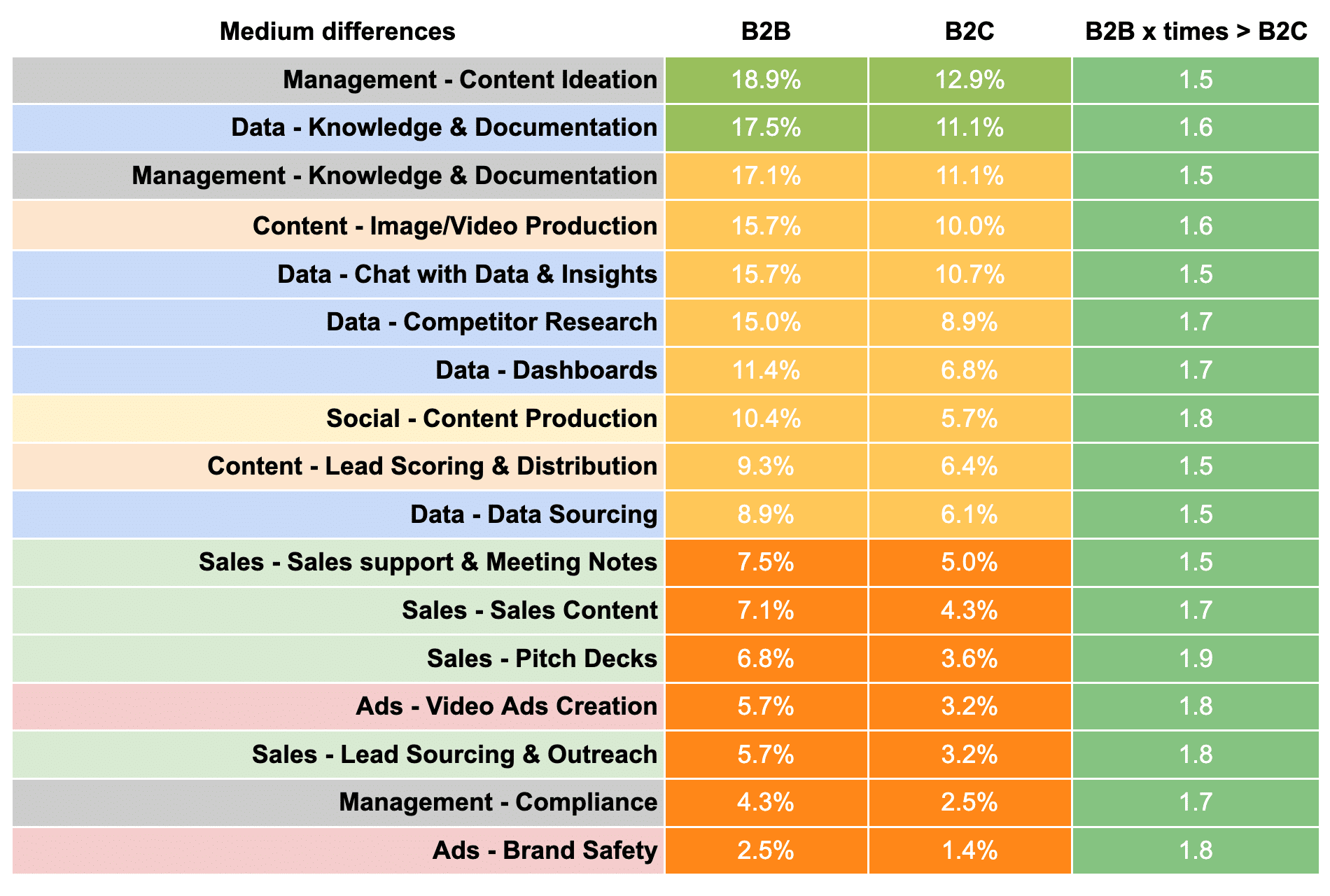
The use cases with medium differences are a mixed bag of data, content, social, management, sales and adtech use cases. The biggest difference between B2B and B2C is also where the highest adoption is in data and management.
B2B differs mostly in data, with use cases like:
- Knowledge and documentation.
- Chat with data and insights.
- Competitor research.
- Dashboards and data sourcing.
As mentioned earlier, B2B needs to know a lot about a few contacts. These numbers show that genAI enhances data-related tasks, empowering complex decision-making hierarchies and extensive documentation needs.
B2C’s transactional nature minimizes reliance on structured knowledge management, making genAI’s role less pronounced in these areas.
Small B2B vs. B2C differences
The least difference between B2B and B2C adoption is in content use cases, while these genAI use cases show the highest adoption across the board. And the other end of the spectrum, we see the advertising and sales use cases showing the least adoption but also differences.

Dig deeper: 3 marketing use cases for generative AI that aren’t copywriting
Final takeaway
The key differences in genAI adoption between B2B and B2C stem from how each engages and analyzes with their audience.
- B2B companies use genAI to support their long sales cycles, with social media at the top of the funnel and more structured, data-driven processes deeper down.
- B2C companies use genAI primarily to support high-volume engagement, where genAI assists with content creation. While genAI supports automation, human creativity remains central to emotional and trend-driven marketing.
B2B adoption is currently more advanced, particularly in social media management, knowledge documentation and data-driven insights — all areas where AI supports expertise-driven, multi-touch sales processes. In contrast, B2C applications focus more on content production and audience engagement, where AI supplements but does not replace human intuition.
As AI technology matures, the adoption gap between B2B and B2C may narrow. However, for now, genAI plays a more pivotal role in B2B’s complex, research-heavy environments than in B2C’s fast-paced, emotionally driven engagement strategies.
The post How B2B and B2C brands adopt genAI — same tech, different strategies appeared first on MarTech.
# How B2B and B2C Brands Utilize Generative AI: Shared Technology, Distinct Strategies
Generative AI is revolutionizing the way businesses engage with customers, create content, and optimize operations. Both B2B (business-to-business) and B2C (business-to-consumer) brands are leveraging this technology to enhance efficiency, personalization, and customer experience. However, while they share the same foundational AI tools, their strategies differ significantly based on their target audiences, sales cycles, and business objectives.
## **Shared Technology: The AI Tools Powering Both B2B and B2C Brands**
At the core, both B2B and B2C brands utilize similar generative AI technologies, including:
– **Natural Language Processing (NLP):** Used for chatbots, automated content creation, and customer support.
– **Machine Learning Models:** Analyze data to personalize recommendations and optimize marketing campaigns.
– **Image and Video Generation:** AI-powered tools create visuals, advertisements, and product mockups.
– **Predictive Analytics:** Helps forecast trends, customer behavior, and sales opportunities.
Despite using the same technology, the way these tools are applied varies significantly between B2B and B2C brands.
## **B2B Strategies: AI for Efficiency, Personalization, and Lead Nurturing**
B2B companies typically have longer sales cycles, complex decision-making processes, and a focus on relationship-building. Generative AI helps them streamline operations and enhance engagement in the following ways:
### **1. AI-Driven Content Marketing**
B2B brands rely heavily on thought leadership and educational content. Generative AI assists in:
– Creating blog posts, whitepapers, and case studies tailored to industry-specific audiences.
– Summarizing research reports and generating insights for decision-makers.
– Automating LinkedIn posts and email newsletters to nurture leads.
### **2. Personalized Sales Outreach**
AI-powered tools analyze customer data to craft personalized emails, sales pitches, and follow-ups. This helps sales teams engage prospects with relevant content at the right time, increasing conversion rates.
### **3. AI-Powered Chatbots for Lead Qualification**
B2B brands use AI chatbots to:
– Answer complex product-related queries.
– Qualify leads by gathering information about potential customers.
– Schedule meetings and demos for sales teams.
### **4. Predictive Analytics for Account-Based Marketing (ABM)**
Generative AI helps B2B marketers identify high-value accounts and predict which leads are most likely to convert. This enables hyper-targeted marketing campaigns that focus on specific industries, companies, or decision-makers.
### **5. Automated Proposal and Report Generation**
B2B companies often need to create customized proposals, reports, and contracts. AI streamlines this process by generating tailored documents based on client needs, saving time and improving accuracy.
## **B2C Strategies: AI for Personalization, Engagement, and Scalability**
B2C brands focus on high-volume transactions, emotional engagement, and real-time interactions. Generative AI helps them enhance customer experience and drive sales through:
### **1. AI-Powered Product Recommendations**
Retailers and e-commerce brands use AI to analyze customer behavior and suggest products based on browsing history, purchase patterns, and preferences. This increases conversion rates and enhances the shopping experience.
### **2. Automated Social Media Content Creation**
B2C brands leverage AI to:
– Generate engaging social media posts, captions, and hashtags.
– Create personalized video ads and product visuals.
– Optimize content for different platforms (Instagram, TikTok, Facebook, etc.).
### **3. AI-Enhanced Customer Support**
AI chatbots provide instant responses to customer inquiries, handling everything from order tracking to troubleshooting. Advanced AI models can even detect sentiment and escalate issues to human agents when necessary.
### **4. Personalized Email and SMS Marketing**
Generative AI helps B2C brands craft personalized email campaigns, promotional messages, and discount offers based on customer preferences and behavior. This improves engagement and increases sales.
### **5. AI-Generated Product Descriptions and Reviews**
E-commerce platforms use AI to generate compelling product descriptions, summarize customer reviews, and highlight key features, making it easier for shoppers to make informed decisions.
### **6. Dynamic Pricing and Demand Forecasting**
AI analyzes market trends, competitor pricing, and customer demand to adjust prices dynamically. This helps B2C brands optimize revenue and stay competitive.
## **Key Differences in AI Utilization Between B2B and B2C**
| **Aspect** | **B2B AI Strategy** | **B2C AI Strategy** |
|——————–|————————————————|————————————————|
| **Sales Cycle** | Longer, relationship-driven, multiple decision-makers

Recent Comments