


U.S. digital advertising will see a 7.3% increase over last year’s spend, according to the latest IAB forecast. This growth is notably lower than the 11.8% 2024 projection.
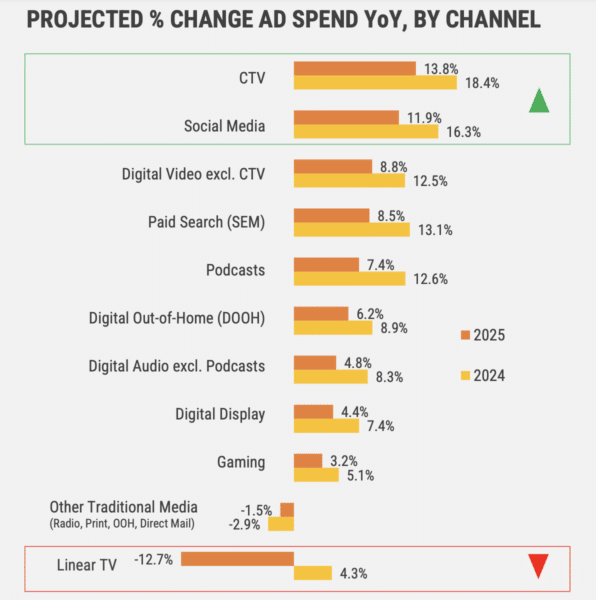
Retail media networks (up 15.6% year-over-year) CTV (+13.8%) and social media (+11.9%) all expect double-digit growth, according to the study, “2025 Outlook: A Snapshot into Ad Spend, Opportunities and Strategies for Growth.”
Slowdown. The study indicated that 2024 accelerated on ad-heavy events like the Paris Olympics and national and state elections.
This year, advertisers will be more selective, focusing on emerging high-growth channels like RMNs and CTV.
“This report clearly shows that budgets are being focused at points where consumers, commerce and video converge — where advertisers can leverage the power of sight, sound, and motion and consumers can engage and transact,” said IAB CEO David Cohen in a release.
Growth by channel. Indeed, the highest-growth channels in the 2025 projections deliver video and full-funnel opportunities from branding to commerce.
Dig deeper: Social media and influencers: 2025 predictions
Here is a breakdown of growth by channel.
Dig deeper: Retail media networks continue to grow: 2025 predictions
Priorities for advertisers. Performance-driven media and measurement and attribution capabilities are top priorities for advertisers, according to Mediaocean’s 2025 Advertising Outlook Report.
Sixty-two percent of marketers said performance-driven paid media was most critical to their plans. Coming in second, measurement and attribution was critical to 50% of marketers.
Brand advertising came in third at 45%, down from 57% in a previous study conducted in summer 2024. (The most recent study asked marketers these same questions in November, 2024.)
GenAI-powered media planning. Marketers are adopting genAI tools to help with media planning, the IAB study found. A full 42% are currently using this technology for media planning and/or activation. Another 36% are exploring the technology.
Mediaocean found genAI the most important trend marketers are watching in 2025. Here are the top ways marketers in the study are using genAI:
- Data analysis (47%).
- Market research (38%).
- Copywriting (32%).
- Image generation (22%).
- Customer service (14%).
Why we care. It’s understandable expectations would be lower following a boom year in 2024. Due to immense competition, marketers are pursuing digital ad channels at the cutting edge of consumer engagement. As a result, traditional media like linear TV will see lower, or negative, growth — although they remain an important part of a full media plan moving forward.
More about the IAB study can be found here. (Membership required to access the full report.)
The post IAB expects digital advertising growth to slow considerably this year appeared first on MarTech.
**IAB Predicts Significant Slowdown in Digital Advertising Growth This Year**
In a surprising turn for the digital advertising industry, the Interactive Advertising Bureau (IAB) has forecasted a significant slowdown in growth for 2023. This projection comes as a stark contrast to the double-digit growth rates the sector has enjoyed over the past decade, fueled by the rapid adoption of digital platforms, e-commerce, and data-driven marketing strategies. The IAB’s prediction has sparked widespread discussions about the factors contributing to this deceleration and its potential implications for advertisers, publishers, and consumers alike.
### The Context: A Decade of Unprecedented Growth
Digital advertising has been a cornerstone of the global economy, with businesses increasingly shifting their budgets from traditional media to online platforms. Over the past ten years, the industry has seen exponential growth, driven by advancements in technology, the proliferation of social media, and the rise of programmatic advertising. In 2022 alone, global digital ad spend reached an estimated $600 billion, accounting for more than 60% of total advertising expenditures.
However, the IAB’s latest report suggests that this era of rapid expansion may be slowing down. While the industry is still expected to grow, the pace of growth is projected to be significantly lower than in previous years.
### Key Factors Behind the Slowdown
Several macroeconomic and industry-specific factors are contributing to the anticipated deceleration in digital advertising growth:
1. **Economic Uncertainty**
Global economic challenges, including inflation, rising interest rates, and geopolitical tensions, have created a cautious environment for businesses. Many companies are tightening their marketing budgets in response to these uncertainties, leading to reduced spending on digital advertising.
2. **Privacy Regulations and Data Restrictions**
The growing emphasis on consumer privacy has led to stricter regulations, such as the General Data Protection Regulation (GDPR) in Europe and the California Consumer Privacy Act (CCPA) in the United States. Additionally, tech giants like Apple and Google have implemented measures to limit third-party tracking, such as Apple’s App Tracking Transparency (ATT) framework and Google’s plans to phase out third-party cookies. These changes have made it more challenging for advertisers to target audiences effectively, reducing the efficiency of digital campaigns.
3. **Market Saturation**
As digital advertising matures, the market is becoming increasingly saturated. Platforms like Facebook, Google, and Amazon have dominated the space for years, leaving little room for new players to disrupt the market. This saturation has led to higher costs for ad placements, which may deter smaller businesses from investing heavily in digital advertising.
4. **Shift in Consumer Behavior**
Consumers are becoming more discerning about the ads they engage with, leading to declining click-through rates and ad fatigue. Additionally, the rise of ad-blocking software and subscription-based, ad-free platforms like Netflix and Spotify has further limited the reach of digital advertising.
5. **Emerging Competition from Alternative Channels**
While digital advertising remains a dominant force, alternative marketing channels such as influencer marketing, experiential marketing, and direct-to-consumer strategies are gaining traction. These channels often offer more personalized and authentic ways to connect with audiences, diverting budgets away from traditional digital ad formats.
### Implications for the Industry
The predicted slowdown in digital advertising growth has significant implications for various stakeholders:
– **Advertisers**
Brands will need to adapt their strategies to navigate this challenging landscape. This may involve diversifying their marketing mix, investing in first-party data collection, and exploring emerging platforms like TikTok and the metaverse to reach younger audiences.
– **Publishers**
Publishers reliant on ad revenue may face financial pressures as advertisers scale back their spending. To mitigate this, many are exploring subscription models, sponsored content, and partnerships to generate alternative revenue streams.
– **Consumers**
For consumers, the slowdown could lead to fewer intrusive ads and a greater emphasis on quality over quantity. However, it may also result in higher costs for ad-supported services if companies seek to offset revenue losses.
### Opportunities Amid the Slowdown
While the IAB’s forecast paints a challenging picture, it also presents opportunities for innovation and growth:
– **Investment in AI and Automation**
Artificial intelligence and machine learning can help advertisers optimize their campaigns, improve targeting, and reduce costs. Companies that leverage these technologies effectively may gain a competitive edge.
– **Focus on First-Party Data**
In the wake of privacy regulations, first-party data has become a valuable asset. Businesses that prioritize building direct relationships with their customers and collecting consented data will be better positioned to succeed.
– **Exploration of Emerging Markets**
While growth may slow in mature markets, emerging economies in Asia, Africa, and Latin America still offer significant potential for digital advertising expansion.
### Conclusion
The IAB’s prediction of a significant slowdown in digital advertising growth serves as a wake-up call for the industry. While the challenges are undeniable, they also present an

Recent Comments